The Ceiling of Selectors and the Audit of Evaluations
Highlights of This Issue
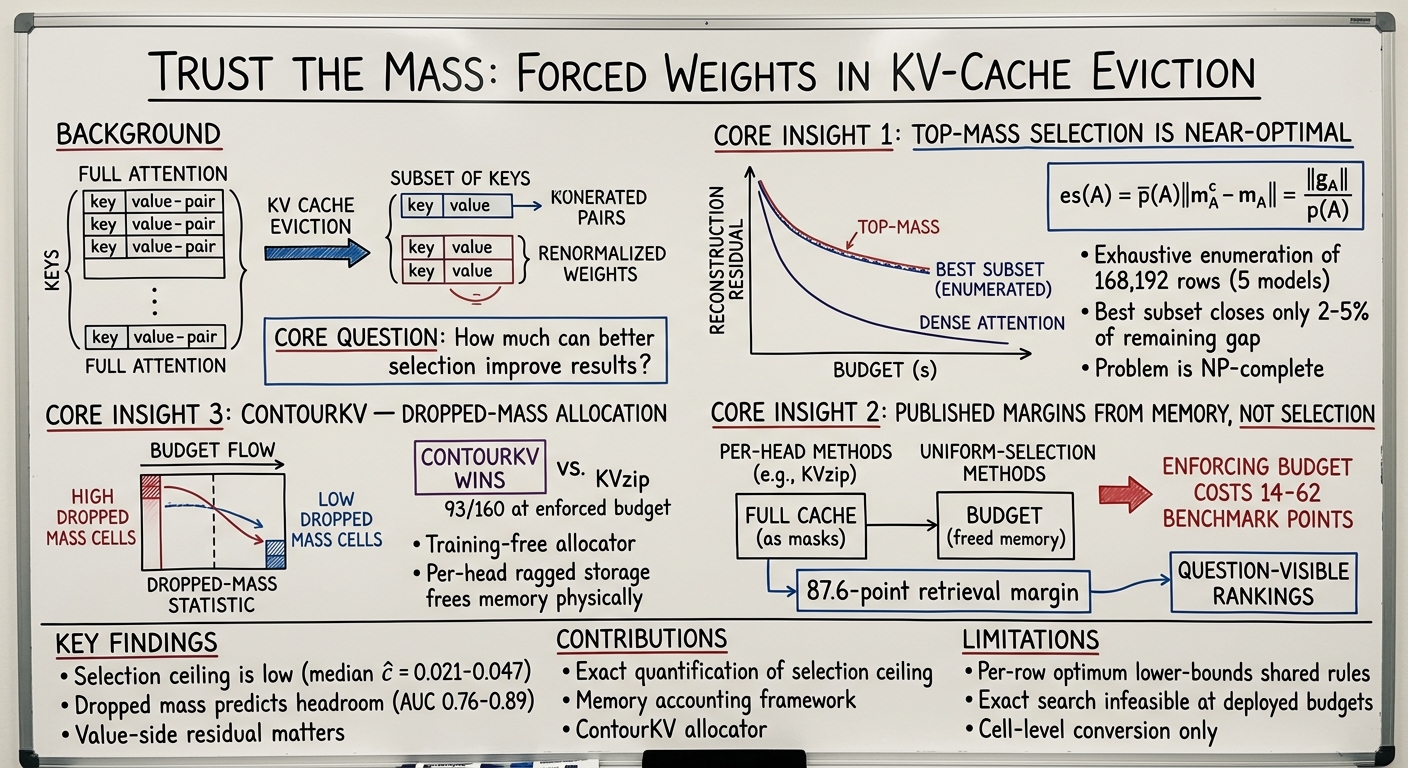
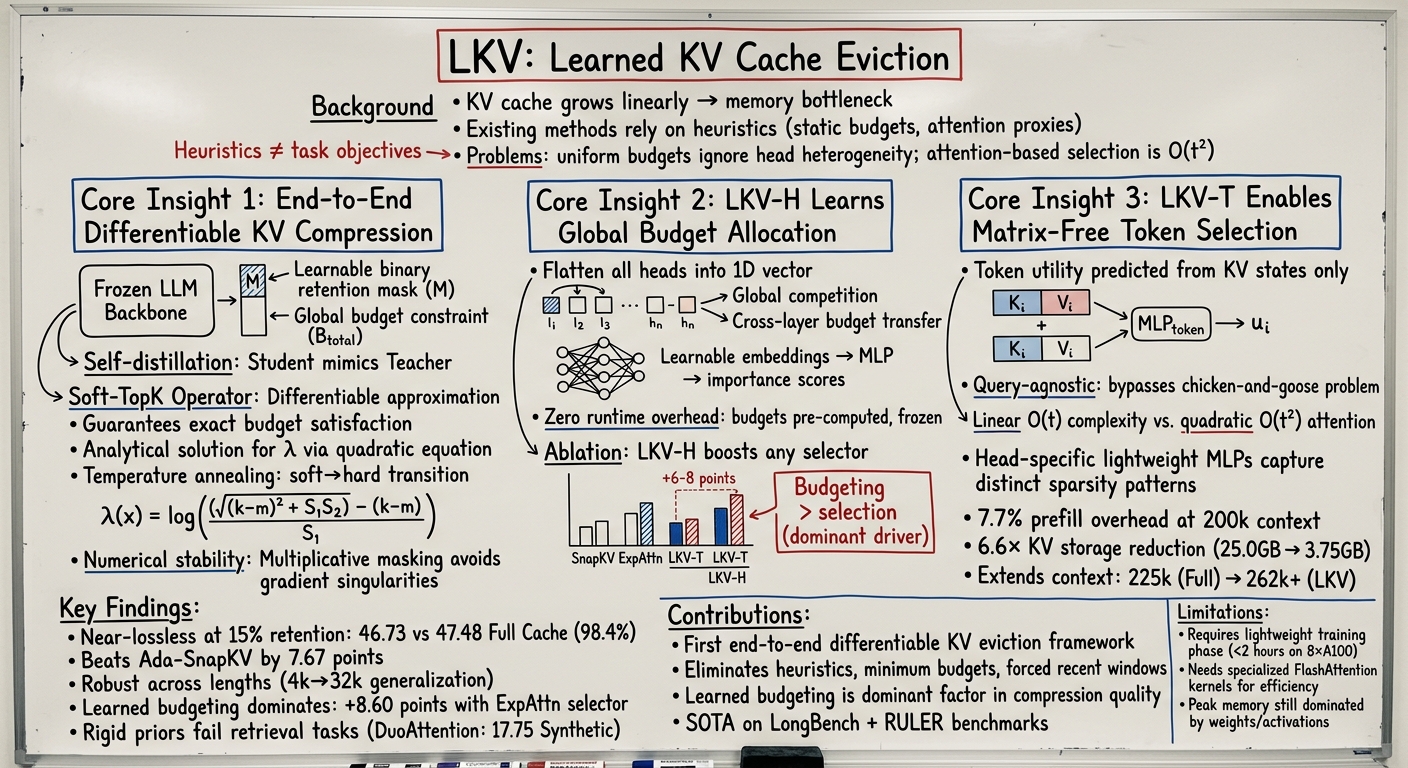
The most noteworthy signals this issue come from the evaluation and audit side: the "ceiling" of selectors has been quantified for the first time. Trust the Mass enumerates optimal subsets over 168k attention rows under forced weight renormalization, proving that top-mass selection is already near-optimal—the optimal subset only closes a median gap of 2-5%—and decomposes the gaps among published eviction methods into memory accounting artifacts (mask storage occupying cache) and query visibility leakage (87.6 points of retrieval gap attributable to the ordering of visible questions). This directly challenges the premise of trainable indexers (SparDA, LongCat, COBS second-order selectors): if selection itself is nearly saturated, the value of trainable indexers may lie primarily in budget allocation rather than selection itself. LKV's "global learnable budget allocation dominates fidelity" corroborates this, while NestedKV provides a training-free, query-agnostic multi-timescale anomaly score as an alternative path.
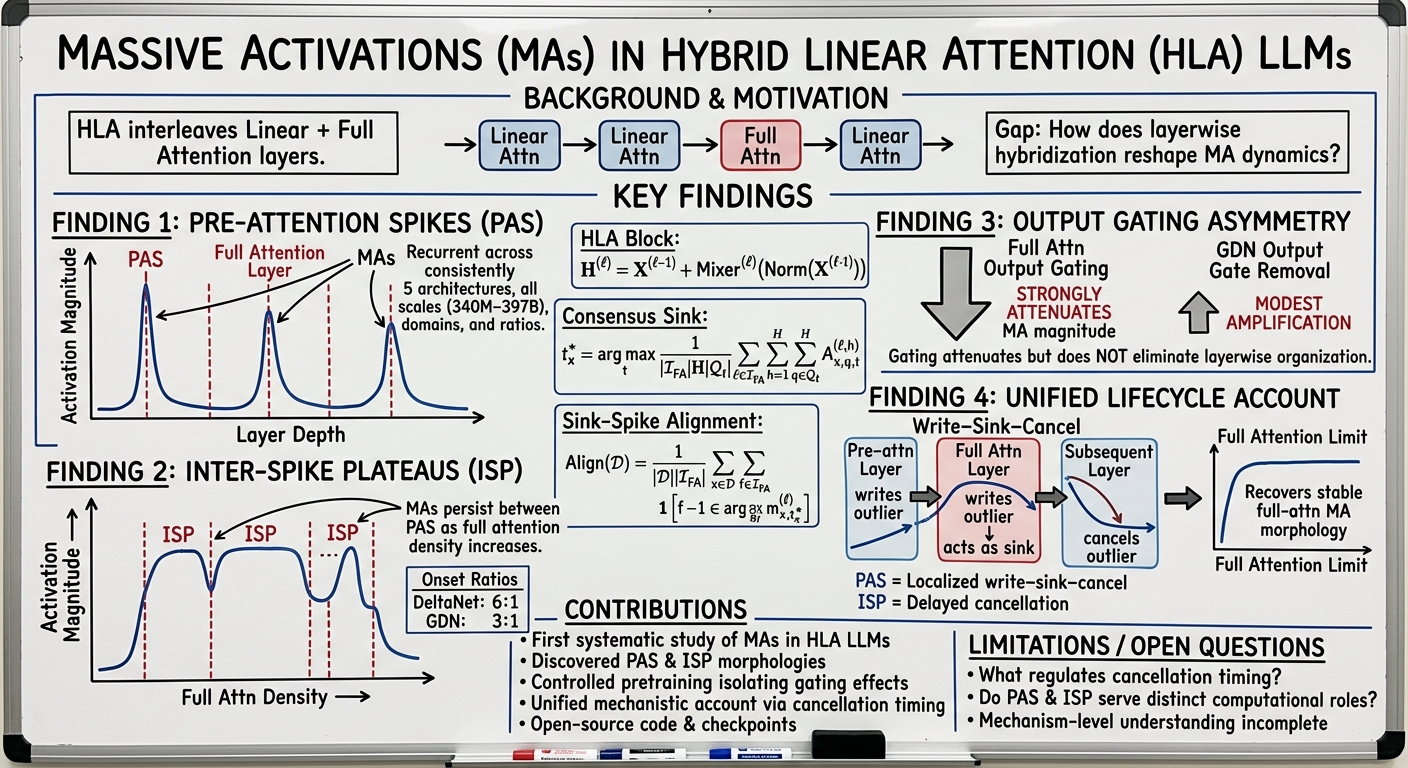
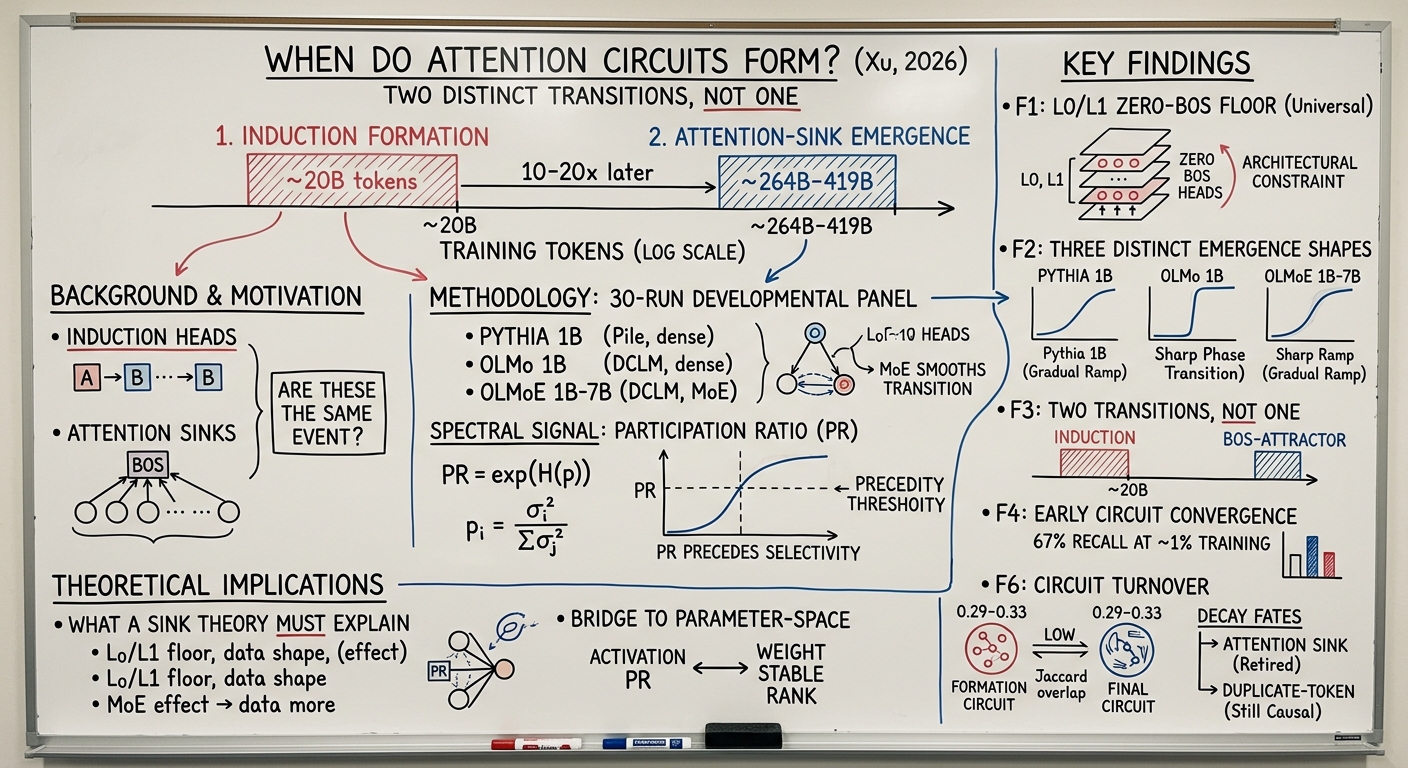
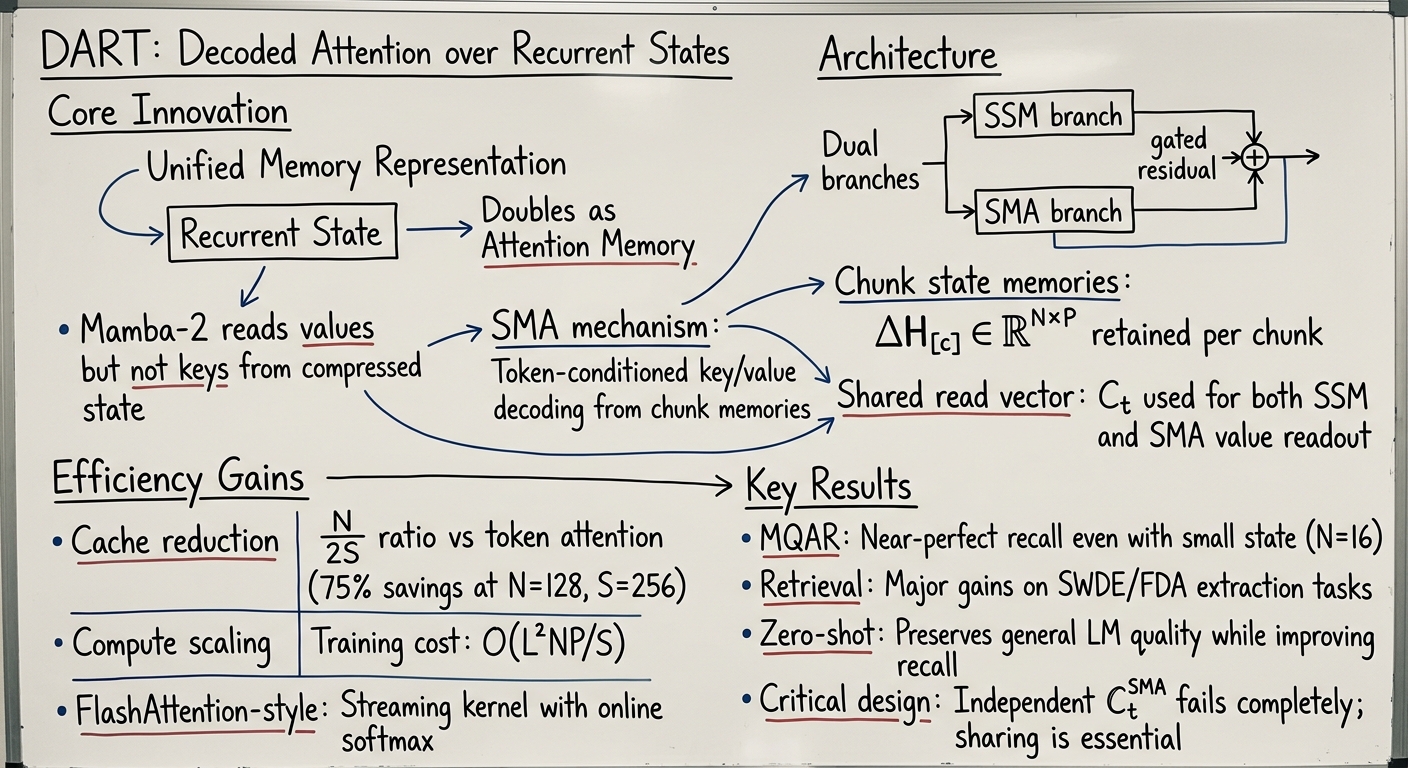
Mechanistic research on hybrid architectures advances on two fronts. Massive Activations in Hybrid Linear Attention provides the first characterization of the layer-wise organization of massive activations—pre-attention spikes and inter-spike plateaus, both aligned with the positions of full attention layers—and explains their continuous spectrum with the mixing ratio via a unified lifecycle of write-sink-cancel and delayed cancellation. DART observes that Mamba-2 decodes values but not keys from the compressed state, and proposes state-memory attention, which unifies recurrent compression and attention retrieval within a single chunk-level loop. The emergence timeline of attention sinks has also been turned into a developmental panel for the first time: When Do Attention Circuits Form proves that induction circuits and BOS-attractors form in two independent phases (with a 10-20× difference in token count), and that the L0/L1 zero BOS floor is an architectural property, not a learning outcome.
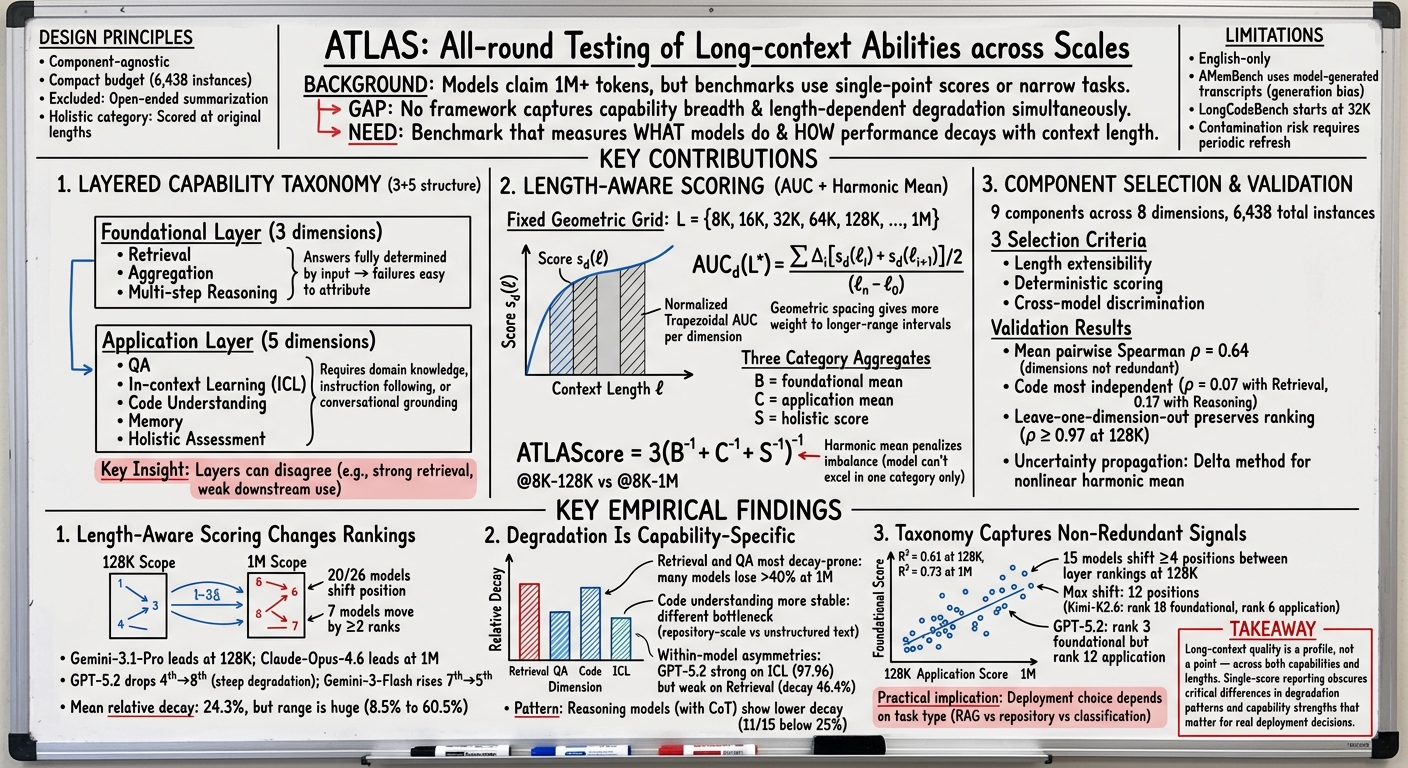
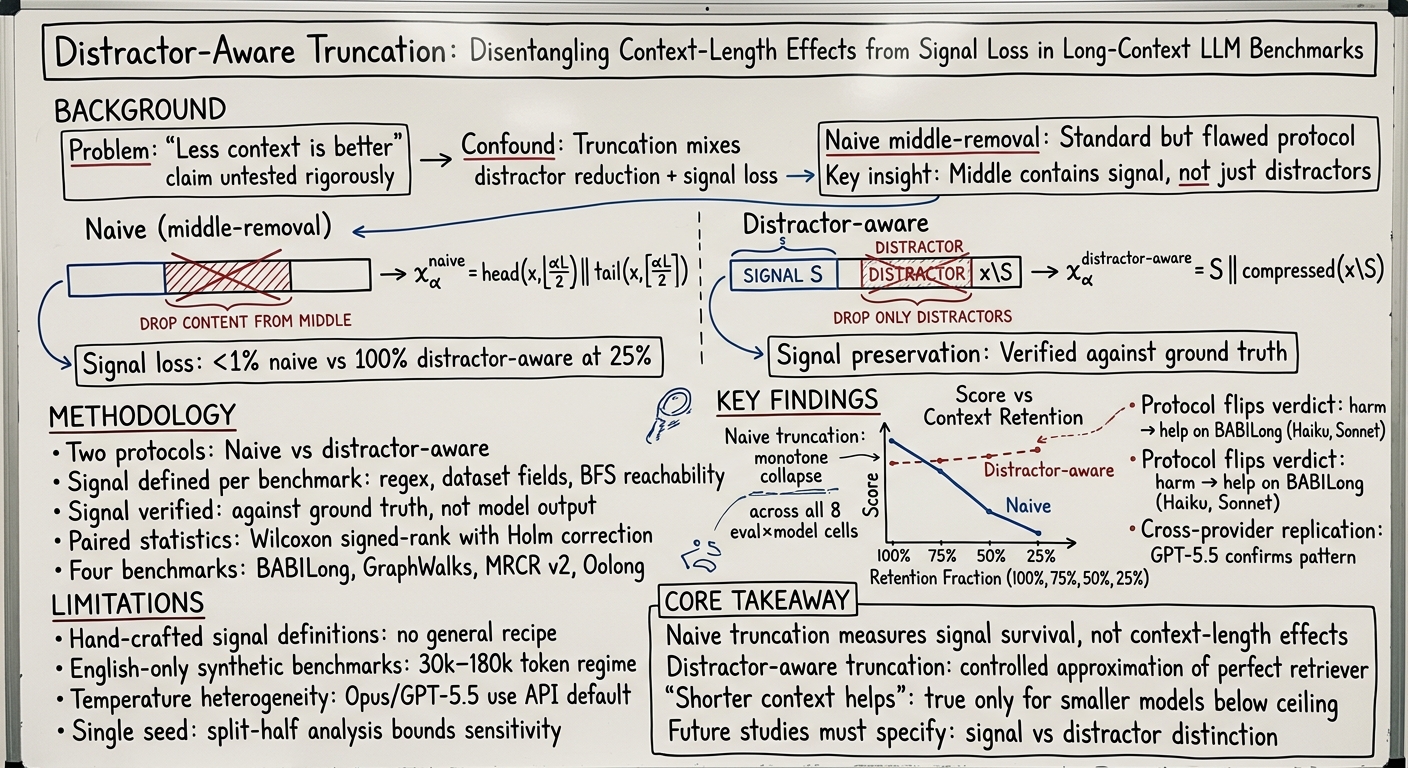
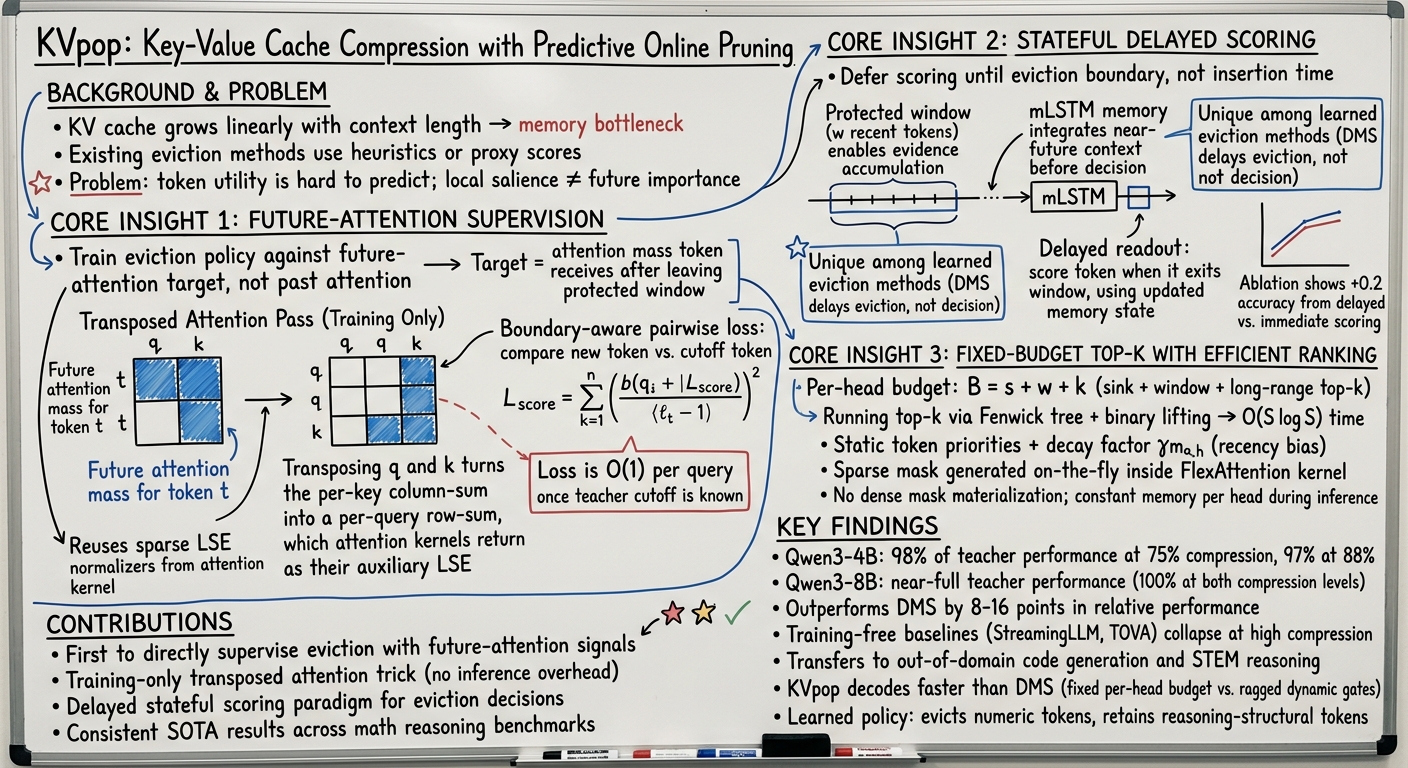
Evaluation validity continues to tighten. ATLAS makes the length degradation curve itself the scoring object (AUC integral over an 8K-1M grid), while Distractor-Aware Truncation proves that naive middle truncation confounds "distractor reduction" with "signal loss," leading to the opposite conclusion of "short context is better." On the KV compression side, KVpop moves eviction scoring from insertion time to eviction boundary, using future attention quality as the supervision signal.
Open Questions
- Last issue asked whether COBS second-order selectors can be reused across layers. This week, Trust the Mass provides a more fundamental constraint: top-mass selection is already near-optimal, leaving only 2-5% headroom for any selector. Should the value of trainable indexers be repositioned toward budget allocation (as in LKV) rather than selection itself? Can second-order cumulant selectors still provide measurable gains under this near-saturated ceiling?
- Massive Activations' PAS/ISP lifecycle and the "large-window laziness" of retrieval heads: are RoPE frequency axes different projections of the same optimization prior, or independent mechanisms? Can the write-sink-cancel timing predict when retrieval heads form in hybrid architectures?
- When Do Attention Circuits Form shows that sink formation lags capability circuits by 10-20× tokens, and that the L0/L1 zero BOS floor is architectural. Should architectures that deliberately avoid sinks place interventions in the early training phase rather than at inference?
- Distractor-Aware Truncation reveals that naive truncation confounds signal and distractor. When KV compression reduces tokens, does it also alter the distractor/signal ratio, thereby polluting "lossless" conclusions? Should compression evaluations incorporate distractor-aware protocols?
Papers in this issue
Forced-weight KV-cache eviction is near-optimal with top-mass selection, closing only 2–5% of the gap to dense attention; published method margins stem from memory accounting artifacts, not selection quality.
Editor's noteFirst to systematically quantify the "selection ceiling" under forced weight renormalization: enumerating optimal subsets over 168k attention rows proves top-mass selection is near-optimal (only closing a median gap of 2-5%), and decomposes gaps among published eviction methods into memory accounting artifacts (mask storage occupying cache) and query visibility leakage (87.6 points of retrieval gap attributable to the ordering of visible questions). Relative to [#2] RestoreKV and [#1] How Query Visibility, it provides an upper bound for any selector improvement and proves that many published gaps are measurement artifacts rather than algorithmic gains; ContourKV's allocator is a minor contribution, but the measurement framework and negative results are essential reading.
Massive activations in hybrid linear attention LLMs spike before full attention layers (PAS) and persist through linear layers (ISP), governed by hybridization ratio and cancellation timing.
Editor's noteFirst to systematically characterize the layer-wise organization of massive activations in hybrid linear attention: identifies pre-attention spikes and inter-spike plateaus, both aligned with full attention layer positions, and explains their continuous spectrum with the mixing ratio via a unified lifecycle of write-sink-cancel and delayed cancellation. Relative to [#1] Rethinking's "large-window laziness" and [#2] RoPE frequency axes, it advances the optimization prior of efficient attention to the layer-wise organization and cancellation timing of massive activations, providing causal evidence through controlled pretraining and output gating interventions.
Induction capability emerges early in 1B models, but the specific heads implementing it remain unstable throughout training, unlike BOS-sink heads which form later and vary greatly by model.
Editor's noteFirst to construct a developmental panel tracking attention sinks and induction circuits across 30 checkpoints: proves that induction circuits and BOS-attractors form in two independent phases (with a 10-20× difference in token count) and that the L0/L1 zero BOS floor is an architectural property, not a learning outcome. It provides direct constraints for architectures that deliberately avoid sinks and transforms "when sinks form" from a static observation into an intervenable training-phase question.
ATLAS reveals long-context model quality is a capability- and length-dependent profile, not a single score, with rankings reshuffling substantially between 128K and 1M scopes.
Editor's noteReframes long-context evaluation from single-point scores to a length-capability dual-axis profile: uses length-aware AUC integrals over a fixed 8K-1M grid instead of single-window scores, and provides the first end-to-end confidence interval propagation for long-context evaluation. Relative to [#2] PredicateLongBench's difficulty-axis decomposition, its increment is making the length degradation curve itself the scoring object and providing ranking reordering evidence across 26 models (7 models move by ≥2 positions between 128K and 1M).
Distractor-aware truncation reveals that naive middle-removal conflates signal loss with distractor reduction, producing false "shorter context helps" conclusions across all tested models and benchmarks.
Editor's noteUses paired statistical designs and cross-provider replication to prove that naive middle truncation confounds "distractor reduction" with "signal loss," leading to the opposite conclusion of "short context is better"; the distractor-aware protocol preserves signal by construction, showing performance retention or improvement. It is a methodological warning for anyone evaluating context length effects or compression methods—naive truncation is not a measurement of context window effects.
KVpop trains lightweight scorers with future-attention supervision and delayed scoring, keeping 97–100% of model quality at 88% KV-cache compression on math reasoning.
Editor's noteMoves KV eviction scoring from insertion time to eviction boundary, using future attention quality as the supervision signal, and computes future attention targets efficiently via transposed attention to avoid dense attention graphs. Relative to DMS's delayed eviction, it is the first to use mLSTM states at the eviction boundary to integrate near-future context, providing degradation curves on AIME/HMMT and OOD benchmarks rather than just NIAH scores.
DART augments Mamba-2 with attention-style key-value retrieval over compressed recurrent states, achieving 75% cache memory savings while substantially improving long-range recall and retrieval tasks.
Editor's noteObserves that Mamba-2 decodes values but not keys from the compressed state, and proposes state-memory attention (SMA), which decodes token-conditioned keys/values from chunk-level memory states, unifying recurrent compression and attention retrieval within a single chunk-level loop. Relative to Jamba/Samba's layer-wise interleaving and Attamba/RAT's chunk-level attention, it places retrieval and compression in the same memory representation and provides compute-matched comparisons with Mamba-2 and full attention.
LKV achieves state-of-the-art KV cache compression via end-to-end learned budgeting and token selection, recovering 98.4% of full-cache performance at 15% retention with zero inference overhead.
Editor's noteUnifies KV eviction budget allocation and token selection into an end-to-end differentiable optimization: LKV-H uses learnable embeddings to compete for a global budget, while LKV-T uses a lightweight MLP to directly predict token importance from KV states (matrix-free), trained with self-distillation. Relative to [#2] KV-CAT's training-time compressibility incentive, it is the first to make budget allocation itself differentiable and query-free; ablations show that budget allocation is the dominant factor in fidelity.
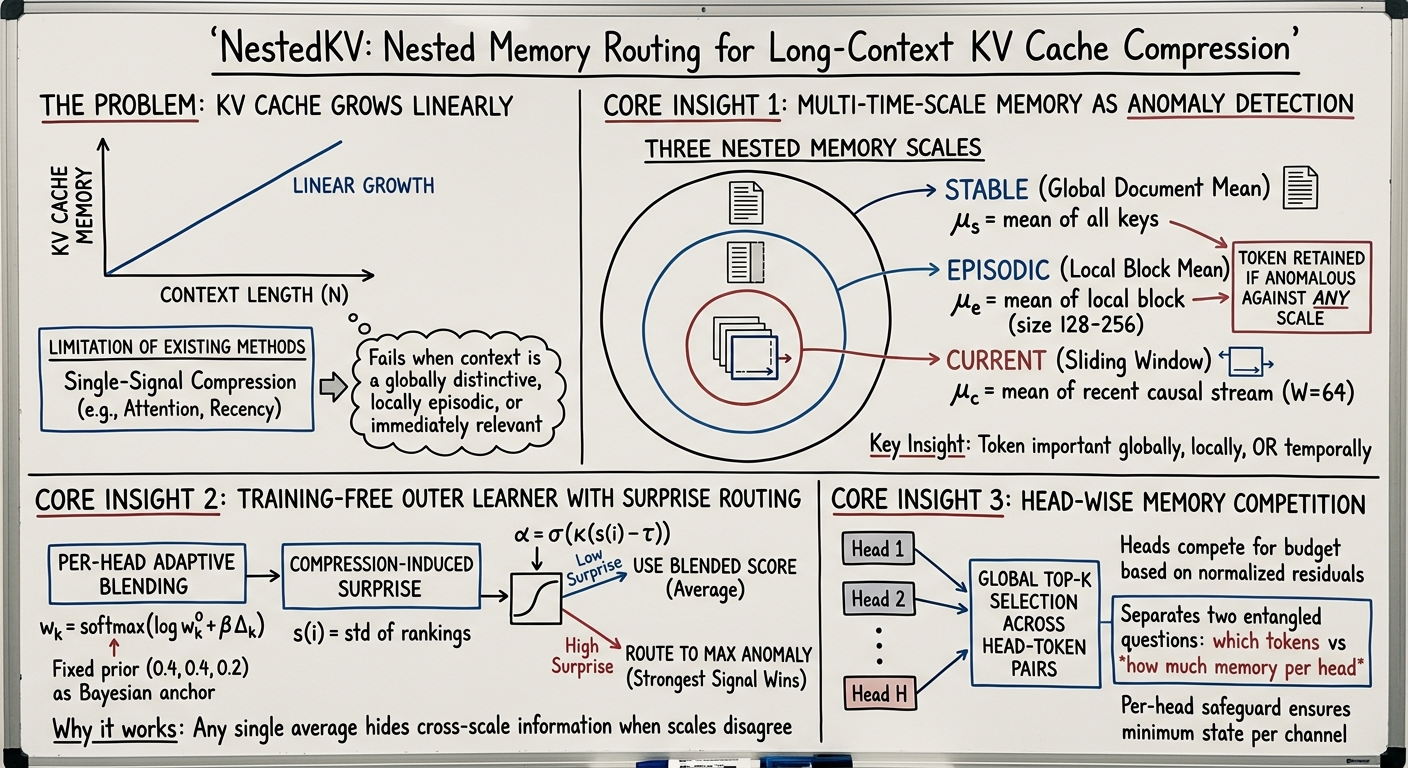
NestedKV reframes training-free KV cache compression as multi-time-scale anomaly detection, outperforming single-anchor methods by up to 19 points under aggressive compression.
Editor's noteReframes training-free KV compression as multi-timescale anomaly detection on the key stream: maintains three anchors (stable, episodic, current) and combines their rankings via head-adaptive mixing and surprise-gated routing. Relative to KeyDiff's single global key-uniqueness anchor and [#2] OasisKV's lookahead prefetch, its increment is a training-free, query-agnostic continuous memory score that yields real degradation curves on RULER/LongBench under aggressive compression ratios (r=0.75-0.95).