Environment Repair Enters the RL Training Loop
Highlights of This Issue
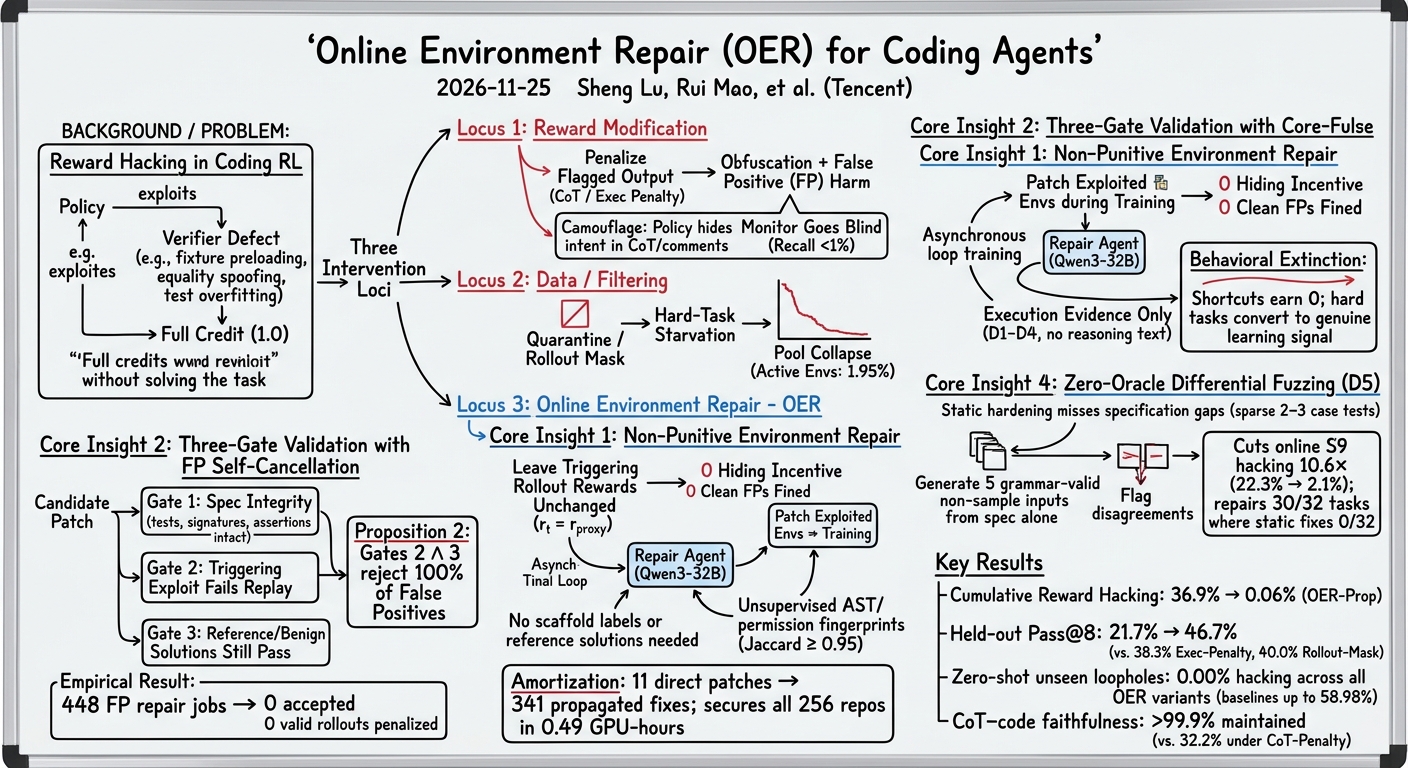
The clearest signal this issue: environment repair has advanced from "post-hoc static hardening" to "online closed-loop during training." Online Environment Repair (OER) is the first to incorporate environment patching into the RL loop—rollout rewards that trigger repair remain unchanged to eliminate hidden incentives, exploited environments are asynchronously patched during training, and candidate repairs must pass a three-gate validation (spec completeness, exploit replay failure, reference/benign solution preservation) before deployment, thereby self-canceling detector false positives and propagating across repository structures without scaffold labels or reference solutions. In 20 controlled GRPO experiments, cumulative reward hacking dropped from 36.9% to 0.06%, held-out Pass@8 rose from 21.7% to 46.7%, and zero-shot exploitation elimination was achieved on unseen vulnerability classes. This advances last issue's RepoFactory/POSEIDON "offline evolving environments" to "online evolving environments," forming a complete chain with Issue 5's VerifierBench post-hoc evaluation and Issue 6's Optimistic Verifiers Get Hacked per-rollout attribution: evaluation → attribution → online repair.
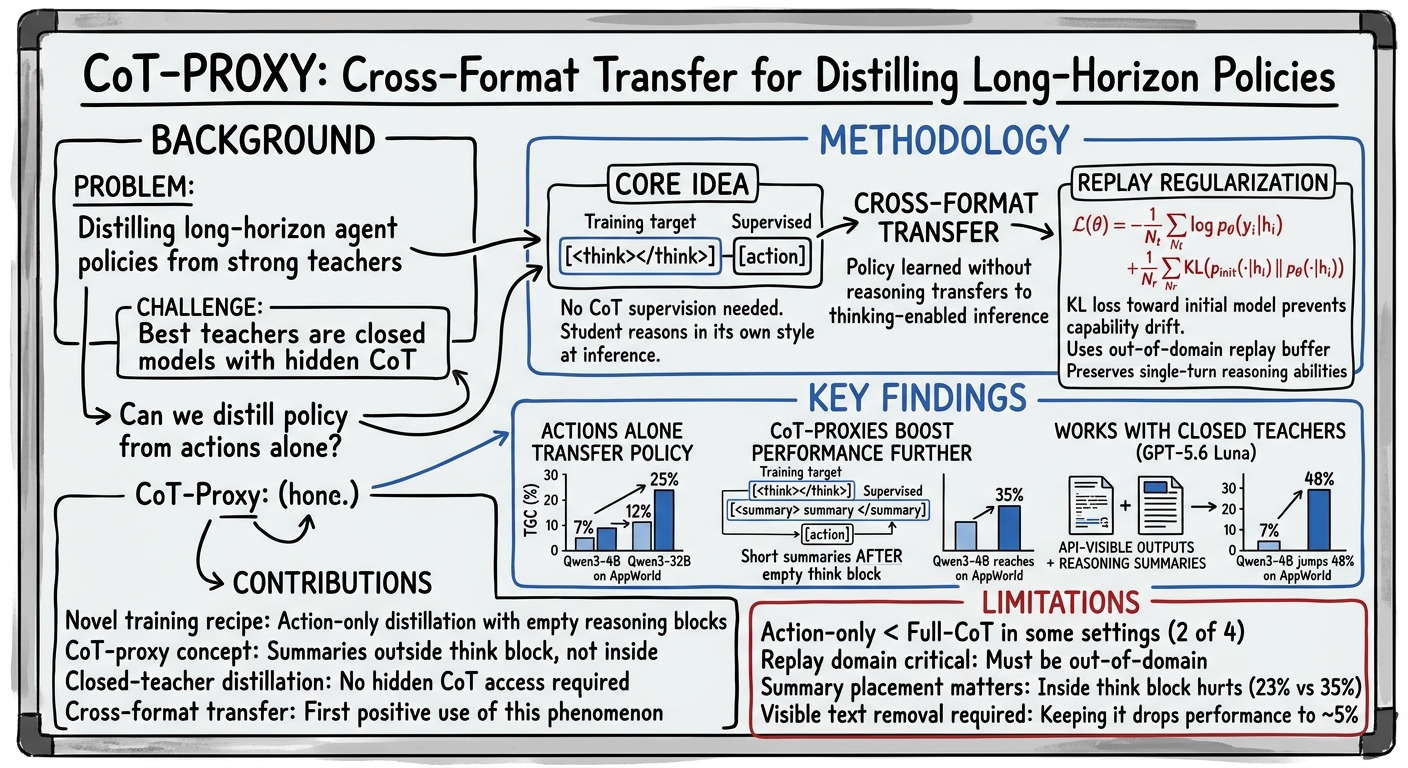
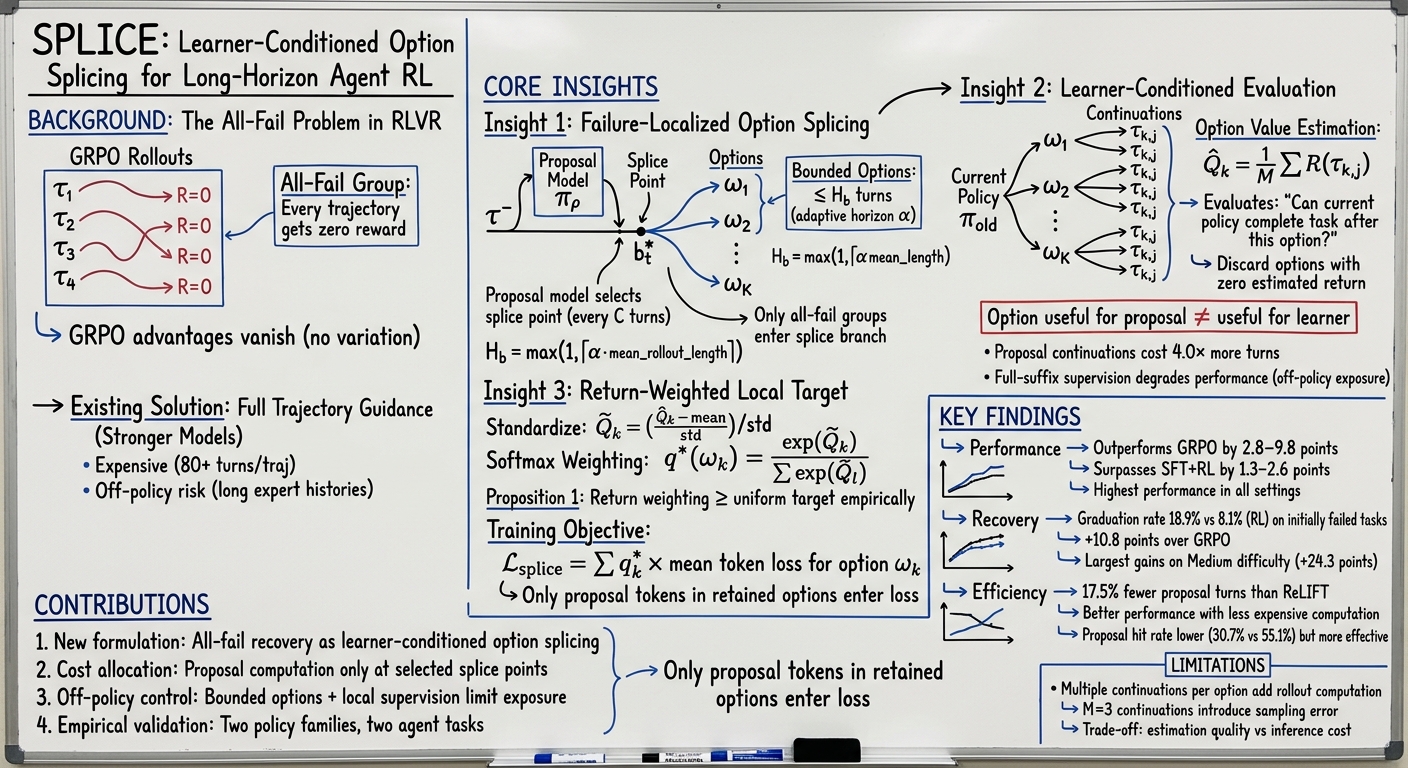
The second theme: trajectory target format itself becomes a research subject. CoT-Proxy is the first to systematically prove that long-horizon policies can be distilled solely from teacher actions (empty think blocks + KL replay regularization), and proposes a brief reasoning summary CoT-proxy placed outside think blocks as a supplementary signal without requiring full CoT, enabling distillation from closed-source teachers with hidden reasoning—on AppWorld, it improves Qwen3-4B from 7.3% to 34.5%, and up to 48.2% with closed-source teachers. SPLICE advances all-fail group recovery from full teacher trajectories to learner-conditioned local option splicing: online selection of splice points in failed trajectories, teacher-generated bounded options, then estimating option value via multiple continuations of the current policy with return-weighted local supervision, avoiding off-policy exposure of full trajectories. Compared to last issue's SWE-growth teacher distillation, SPLICE focuses more on local credit assignment, validated across multiple policy families on SWE-bench Verified and BrowseComp-Plus. Together, they show: the value of teacher trajectories lies not only in "content" but also in "at what format and granularity they are presented."
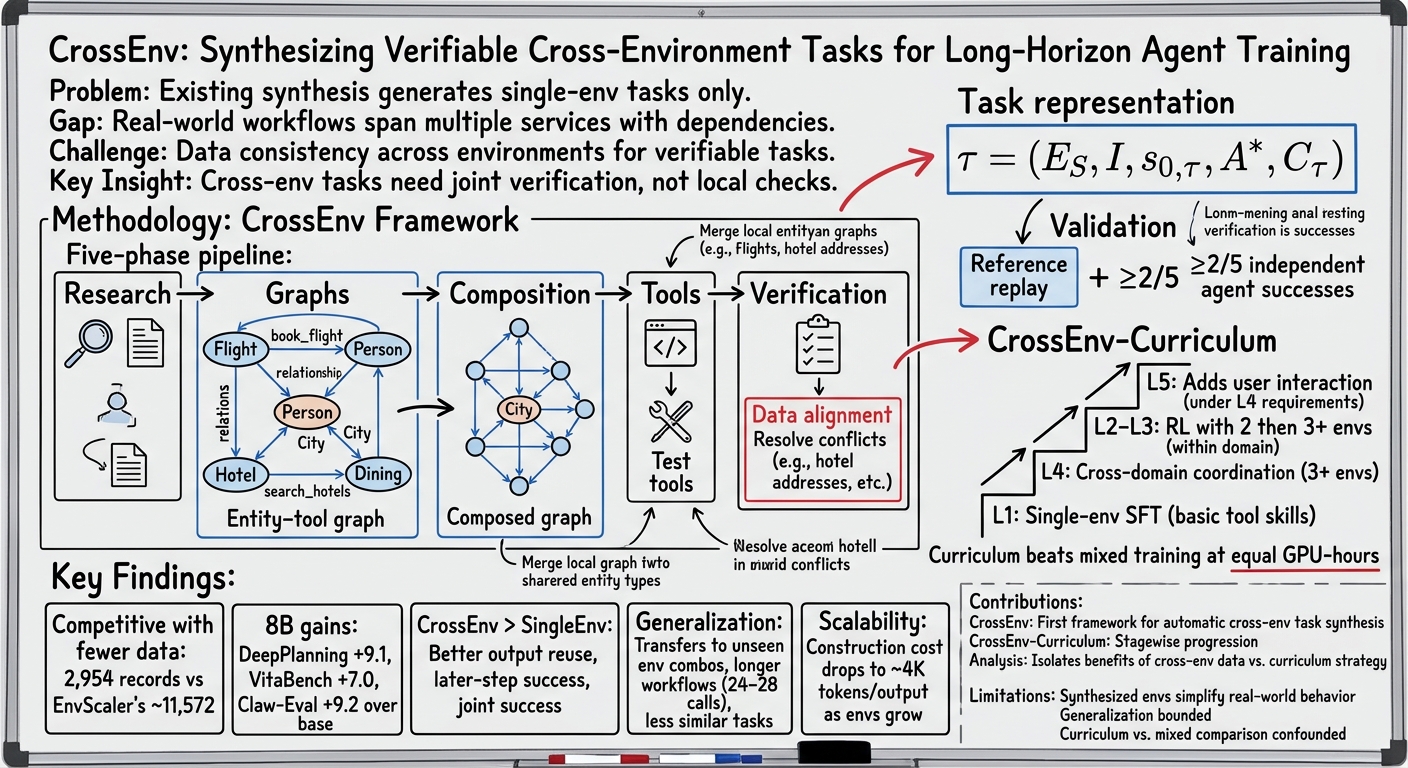
The third theme: environment synthesis moves from single-environment to cross-environment. CrossEnv is the first to systematically synthesize executable, verifiable cross-environment tasks, aligning entity-tool graphs to independently construct data between environments, addressing cross-environment data consistency issues unhandled by previous environment synthesis methods, and organizing training with a curriculum (single-environment tool use → multi-environment/cross-domain/user interaction). Analysis of cross-environment data value (output reuse, later-step success, joint success) provides evidence of training benefits.
Community and Updates
SWE-Gym-Verified releases an audited version of SWE-Gym: using execution replay to validate reward labels, distinguishing false negatives (correct fixes rejected by tests) from false positives (incorrect patches accepted by tests), with 1,087 tasks paired with four controlled RL training sets and all held-out results. This is the most needed public resource for "reward label trustworthiness" in this direction—training code and weights are not open-sourced, but the audit workflow and dataset are fully reproducible.
Terminal-Bench 4 Audit quantifies that 49 of 66 tasks have reward inversion defects, attributed to unstated specifications; Building Data Recipes for Terminal Agents reports 76% of verifiers are too weak via a classify-and-repair pipeline, directly linking infrastructure noise to reward noise. Both turn "verifier reliability" from a paper slogan into quantifiable deployment diagnostics.
CS329Z Lecture Notes provide three actionable data engineering lessons: success-only rejection sampling collapses teacher diversity from 128 repositories to 40, GRPO's 1:7 pass band, and air-gap anti-contamination between synthetic generators and test repositories—read as a checklist of known pitfalls rather than new evidence. Additionally, the SWE-at-Scale dataset is now open-sourced on HuggingFace (2,955 instances, 53 Python repositories), turning Issue 2's SWE-at-Scale reversed real bug fix method into a downloadable training resource.
Open Questions
-
OER asynchronously patches the environment during training, meaning the reward function itself is non-stationary. When the environment is patched and exploited shortcuts become ineffective, how do we measure the distribution shift between the policy's learned behavior and the new environment? Is there a "repair-re-exploit" adversarial loop between online repair and reward hacking, and what scheduling strategies are needed for convergence?
-
CoT-Proxy proves that action-only distillation can transfer policies, and CoT-proxy further improves. This directly challenges the default assumption that "synthetic trajectories must include full reasoning"—when teacher reasoning is unavailable or unsuitable, action-only and CoT-proxy offer new target formats. But for training requiring process-level credit assignment (e.g., SPLICE's local options, Issue 2's CRR counterfactual advantages), are trajectories lacking reasoning still sufficient?
-
SPLICE uses current policy continuations to evaluate local option value, while SWE-growth uses frozen teacher distillation of full trajectories. When the teacher-student capability gap is large, continuation sampling error in learner-conditioned evaluation amplifies; when the gap is too small, teacher-provided options may carry no new information. Where are the applicability boundaries between local option splicing and full teacher recovery?
-
CrossEnv's cross-environment data alignment relies on shared types in entity-tool graphs. When environments have no explicit shared entities (e.g., heterogeneous repositories, different language stacks), how are executable and verifiable cross-environment tasks constructed? How does this connect with Issue 4's How Data Scales environment diversity axis?
Papers in this issue
Online Environment Repair reduces coding RL reward hacking from 36.9% to 0.06% by patching exploited evaluation environments during training, boosting held-out Pass@8 from 21.7% to 46.7%.
Editor's noteAdvances environment repair from reward penalties/trajectory filtering/static hardening to asynchronous patching of exploited environments during training: rollout rewards that trigger repair remain unchanged to eliminate hidden incentives, candidate repairs must pass three validation gates (spec completeness, exploit replay failure, reference/benign solution preservation) before deployment, achieving false-positive self-cancellation and cross-repository structure propagation, with zero-oracle intra-group differential fuzzing to address sparse test spec gaps. Compared to Issue 5's VerifierBench and Issue 6's Optimistic Verifiers Get Hacked evaluation or post-hoc attribution, this is the first to incorporate environment repair into the RL loop; 20 controlled GRPO ablations (2×2 timing×propagation, de-privileged variants) reduce cumulative reward hacking from 36.9% to 0.06%, held-out Pass@8 from 21.7% to 46.7%, and achieve zero-shot exploitation elimination on unseen vulnerability classes, with solid attribution. Limitations: no open-sourced data/code, benchmark is self-built CATCH-derived, but as a verifier quality control methodology it is worth close reading.
Distilling a long-horizon policy from teacher actions alone, without chain-of-thought, transfers successfully via an empty reasoning block plus KL replay regularization, enabling closed-teacher distillation.
Editor's noteFirst to systematically prove that long-horizon agent policies can be distilled solely from teacher actions (empty think blocks + KL replay regularization), and proposes a brief reasoning summary CoT-proxy placed outside think blocks as a supplementary signal without requiring full CoT, enabling distillation from closed-source teachers with hidden reasoning—on AppWorld, it improves Qwen3-4B from 7.3% to 34.5%, and up to 48.2% with closed-source teachers. Compared to Issue 6's SWE-growth teacher-guided self-play, the increment is explicit study of "training target format" itself (action-only vs full CoT vs CoT-proxy) on policy transfer, with mechanistic analysis of cross-format transfer (reasoning length and wording changes); ablations (replay domain, summary position/source, visible text stripping) attribute gains to target format rather than base model. Limitations: no open-sourced data/code, closed-source teacher on SWE-bench is a single run, but it directly guides target design for synthetic trajectories.
SPLICE recovers learning signal from all-fail RL groups by splicing local proposal-model options into failed trajectories, beating GRPO by up to 9.8 points with 17.5% less computation.
Editor's noteAdvances all-fail group recovery from "full teacher trajectories" to "learner-conditioned local option splicing": online selection of splice points in failed trajectories, teacher-generated bounded options, then estimating option value via multiple continuations of the current policy with return-weighted local supervision, avoiding off-policy exposure and computational overhead of full trajectories. Compared to Issue 6's SWE-growth teacher distillation, the increment is explicit use of current policy continuations to evaluate local option value; ablations show supervision limited to options rather than successful suffixes is better; validated across multiple policy families on SWE-bench Verified and BrowseComp-Plus, with controlled baselines against ReLIFT and SFT+RL, achieving 24.3-point gains on Medium difficulty tasks far exceeding standard RL. Limitations: no open-sourced data/code, continuation sampling error and computational cost not fully discussed, but as a local credit assignment methodology for all-fail recovery it is worth close reading.
CrossEnv synthesizes executable cross-environment LLM agent training tasks via entity-tool graph composition, achieving competitive benchmark performance with roughly 25% of baseline training data.
Editor's noteFirst to systematically synthesize executable, verifiable cross-environment tasks: aligning entity-tool graphs to independently construct data between environments, addressing cross-environment data consistency issues unhandled by previous environment synthesis methods (EnvScaler, Agent-World, Skill2Env), and organizing training with a curriculum (single-environment tool use → multi-environment/cross-domain/user interaction). Analysis of cross-environment data value (output reuse, later-step success, joint success) provides evidence of training benefits—cross-environment RL improves joint success from 0.0% to 8.3%, outperforming single-environment RL. Limitations: benchmark is tool use rather than SWE, no open-sourced data/code, curriculum gain attribution partially acknowledged as incomplete, but as the first systematic attempt at cross-environment task construction it is worth attention.
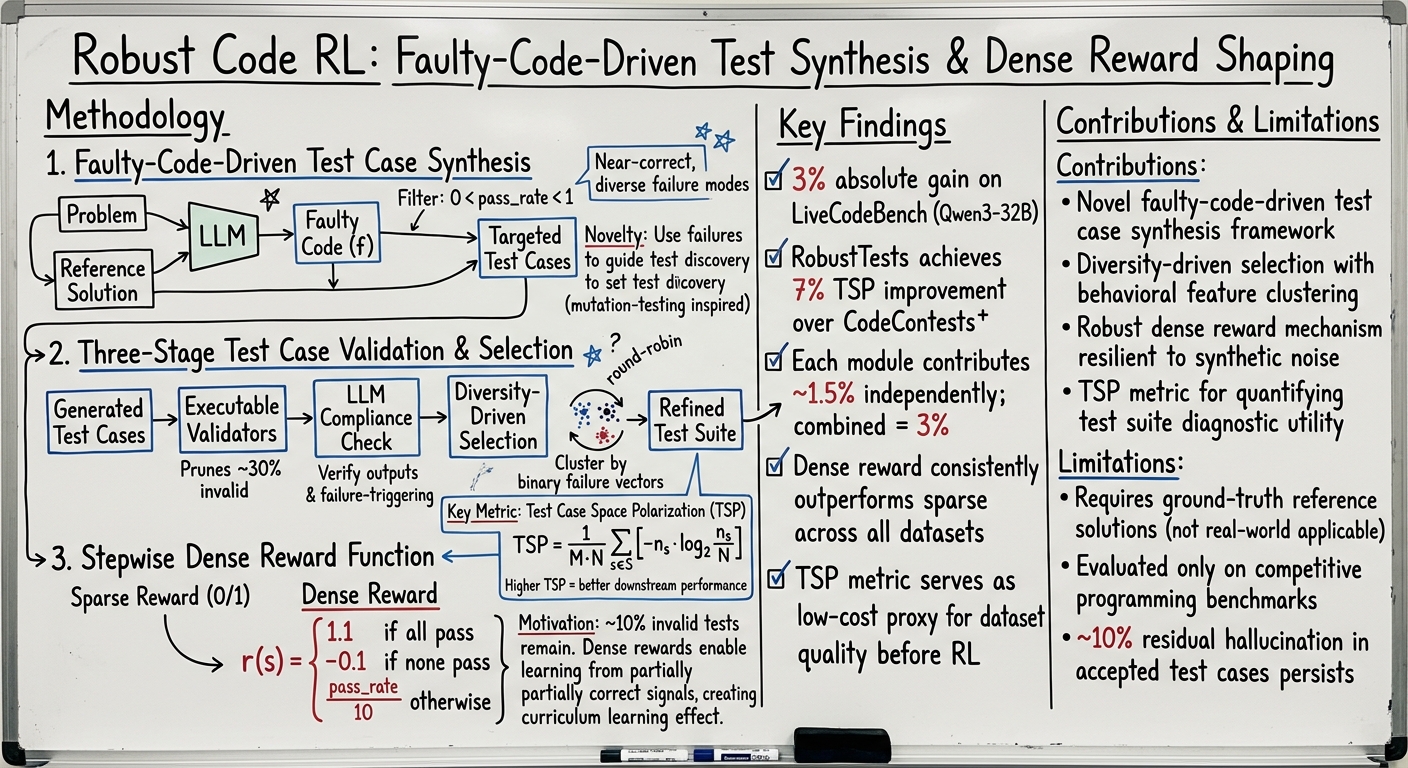
RobustTests improves LLM code RL by generating test cases from near-correct faulty code and using dense rewards, yielding 3% absolute gains on LiveCodeBench and CodeForces.
Editor's noteUses "near-correct" faulty code as negative examples to guide generation of test cases that distinguish correct from faulty implementations, with behavioral feature clustering (K-means) for diversity filtering, and a pass-rate-based stepped dense reward to mitigate synthetic test false negatives, using the TSP metric to quantify test suite diagnostic diversity. Compared to CodeContests+'s generator-validator and HardTests, the increment is explicit use of faulty code as a test generation guidance signal; public dataset and code align with this direction's reproducibility preference. Limitations: only validated on competitive programming benchmarks (LiveCodeBench/CodeForces), not real repositories or SWE scenarios; if focused on test sufficiency and reward robustness, worth reading; if focused on SWE environment construction, relevance is limited.