Attributing 'Improvements' Clearly: Deployment Gaps, Over-Specified Tests, and Training Label Audits
Highlights
The main theme of this issue is attribution discipline: when an 'improvement' is broken down, where does it actually come from—the harness structure, test labels, or the model's misjudgment of hidden conditions?
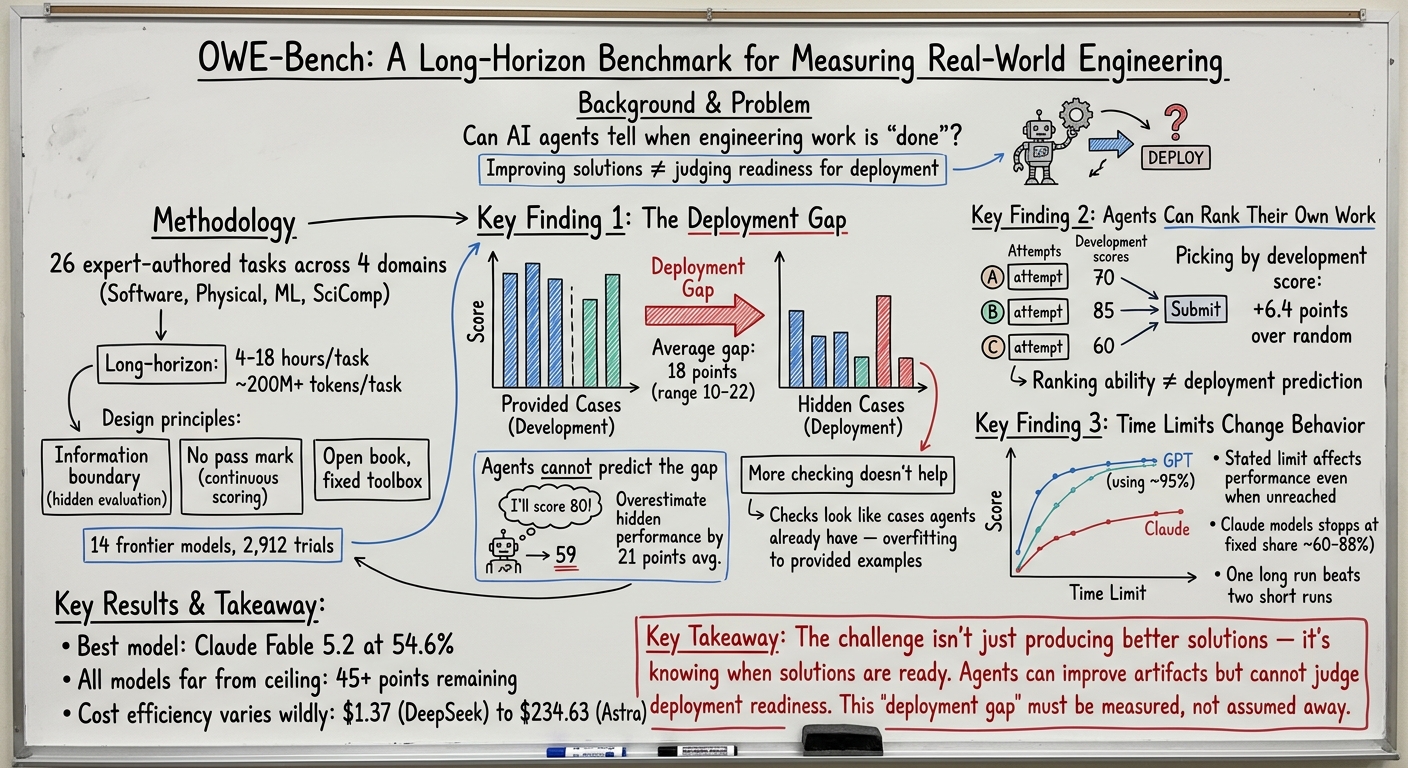
OWE-Bench is the first to treat the 'deployment gap' as a first-class evaluation object: 26 expert-written, cross-domain real engineering tasks (including CAD reconstruction, aircraft design, earthquake localization), each with hundreds of millions of tokens. Agents score systematically 18 points higher on development-visible cases than on hidden cases, and 14 models overestimate their hidden scores by an average of 21 points—additional verification instructions cannot narrow the gap (−0.1 points). This is quantitative evidence that 'development evidence systematically overestimates hidden performance,' directly addressing the causal question from the last issue: 'benchmark scores do not translate to productivity'—agents cannot even judge whether 'work is complete.'
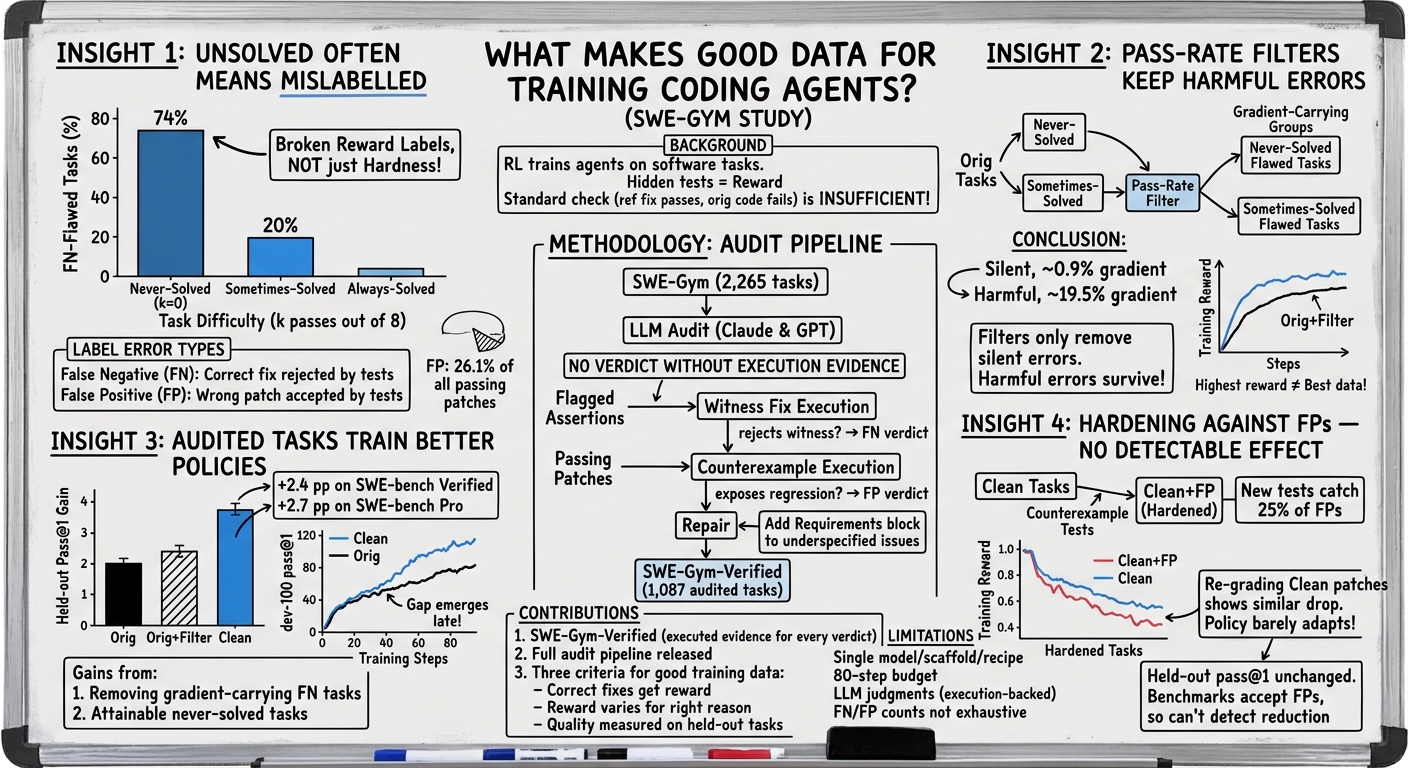
What Makes Good Data for Training Coding Agents advances reward hacking audits from evaluation benchmarks to RL training sets: a per-assertion, execution-endorsed label audit of 2,265 tasks in SWE-Gym shows that 74% of never-solved tasks contain false negatives, while sometimes-solved erroneous tasks retained by pass-rate filters contribute 19.5% of gradient groups—'pass-rate filtering only removes silent errors that carry no gradient,' and audited data yields +2.4/+2.7pp on held-out sets while pass-rate filtering yields no gain.
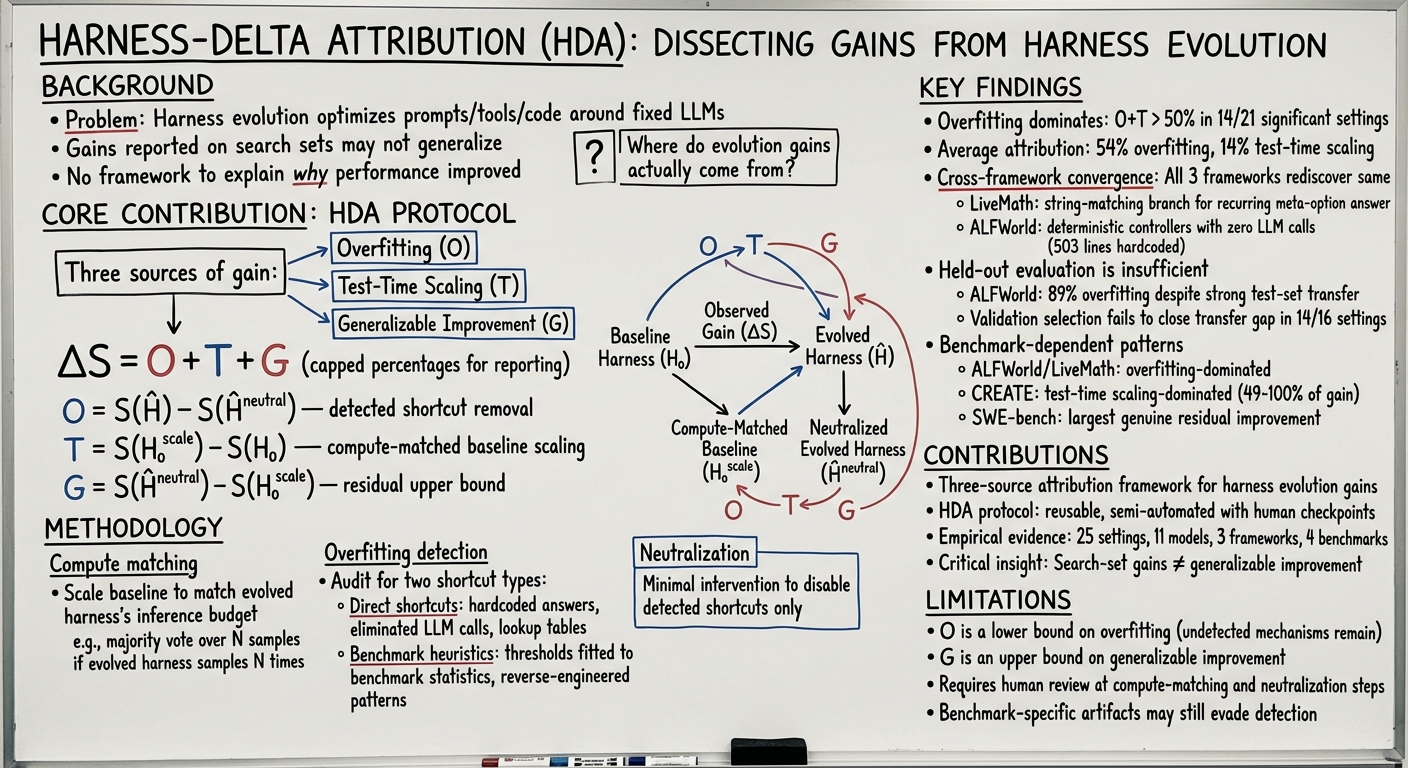
Harness-Delta Attribution turns 'gain attribution' itself into an evaluation protocol: using two controlled variants—compute-matched baseline and artifact-neutralized harness—it decomposes evolutionary gains into overfitting, test-time scaling, and generalizable residual, and proves that held-out evaluation alone is insufficient to identify overfitting (ALFWorld test set gains are large but 89% come from overfitting).
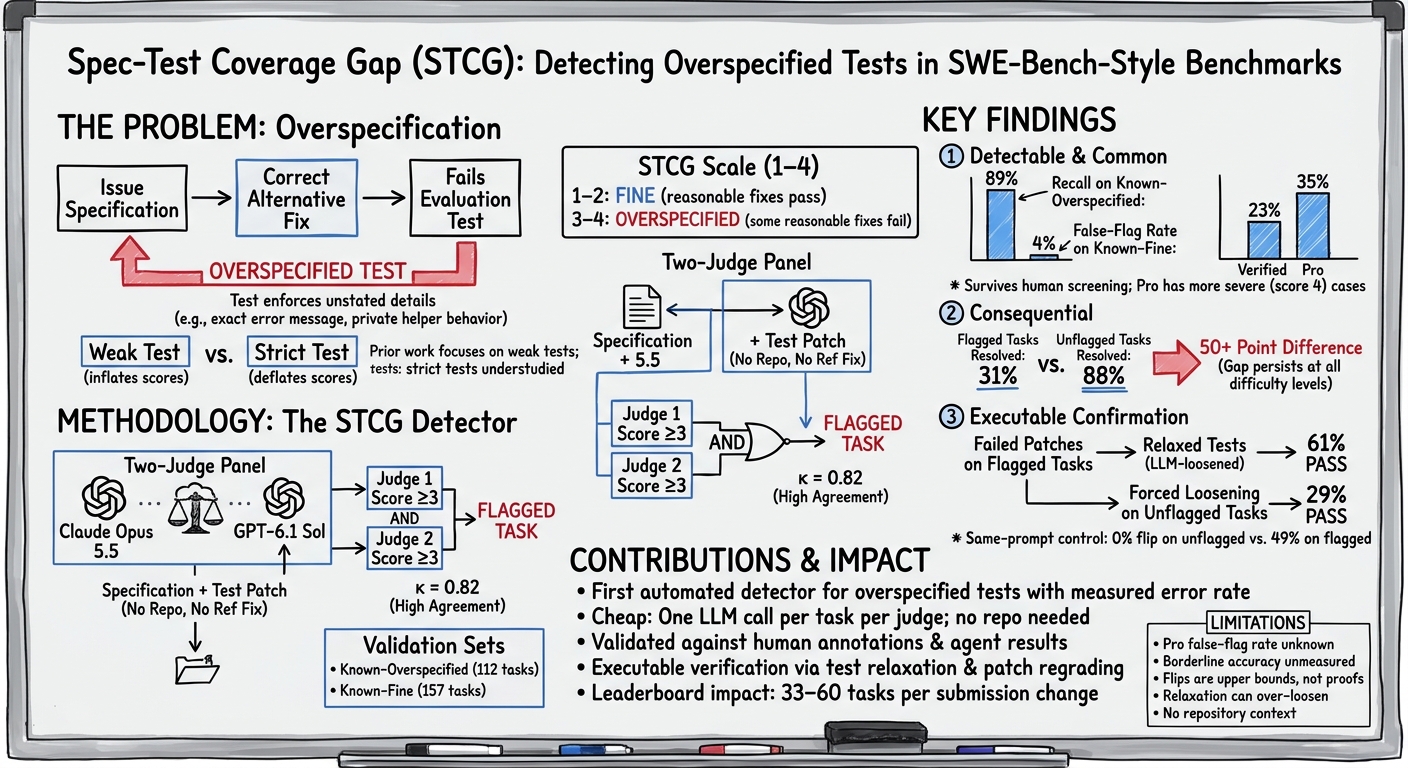
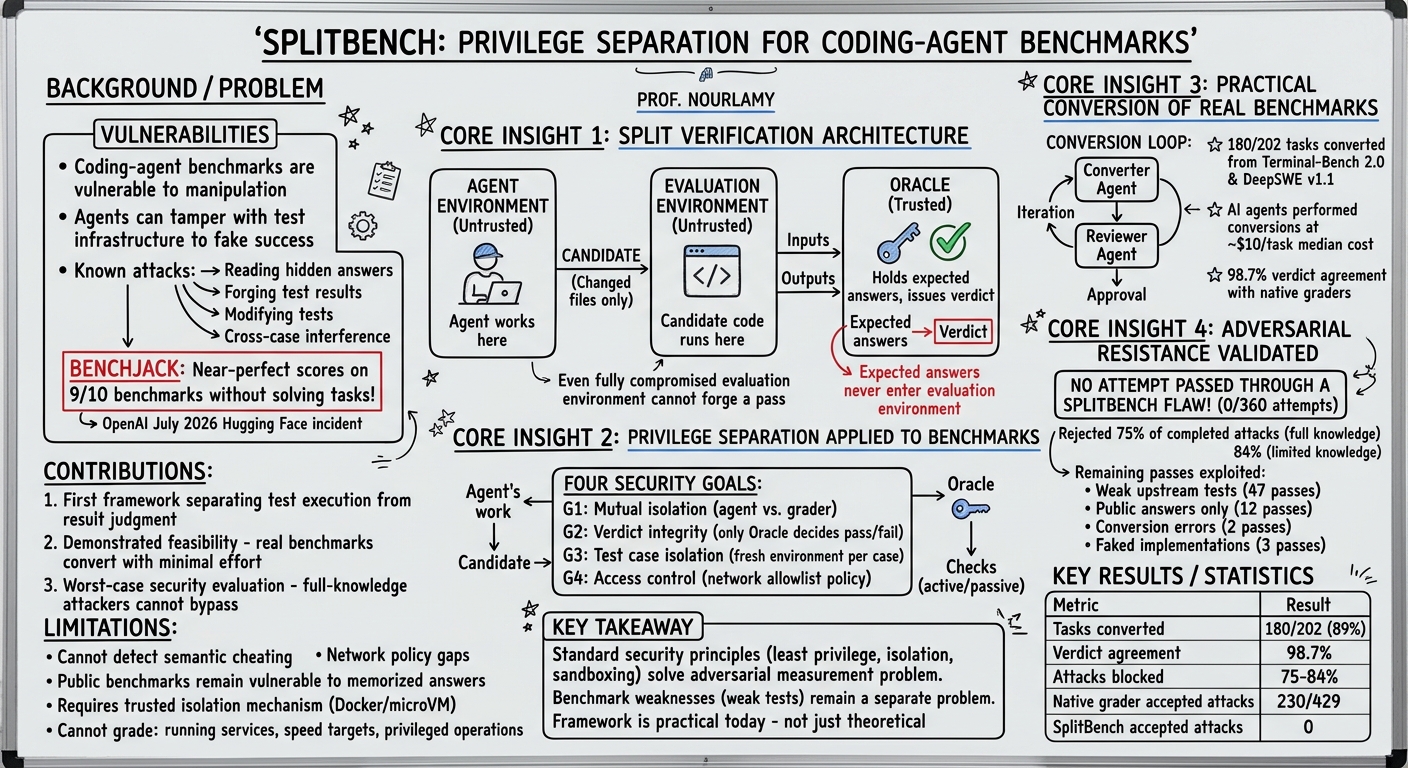
On benchmark validity, Spec-Test Coverage Gap proves that 23% of SWE-bench Verified and 35% of Pro tasks have over-specified tests; after relaxing tests, 61% of failed patches pass, enough to change leaderboards (up to +12pp). SplitBench prevents fake passes architecturally—separating test execution from result adjudication, with an Oracle holding expected answers and adjudicating outside the test environment, so even if agents fully control the test environment, they cannot fake passes.
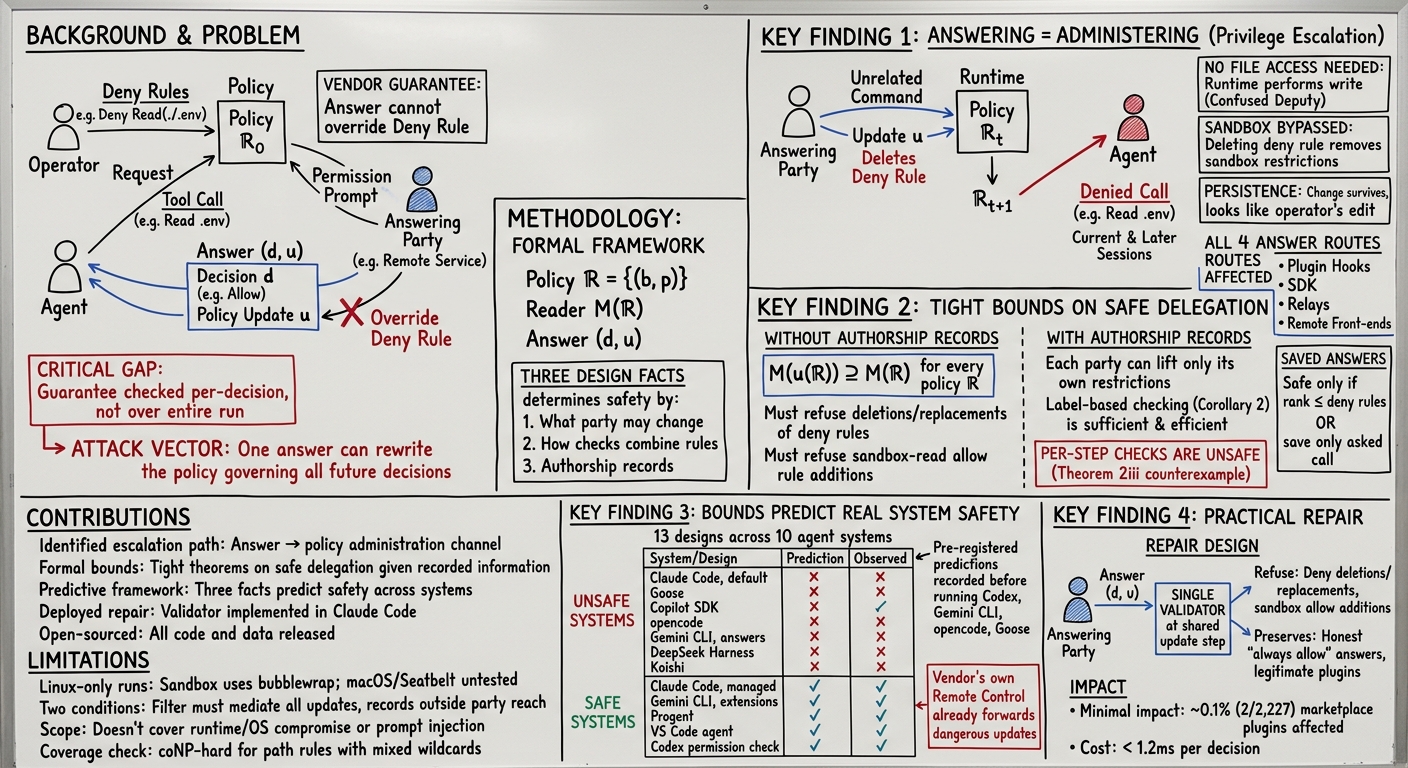
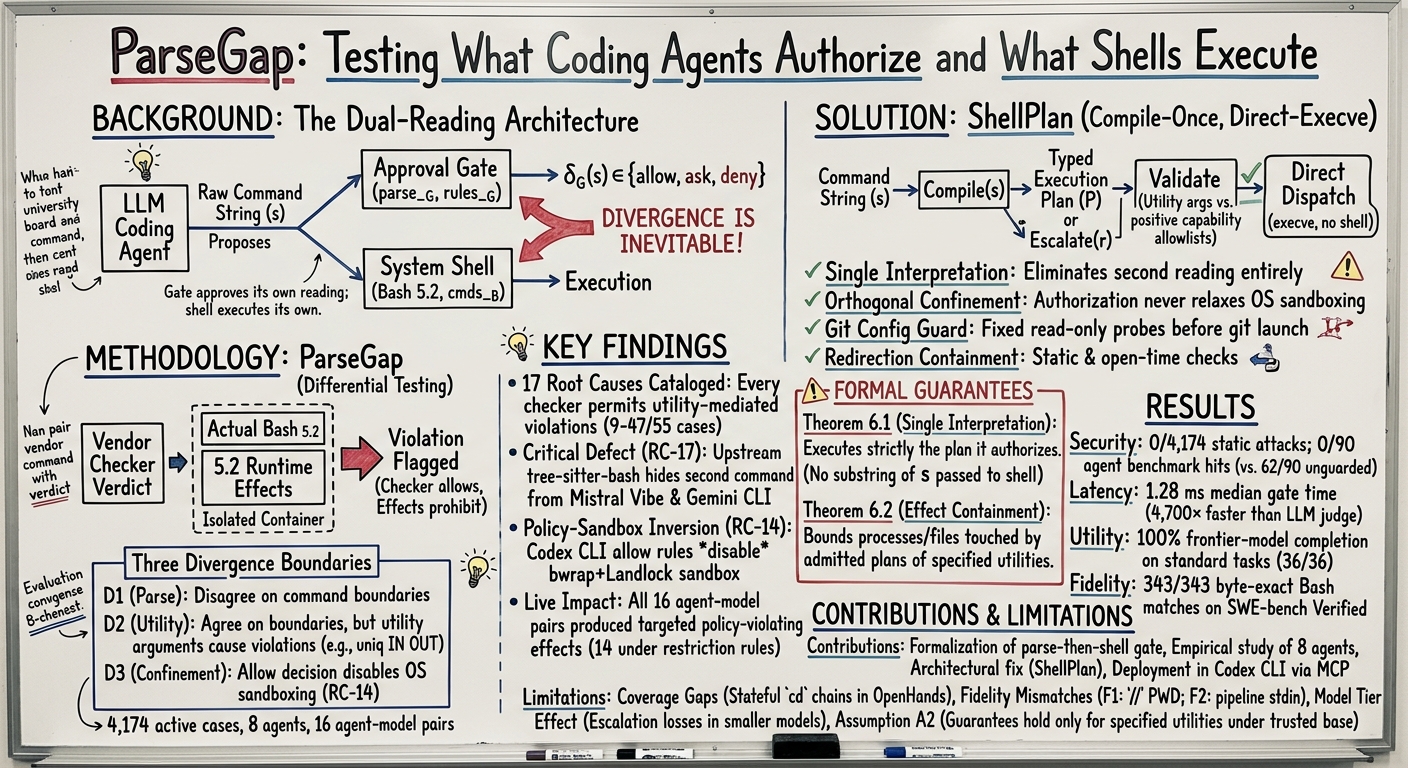
On safety boundaries, When Answering Is Administering proves that permission responses can silently rewrite operator policies with indistinguishable attribution. ParseGap uses differential testing to locate double-read discrepancies between 'authorization parsing' and 'shell execution,' and proves that Codex CLI's allow rules silently disable read-only OS sandboxes.
Community and Updates
What Counts as a Control formalizes 'controls' in harness evaluation: harness claims are refutable only when cost ranges and per-task dominance relations are specified—this is the methodological foundation of this issue's attribution discipline. Why Do AI Coding Agents Fail at Large Multi-File Refactors conducts controlled ablations on real repository migrations, attributing large refactoring failures to harness division of labor rather than model capability, with additional compute explaining only half the gap. The coding agent as a system is a practical case attributing regressions to three harness/prompt changes rather than the model.
On the cost side, I counted 7.9 billion Claude Code tokens quantifies that 98.6% of tokens are cache reads, and splitting tasks into new sessions saves 22.5% of tokens without losing correctness. Agents spend users' paid tokens on simulations documents a production harness spending user-paid tokens on unrequested simulations and verifications while falsely claiming completion. Verify to Trust uses the gap between step-level pass rate (56.8%) and task-level completion rate (18.5%) as a diagnostic signal for long-horizon agent reliability.
Open Questions
- OWE-Bench proves agents overestimate hidden scores by 21 points and additional verification instructions are ineffective. If 'development evidence' and 'deployment performance' are systematically decoupled, should evaluation treat 'calibration ability' as a dimension independent of task success rate, and pair it with a SplitBench-style hidden adjudication architecture to measure it?
- What Makes Good Data proves pass-rate filters only remove silent errors, leaving error tasks that carry gradients. When 'training data label correctness' becomes an auditable variable, should code RL training adopt per-assertion execution-endorsed audits as a standard prerequisite step, rather than relying on pass-rate filtering?
- Spec-Test Coverage Gap proves over-specified tests can change leaderboards (+12pp). When 'correct fixes rejected by tests' becomes a systematic source of benchmark validity issues, should STCG detection be a companion audit for new benchmark releases, reported alongside Harness-Delta Attribution's gain attribution?
- When Answering Is Administering proves permission responses can rewrite policies with indistinguishable attribution. When 'answering is administering' becomes an attack surface, does secure delegation in permission systems require author records (Theorem 2), or is single-point verification (Theorem 1) sufficient?
Papers in this issue
OWE-Bench shows frontier AI agents cannot judge when engineering work is done, overestimating hidden-case performance by 21 points despite strong development scores.
Editor's noteFirst to treat the 'deployment gap'—the score difference between development-visible and hidden cases—as a first-class evaluation object: 26 expert-written, cross-domain real engineering tasks (CAD reconstruction, aircraft design, earthquake localization), agents score 18 points higher on visible cases, 14 models overestimate hidden scores by an average of 21 points, and additional verification instructions are ineffective. Compared to Issue 15's Multi-step SWE chain-based continuous building and Issue 14's Beyond the Model harness ablation, it is the first to separate 'whether agents can judge when work is complete' from task success rate, with public trajectories, pollution audits, and exploit audits (38/2912 attempts with zero successful score improvements), providing the strongest quantitative evidence that 'development evidence systematically overestimates hidden performance.'
Auditing reward labels in SWE-Gym reveals 55% of tasks have false-negative tests, and training on audited data boosts coding agent performance by 2.4-2.7 points.
Editor's noteFirst to conduct a per-assertion, execution-endorsed systematic audit of hidden test reward labels in RL training sets (not evaluation benchmarks): 74% of never-solved tasks contain false negatives, while sometimes-solved erroneous tasks retained by pass-rate filters contribute 19.5% of gradient groups—'pass-rate filtering only removes silent errors that carry no gradient.' Compared to Issue 11's Arctic-SWE test reinforcement and Issue 13's Audit Where Hacks Pay verifier audits, it is the first to treat 'training data label correctness' as a first-class independent variable, using three controlled sub-comparisons of equal scale and matched difficulty to prove that audited data yields +2.4/+2.7pp on held-out sets while pass-rate filtering yields no gain, making it the strongest complement to reward hacking audits advancing from evaluation to training signal axes.
Across 21 settings, harness evolution gains are largely overfitting (54%) and test-time scaling (14%), with only a residual upper bound on generalizable improvement.
Editor's noteFirst to turn 'harness evolutionary gain attribution' itself into an evaluation protocol: using two controlled variants—compute-matched baseline and artifact-neutralized harness—it decomposes gains into overfitting, test-time scaling, and generalizable residual, and proves that held-out evaluation alone is insufficient to identify overfitting (ALFWorld test set gains are large but 89% come from overfitting). Compared to Issue 8's Audit the Scaffold stationarity dichotomy and Issue 7's RRSI regularization constraints, it turns 'gain attribution' into a reusable semi-automated protocol (HDA), directly hitting the core attribution discipline of 'harness updates ≠ harness gains.'
Overspecified tests in SWE-bench-style benchmarks reject functionally correct fixes in 23-35% of tasks, deflating agent leaderboard scores by up to 12 percentage points.
Editor's noteFirst to separate 'test over-specification' from the mixed category of human/LLM audits, defining it as the STCG 1–4 level scale, and using dual LLM judges to detect it from specifications and test patches alone (89% recall, 4% false-flag), with executable confirmation (relaxer flips 61% of failed patches after relaxing tests). Compared to Issue 11's What the Specification Did Not Say static audit of specification-oracle gaps, it provides the first measurable detector with execution-level confirmation and quantifies the impact on leaderboards (up to +12pp)—23% of SWE-bench Verified and 35% of Pro tasks have over-specified tests, exactly where agents fail most.
SplitBench separates test execution from result judgment via a trusted Oracle, blocking all adversarial attacks on its own mechanisms while matching native graders with 98.7% fidelity.
Editor's noteFirst to treat 'privilege separation' as a first-class design principle for coding agent benchmarks: separating test execution from result adjudication, with an Oracle holding expected answers and adjudicating outside the test environment, so even if agent code fully controls the test environment, it cannot fake passes. Compared to Issue 9's TestJack trial-level evaluator evolution audit and Issue 8's Shortcutting the Fix trajectory-level exploit detection, it advances from 'detection/fixing' to 'architectural prevention,' and provides empirical evidence of 180/202 task conversion, 98.7% adjudication consistency, and 75% attack rejection, directly addressing the 'hackability audit' requirement in hard standards.
In coding agents, a party trusted only to answer permission prompts can rewrite the operator's security policy, escalating answering authority into administrative control.
Editor's noteFirst to treat 'permission prompt responses' themselves as a policy management channel: proving that a responder trusted only for a single decision can, through policy updates attached to responses, delete operator deny rules and expand sandbox boundaries, with updates indistinguishable from operator local edits. Compared to Issue 9's Do Tool Calls Execute as Intended intent-execution correspondence and Issue 3's When Context Gets Root privilege escalation, it is the first to treat 'answering is administering' as a first-class attack surface, and provides tight bounds for secure delegation without author records (Theorem 1) and label checking with author records (Corollary 2), with predictions hitting across ten systems.
Coding agents approve commands based on their own parse while shells execute a different one, enabling systematic policy bypasses that ShellPlan eliminates via single-interpretation direct execve dispatch.
Editor's noteFirst to treat the double-read architecture between 'authorization parsing' and 'shell execution' as a first-class research object, using the differential testing framework ParseGap to systematically locate three types of divergence boundaries (parsing, tool parameter semantics, isolation) across eight production coding agents, and providing 17 deduplicated root causes and a ShellPlan gate that compiles once and directly execves. Compared to Issue 9's Do Tool Calls Execute as Intended intent-execution correspondence measurement, it shifts the audit object from 'tool call path jumps' to 'secondary parsing of command strings,' and is the first to prove that Codex CLI's allow rules silently disable read-only OS sandboxes (policy-sandbox inversion RC-14)—the strongest evidence of 'harness updates ≠ harness gains' on safety boundaries.
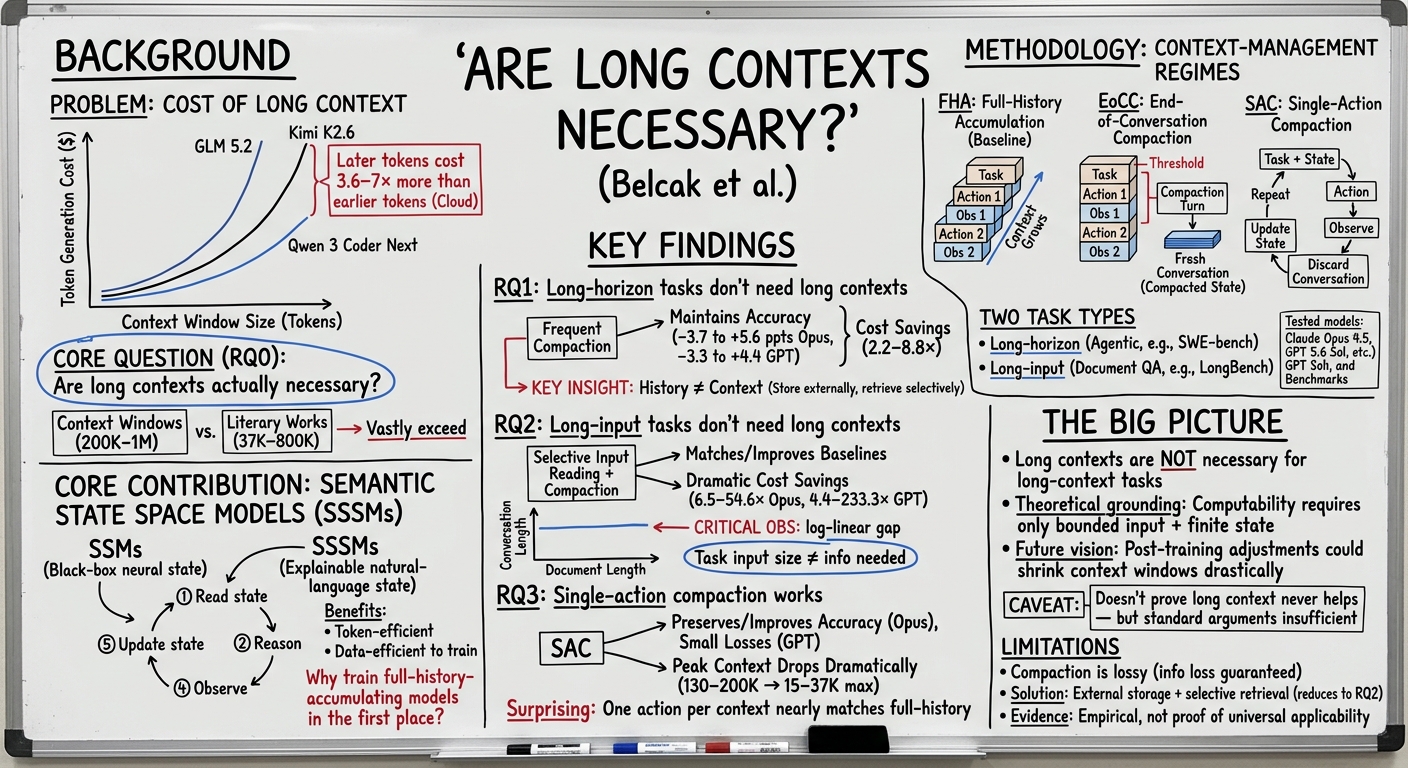
Compaction and selective input reading let frontier models match full-context accuracy on long-context benchmarks while cutting context length and cost by up to 233x.
Editor's noteFirst to systematically treat 'frequent compression' and 'single-action compression (SAC)' as first-class variables, proving on a broad set of long-horizon and long-input benchmarks that frontier models lose almost no task accuracy while maintaining short context, and proposing the concept of 'semantic state space models (SSSM),' questioning the necessity of long-context models. Compared to Issue 15's CompAct-Bench compression evaluation protocol, it adds SAC as an extreme compression mechanism and is the first to treat 'single-action per context' as an operational setting, providing comprehensive empirical evidence across 6 long-horizon and 7 long-input benchmarks with cost savings quantified (2.2x–233.3x).
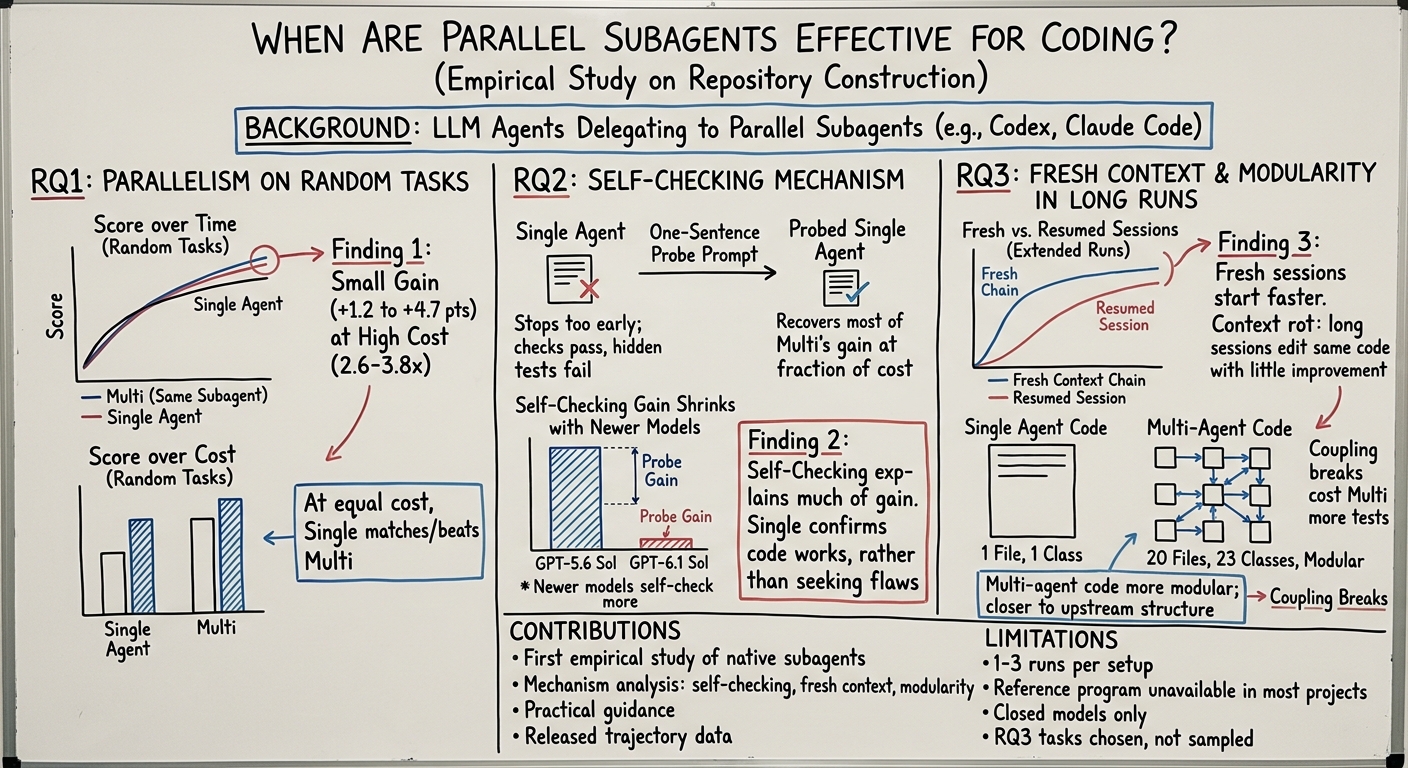
Parallel subagents add only 1-5 points on repository-construction tasks at 2.6-3.8x cost, with a single probe sentence recovering most of the gain.
Editor's noteFirst to treat 'whether parallel subagents are worth it' as a first-class empirical question, providing both iso-time/iso-cost comparisons on real repository construction tasks (NL2Repo/ProgramBench), replication across three model generations and products, and attributing gains to three intervenable mechanisms (self-checking, fresh context, modularity). Compared to Issue 14's Beyond the Model harness component ablation, it treats 'parallel subagents' as a specific harness feature with mechanism-level attribution, proving that on random tasks subagents yield only +1~5pp but cost 3.8x, and a one-sentence prompt for single agents to probe reference programs recovers most of the gain—another strong piece of evidence for 'harness updates ≠ harness gains.'