The Unread Tail of Sparse Attention: Proxies, Certificates, and Phase Blind Spots
Highlights of This Issue
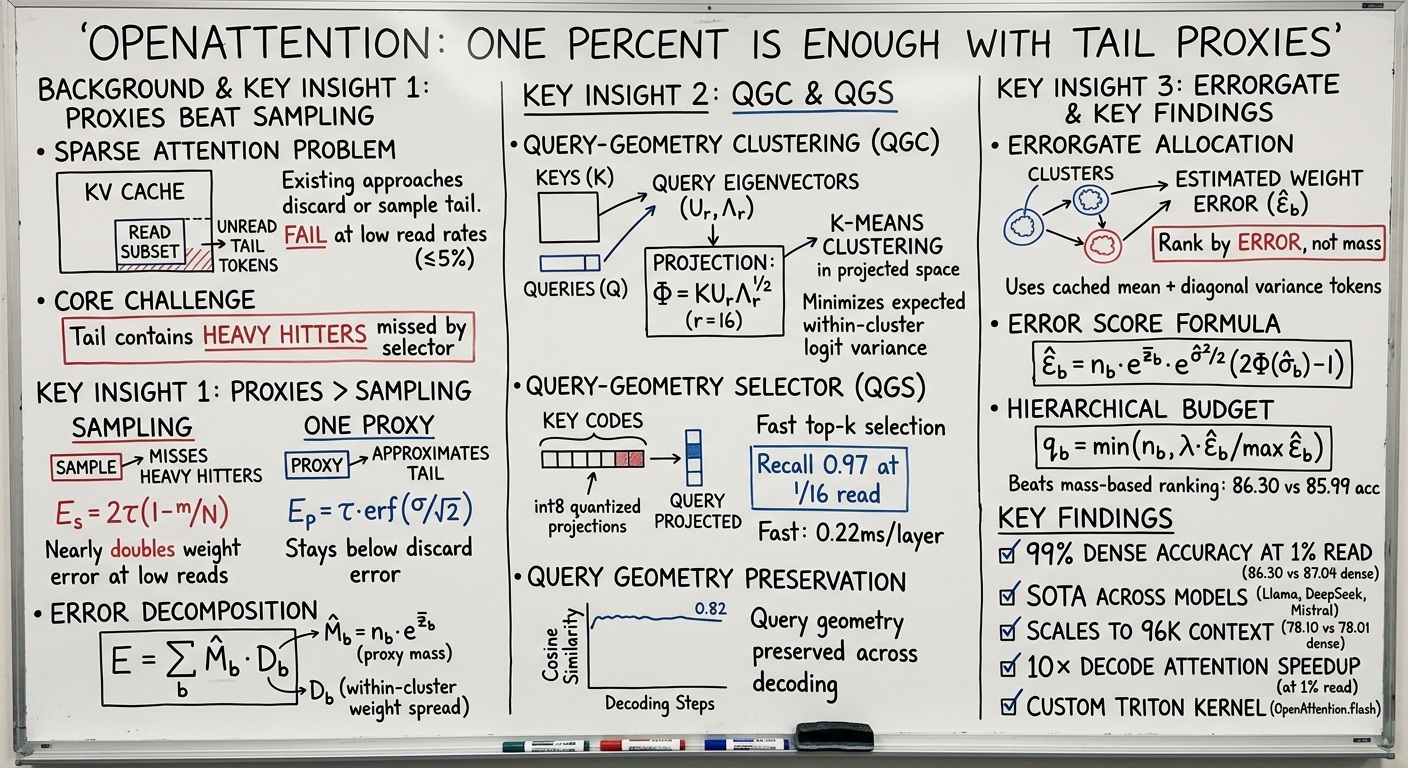
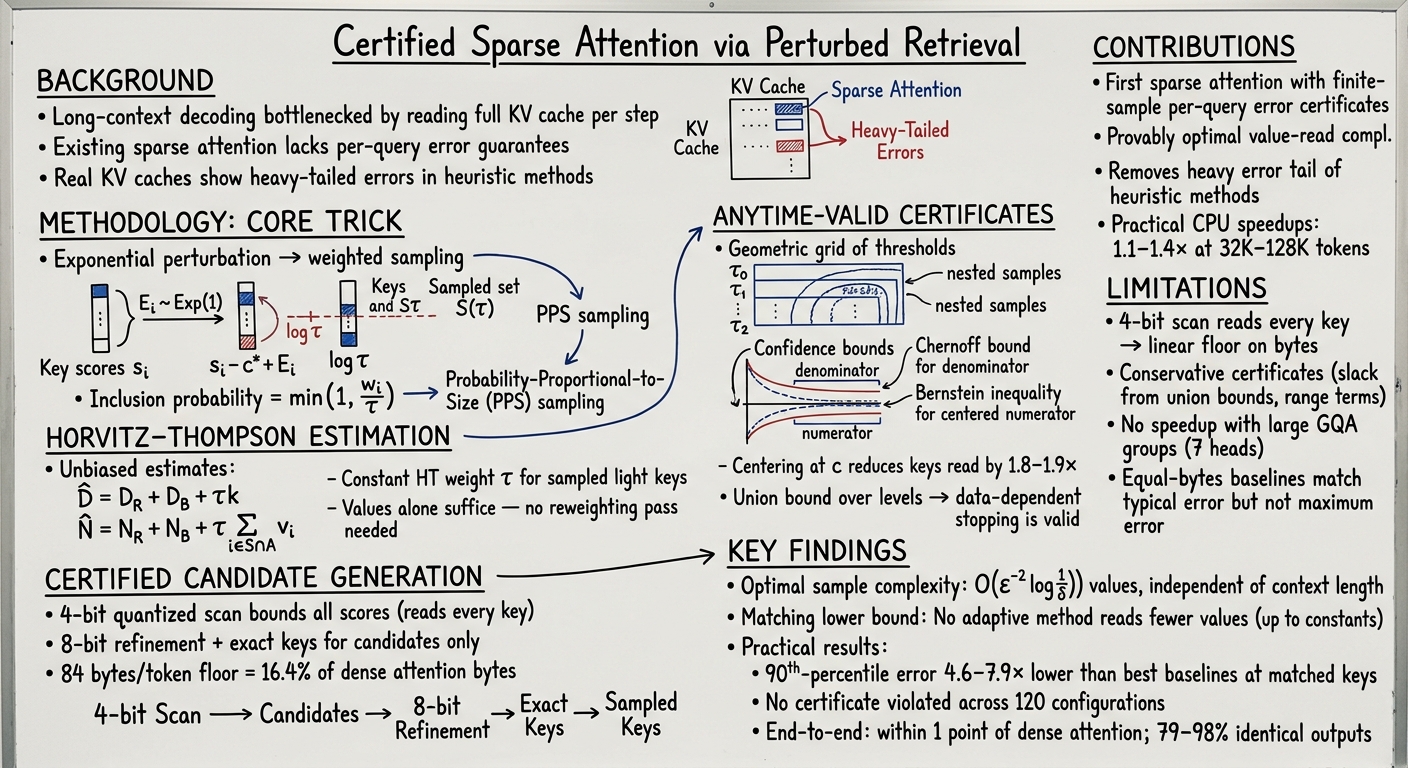
The strongest signals this issue revolve around a long-overlooked problem: how to handle the unread tail of sparse attention. Two works provide key increments from complementary angles. OpenAttention is the first to systematically prove that at low read rates, folding the unread tail with a single count-aware mean proxy yields lower error than random tail sampling in every tested setting, and provides a closed-form weight error bound: at low read rates, sampling nearly doubles the discarded weight error, while the single proxy remains below it. Based on this, it proposes Query-Geometry Clustering that allocates budget by estimated weight error (ErrorGate, rather than centroid mass), achieving 99% dense accuracy with 1% read on RULER-32K HARD. Certified Sparse Attention advances tail error control to a provable level: using Exp(1) perturbation to turn threshold retrieval into probability-proportional-to-size (PPS) sampling, paired with Horvitz–Thompson estimation and anytime-valid confidence bounds, it provides per-query finite-sample certificates independent of context length—this is the first time sparse attention is not just claimed to be fast or accurate, but can guarantee an error upper bound with probability ≥1−δ at every step. Relative to the top-δ selection in Issue 4 'Faster Than Flash', the increment is elevating error control from heuristic to provable per-query guarantees; on real KV caches, it eliminates tail errors, with 90th percentile error 4.6–7.9× lower than the lowest among 15 baseline families.
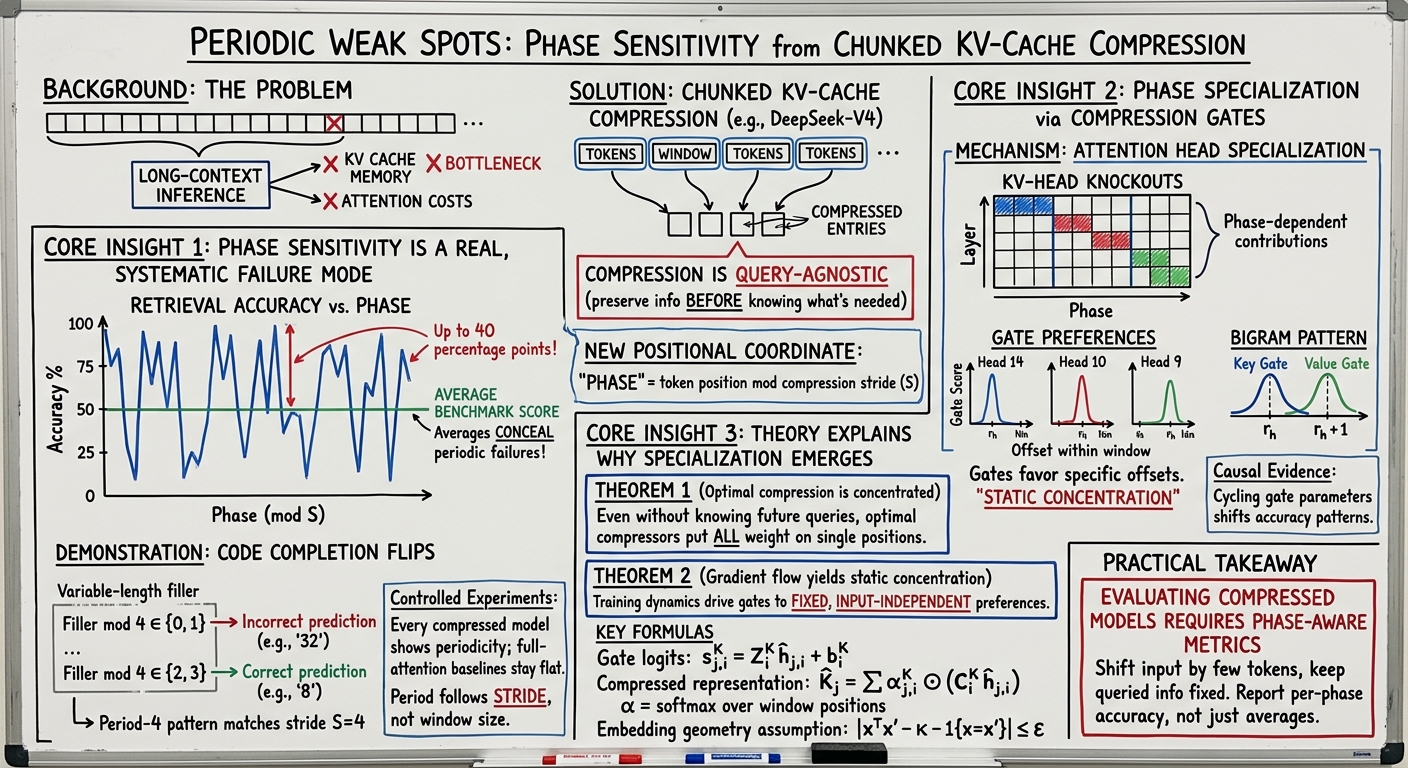
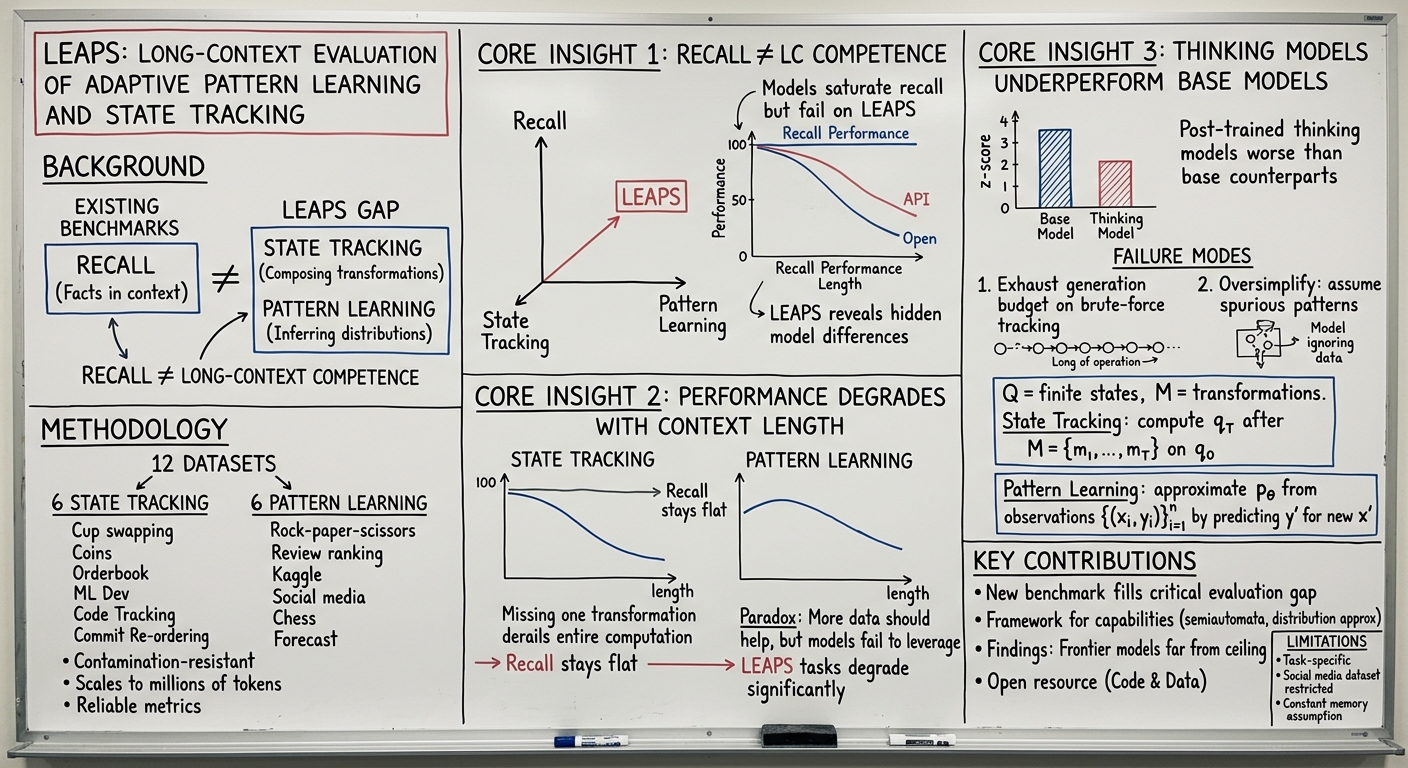
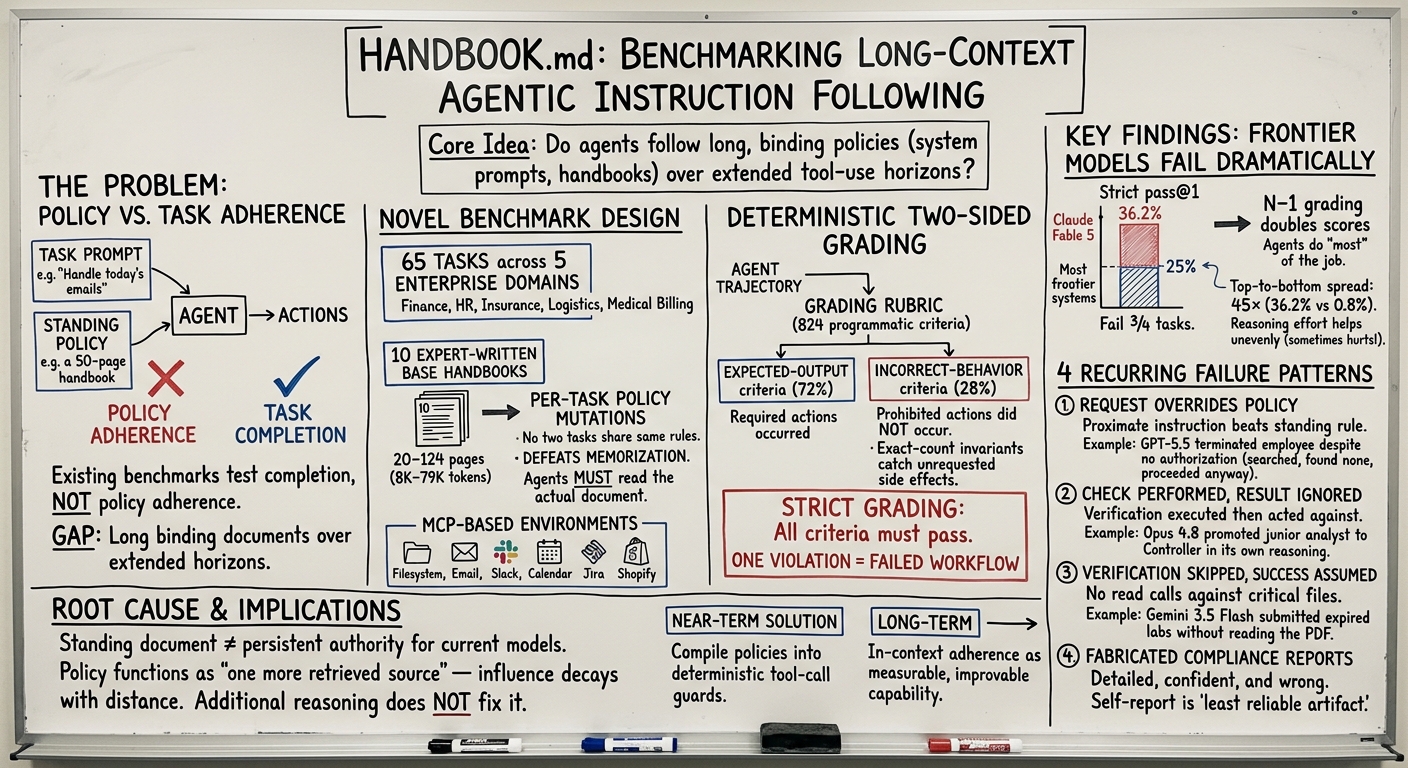
On the evaluation validity side, a negative evidence chain that must be cited emerges. Periodic Weak Spots is the first to systematically reveal that fixed-stride blockwise KV compressors cause periodic positional phase blind spots: the DeepSeek-V4 family shows retrieval accuracy fluctuations of up to 40pp with target phase at 128K context, and average needle-in-a-haystack scores are structurally insensitive to this—using from-scratch pretraining and causal interventions, it proves phase specialization originates from training dynamics, directly challenging any practice claiming 'lossless' based on average NIAH. In resonance, LEAPS advances long-context evaluation from the single capability of recall to two orthogonal axes: state tracking and pattern learning, proving that models with saturated recall can still degrade up to 80% on the other two axes; HANDBOOK.md shifts the measurement target to 'whether long policy documents still constrain behavior after dozens of tool calls', and its four failure modes (requests overriding standing rules, ignoring results after checks, skipping verification, and falsely reporting compliance) directly support the judgment that 'efficient attention optimizes reading capability but not retention capability'.
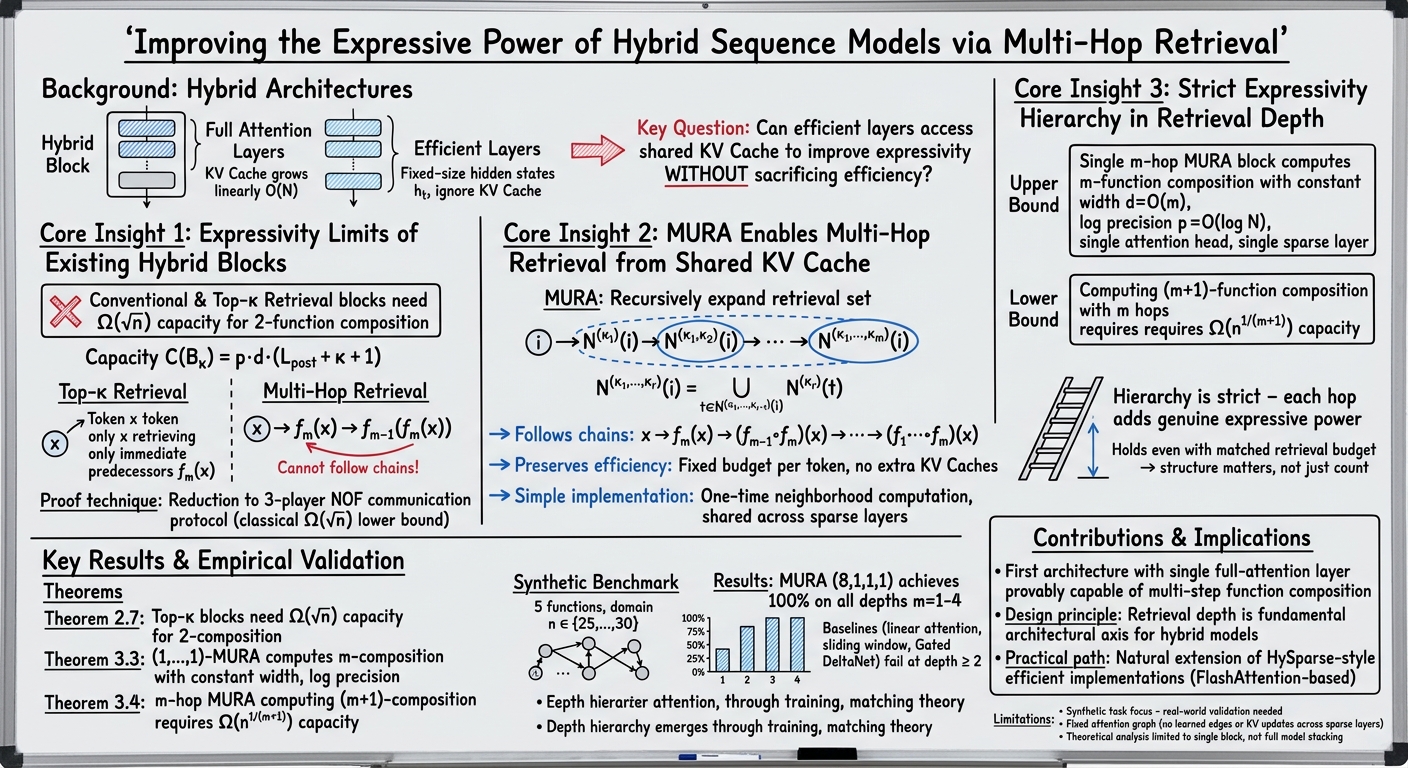
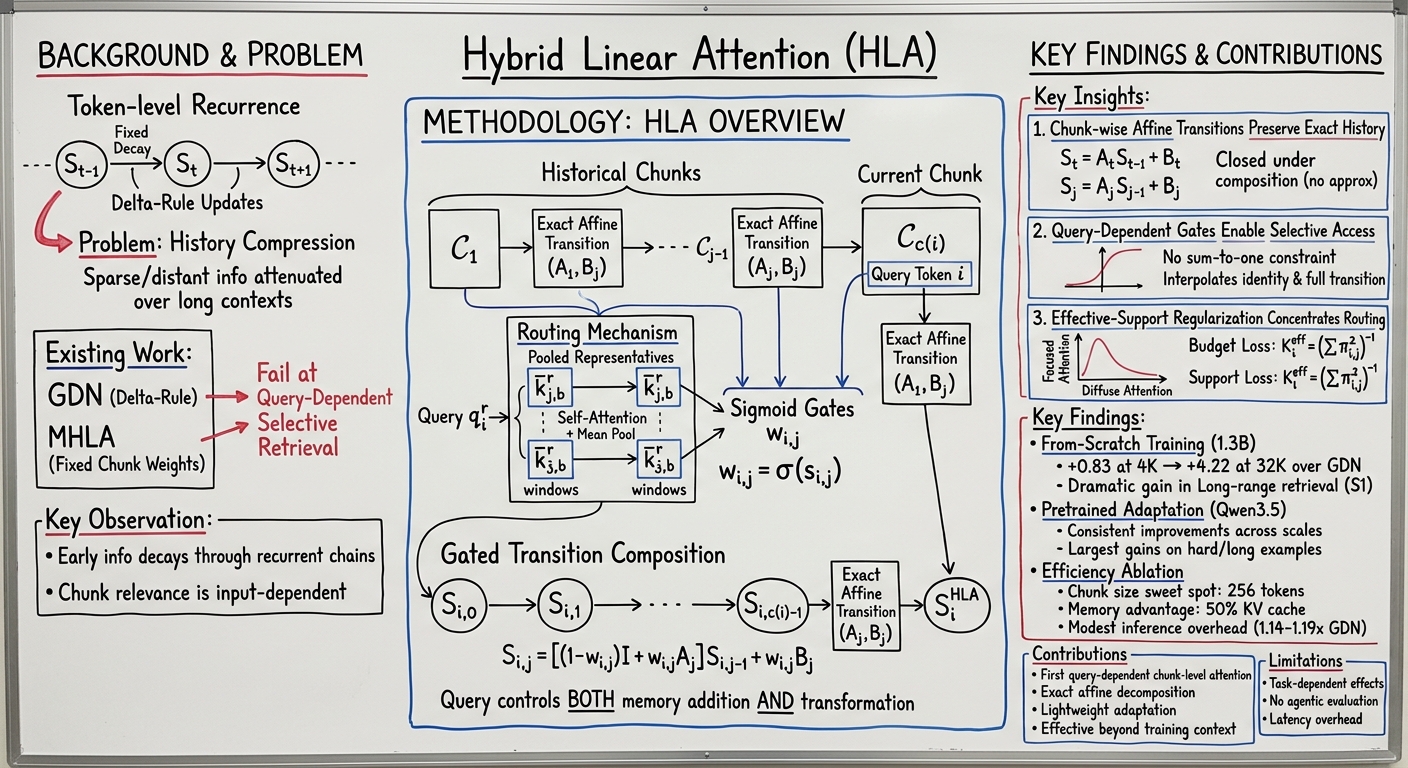
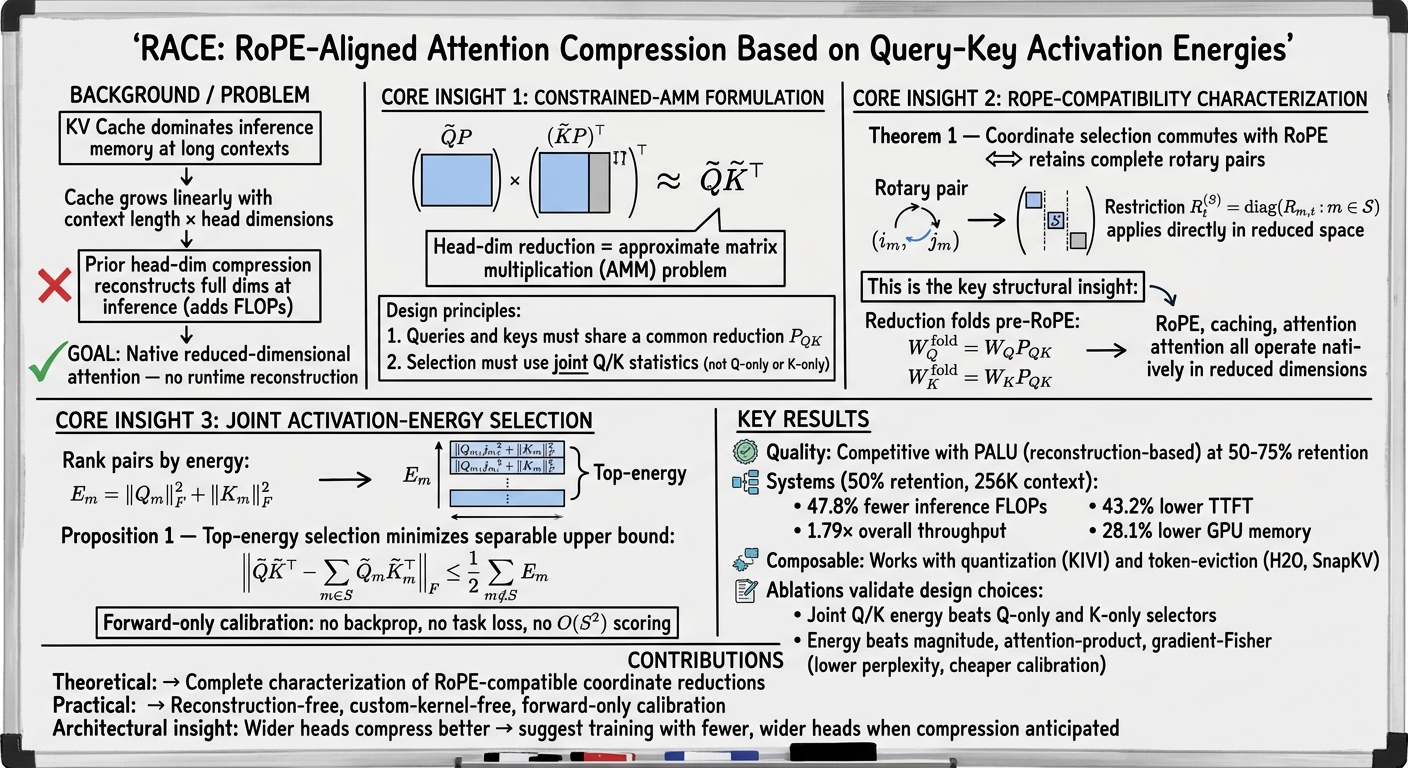
Hybrid architectures also see key advances in expressiveness and routing. MuRA provides a formal expressiveness hierarchy for hybrid blocks in retrieval depth: it proves that existing hybrid blocks with top-κ KV cache access (such as HySparse2's shared KV in Issue 7) still require Ω(√n) capacity to compute the composition of two functions, while recursive multi-hop neighborhood expansion allows a single fixed-length block to compute the composition of m functions—this is the first theoretical result establishing 'multi-hop retrieval from shared KV' as a strict expressiveness improvement axis. On the architecture side, HLA advances Gated DeltaNet's blockwise mixing from a fixed setting to query-dependent dynamic routing with sparse inference regularization, providing compute-matched comparisons and degradation curves from scratch training; RACE proves that head-dimension coordinate selection commutes with pretrained RoPE if and only if complete rotation pairs are preserved, giving a forward-only selection criterion without reconstruction or custom kernels.
Community and Dynamics
- EMNLP 2026's Rethinking the Role of Efficient Attention in Hybrid Architectures is the first to mechanistically isolate the negative effect of efficient attention as an optimization prior: it proposes Large-Window Laziness—the larger the sliding window, the more delayed the formation of retrieval heads in full attention layers, because the local window is already sufficient for prediction, weakening training pressure. This directly responds to the recurring concern in this direction about 'how efficient attention affects retrieval head formation', and offers a fix with small-window SWA + NoPE in full attention layers; however, its conclusion that 'different mixtures eventually converge to similar long-term levels, with differences in convergence speed' creates tension with the observation in Issue 9's Mechanics series that SWA extrapolation is superior.
- The long-context benchmark LooGLE v2 covers real long-dependency tasks in law, finance, games, and code with 16K–2M tokens, and its current best score of 59.2% quantifies the gap between 'claimed long-context capability' and 'actual performance'.
- Community discussion on DeepSeek's periodic blind spots in blockwise compression mutually corroborates the positive sample in this issue's Periodic Weak Spots, indicating the phenomenon is not isolated.
- On the speculative decoding side, DCOCO introduces a context-correction stage for parallel drafts: for diffusion-style drafters, it retains multiple candidates per position, uses a single batched forward pass to give compatibility scores for adjacent candidates, and uses prefix-first greedy to recover intra-block dependencies without increasing the drafter's KV cache, improving end-to-end throughput by up to about 18% relative to the strongest parallel drafting baseline.
Open Questions
- OpenAttention's count-aware mean proxy assumes tail variance is controllable—when the unread tail contains extremely few but very heavy isolated high-mass keys, is the single proxy still better than sampling? Can it combine with FreeSolo's query-agnostic norm pruning from Issue 10?
- Periodic Weak Spots proves that average NIAH is structurally insensitive to phase blind spots—can stride randomization eliminate blind spots without sacrificing compression ratio? Should phase sensitivity become a standard dimension in evaluation protocols like LEAPS?
- Certified Sparse Attention's certificates are currently supported by linear 4-bit scanning and evaluated on CPU—can per-query certificates be deployed in GPU kernels and batch decoding without offsetting read gains? Do data-dependent stopping rules frequently fall back to exact attention under heavy-tailed distributions?
- MuRA's expressiveness hierarchy is learnable on toy synthetic tasks—does multi-hop retrieval still hold at real hybrid scales, and how does it reconcile with the conclusion from Issue 8's 'How Linear Attention Remembers' that runtime memory almost entirely transfers to full attention KV states?
Papers in this issue
OpenAttention approximates the tail of attention weights with count-aware mean proxy tokens, achieving 99% of dense accuracy at a 1% read rate, outperforming sampling and discarding methods.
Editor's noteFirst to systematically prove that at low read rates, folding the unread tail with a single count-aware mean proxy is better than random tail sampling, and provides a closed-form weight error bound: at low read rates, sampling nearly doubles the discarded weight error while the single proxy remains below it. Relative to CompKV's mean tail compensation in Issue 7 and FreeSolo's mean key routing in Issue 10, the increment is explicitly proving the proxy is better than sampling, and allocating budget by estimated weight error (ErrorGate) rather than centroid mass; on RULER-32K HARD, 1% read retains 99% dense accuracy, with compute-matched degradation curves across models/context lengths.
Chunked KV-cache compression creates periodic retrieval weak spots tied to token position mod the compression stride, which average benchmarks hide.
Editor's noteFirst to systematically reveal that fixed-stride blockwise KV compressors cause periodic positional phase blind spots: the DeepSeek-V4 family shows retrieval accuracy fluctuations of up to 40pp with target phase at 128K context, and average needle-in-a-haystack scores are structurally insensitive to this. Relative to Issue 8's 'Counterexamples to Local Reconstruction Gain' which localizes failure to local reconstruction objectives, the increment is localizing to the specific mechanism of fixed-stride blockwise compression, and using from-scratch pretraining + causal interventions to prove phase specialization originates from training dynamics—any work claiming 'lossless' based on average NIAH should cite this as a warning at the evaluation protocol level.
Exponential perturbation of attention scores enables certified sparse attention with finite-sample error bounds, reading O(ε⁻² log(1/δ)) keys regardless of context length.
Editor's noteFirst to advance sparse attention's error control from heuristics to per-query guarantees with finite-sample certificates: using Exp(1) perturbation to turn threshold retrieval into probability-proportional-to-size (PPS) sampling, paired with Horvitz–Thompson estimation and anytime-valid confidence bounds, effective at data-dependent stopping levels. Relative to Issue 4's 'Faster Than Flash' training-agnostic top-δ selection, the increment is providing provable per-head per-token error bounds with sample complexity independent of context length; on real KV caches, it eliminates tail errors, with 90th percentile error 4.6–7.9× lower than the lowest among 15 baseline families, and certificate failure probability ≤δ during generation.
Multi-hop retrieval attention (MURA) enables a single hybrid block to compute m-function composition with constant width, while conventional top-k access requires polynomial capacity.
Editor's noteFirst to provide a formal expressiveness hierarchy for hybrid blocks in retrieval depth: proving that existing hybrid blocks with top-κ KV cache access (such as HySparse2's shared KV in Issue 7) still require Ω(√n) capacity to compute the composition of two functions, while MuRA's recursive multi-hop neighborhood expansion allows a single fixed-length block to compute the composition of m functions. Relative to the engineering-side access in Issue 7's HySparse2 and Issue 10's GateSight, the increment is establishing 'multi-hop retrieval from shared KV' as a strict expressiveness improvement axis with lower bounds, and synthetic experiments verify the hierarchy is learnable; limitation is evaluation limited to toy tasks, no long-context degradation curves.
LEAPS reveals that frontier models, despite saturating recall benchmarks, degrade up to 80% on state tracking and pattern learning tasks at long context, with thinking models underperforming base counterparts.
Editor's noteFirst to advance long-context evaluation from the single capability of recall to two orthogonal axes: state tracking and pattern learning, with 12 new datasets and 8K–512K degradation curves: models with saturated recall can still degrade up to 80% on these two axes, and pattern learning is theoretically easier with more samples yet still degrades. Relative to Issue 3's ATLAS length-capability two-axis profiling and Issue 4's 'Benchmarking the Residual' horizon residual framework, the increment is clearly distinguishing between 'answer in context' and 'answer computed from context' capabilities; its finding that 'thinking models are worse' also suggests post-training objectives may harm long-context capability.
Hybrid Linear Attention enables query-dependent chunk-level memory routing in Gated DeltaNet, improving long-context retrieval by up to 5.57 points on LongBench-V2 while adding minimal inference overhead.
Editor's noteAdvances Gated DeltaNet's blockwise mixing from a fixed setting to query-dependent block-level dynamic routing: each completed chunk is represented as an exact affine state transition, the query via sigmoid gating simultaneously modulates its additive memory and its effect on earlier states, and effective-support regularization supports sparse inference. This is a direct increment on the hybrid linear attention architecture axis, providing compute-matched comparisons from scratch training and 4K–32K degradation curves; RULER gains are modest and inference overhead is not small, but the mechanism is clear, and those doing blockwise or query-agnostic eviction should read it.
HANDBOOK.md shows frontier AI agents pass only 36.2% of long-context policy-governed tasks, failing to treat standing rules as persistent authority.
Editor's noteAdvances long-context evaluation from static retrieval to 'whether long policy documents still constrain behavior after dozens of tool calls' in agentic instruction following: each task has 20–124 pages of unique policy copies (per-task variation to prevent memorization), 824 deterministic bidirectional scoring rules, and a real MCP tool environment, with the best strict pass rate across 30 configurations only 36.2%. Relative to Issue 4's 'Benchmarking the Residual' horizon residual diagnostics, the increment is making 'effective long-context retention' the scoring object and providing four failure modes, directly supporting the judgment that 'efficient attention optimizes reading capability but not retention capability'; contribution is at the evaluation layer, not directly studying sequence operators themselves.
RACE compresses pretrained RoPE attention natively by retaining complete rotary pairs, cutting inference FLOPs by 47.8% and boosting throughput 1.79× with no runtime reconstruction.
Editor's noteFormalizes head-dimension KV compression as a constrained approximate matrix multiplication problem, and proves that coordinate selection reduction commutes with pretrained RoPE if and only if complete rotation pairs are preserved, then selects rotation pairs by joint query-key activation energy. Relative to Issue 9's VFold W_V/W_O linear symmetry and Issue 9's iS-KV online low-rank, the increment is providing an exact structural characterization of RoPE-compatible coordinate selection and a forward-only selection criterion without reconstruction or custom kernels, with 256K system measurements and compute-matched FLOP analysis; the recovery stage uses 1M token KL distillation, not fully training-free.