State Stability and Indexer Training Signals Become the New Battleground for Efficient Sequence Modeling
Highlights of This Issue
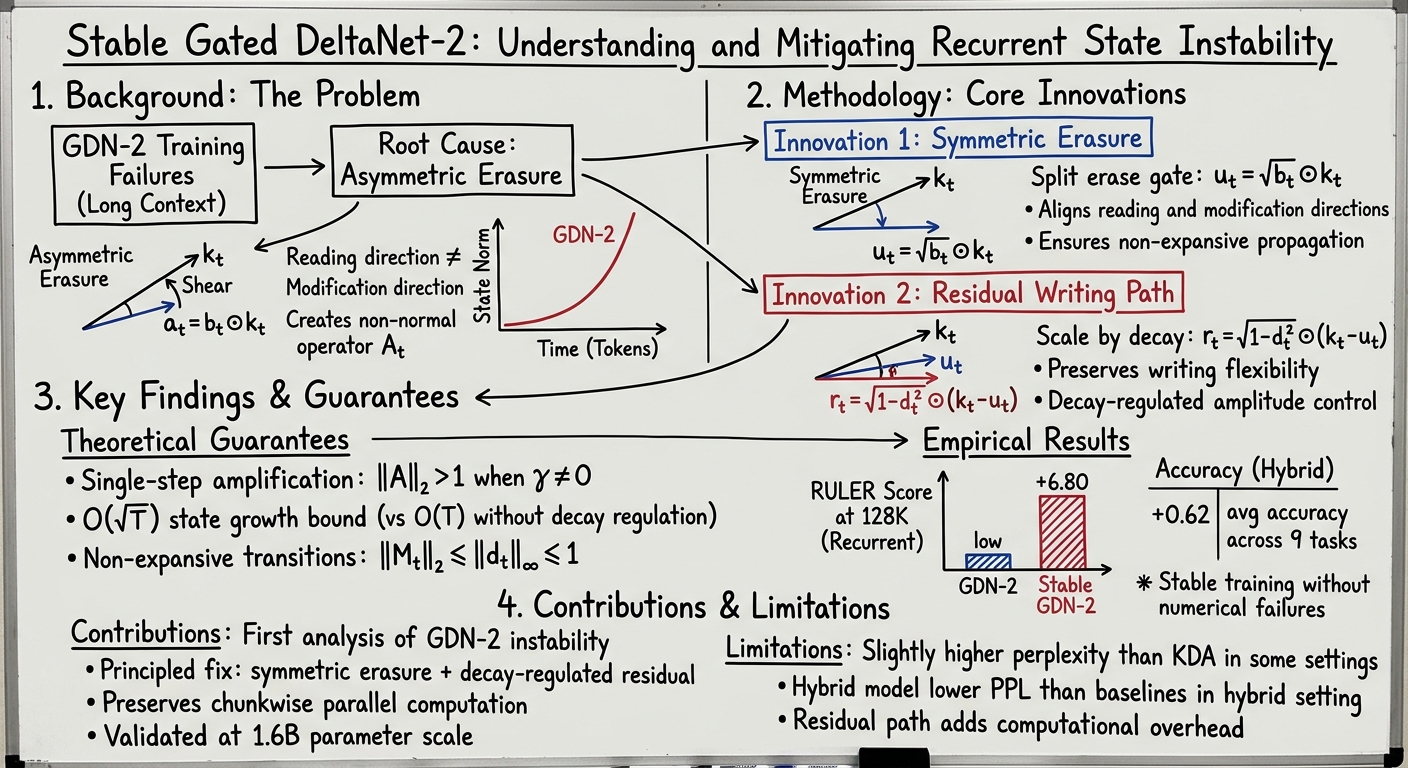
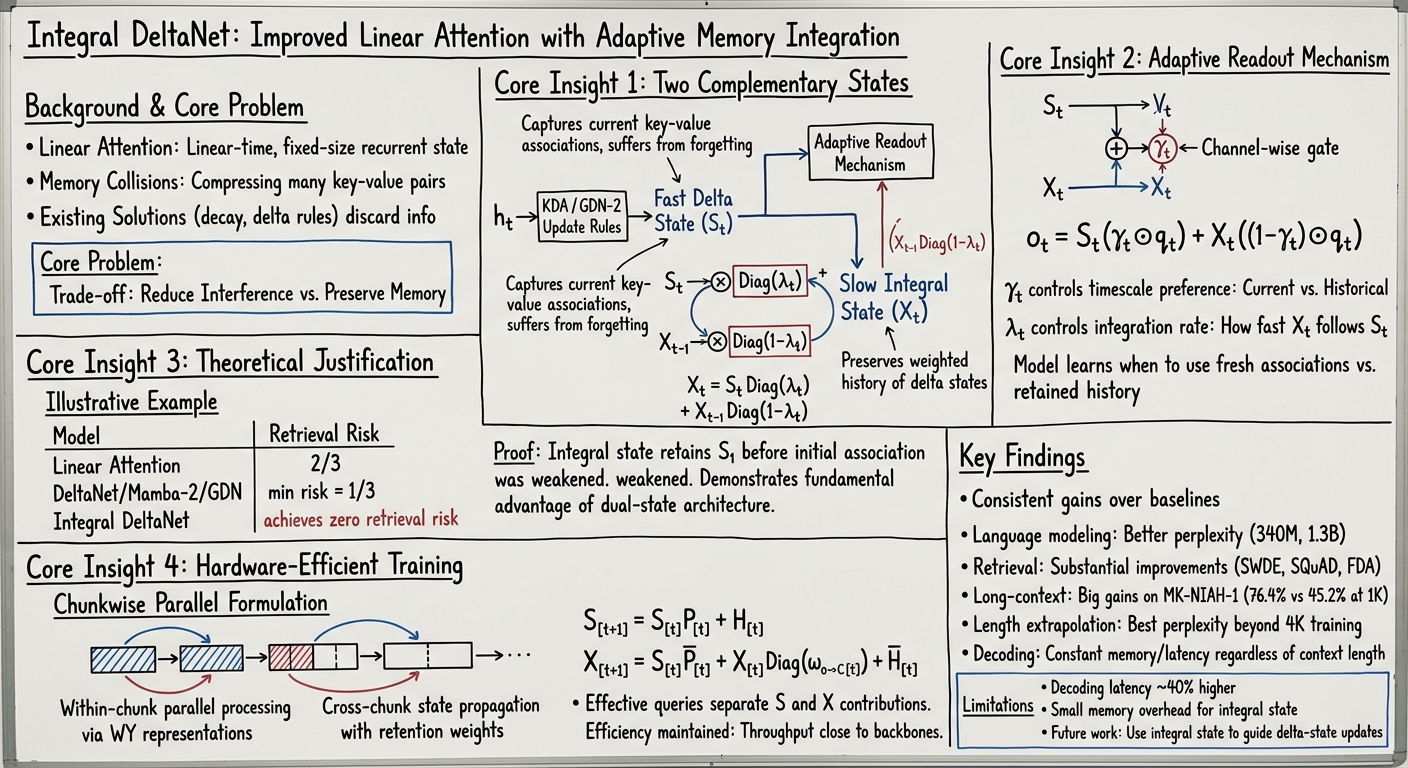
The most prominent signal this issue: the "training side" of efficient sequence modeling has become the new main battlefield—linear state stability, the gradient source of indexers, and the effectiveness of top-k selection itself, advancing on three fronts. Stable Gated DeltaNet-2 is the first to attribute GDN-2's training instability to the non-normal erasure operator (shear) caused by asymmetric coupling of the erasure gate and key: even if all eigenvalues have modulus ≤1, non-normal operators can still amplify state components along certain directions, and it provides a single-step spectral norm amplification theorem and a constructive counterexample of exponential growth without writes; accordingly, it proposes symmetric erasure (square-root gate decomposition) plus decay-adjusted residual writes, restoring non-expansive propagation and giving an O(√T) state norm upper bound while maintaining chunkwise parallelism—this is a mechanism-level convergence with Muir's sensitivity-gated rank allocation from Issue 13, advancing state explosion from empirical phenomenon to provable operator theory. Integral DeltaNet answers the same question from the other side: it splits fixed state memory into a dual-timescale structure of "fast delta state + slow integral state," adaptively mixing at the readout end with channel-wise gating, providing a constructive proof that single-state models cannot achieve zero retrieval risk, along with compute-matched comparisons at 340M/1.3B and degradation curves.
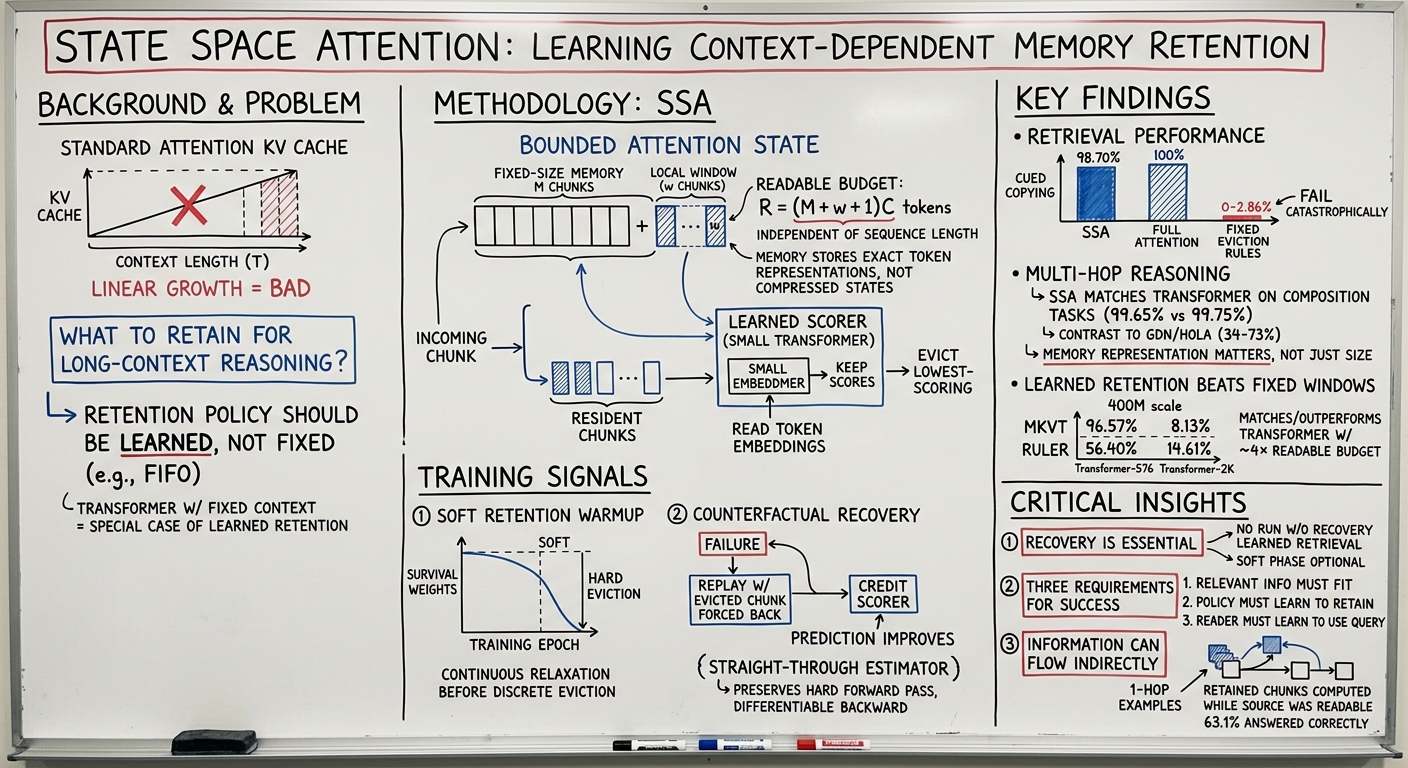
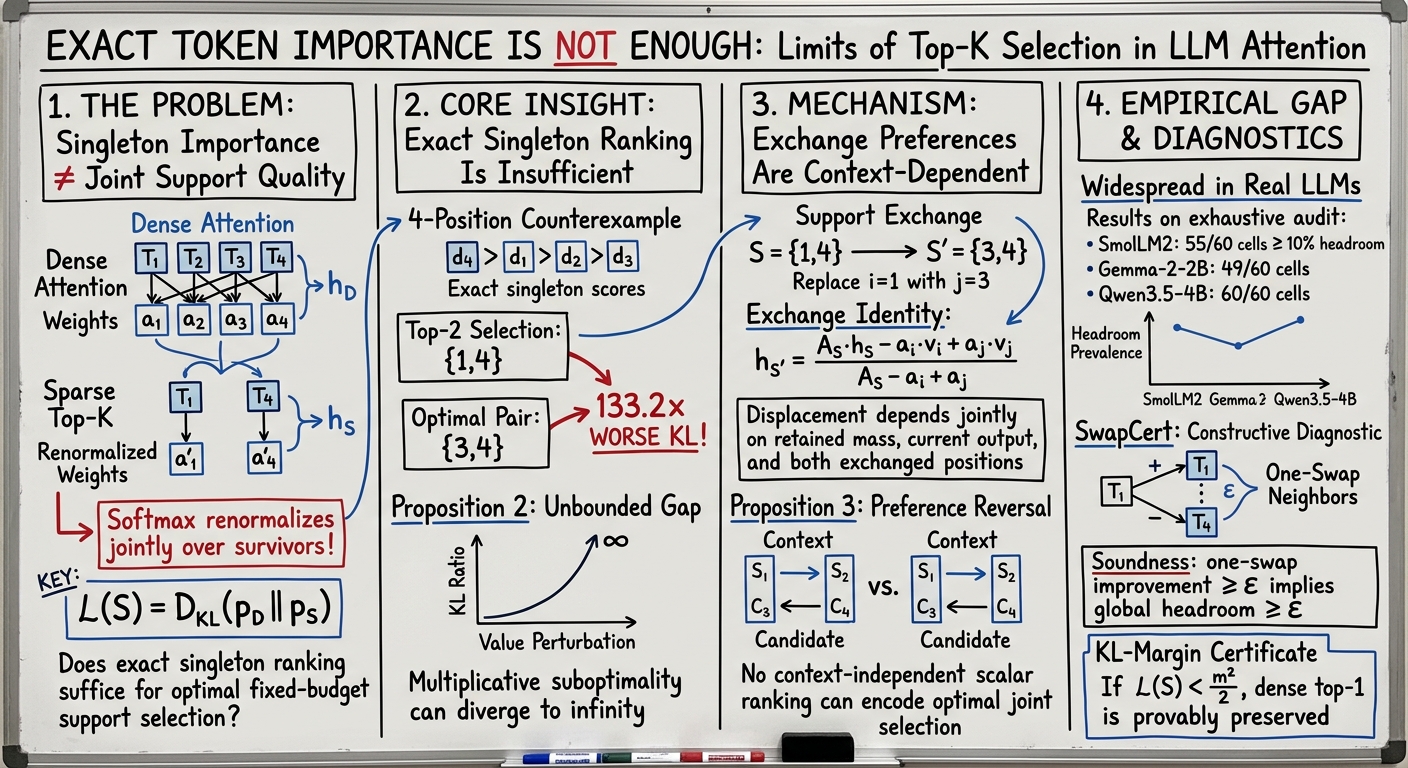
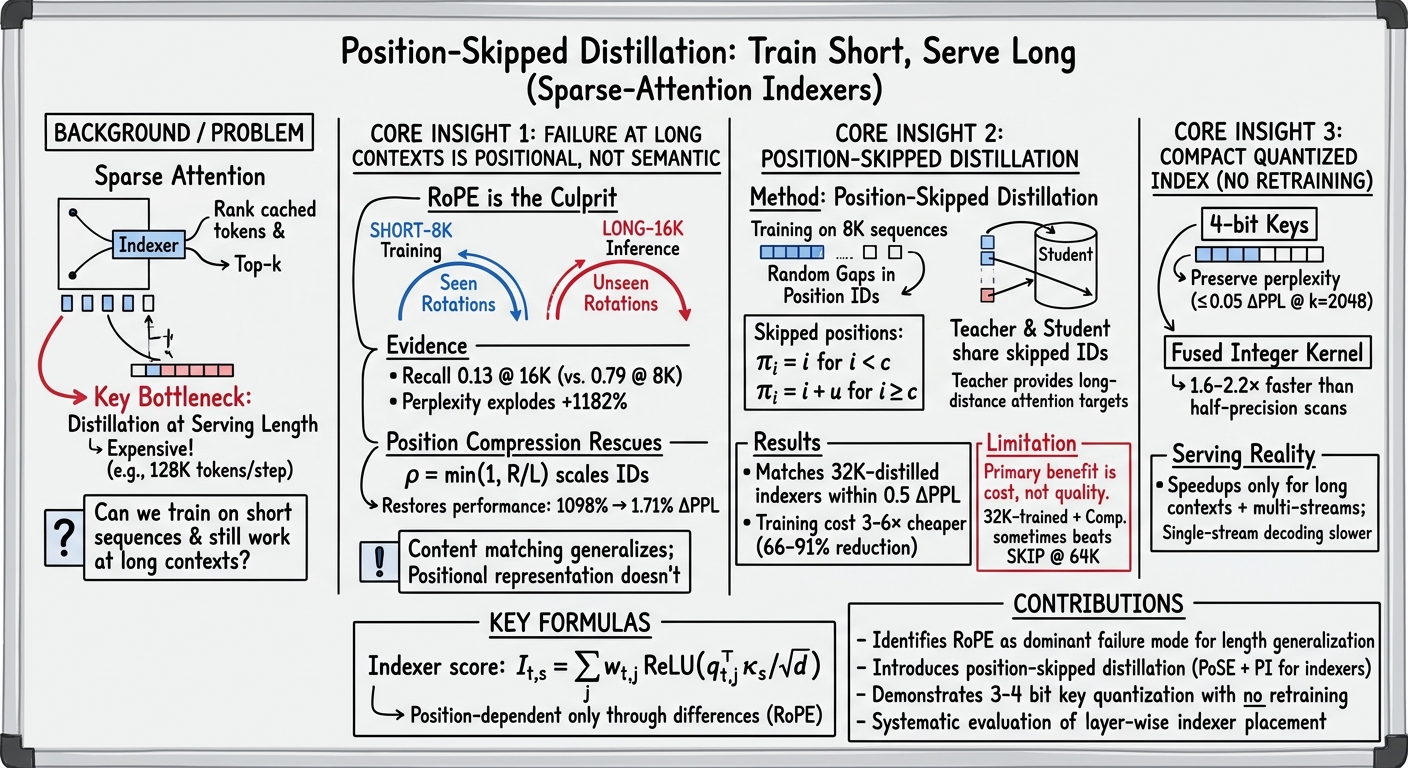
The "where does the gradient come from" for indexers also has substantial progress. State Space Attention is the first to advance the selection signal for trainable block-sparse indexers from local reconstruction/attention scores to counterfactual recovery: when an evicted block, if retained, could have corrected training errors, it directly grants survival credit and marginal loss to the selector, and proves that the soft-retention phase is a local first-order approximation of this counterfactual credit, with ablations at 400M scale showing "without recovery, retrieval learning completely fails." Position-Skipped Distillation provides a training-time recipe: it identifies RoPE rather than content matching as the main cause of indexer failure in short-to-long generalization, and uses short-sequence distillation with random position gaps so that both the indexer and teacher never need to handle contexts longer than the training length, matching the quality of direct distillation at 64K with 8K training on DeepSeek-V2-Lite/Qwen3/Llama-3.1. When Exact Token Importance Is Not Enough theoretically challenges the default paradigm of "per-token scoring + top-k" itself: even if scoring is exact and target-matching, independent top-k ranking is unreliable for joint renormalized support set selection, providing an unbounded approximation ratio theorem and the SwapCert single-swap audit—a direct warning to the closed-form scoring of Sparse Attention Is Matrix Approximation from Issue 12.
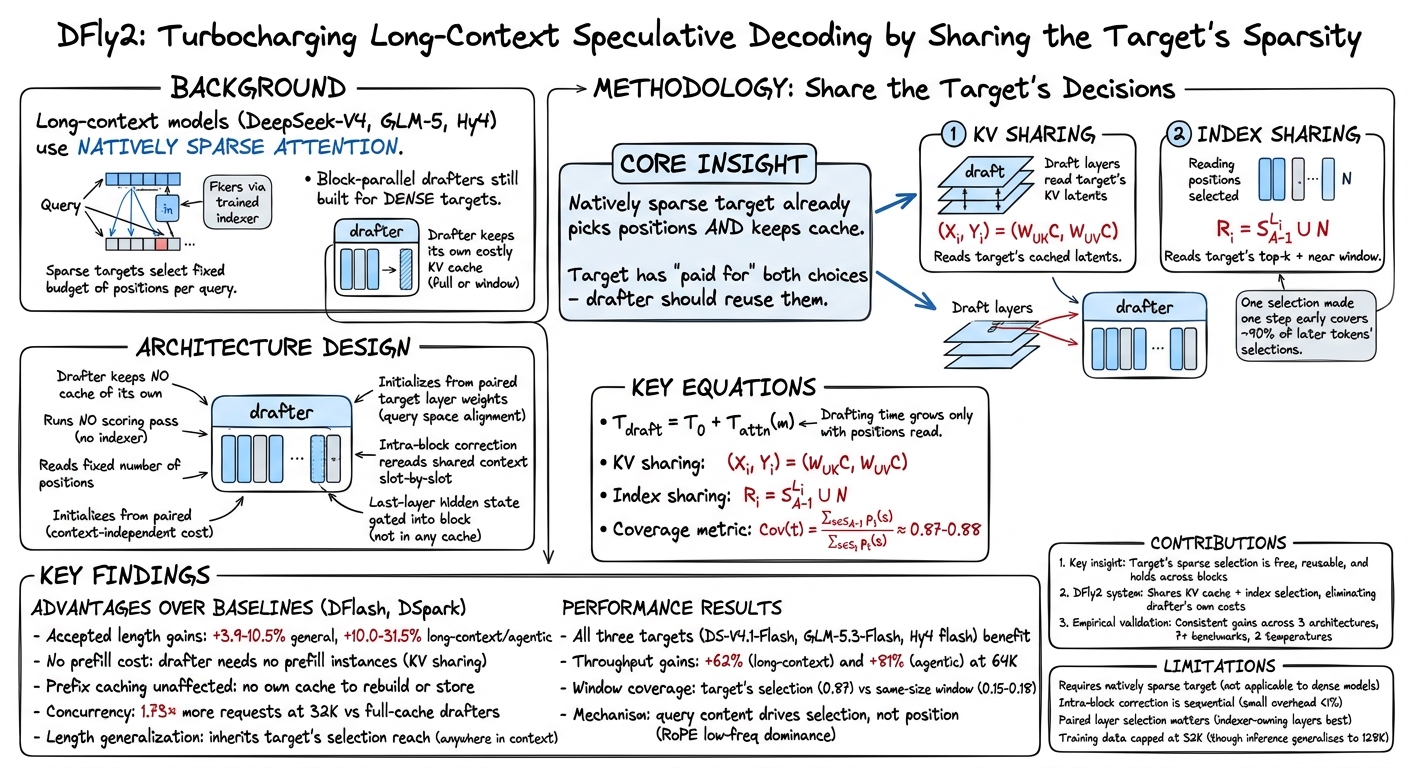
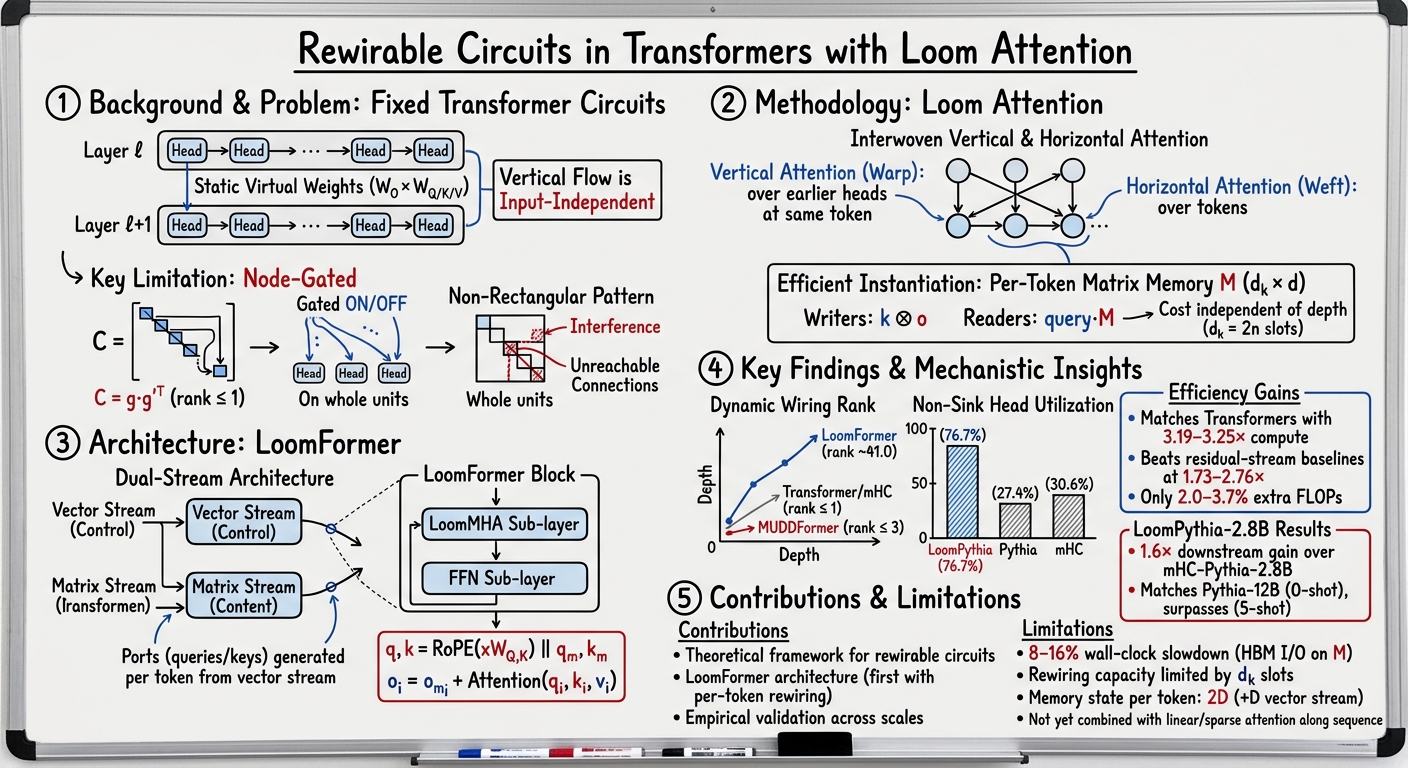
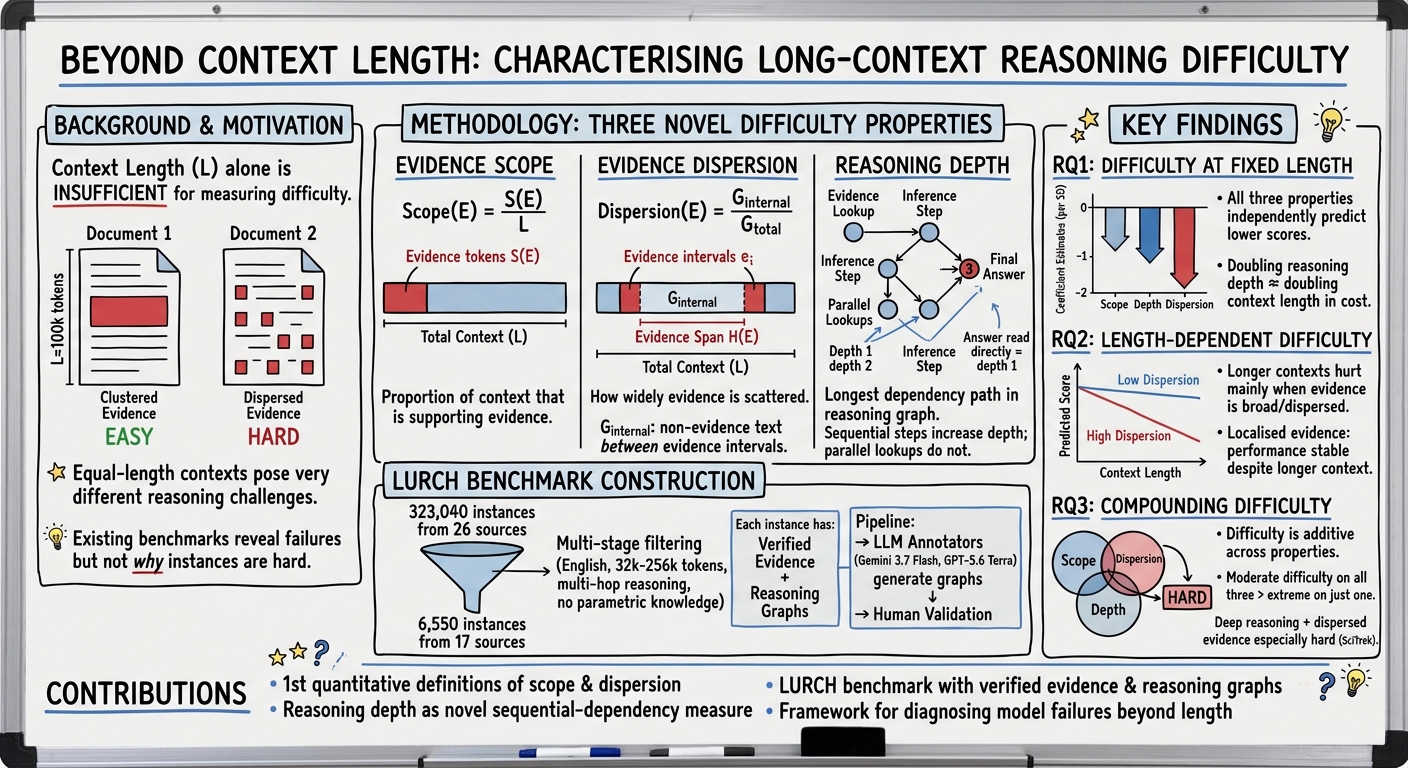
On the inference and evaluation sides, there are worthwhile increments. DFly2 is the first to advance the drafter's context source in speculative decoding to "directly reuse the target's sparse attention KV cache and indexer selections": the drafter does not keep its own KV, does not run a scoring pass, and each draft layer reads the paired target layer's latent and top-k positions, eliminating three types of costs (prefill/prefix-cache/concurrency), with end-to-end throughput evidence across three different sparse architectures (DS-V4.1-Flash/GLM-5.3-Flash/Hy4 flash)—a convergence with the two-stage verification of HybridSpec from Issue 14. Loom Attention is the first to advance cross-layer head combination in Transformers from fixed virtual weights to a per-token rewireable "warp-weft" structure, raising wiring rank from 1 to 2n, and providing a cover-free lower bound proof that node gating requires Θ(w) heads/readers. LURCH advances long-context reasoning difficulty from a single length axis to three quantifiable instance-level properties (evidence scope, evidence dispersion, reasoning depth), and provides interaction evidence that length is only significantly harmful when evidence is widespread or dispersed, directly supporting the evaluation design that "length is not the only difficulty."
Community and Updates
- Context rot: what long-context research says offers a practitioner's critique of evaluation validity in long-context research: it argues that context rot measurements are based on QA/synthetic retrieval rather than real agent sessions, questioning the validity of existing long-context benchmarks—consistent with this direction's focus on evaluation validity, but without new data or methods.
- State space models vs transformers, three years on summarizes the attention-linear layer ratios of frontier hybrid models (3:1, 9:1, 7:1, trailing attention), framing "quarter full attention" as the empirical cost of retrieval—valuable as a quick reference for inter-layer ratios in hybrid architectures, but it is an analytical review rather than a controlled experiment.
Open Questions
- Stable Gated DeltaNet-2's symmetric erasure fix is only validated up to 1.6B—does the stability fix for non-normal erasure operators still hold at larger scales? Is it complementary or conflicting with Muir's sensitivity-gated rank allocation from Issue 13?
- Can the counterfactual recovery signal of State Space Attention be combined with the blind-head repair of Lost in a Few Heads from Issue 15 into a "diagnose-then-train" closed loop? Is its 6× Transformer training overhead in the hard phase acceptable at larger scales?
- When Exact Token Importance Is Not Enough proves that independent top-k is unreliable for joint support sets—does this mean that trainable indexers (e.g., AttentionIndex's causal IVF from Issue 14) with joint selection mechanisms naturally avoid this problem, or are they equally affected?
- DFly2 has the drafter fully share the target's sparsity—when the target's sparsity itself is suboptimal (e.g., errors from blind heads), does sharing amplify the errors?
Papers in this issue
Stable GDN-2 fixes Gated DeltaNet-2's training instability from non-normal erase operators via symmetric erasure and decay-regulated residual writing, boosting 128K RULER scores by 6.80 points.
Editor's noteFirst attributes GDN-2 training instability to the non-normal erasure operator (shear) caused by asymmetric coupling of the erasure gate and key, providing a single-step spectral norm amplification theorem and a constructive counterexample of exponential growth without writes; accordingly, proposes symmetric erasure (square-root gate decomposition) plus decay-adjusted residual writes, restoring non-expansive propagation and giving an O(√T) state norm upper bound while maintaining chunkwise parallelism. Relative to Muir's sensitivity-gated rank allocation from Issue 13, the increment is advancing state explosion from empirical phenomenon to non-normal operator theory and providing a provable stability fix; with 64K pretraining and 128K RULER degradation curves. Must-read for those working on GDN/KDA-type delta-rule hybrid linear attention; limitations: evaluation only up to 1.6B, RULER absolute scores still low (128K average 11.62), no compute-matched comparison with full attention.
State Space Attention matches full-attention retrieval and multi-hop reasoning with constant memory by learning which tokens to retain, not how to compress them.
Editor's noteFirst advances the selection signal for trainable block-sparse indexers from local reconstruction/attention scores to counterfactual recovery: when an evicted block, if retained, could have corrected training errors, it directly grants survival credit and marginal loss to the selector, and proves that the soft-retention phase is a local first-order approximation of this counterfactual credit. Relative to the no-op gate diagnosis of The Gating Mechanism of KV Cache Eviction from Issue 13 and the blind-head repair of Lost in a Few Heads from Issue 15, the increment is providing an end-to-end trainable selector training recipe from scratch, with ablations at 400M scale showing 'without recovery, retrieval learning completely fails.' Those working on trainable block-sparse indexers or learned eviction should read; limitations: evaluation mainly on RULER, no agentic benchmarks, 400M single seed, and high training overhead (6× Transformer in hard phase).
Integral DeltaNet pairs a fast delta state with a slow integral state to overcome the memory-retention trade-off that limits single-state linear attention models.
Editor's noteFirst advances the fixed state memory of linear attention/DeltaNet from a single fast state to a dual-timescale complementary structure of 'fast delta state + slow integral state,' adaptively mixing at the readout end with channel-wise gating, providing a constructive proof that single-state models cannot achieve zero retrieval risk, and deriving a chunkwise parallel form supporting hardware-efficient training. Relative to Muir's sensitivity gating from Issue 13 and Multi-State Linear Attention's segment-level second-moment routing from Issue 12, the increment is establishing 'multi-timescale states + readout-end gated mixing' as a new architectural axis, with compute-matched comparisons at 340M/1.3B and NIAH/LongBench/extrapolation degradation curves. Those working on KDA/GDN-2-type gated delta linear attention should read; limitations: scale only up to 1.3B, no compute-matched comparison with full attention, and noticeable decoding latency increase (Integral KDA 4.63ms vs KDA 3.34ms).
DFly2 shares a natively sparse target's KV cache and attention selection with its drafter, boosting speculative decoding speedups by up to 31.5% on long-context workloads.
Editor's noteFirst advances the drafter's context source in speculative decoding from 'self-built KV cache + fixed window/full read' to 'directly reuse the target's sparse attention KV cache and indexer selections': the drafter does not keep its own KV, does not run a scoring pass, and each draft layer reads the paired target layer's latent and top-k positions, with last-layer hidden injection and intra-block correction. Relative to HybridSpec's two-stage verification from Issue 14 and Multi-layer Indexer's scheduling-level overlap from Issue 15, the increment is letting the drafter fully share the target's sparsity (KV and index), eliminating three types of costs (prefill/prefix-cache/concurrency), with end-to-end throughput evidence across three different sparse architectures (DS-V4.1-Flash/GLM-5.3-Flash/Hy4 flash). Those working on speculative decoding and sparse attention inference should read; limitations: no compute-matched comparison with full attention, long-context evaluation mainly on accepted length and throughput rather than retrieval accuracy.
Even exact per-token importance scores fail: softmax renormalization makes Top-K selection arbitrarily suboptimal, with unbounded KL loss gaps already at K=2.
Editor's noteFirst proves under the strongest assumption of 'exact single-point importance' that independent top-k ranking is unreliable for joint renormalized support set selection: provides a four-position construction (133.2× loss ratio) and an unbounded approximation ratio theorem, and proves preference reversal holds for any K≥2. Relative to the closed-form scoring of Sparse Attention Is Matrix Approximation from Issue 12 and the no-op gate diagnosis of The Gating Mechanism of KV Cache Eviction from Issue 13, the increment is advancing the failure attribution from scoring criteria to 'joint support quality' as an independent analysis object, and providing a verifiable SwapCert single-swap audit. Those working on trainable block-sparse indexers or KV eviction selection criteria should read; limitations: small-scale experiments (mainly M=24, K=4), no compute-matched comparison with full attention, long-context evaluation only up to 2K.
LoomFormer's loom attention interweaves vertical and horizontal attention over a per-token matrix memory, making transformer circuits rewirable per token and matching models trained with over 3x more compute.
Editor's noteFirst advances cross-layer head combination in Transformers from fixed virtual weights + rank-1 node gating to a per-token rewireable 'warp-weft' structure: vertical linear attention and horizontal token attention interleave, allowing each head to per-token select which early heads to read and which slots to write, raising wiring rank from 1 to min(d_k, 3n)=2n, and providing a cover-free lower bound proof that node gating requires Θ(w) heads/readers. Relative to Multi-layer Indexer's scheduling-level overlap from Issue 15 and AttentionIndex's indexer acceleration from Issue 14, the increment is treating 'cross-layer combination itself' as a trainable dynamic object rather than fixed weights or shared index. Those working on hybrid architecture inter-layer ratios or trainable block-sparse indexers should read; limitations: evaluation mainly on Pile perplexity and 10 downstream tasks, no long-context degradation curves or agentic benchmarks.
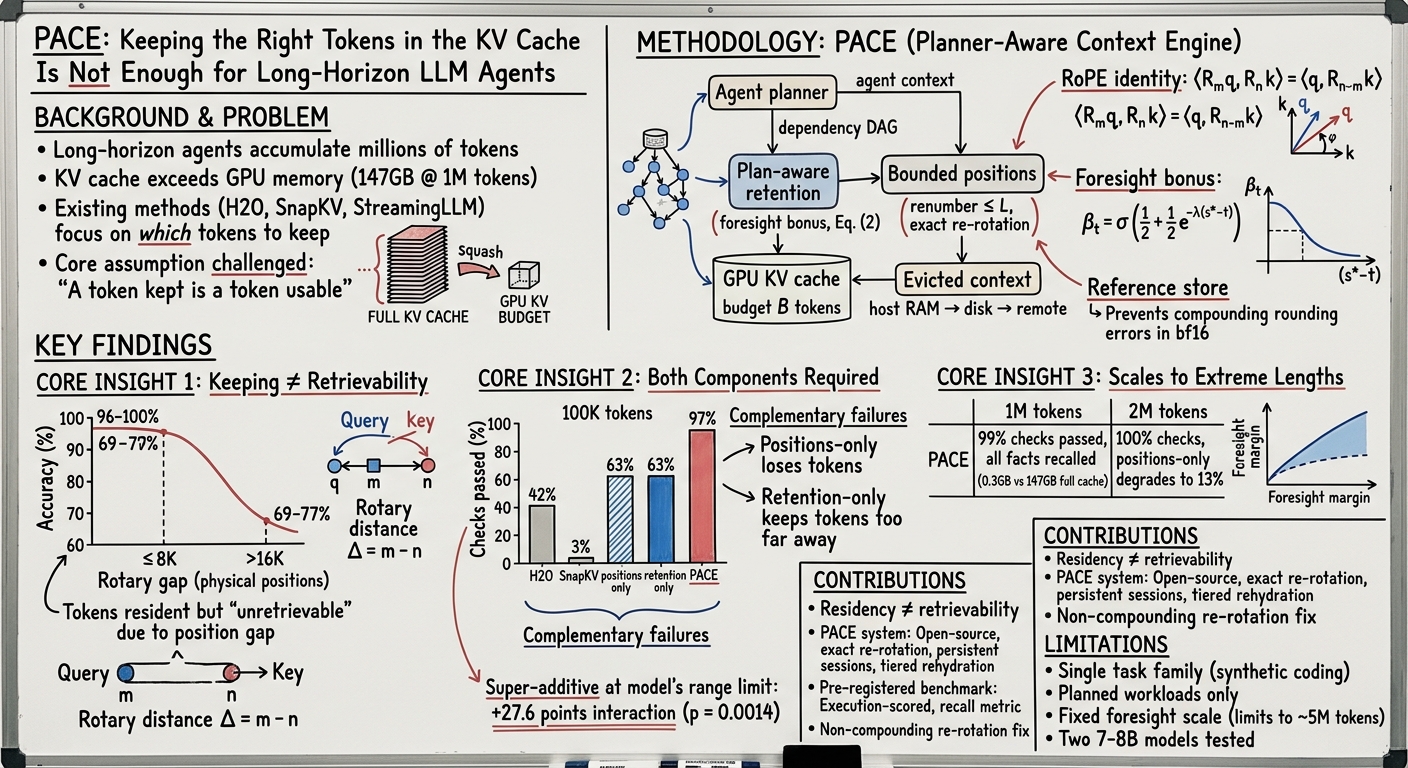
PACE shows that keeping the right tokens in a KV cache is insufficient for long-horizon agents; renumbering positions to bound rotary distance is equally critical, lifting accuracy from 42% to 97%.
Editor's noteFirst advances the failure of long-context KV eviction from 'which tokens to retain' to 'the rotary position distance of retained tokens': proves accuracy decays with rotary gap when residency≈1, and proposes bounded positions (exact re-rotation and renumbering) as a new design axis orthogonal to retention strategies. Relative to the scoring-layer depth axis of Who Should Score the Cache from Issue 15 and the attention competition attribution of Length Is Cheap from Issue 13, the increment is providing 'position distance' as an independent failure mechanism from retention quality, with a plan-aware retention engineering system. Those working on KV eviction or block-sparse indexers should read; limitations: evaluation on synthetic coding sessions, no full-attention compute-matched comparison, plan-aware relies on oracle planner.
Position-skipped distillation trains sparse-attention indexers on short sequences with position-ID gaps, matching 32K-distilled quality at 3–6× lower training cost.
Editor's noteFirst identifies RoPE rather than content matching as the main cause of indexer failure in short-to-long generalization, and proposes position-skipped distillation: both the indexer and frozen teacher only see short sequences with random position gaps, avoiding long-context dense attention during training. Relative to Recursive Sparse Attention's logarithmic selection cost from Issue 13 and HyScale's selection system optimization from Issue 12, the increment is a training-time recipe that decouples training length from serving length, matching the quality of direct distillation at 64K with 8K training on DeepSeek-V2-Lite/Qwen3/Llama-3.1, with compute-matched evidence. Those working on long-context generalization of trainable block-sparse indexers should read; limitations: gains are modest on Llama-3.1, early layers need to remain dense.
Long-context reasoning difficulty depends on evidence scope, dispersion, and reasoning depth, not just context length, with these properties compounding to predict model performance.
Editor's noteFirst advances long-context reasoning difficulty from a single length axis to three quantifiable instance-level properties (evidence scope, evidence dispersion, reasoning depth), and provides effect sizes comparable to length and interaction evidence: length increase is only significantly harmful when evidence is widespread or dispersed, and difficulty compounds across properties. Relative to LEAPS' capability-axis profiling from Issue 11 and ATLAS's length-capability dual axis from Issue 3, the increment is providing computable evidence geometry and reasoning graph depth definitions, and systematically separating length from property effects. Those working on long-context evaluation validity should read; limitations: observational analysis, property annotation relies on automatic labeling (depth consistency only 65.6%), not linked to compute-matched comparisons with efficient attention architectures.
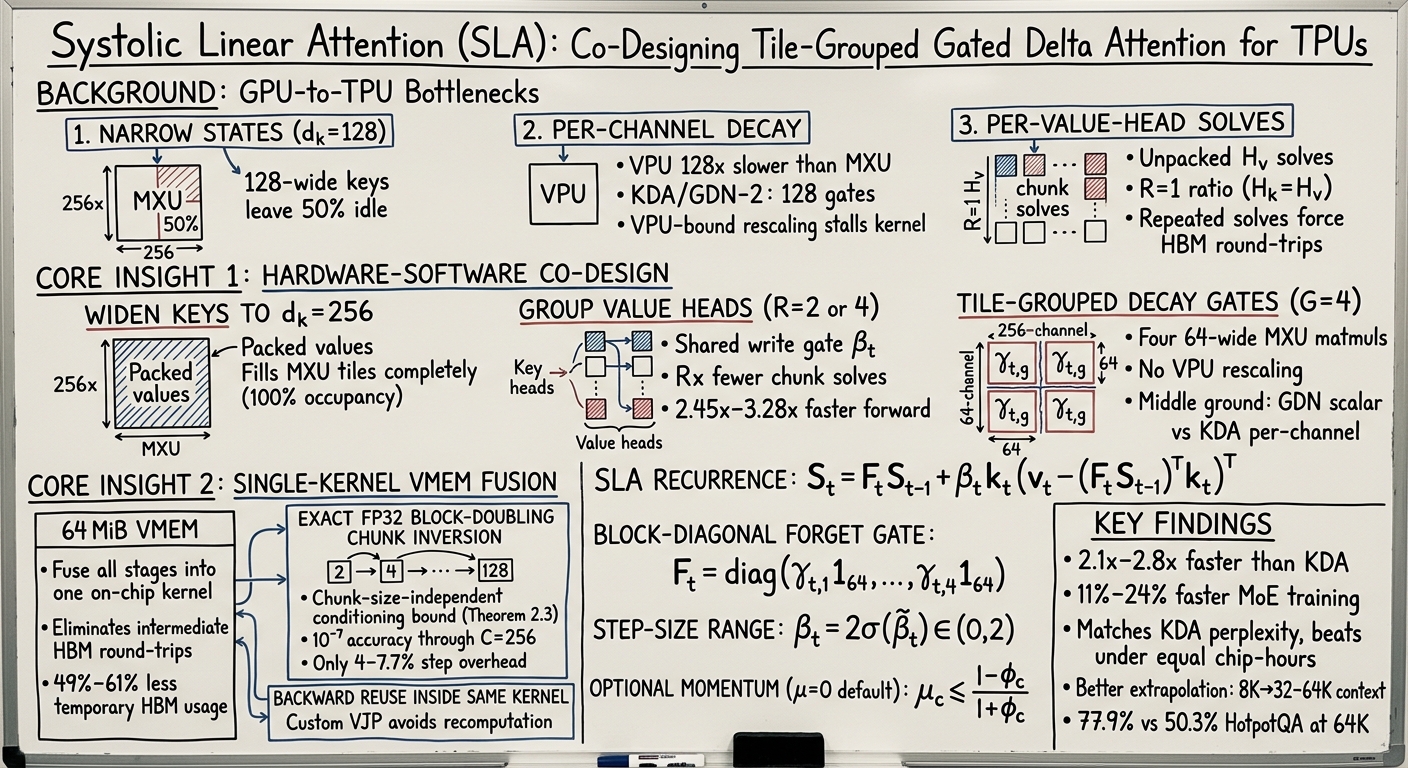
Systolic Linear Attention reshapes gated delta attention around TPU systolic arrays, achieving 2.1x-2.6x speedup over KDA with 49%-61% less HBM while matching perplexity.
Editor's noteFirst advances the design of gated delta linear attention from GPU-oriented to TPU systolic array-oriented: key width expanded to 256 and sharing a scalar write gate β_t across R value heads, reducing chunk solves by R times; decay gates grouped into 4 blocks of 64 channels to eliminate VPU sub-block rescaling; and provides a condition number certificate independent of chunk size. Relative to Toaster's cascaded linear memory from Issue 15 and Muir's sensitivity gating from Issue 13, the increment is first using the hardware systolic array's tile shape as a design axis for gated delta architectures, with compute-matched pretraining comparisons at 6.5B–63.1B MoE and 8K→64K extrapolation curves. Those working on GDN/KDA-type hybrid linear attention should read; limitations: only for TPU hardware, no agentic benchmarks, long-context evaluation mainly on HotpotQA.