Theorizing Block-Sparse Selectors and Knowledge Transfer in Hybrid Architectures
Highlights
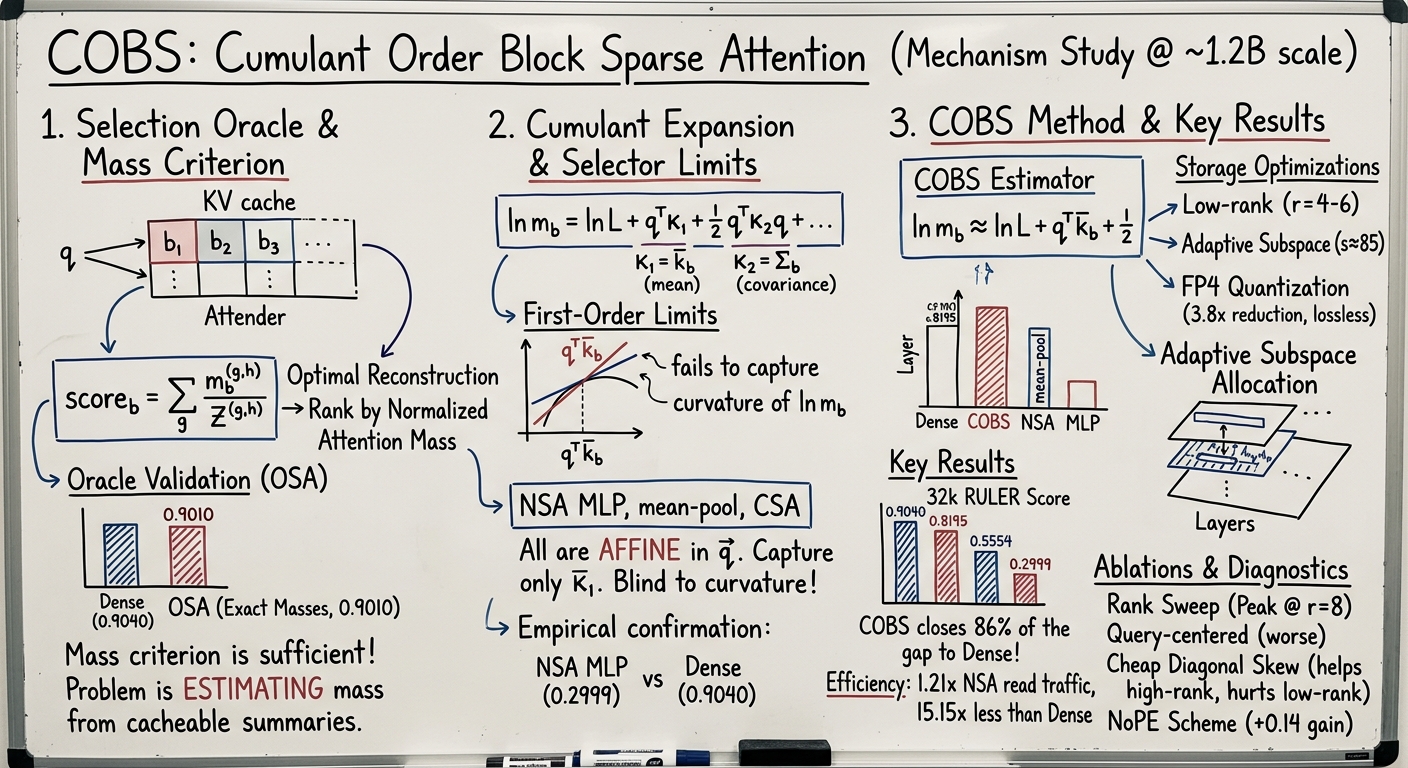
This issue's efficient sequence modeling research elevates the 'selector quality' from an engineering problem to a provable theoretical one. COBS uses cumulant expansion to reduce block-sparse selection to ranking by attention mass, and proves that existing first-order selectors like NSA/Quest have a curvature blind spot due to discarding intra-block covariance. It proposes estimating attention mass using compressed second-order statistics per block (low-rank covariance + subspace projection + FP4 quantization), improving the NSA baseline from 0.2999 to 0.8195 on 32k RULER, approaching dense attention's 0.9040, with only 1.21× KV read traffic. This is a theoretical advancement of the concern about 'aligning with the main attention distribution' for block-sparse indexers: the selector no longer only aligns first-order moments but explicitly carries second-order curvature information within blocks.
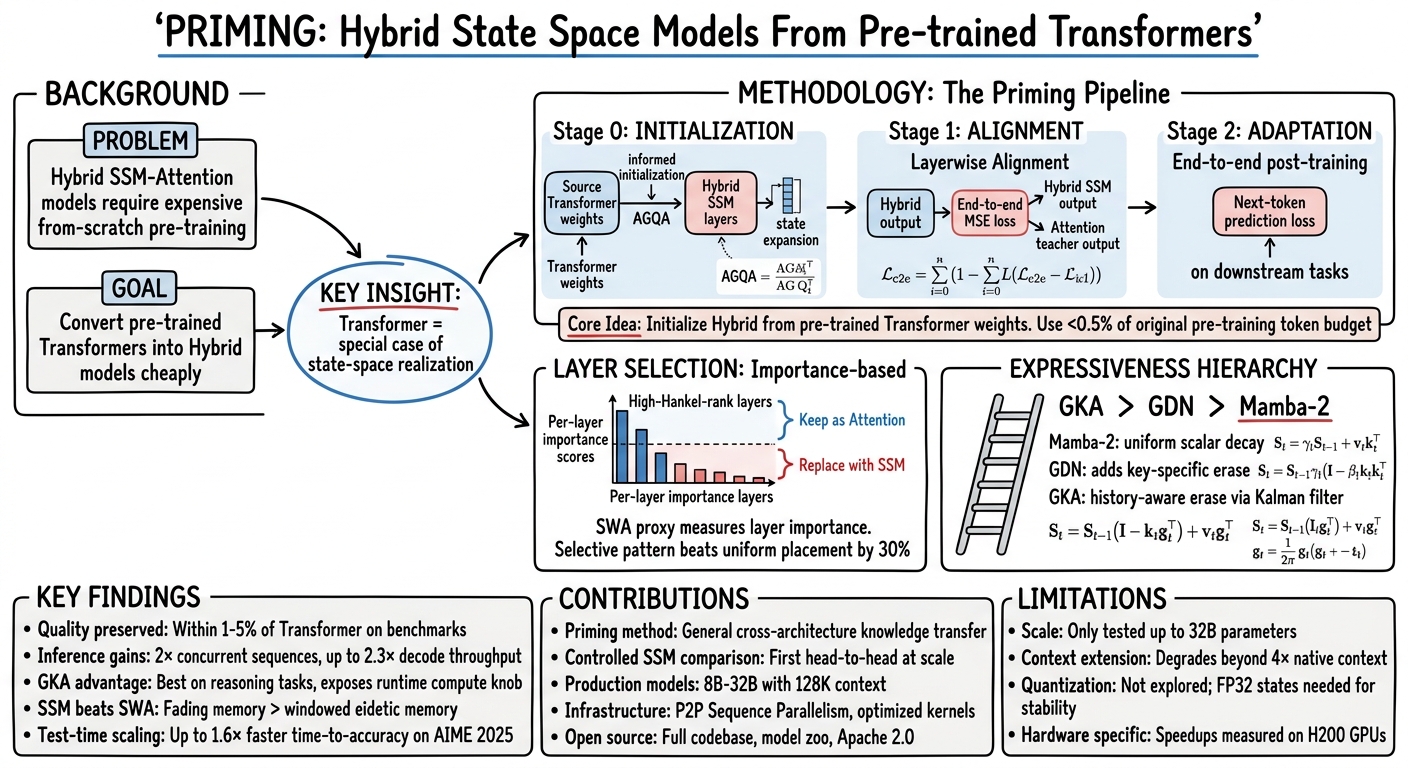
The second line is hybrid architecture design shifting from a 'pretraining problem' to a 'knowledge transfer problem'. Priming initializes a pretrained Transformer into a hybrid SSM-attention model via layer selection, weight transfer, and short alignment, using less than 0.5% of the source model's pretraining budget, thus enabling the first controlled comparison of GKA/GDN/Mamba-2 under identical conditions, and proving that compressed decaying memory is more useful than a 4× larger sliding window. This provides a previously missing controlled experimental platform for the layer-mixing ratio axis and brings the question of 'what drives the mixing ratio' to the forefront.
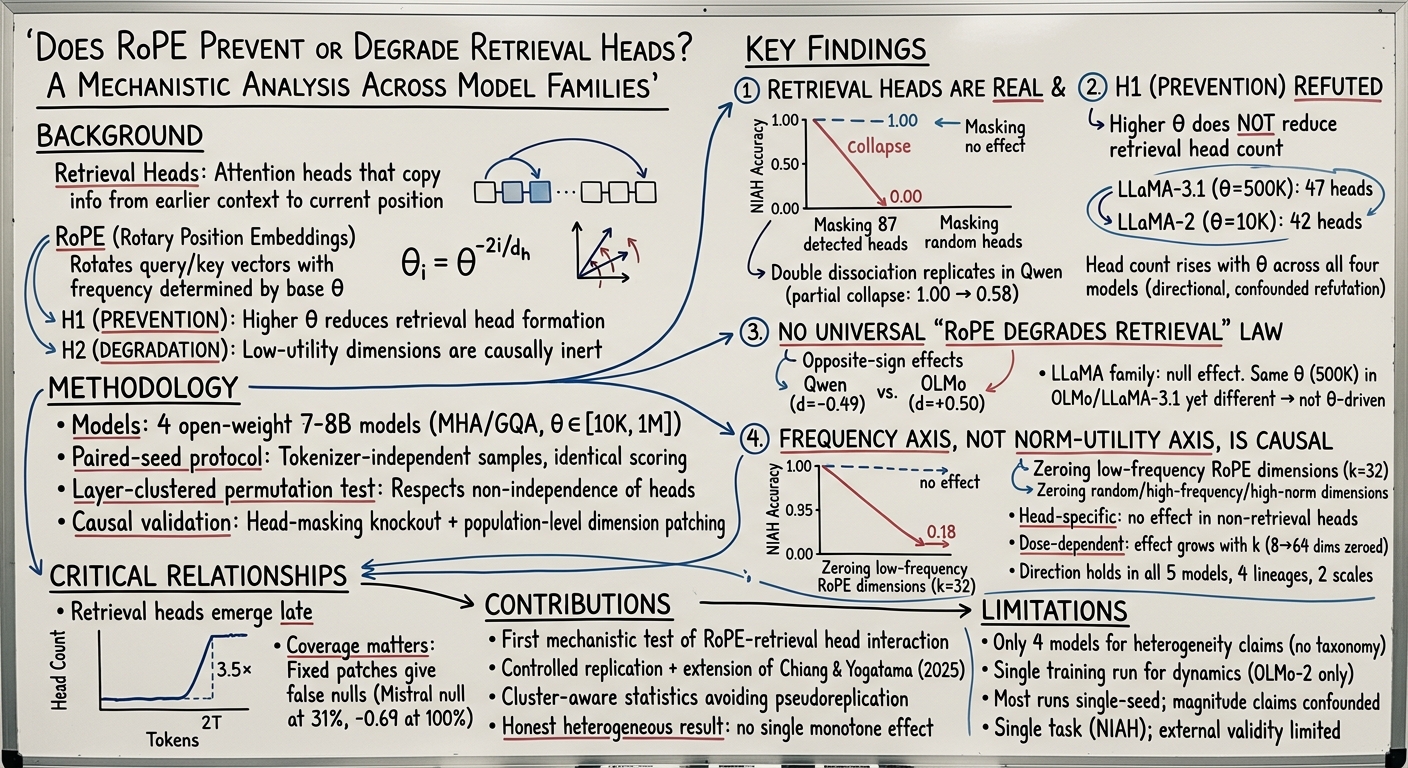
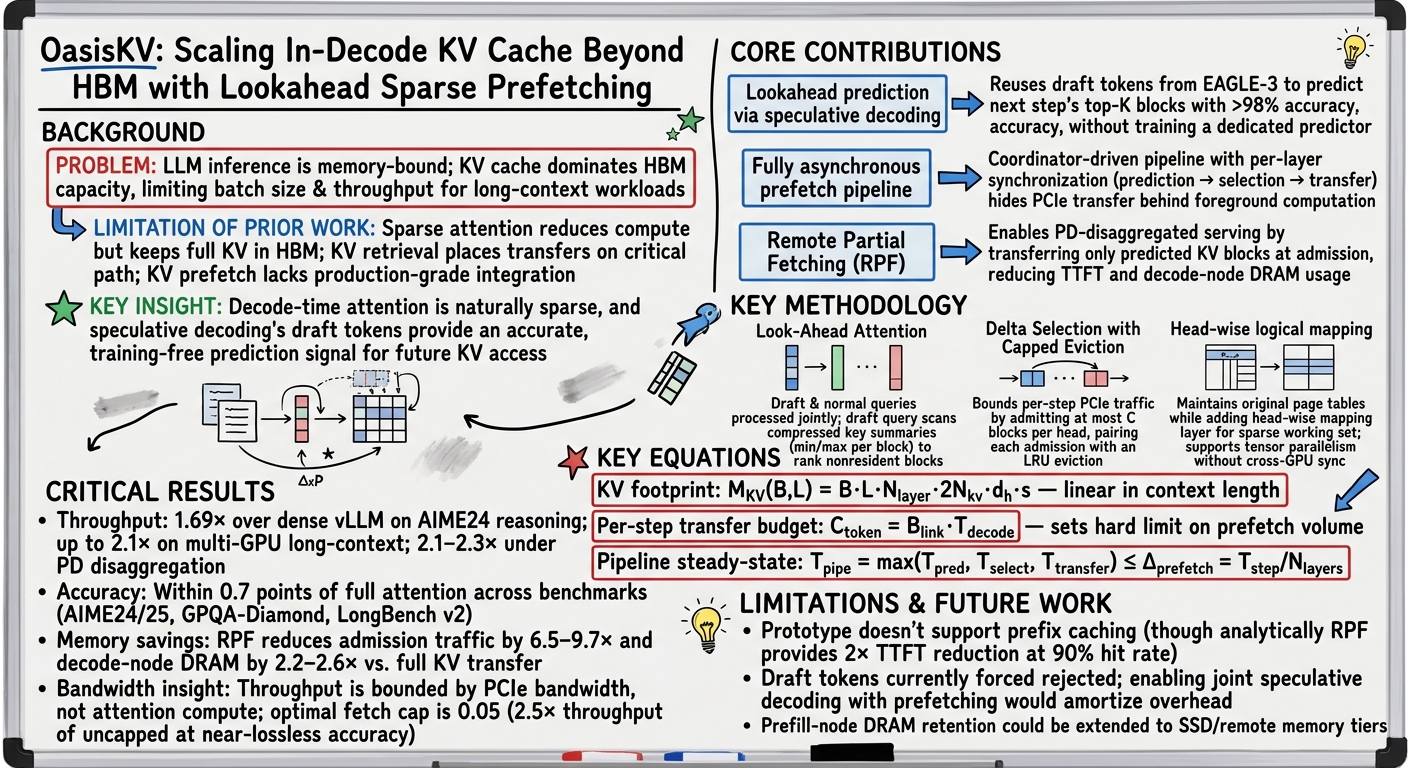
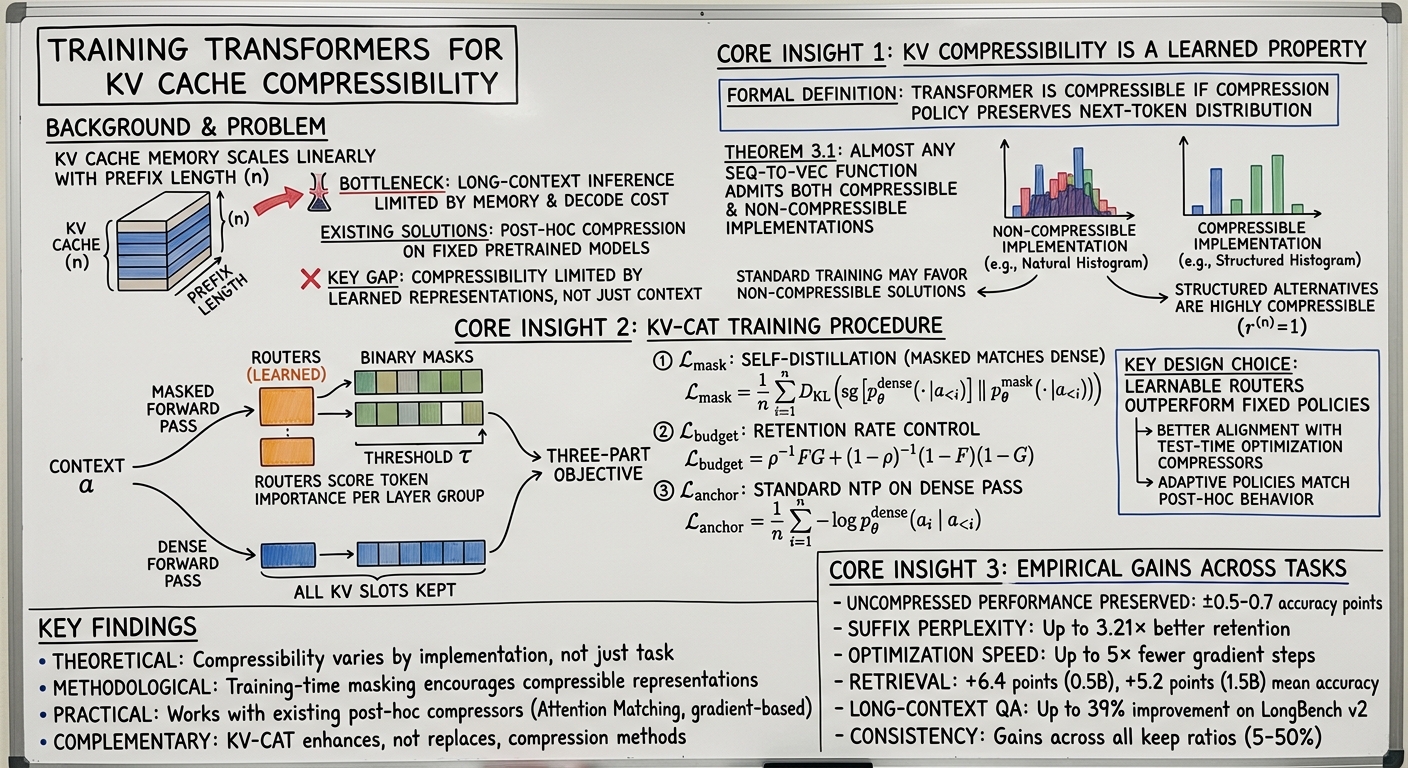
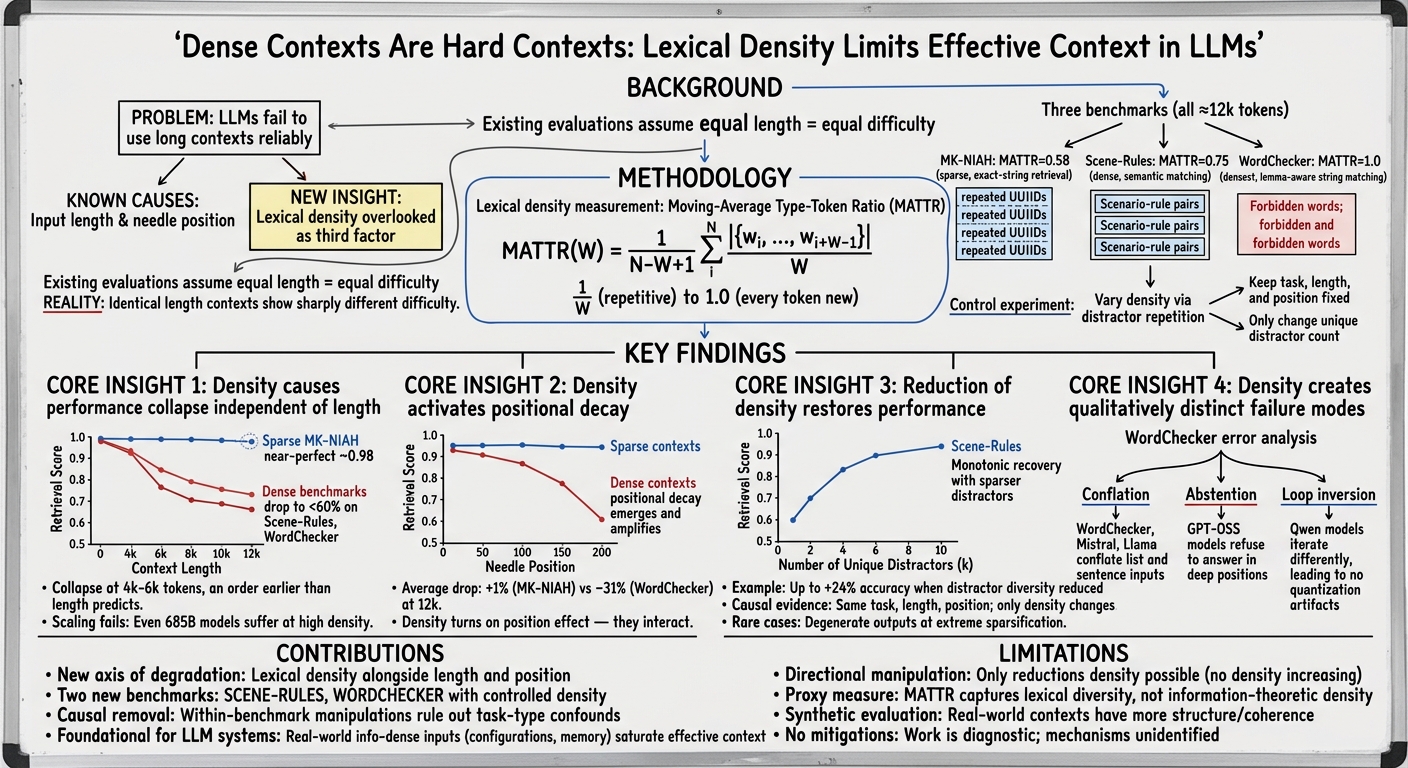
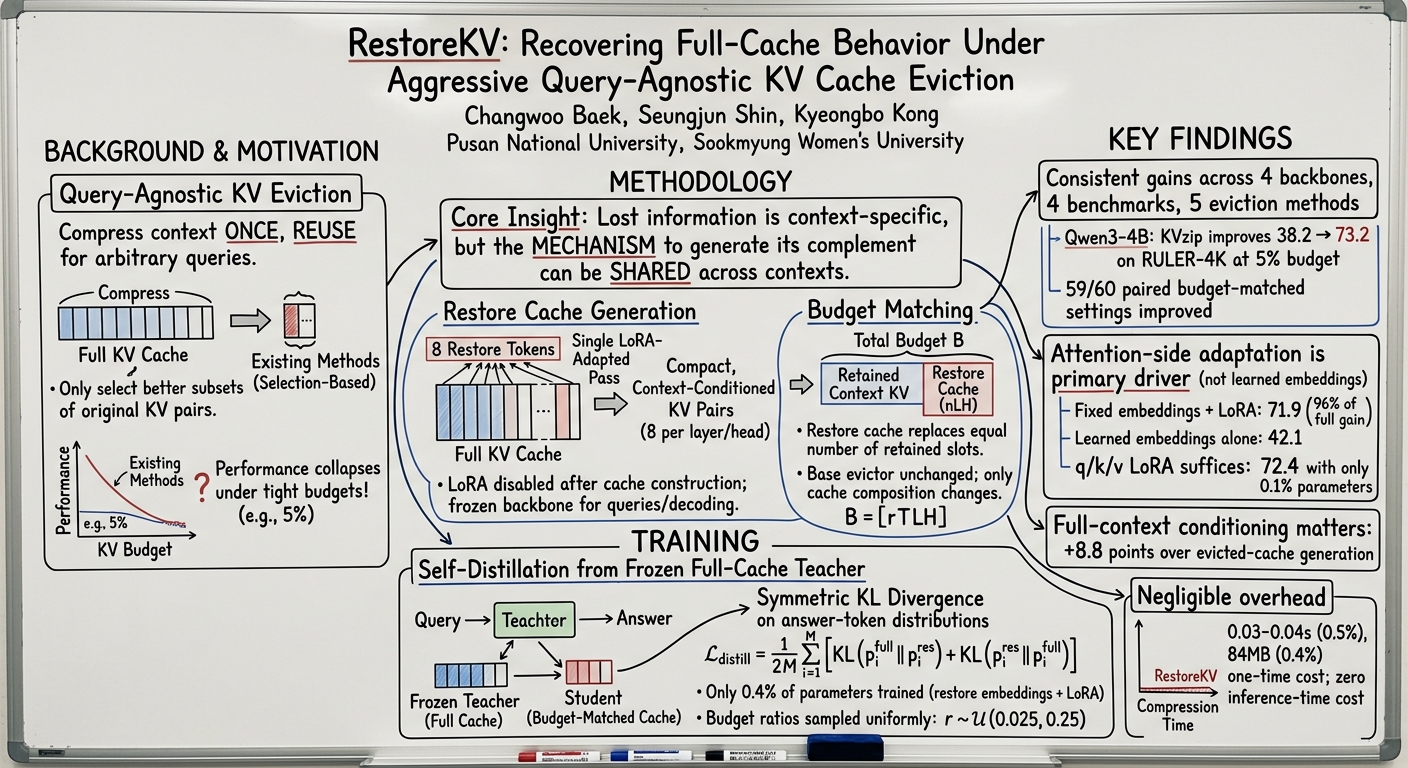
The third line is the re-expansion of mechanistic negative results and evaluation validity. Does RoPE Prevent or Degrade Retrieval Heads uses paired seed protocols and layer-clustering permutation tests to disprove the hypothesis that 'RoPE prevents retrieval head formation', and localizes the causal variable to the frequency axis rather than the norm utility axis. Dense Contexts Are Hard Contexts identifies lexical density as a third degradation axis independent of length and position, and warns that compression methods may increase density while reducing tokens, harming reliability. On the system side, OasisKV reuses speculative decoding draft tokens as a training-free lookahead signal for KV prefetching, KV-CAT makes compressibility a trainable attribute, and RestoreKV uses learned restoration caches to complement query-agnostic eviction.
Community and Dynamics
On the hybrid architecture design axis, Qwen3.8 architecture analysis proposes that the optimal mixing ratio should be driven by recall performance rather than perplexity, linking Qwen3.8's 3:1 Gated DeltaNet-full attention ratio to system analysis—this complements Priming's controlled SSM comparison but remains a hypothesis awaiting empirical validation. Let's Stop Calling Everything 'Linear Attention' proposes more precise terms such as prefill-linear, decode-constant, state-constant, and hybrid-linear, pointing out that the term 'linear' obscures three independently variable dimensions: capacity, traffic, and computation, providing a clearer coordinate system for hybrid architecture design.
On the evaluation validity side, Your Perplexity Can't See the Retrieval Cliff criticizes global proxies like perplexity and average attention MSE for failing to detect functional retrieval cliffs in sparse/local window attention at the tail, advocating for functional evaluation over averages. The community-run Beyond 272K provides real degradation and latency curves for Codex from 200K to 899K, explicitly stating its confidence intervals and limitations of synthetic tasks, serving as a counterexample to the '272K cliff' claim. Additionally, thunlp/rethinking-hybrid-attention released the official code for the 'lazy large window' paper, enabling reproduction of retrieval head formation delays and NoPE-on-full-attention designs.
Open Questions
- Does COBS's second-order selector maintain the specificity of retrieval heads across layers when sharing indices across layers (e.g., the reuse axis in You Only Index Once and LongCat)? Can the second-order statistic of within-block covariance be safely reused across layers like first-order top-k, or will it repeat the 'lazy large window' retrieval head formation delay?
- Priming proves that the SSM expressiveness hierarchy (GKA>GDN>Mamba-2) directly translates to downstream performance, but does this hold when the mixing ratio is pushed to extremes? Can the hypothesis from Qwen3.8 analysis that 'mixing ratio is driven by recall' be validated under compute-matched controlled comparisons?
- Are the RoPE frequency axis and the 'lazy large window' window axis two independent optimization priors, or do they interact? Is there a separable or additive causal path between the low-frequency channels reshaped by base-scaling and the delay in retrieval head formation caused by local windows?
- Lexical density as a third degradation axis poses a direct threat to KV compression methods—does compression, by reducing tokens while increasing density, invalidate 'lossless' conclusions on density-sensitive tasks? Should the density axis be included in the evaluation protocol for compression methods?
Papers in this issue
COBS stores compressed per-block key covariances to raise block sparse attention selection from first-order to second-order approximations, closing 86% of the gap to dense attention with minimal extra KV cache reads.
Editor's noteFirst to use cumulant expansion to prove that first-order block selectors (NSA MLP, Quest) have a curvature blind spot due to discarding within-block covariance, proposing to estimate attention mass using compressed second-order statistics per block (low-rank covariance + subspace projection + FP4), improving NSA baseline from 0.2999 to 0.8195 on 32k RULER, approaching dense 0.9040, with only 1.21× KV read traffic. Relative to [#1] MiniMax Sparse Attention's per-group block-level top-k, its increment is elevating the selector from first-order to second-order cumulants and providing a cacheable compression scheme; NoPE ablation and rank scans are also high-quality scientific records.
Priming initializes hybrid state-space models from pre-trained Transformers using less than 0.5% of the token budget, yielding faster, lighter models that outperform source Transformers on reasoning benchmarks.
Editor's noteTurns hybrid architecture design from a pretraining problem into a knowledge transfer problem—initializing a pretrained Transformer into a hybrid SSM using layer selection, weight initialization, and short alignment, with less than 0.5% of the source model's pretraining budget, thus enabling the first controlled comparison of GKA/GDN/Mamba-2 under the same conditions, and proving that compressed decaying memory is more useful than a 4× larger sliding window. It provides compute-matched comparisons at 8B/32B and degradation curves on HELMET/MRCR/BABILong, with GKA also offering a new design axis of solver iterations adjustable at serving time.
RoPE's frequency axis, not dimension utility, is causally load-bearing for retrieval heads, with zeroing low-frequency dimensions collapsing recall across all model families tested.
Editor's noteUsing paired seed protocols, layer clustering permutation tests, and causal head masking, it mechanistically tests whether RoPE base frequency prevents or weakens retrieval head formation: the prevention hypothesis is rejected, utility-retrieval associations are family-specific and opposite in direction, and the causal localization is to the RoPE frequency axis (low-frequency dimensions) rather than the norm utility axis. Relative to [#1] Rethinking the Role of Efficient Attention's 'lazy large window', it advances the optimization prior problem of efficient attention to the frequency axis of positional encoding, and provides NIAH dose-response curves rather than just needle-in-a-haystack scores.
OasisKV uses speculative decoding's draft tokens to predict future KV-cache access, enabling asynchronous prefetching that boosts LLM inference throughput up to 2.1x with negligible accuracy loss.
Editor's noteReuses speculative decoding draft tokens as a training-free lookahead signal for KV block prefetching, with top-K agreement with actual next-token queries exceeding 98% per layer, and integrates into vLLM's asynchronous layer-wise prefetch pipeline and PD separation. Relative to [#1] SparDA's trainable Forecast indexer, it avoids dedicated predictor training while maintaining accuracy, providing throughput and accuracy curves on AIME/LongBench rather than just NIAH scores.
KV-CAT trains transformers with learned routers to produce inherently compressible KV caches, improving compression quality up to 3.21x without sacrificing dense performance.
Editor's noteDefines KV compressibility as a learnable representation attribute rather than a fixed post-processing constraint—using training-time KV sparsification strategies (learnable router + self-distillation) to make the model easier to compress post-hoc at inference, with the architecture unchanged. Relative to post-processing methods like Cartridges/Attention Matching on fixed pretrained models, it incentivizes compressible representations from the training side, improving quality-budget trade-offs across retrieval, LongBench v2, and perplexity under matched budgets.
Lexical density, not just length, causally degrades LLM retrieval, activating lost-in-the-middle effects at contexts far below advertised limits.
Editor's noteIdentifies lexical density (MATTR metric) as a third axis of long-context degradation, independent of length and position—using three benchmarks with equal length and needle position but increasing density, and within-benchmark interventions, it shows that high-density contexts cause performance to collapse an order of magnitude earlier than length alone predicts. It provides real degradation curves for eight models from 9B to 685B, and directly warns that compression methods may increase density while reducing tokens, harming reliability.
RestoreKV generates a small, context-conditioned restore cache via LoRA-adapted tokens to complement evicted KV pairs, boosting RULER accuracy by up to 35 points at 5% budget with negligible overhead.
Editor's noteUnder a fixed budget, it uses a learnable, context-conditioned 'restore cache' to complement query-agnostic eviction—a single LoRA adaptation pass allows a few restore tokens to read the full KV cache and generate compact completions, preserving the base evictor and most retained states. Relative to synthetic cache methods like KV-Distill/Cartridges, it first proves that restoration is driven by attention-side adaptation rather than learned embeddings, improving KVzip from 38.2 to 73.2 on Qwen3-4B at 5% budget.
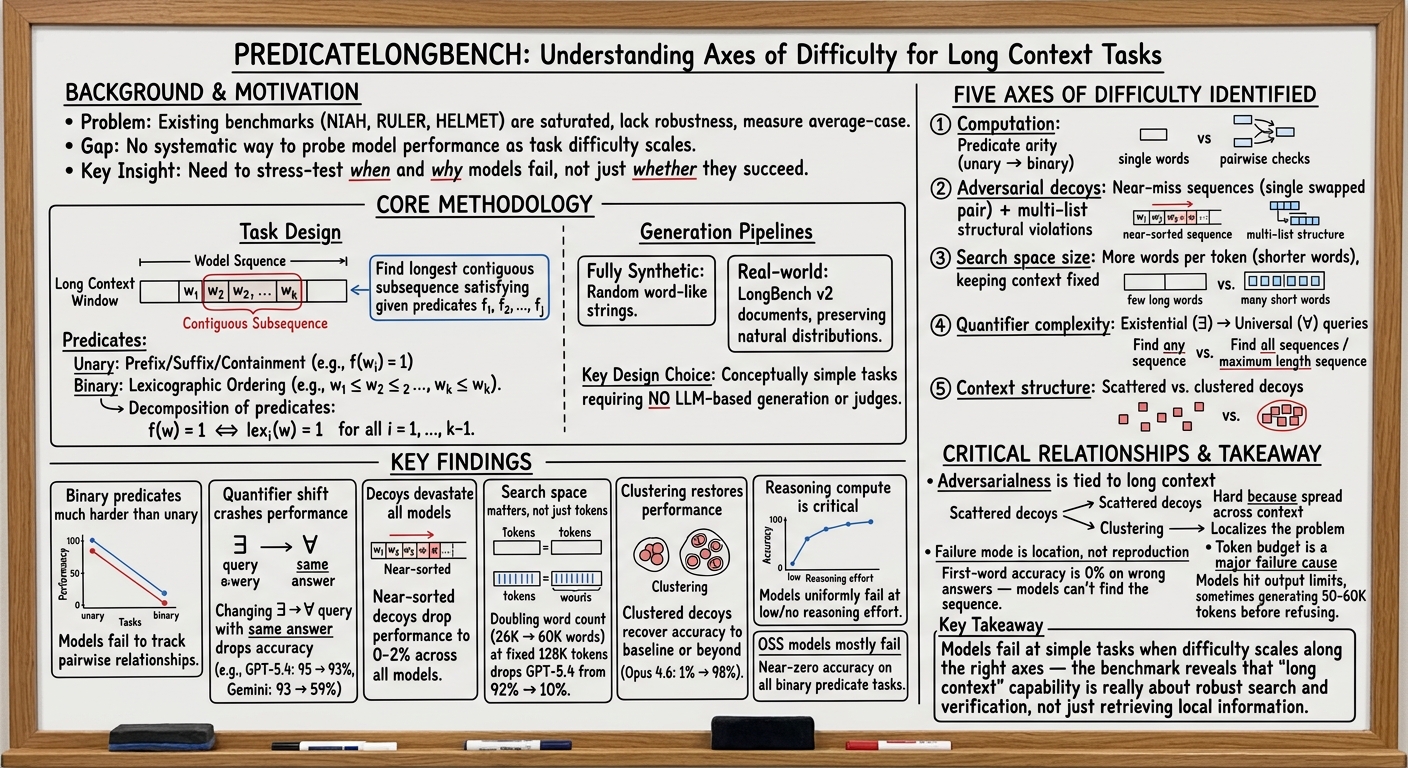
PREDICATELONGBENCH shows frontier LLMs collapse on simple long-context retrieval tasks when predicate arity, quantifier complexity, or adversarial decoys increase, even with unchanged answers.
Editor's noteUses simple predicate satisfaction tasks to systematically decompose long-context difficulty into orthogonal axes: computation, distractors, search space, quantifier complexity, and context structure, and shows that frontier models degrade as difficulty increases along each axis. The key increment is a search space axis that can be scaled under a fixed token budget, and the finding that 'distractor hardness is a long-context property' (clustered distractors are far easier than scattered ones), providing a difficulty scaling framework beyond RULER/HELMET.