AI Discovers and Formalizes a 70-Year-Old Open Conjecture
Highlights
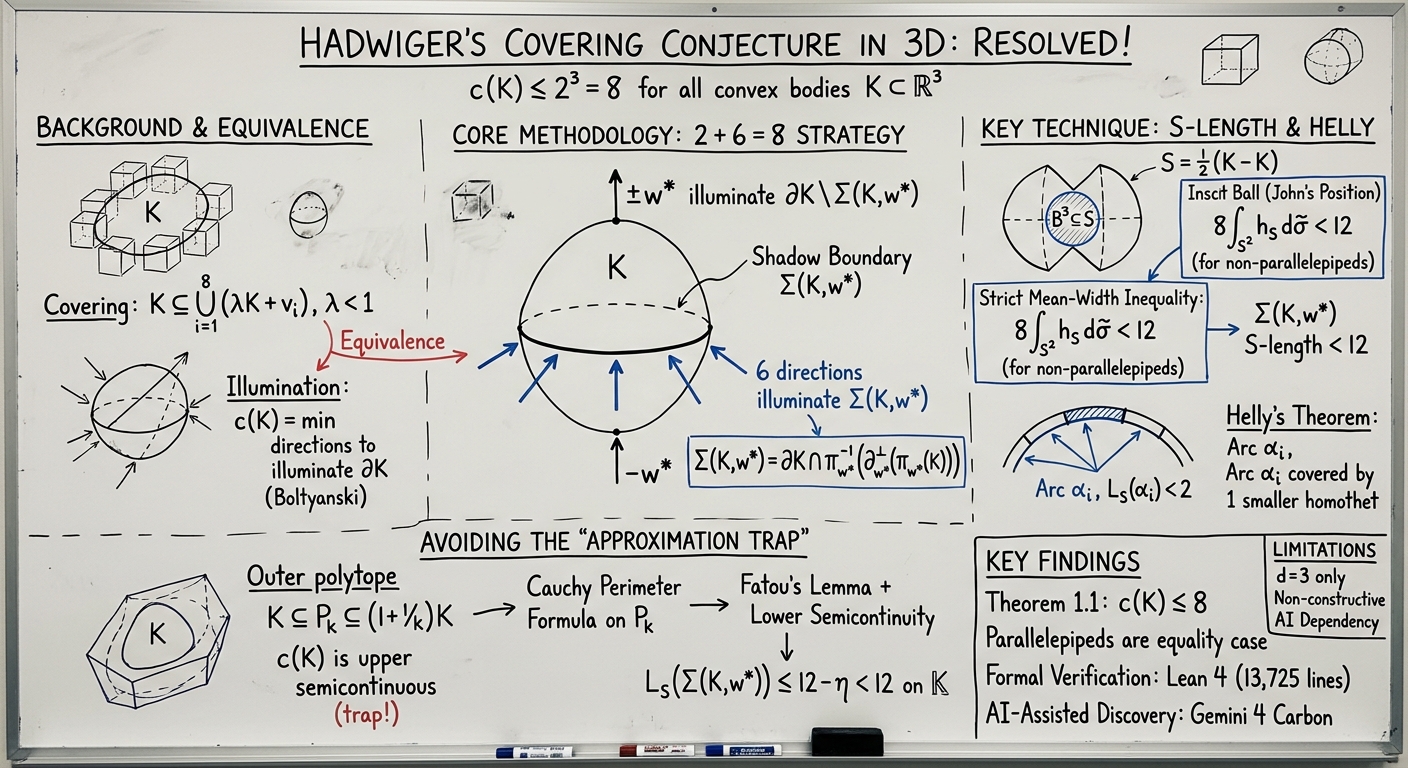
This issue is dominated by a milestone event: frontier AI has, for the first time, "discovered and fully formalized" a 70-year-old open conjecture. The Hadwiger covering conjecture in three dimensions was discovered and proved by Google's experimental harness based on Gemini 4 Carbon, and was also formalized by the agentic harness in Lean 4—13,725 lines, 34 files, no sorry, only standard axioms. This is fundamentally different from previous "AI-assisted formalization of known theorems" or "AI solving open problems but only LLM-verified": discovery and verification are completed in the same closed loop. Mathematically, the proof combines John's position with the strict mean width bound 8∫h_S<12, and uses Fatou's lemma to bypass the classic "approximation trap" to obtain a strict shadow boundary length bound; formally, it is a milestone sample of the "AI discovery + AI formalization" closed loop, with the Lean source code publicly available as an arXiv attachment.
The Riemann hypothesis Lean proof reported in the previous issue has entered the community certification stage in this issue. The Lean community blog issued a joint statement by Lean FRO and the Mathlib Initiative, confirming that Alpöge's 17M-line proof satisfies the four-question framework proposed by Buzzard (statement correctness, compilation, Comparator comparison, kernel replay), and stating "full confidence in the correctness of the proof"; the community cleanup repository treats readability and buildability as first-class artifacts, aiming to compress the 17M lines to Mathlib level. This continues the "multi-kernel independent verification" protocol from the previous issue, but shifts the focus from "whether verification is possible" to "how to make large-scale proofs maintainable and human-understandable."
At the evaluation level, multiple works in this issue advance "faithfulness" from the statement level to the project and infrastructure levels. AutoformBench is the first to make "constructing missing definitions and intermediate lemmas" a core evaluation dimension; Improving semantic equivalence shows that fine-tuning on "pairs of differences between informal and formal" significantly improves consistency with the project's own formalization choices; LeanReviewBench systematizes project-level semantic alignment review into a benchmark. These works collectively point to a judgment: when "compilation passes" is no longer the bottleneck, "whether the formalization is faithful to the source text" and "how to measure such faithfulness" are becoming the true frontier of automated formalization research.
Community and News
- RH proof receives community certification: The Lean community blog issued a joint statement by Lean FRO and Mathlib Initiative, confirming that Alpöge's Riemann hypothesis proof satisfies the four-question framework and stating "full confidence in the correctness of the proof"; the verification files record 175,187 modules compiling successfully, the five headline theorems depending only on three standard axioms, and independent kernel replays (nanoda and con-leche) accepting.
- RH proof community cleanup: leanprover-community/riemann-hypothesis treats readability and buildability as first-class artifacts, uses Comparator to compare headline theorem statements, and aims to compress the 17M lines to Mathlib level—providing a high-value test target for premise selection and proof repair tools.
- Buzzard's four-question framework: The Xena Project proposes a four-question checklist (statement matching, compilation, Comparator, kernel bugs) for trusting AI-generated Lean proofs, providing an actionable framework for evaluating the trustworthiness of AI proofs.
- daVinci-prover open-sourced: GAIR-NLP/daVinci-prover releases the first single-agent Lean 4 proof harness combining LeanExplore retrieval, compiler feedback, and Comparator acceptance mechanisms, achieving SOTA on FATE-H and Putnam-200.
- AlphaProof Code Verification Signal: The official page reports the first machine-code-level verification of a real cryptographic protocol (Signal's libsignal) in Lean 4, with a 6.3M-line corpus providing a rich training ground for premise selection and tactic prediction.
- vdash open-source reimplementation: noncanonicAleae/vdash provides an open-source reimplementation of AlphaProof's multi-agent formal verification loop, including a deterministic gatekeeper and independent Lean kernel replay.
- Lean 4.36.0 released: The release notes introduce vcgen exception contracts, bv_decide uninterpreted functions, grind interactive mode, and bring about a 12% speedup in Mathlib builds.
- Community reactions and critiques: Quanta reports mathematicians racing to verify the AI Riemann proof while a human proof emerges; Scientific American reports independent mathematicians confirming the proof is "almost certainly correct" but emphasizing the correspondence problem between formal statements and intended theorems; Nature documents the shock and excitement in the mathematical community; riemann.wiki aggregates critiques of "why vs. symbolic manipulation" and authorship debates.
Open Questions
- The Hadwiger proof was both discovered and formalized by AI, but the paper explicitly acknowledges that "the correspondence between natural language statements and formal statements still requires human judgment." When AI is both the prover and the formalizer, will the "statement faithfulness verification" bottleneck raised in the previous issue be amplified—i.e., do we need a "statement audit" layer independent of proof search?
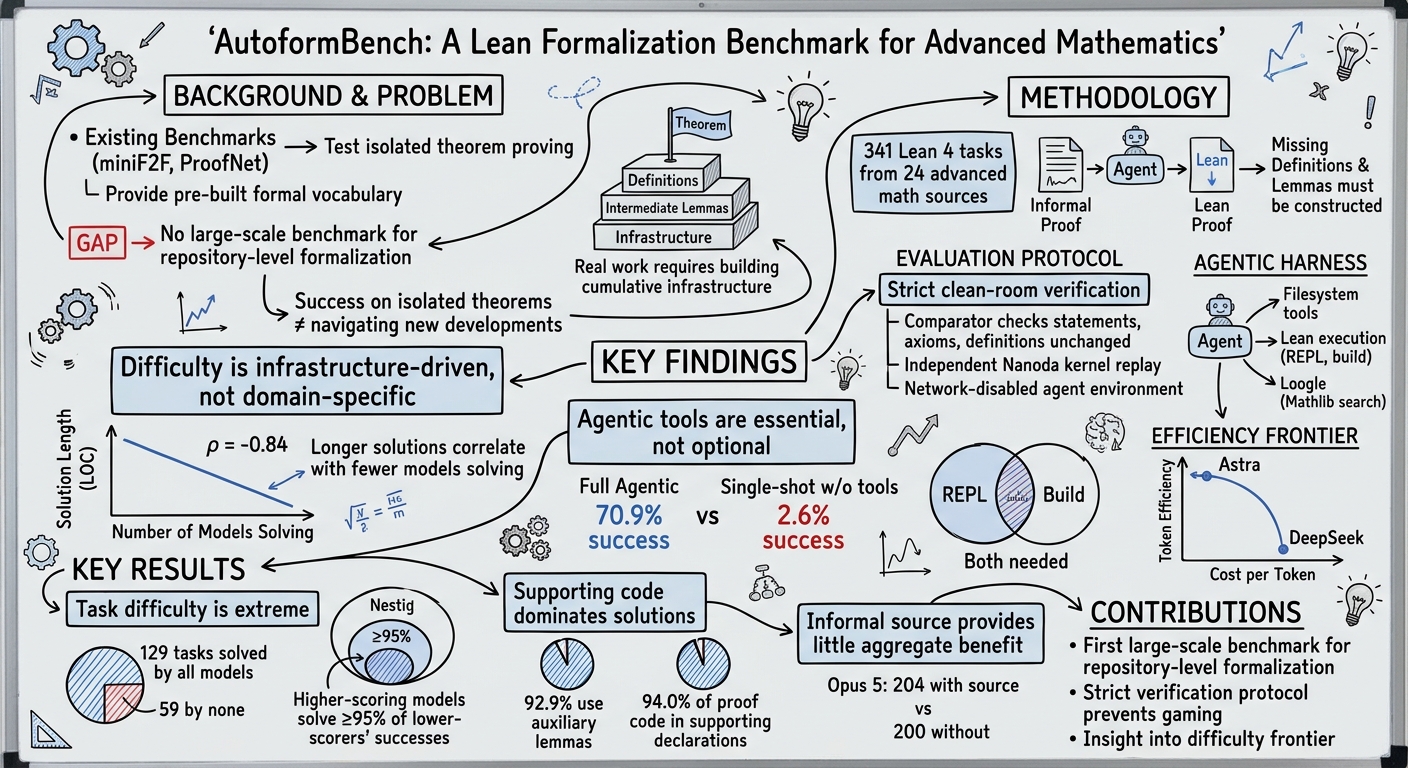
- AutoformBench finds that success "depends more on the model's ability to construct missing formal infrastructure than on the mathematical domain." If infrastructure construction becomes the dominant bottleneck, does this mean that Mathlib coverage, rather than reasoning ability, is the true constraint on formalization scaling, and that "library building" itself should be evaluated and incentivized?
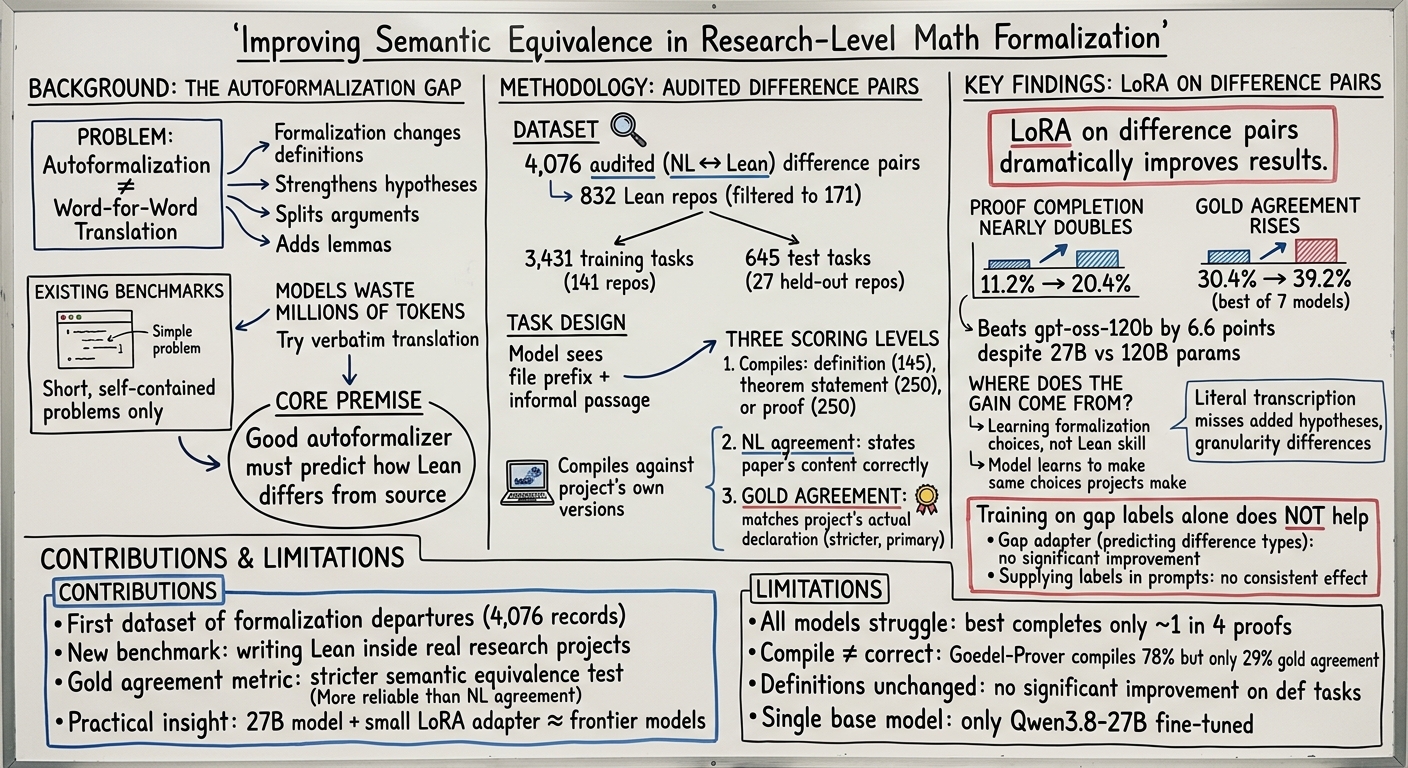
- Improving semantic equivalence shows that fine-tuning on difference pairs is effective, but training on labels describing differences is not. This suggests that the "gap between informal and formal" is not a property that can be explicitly described, but a behavior that needs to be internalized—what does this imply for designing semantic feedback signals?
- The RH community cleanup compresses the 17M-line proof to a readable level, providing an unprecedented real target for premise selection and proof repair tools. But is the compressed proof still "the same proof"—when cleanup changes the dependency structure, will the previous concern about "AI proofs systematically biased toward LLM style" be amplified or mitigated during cleanup?
Papers in this issue
Hadwiger's covering conjecture is proven in three dimensions: every convex body in R^3 can be covered by eight smaller homothetic copies, with a formally verified Lean 4 proof.
Editor's noteFor the first time, a frontier AI (Gemini 4 Carbon) discovered and fully formalized a 70-year-old open conjecture: proving the three-dimensional Hadwiger covering conjecture c(K)≤8, with 13,725 lines of Lean 4 (34 files) with no sorry and only standard axioms. The mathematical increment lies in combining John's position with the strict mean width bound 8∫h_S<12, and using Fatou's lemma to bypass the "approximation trap" to obtain a strict shadow boundary length bound; the formalization increment lies in this being a milestone sample of the "AI discovery + AI formalization" closed loop. The Lean source code is publicly available as an arXiv attachment, providing a complete reproducible artifact for future benchmarks and training data. Note that the correspondence between natural language statements and formal statements still requires human judgment.
AutoformBench shows frontier models need hundreds of millions of tokens for 50% task completion, proving infrastructure construction, not domain knowledge, is the core bottleneck in formalization.
Editor's noteThe first large-scale Lean 4 benchmark that makes "infrastructure construction" a core evaluation dimension: 341 tasks, 24 advanced mathematical sources, where agents must construct missing definitions, intermediate lemmas, and supporting infrastructure while proving target theorems. Compared to Paper2Lean (issue 15) and LeanContext (issue 14), the increment lies in systematically quantifying frontier models' performance on the infrastructure dimension (92.9% of successful solutions use auxiliary lemmas), and includes clean-room verification (Comparator + Nanoda), budget-conditioned leaderboards, and tool ablations. Data and code are public, directly addressing the saturation problem of miniF2F/PutnamBench.
Training on 4,076 informal-to-Lean "difference pairs" nearly doubles proof completion and boosts gold statement agreement, showing formalization choices are learnable.
Editor's noteConstructs 4,076 audit samples targeting "differences between natural language sources and faithful Lean formalizations" in research-level automated formalization, and shows that fine-tuning on these difference pairs (rather than training on labels describing differences) significantly improves consistency with the project's own formalization choices: proof completion rate nearly doubles (11%→20%), and gold agreement improves by nearly a third (30%→39%). Compared to Paper2Lean (issue 15) and LeanContext (issue 14), the increment lies in explicitly training on the "gap between informal and formal," and the negative result of gap-label training has direct implications for semantic feedback design. Benchmark and code are public.
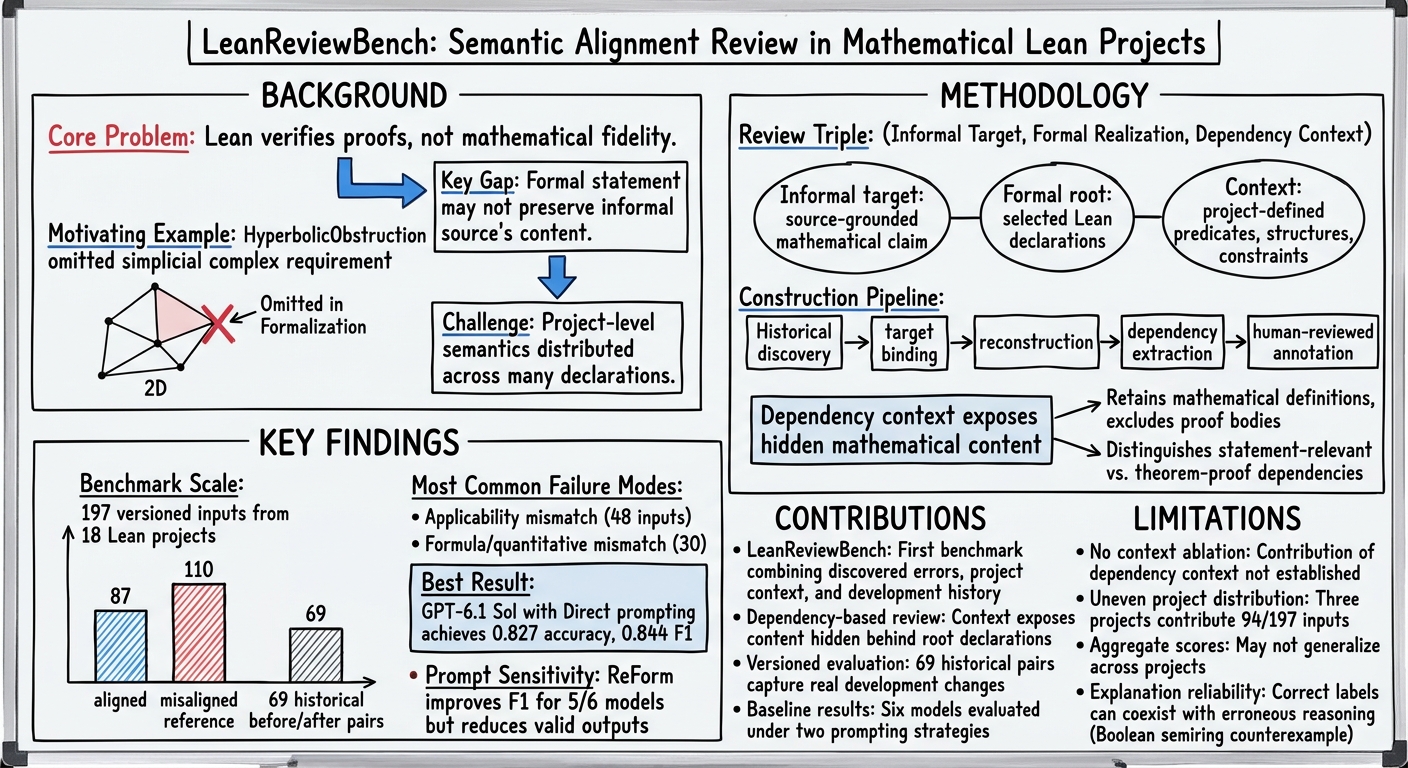
LeanReviewBench introduces the first benchmark for project-level semantic alignment review in Lean, showing GPT-6.1 Sol achieves 0.827 accuracy at detecting formalization errors.
Editor's noteSystematizes project-level semantic alignment review into a benchmark: collects 197 versioned inputs (including 69 historical pairs) from 18 real Lean projects, uses development history to discover real errors, independent target binding, and dependency context extraction, providing 87 aligned/110 misaligned human labels. Compared to MechAlign (issue 12, 501 fixed triples, no historical pairs), the increment lies in using development history to discover real errors and preserving versioned snapshots, with a construction pipeline reusable for other projects. Results depend on frontier closed-source models, but the benchmark itself is a lasting contribution.
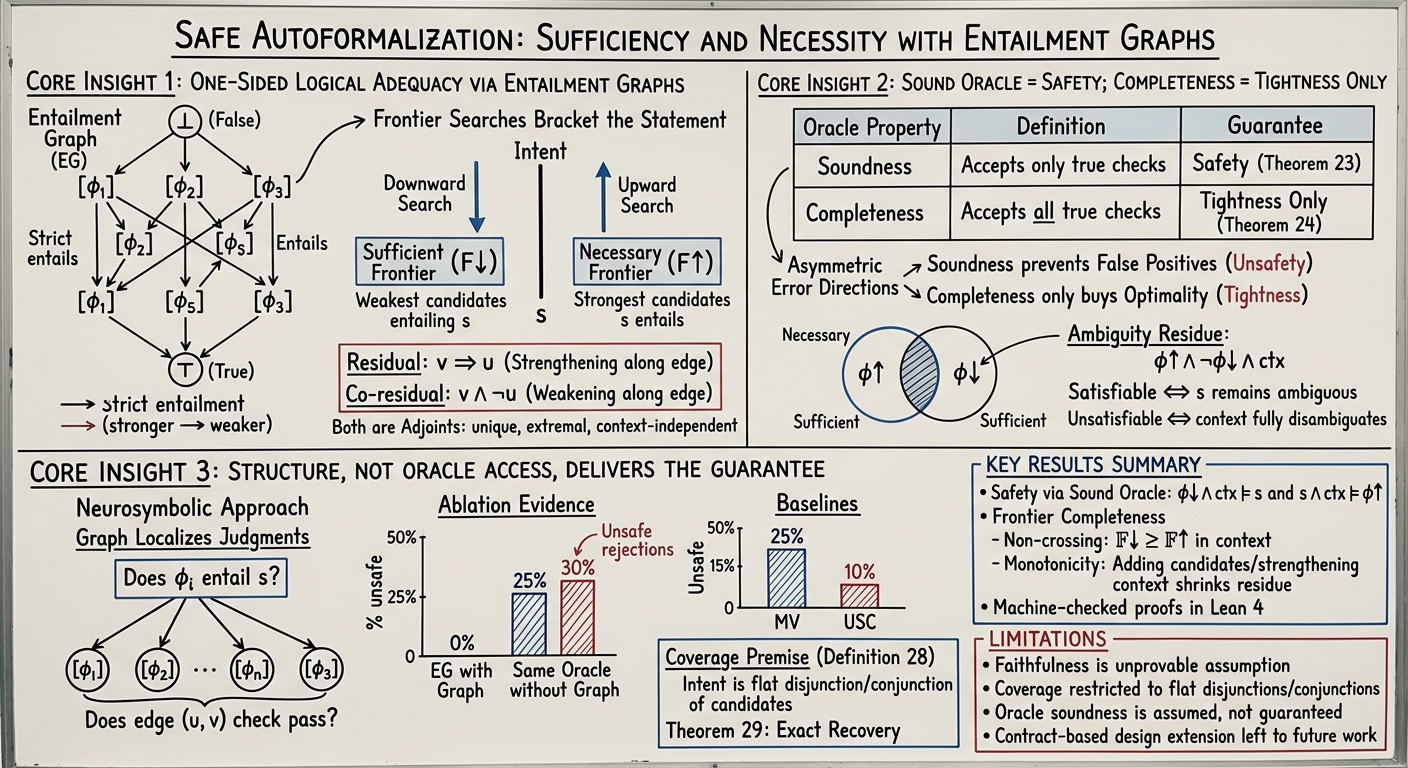
Entailment graphs certify safe autoformalization by returning the weakest sufficient and strongest necessary candidates, guaranteeing safety from a sound oracle alone.
Editor's noteProposes entailment graphs for safe automated formalization: candidate formulas are sorted by logical strength, bidirectional search returns sufficient/necessary frontiers that sandwich the statement's intent, and proves that "a sound LLM entailment oracle suffices for safety, independent of candidate pool quality; completeness only determines frontier tightness." Compared to SemantEq (issue 15) and FaithAlign (issue 10), the increment lies in one-sided safety guarantees and expressing ambiguity residuals as formulas (rather than scalar scores), with neuro-symbolic division of labor (solver builds graph, LLM only answers local edge checks) and algebraic foundations for Lean machine verification as new contributions. Focus is on safety properties rather than mathematical theorems, with indirect but solid methodological value.
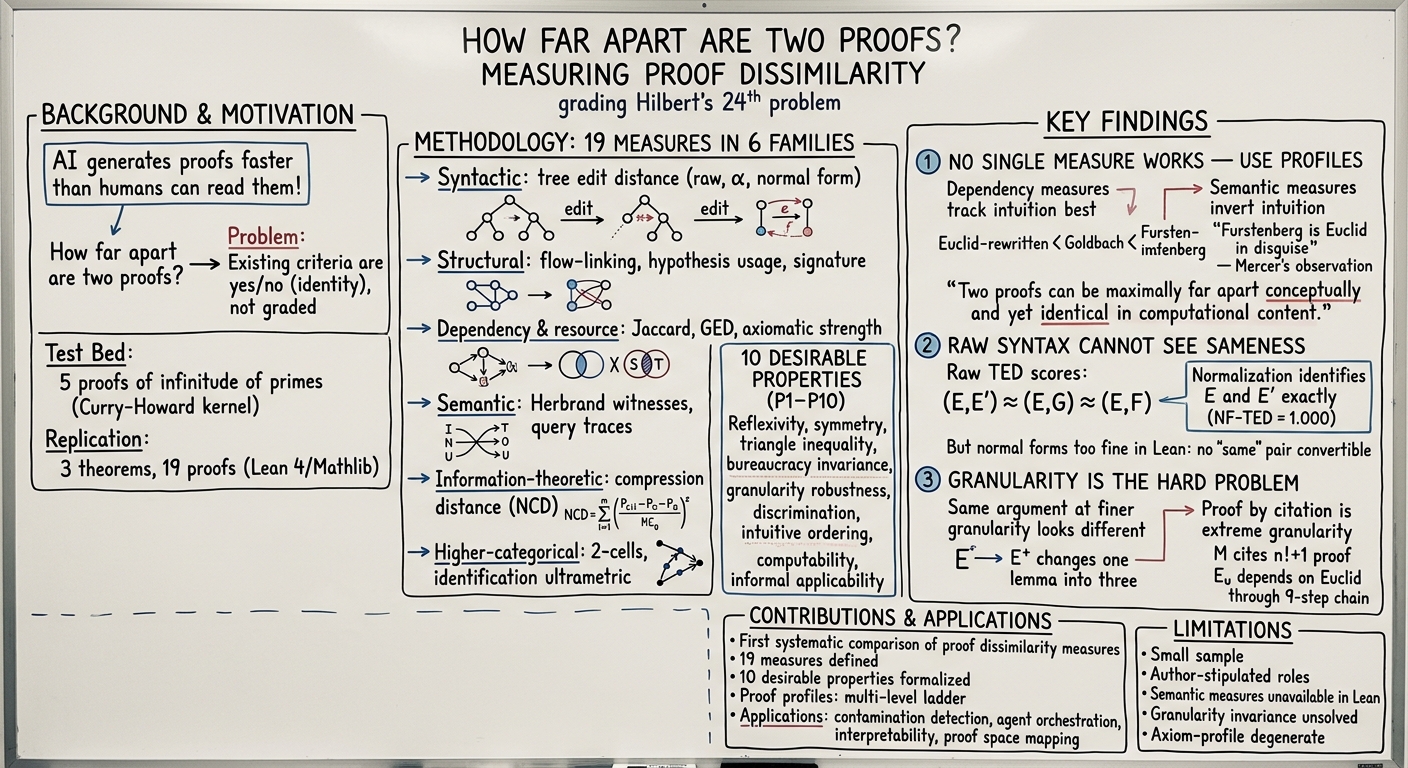
Dependency-based dissimilarity measures best capture intuitive proof differences, while semantic measures reveal Furstenberg's topological proof computes exactly Euclid's witness.
Editor's noteFirst systematic comparison of 6 families of 19 proof dissimilarity measures (12 newly proposed or adapted), doubly validated in a controlled Curry-Howard kernel and in Lean/Mathlib, and provides 10 properties that "safely optimizable measures" should satisfy. Key findings: dependency-closure measures best match intuition, while semantic measures can reverse intuitive order (the Furstenberg proof under the finite prime assumption exactly computes Euclid's witness); normal form equality, a classic identity criterion, never holds in proof assistants. Compared to proof-theoretic measures (issue 11), the increment lies in systematic comparison and Lean reproduction. Direct value for detecting duplicate/recalled proofs and orchestrating proof agents; sample size is small, results should be treated as relative signals.
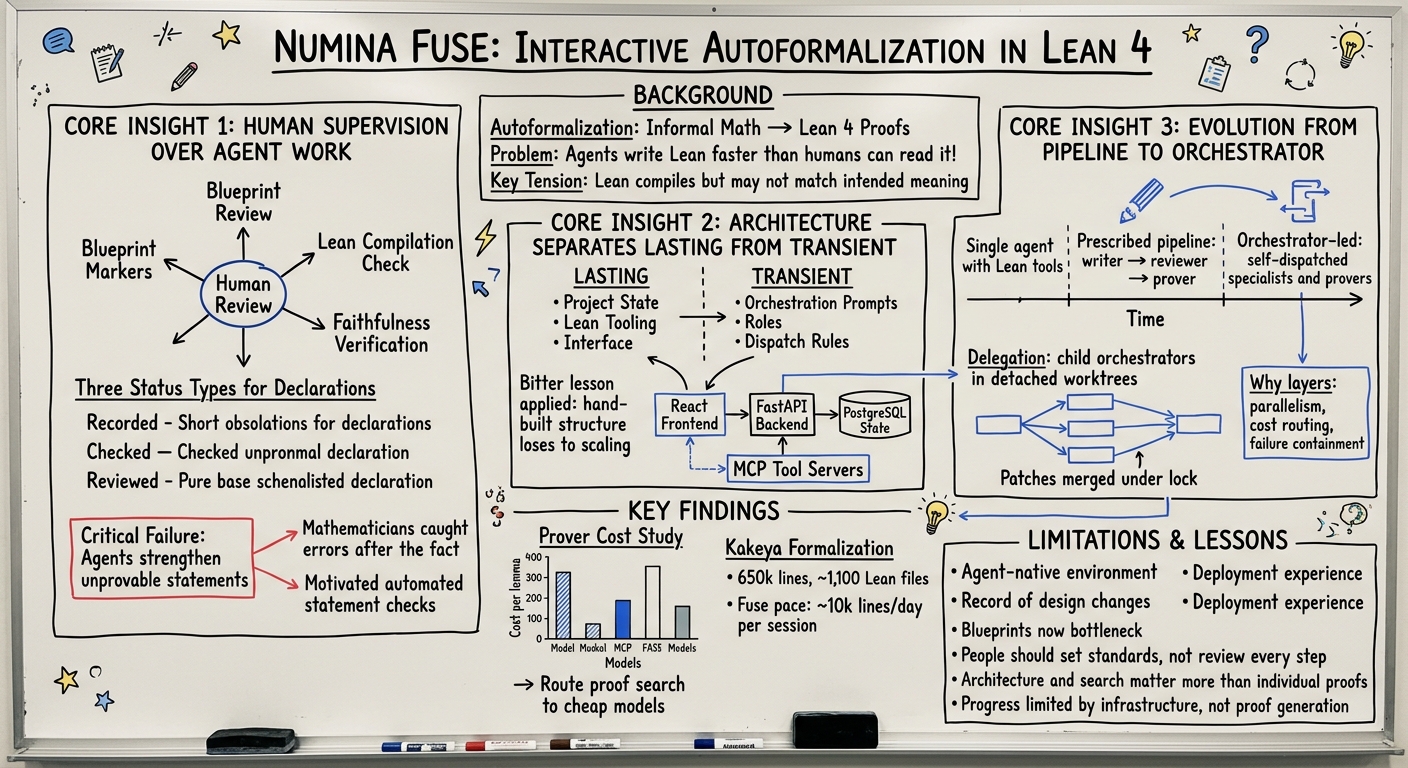
Numina Fuse shows proof search can route to cheap models with equal accuracy, while durable infrastructure, not orchestration, drives long-term formalization success.
Editor's noteAn empirical record of agent-native automated formalization applications: reframes human supervision from step-by-step review to "setting standards" (definitions, main theorem statements, release acceptance), and systematically documents the architectural evolution from fixed pipelines to autonomous orchestrators in 2026, with deployment data for the three-dimensional Kakeya formalization (approximately 650,000 lines of Lean, no axioms, main theorem depends on StickyFrostmanHypothesis). Compared to Paper2Lean (issue 15) and FormalFlow (issue 7), the increment lies in explicitly separating persistent project state/tools/interfaces from the orchestration layer, and reporting which mechanisms were removed as model capabilities improved. Engineering report rather than new algorithm; final assembly phase completed outside Fuse, results should be treated as relative signals.
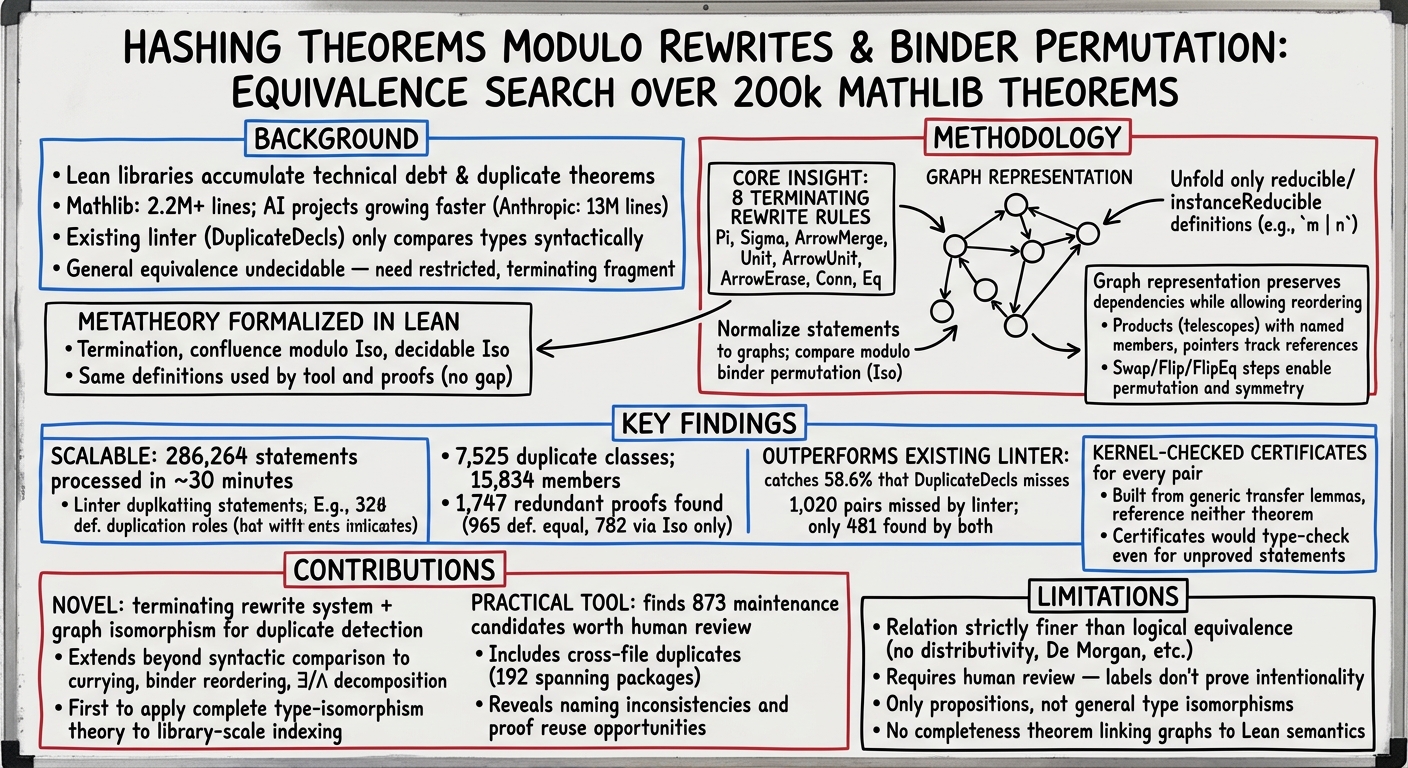
A formally verified rewrite system detects 1,747 redundant Lean theorem proofs across 1,687 duplicate classes, outperforming existing linters by 58.6%.
Editor's noteProposes a terminating eight-rule rewriting system that normalizes theorem statements while preserving dependencies, and uses graph isomorphism (modulo binder permutation) to detect duplicates among 200,000+ Mathlib theorems, with each matched pair accompanied by a kernel-checked equivalence certificate. Compared to Mathlib's duplicate declaration linter (syntactic comparison only), the increment lies in supporting unfolding, associative/commutative rearrangement, currying/uncurrying, and connective symmetry, with machine-checked metatheory. Direct value for library maintenance and premise selection deduplication; although not directly involving neural proving, the rewriting and certificate methods are transferable.
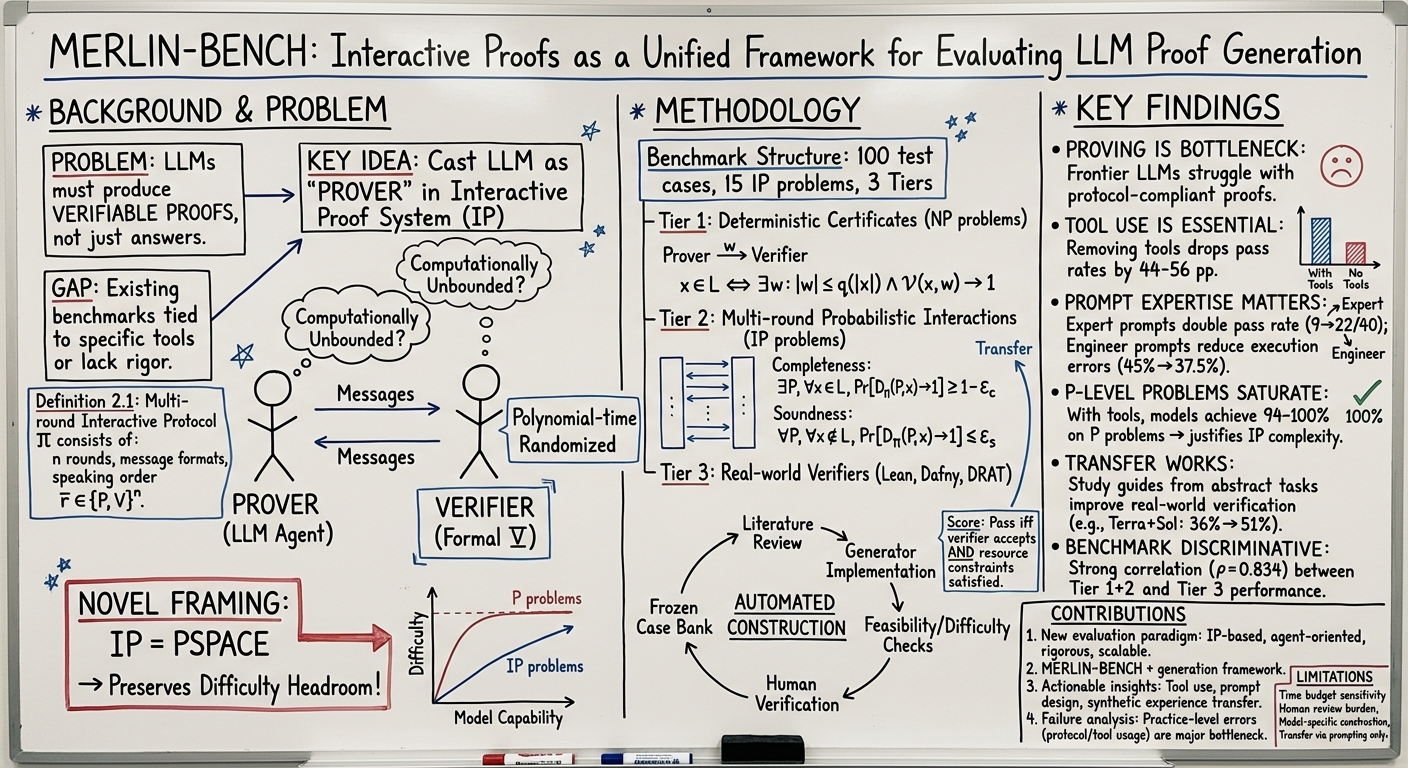
MERLIN-BENCH evaluates LLM agents as provers in interactive proof systems, showing that verifiable proof construction remains a major capability bottleneck across 10 frontier models.
Editor's noteFirst to use interactive proof systems (IP=PSPACE) as a unified framework to evaluate LLM agents' proving abilities, constructing a three-tier benchmark Merlin-Bench (deterministic certificates, multi-round interaction, real verification tools), and proposing a scalable test case auto-construction pipeline. Compared to TCSExam (issue 14, covering the full spectrum of TCS research but not using IP as a unified framework) and ITPEval (issue 11, cross-ITP translation), the increment lies in using IP theory as a cornerstone, making the benchmark naturally resistant to saturation (problem complexity up to PSPACE) and scalable. Tier-3 directly involves Lean verification, and case studies (tool necessity, prompt hierarchy, empirical transfer) are valuable for designing proof agents; Tier-1/2 focus on combinatorial/complexity problems and depend on frontier closed-source models, results should be treated as relative signals.