Architectural Interventions Begin Rewriting Scaling Exponents
Highlights of This Issue
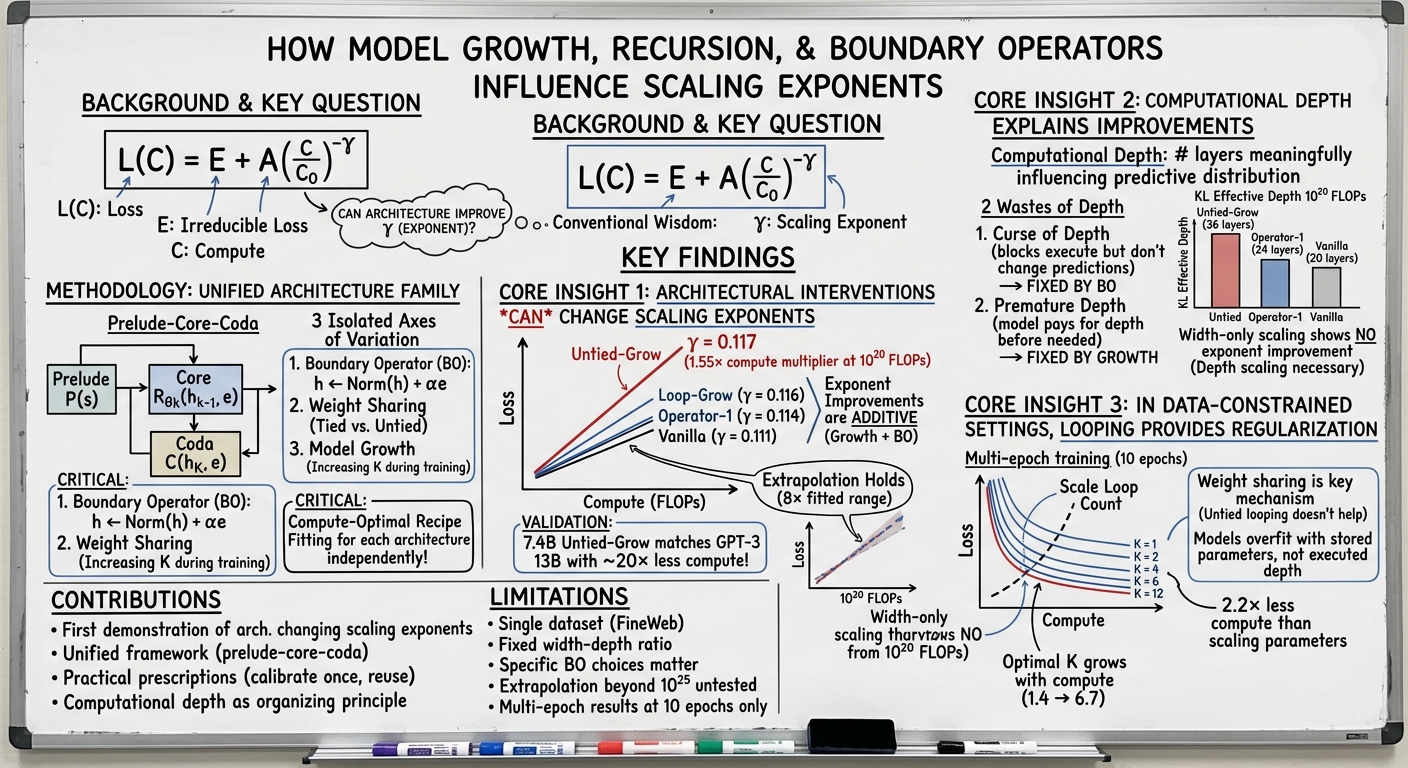
The most notable shift this issue is that looped deep research has advanced from the equal-compute debate of "whether looping is worth it" to the more fundamental question of "whether architecture can change scaling exponents." How Model Growth, Recursion, and Boundary Operators Influence Scaling Exponents provides the first systematic proof that architectural interventions such as boundary operators, weight sharing, and model growth can not only change the constants of compute-optimal pretraining but also the scaling exponents themselves—a clear contrast with the scaling studies in Issue 1 that only reported constants or fixed loop counts, and it proposes "compute depth" as a unified perspective. If this conclusion holds at larger scales, it would upgrade looping from a "predictable scaling axis" to a "designable scaling axis."
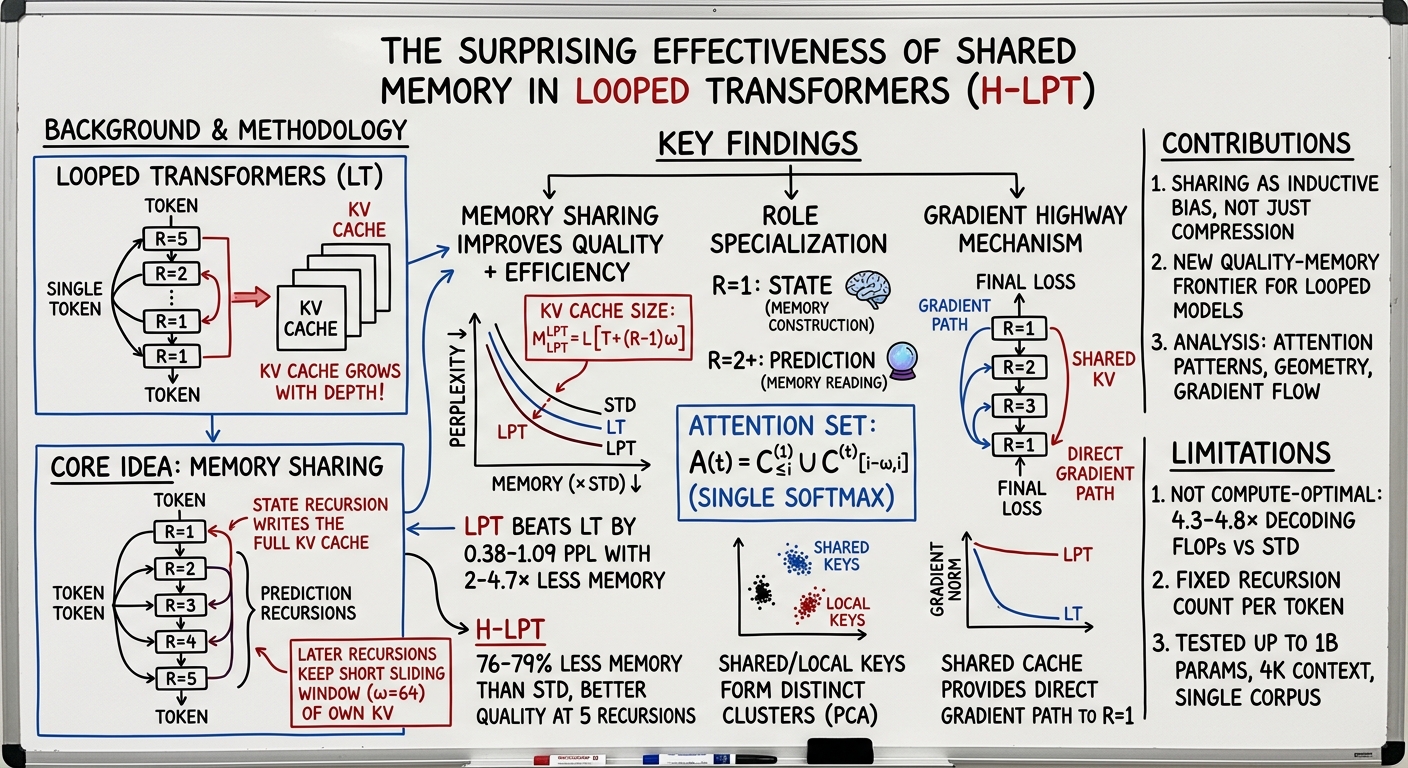
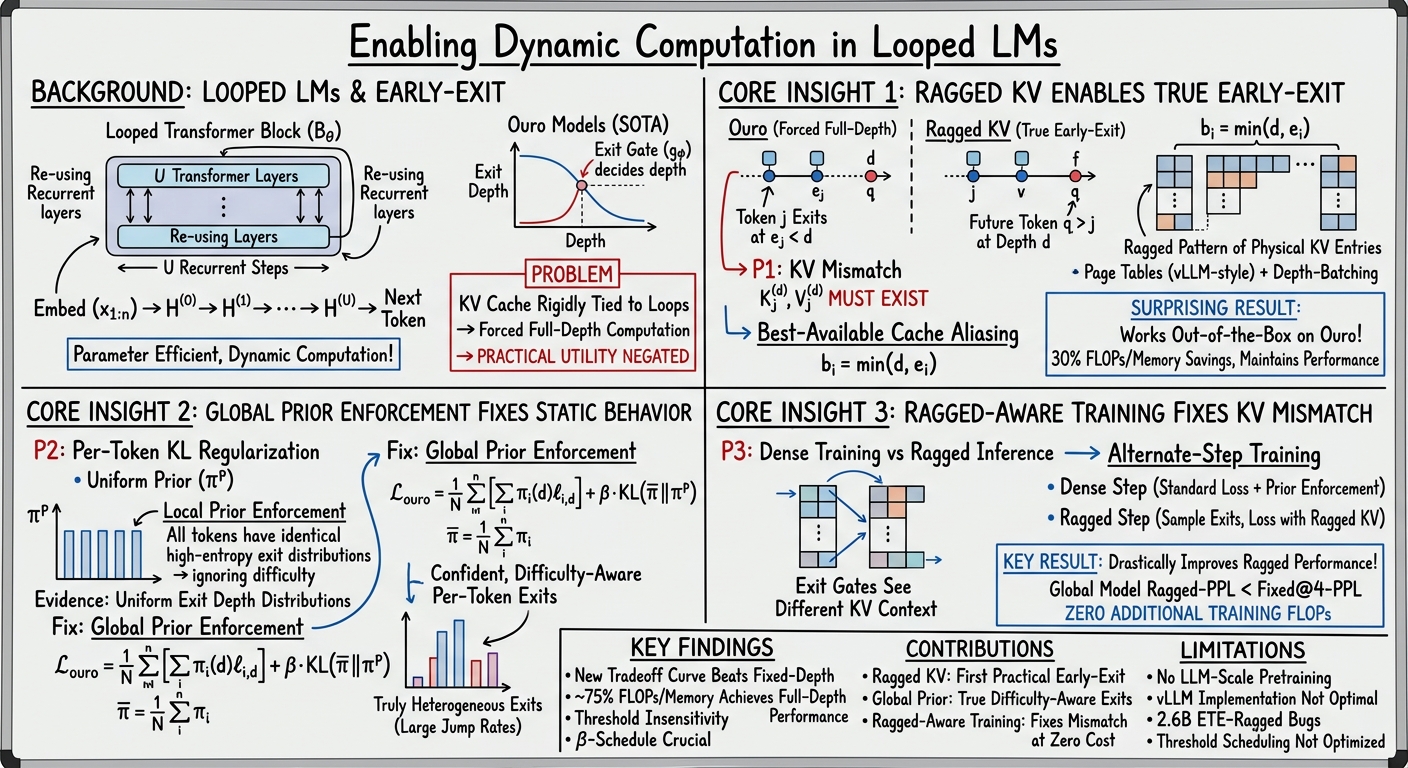
The second theme is memory becoming a design axis for looped architectures. The "single-loop tax" discussed in the previous issue focused on compute, but this issue turns attention to KV cache. The Surprising Effectiveness of Shared Memory in Looped Transformers elevates shared memory from an inference-time compression trick to a training-time inductive bias—only the first recursion writes the full context cache, while subsequent recursions read only the shared cache plus a short window, which not only saves memory but improves quality, and it provides a mechanistic explanation that "the shared KV path forms a gradient highway directly to the first recursion"; Enabling Dynamic Computation in Looped LMs uses training-free Ragged KV to enable true early exiting in looped models like Ouro, achieving about 30% FLOPs/memory savings without performance degradation. Together, these show that the memory organization of looped models is becoming a design freedom as important as depth itself.
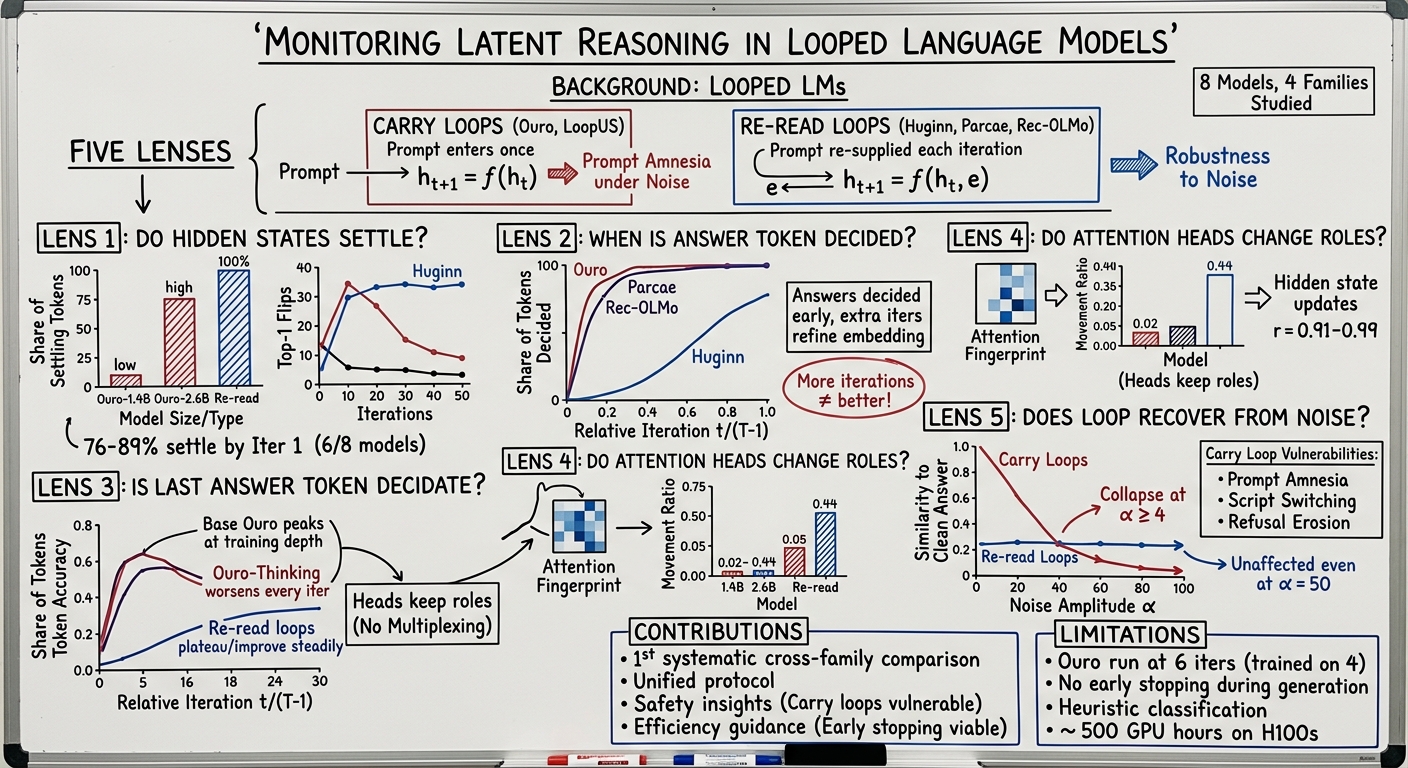
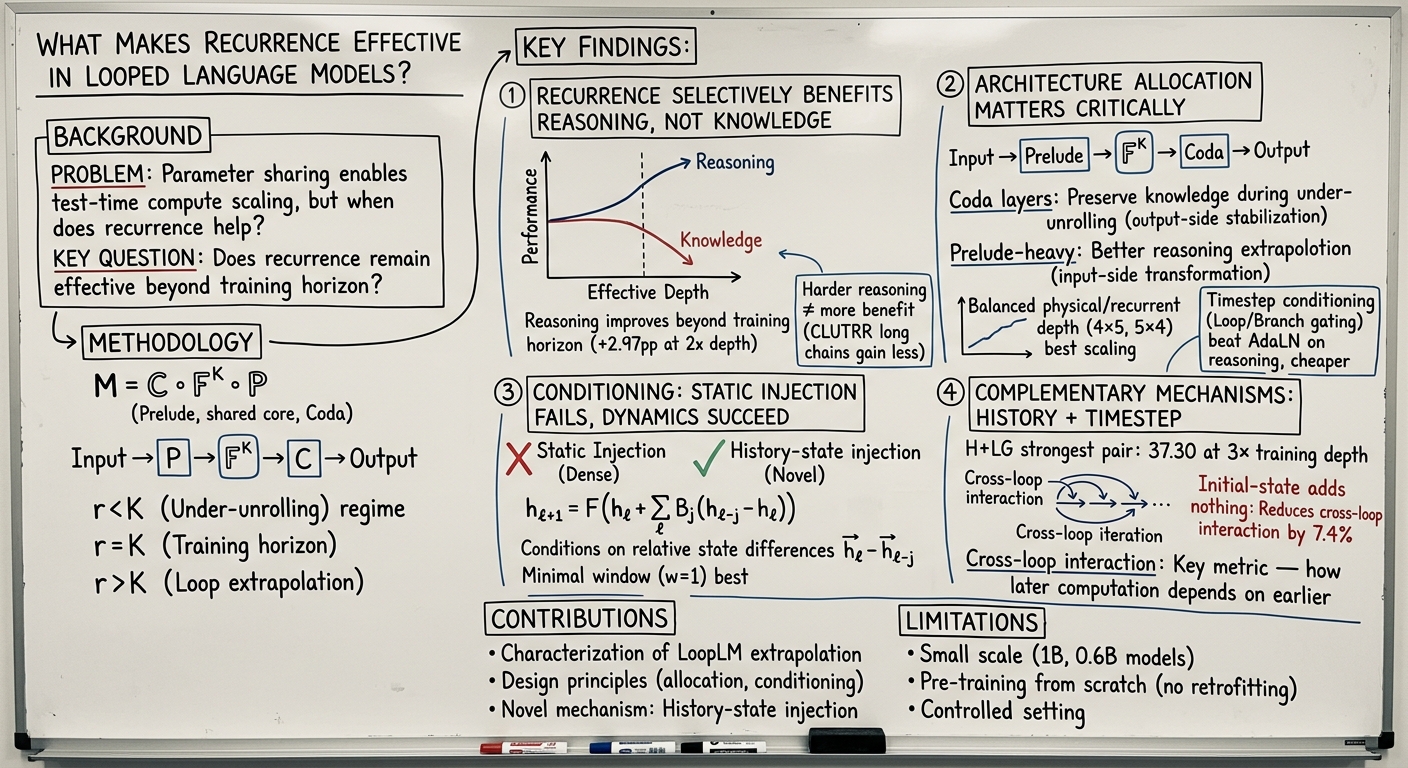
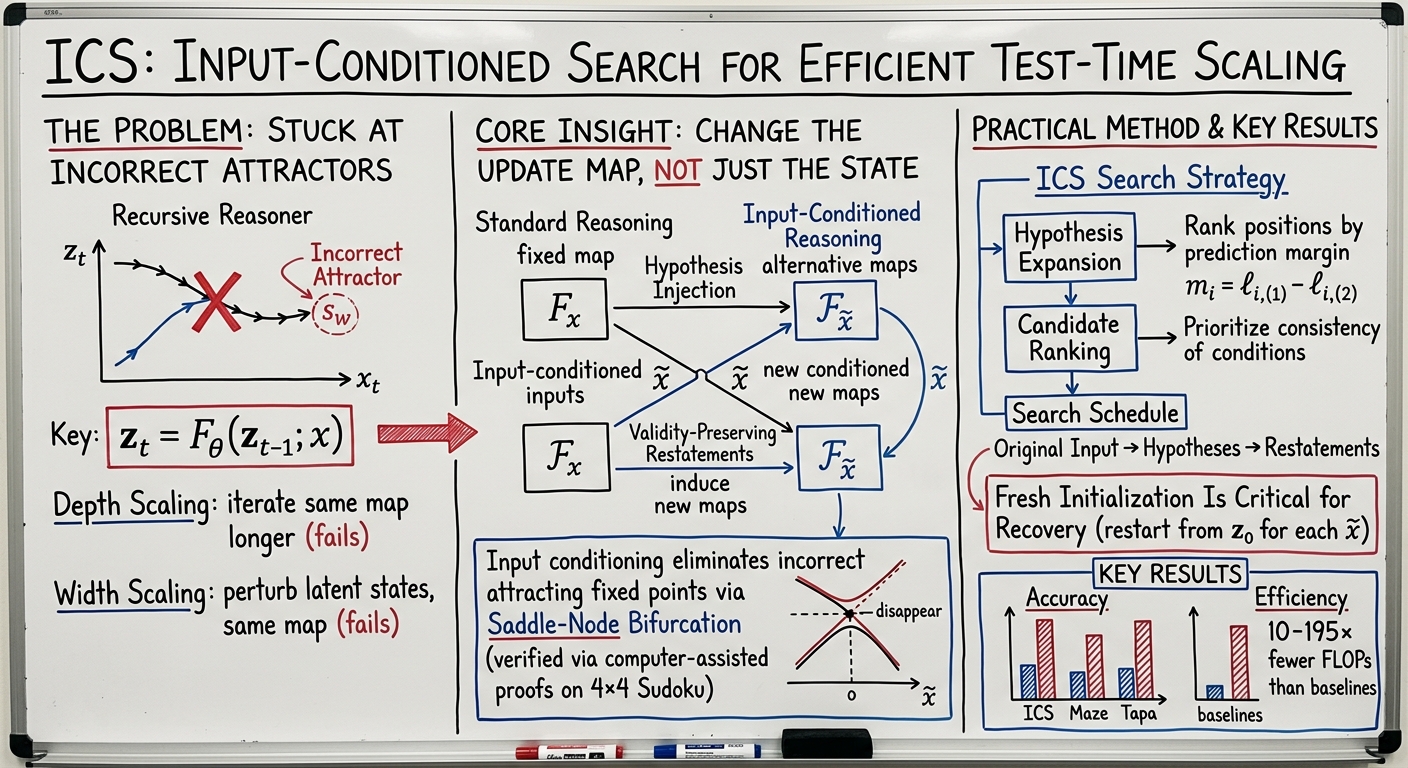
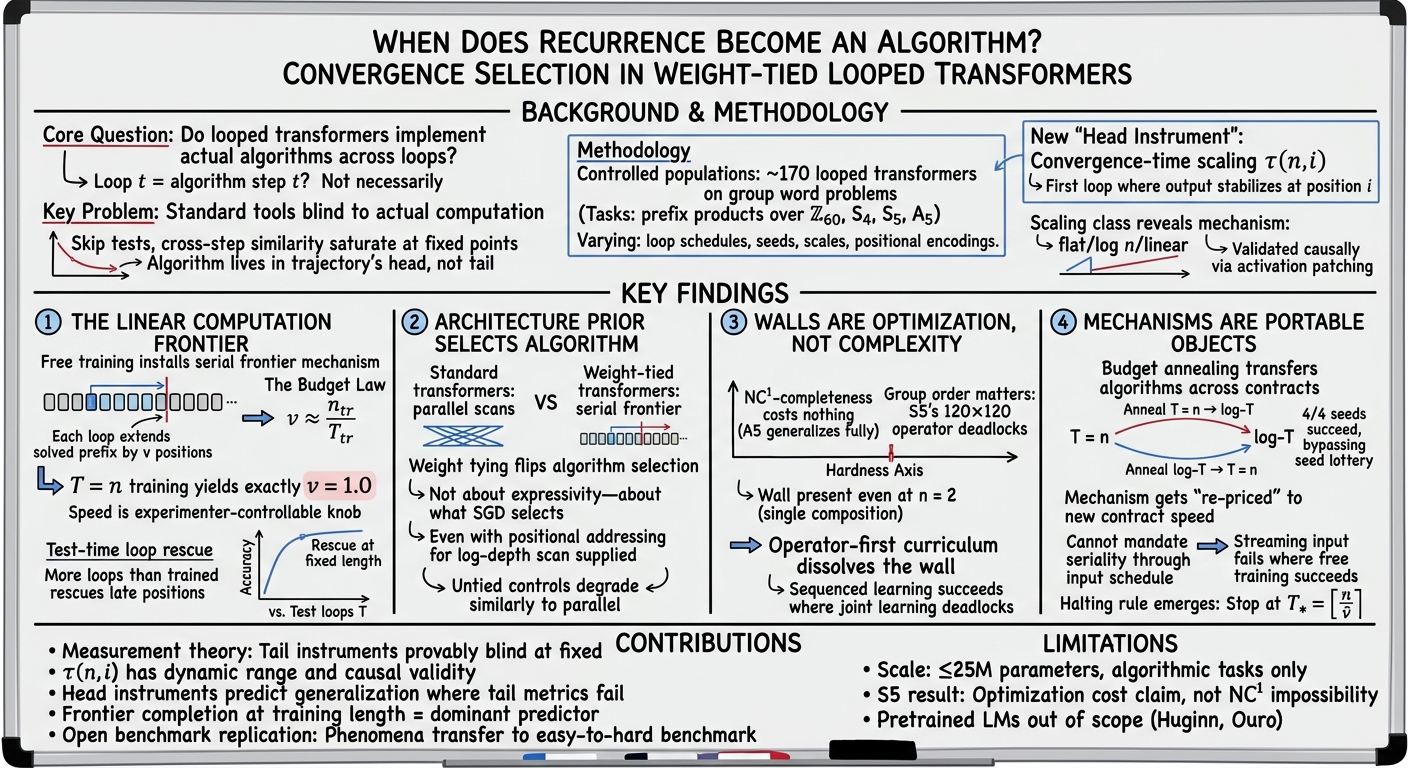
The third theme is the maturation of mechanistic analysis. While the previous issue had explanatory warnings for a single family, this issue presents the first cross-family unified mechanistic comparison: Monitoring latent reasoning in looped language models uses five identical lenses to compare eight looped models from four families, finding that answer tokens are mostly decided in the first iteration, with subsequent loops mainly refining confidence, and that carry-type loops (Ouro, LoopUS) peak at training depth and then degrade with iterations, while re-read-type loops (Huginn) decide progressively and plateau or improve; What Makes Recurrence Effective in Looped Language Models? uses controlled experiments to localize that reasoning tasks benefit from loop extrapolation while knowledge tasks degrade, and proposes a historical state injection mechanism. When Does Recurrence Become an Algorithm? approaches from another angle, using the "linear compute frontier" and budget law to show that algorithm selection under weight sharing is determined by training contracts rather than expressive power. Test-time compute for recursive reasoning models is also differentiating into new axes—Input-Conditioned Search induces different update mappings from frozen models by changing input conditions, rather than perturbing hidden states as before.
Community and Updates
- Regarding the debate on loop depth and compute, How concerned should we be about Astra's recurrent (looped) transformer? offers a meta-observation worth heeding: under matched compute, scaling parameters still beats scaling loop count, and the optimal loop count decreases with model size (Huginn 32 → Ouro 4 → Loopie 2). This creates tension with this issue's optimistic conclusion that architecture can change exponents, suggesting that loop benefits are highly dependent on scale and recipe.
- The equivalence between implicit reasoning and explicit CoT is directly tested: Do looped transformers write reasoning they don't use? finds on Huginn that increasing loop count does not lead to skipping explicit reasoning traces—more latent computation does not turn "written reasoning" into "unused reasoning," which is an important negative result for claims that treat loop depth as a substitute for CoT.
- Cautious voices at small scale are also accumulating: Do Looped Transformers Generalize? A Three-Day, Five-Task Test finds that depth scaling is only effective on Dyck-1 length extrapolation, and points out that fixed truncated backpropagation windows can confound comparisons of high loop counts—a common methodological pitfall in evaluating looped models.
- On the other side of scale comparison: Ouro: Looped Language Models reports that 1.4B/2.6B looped models match dense models up to 12B on several benchmarks, establishing loop depth as a third scaling axis alongside model size and data.
Open Questions
- If architectural interventions can change scaling exponents, then which factor—boundary operators, weight sharing, or growth scheduling—is responsible, and what are their respective contributions? At what scale do these gains still hold, and could they flip with scale like "scaling parameters beats scaling loops"?
- Why does shared memory as a training-time bias not hurt quality but improve it—does the "gradient highway directly to the first recursion" imply that later recursions are merely refinements of the first recursion's output? How does this interact with the decision timing differences between carry and re-read types?
- Cross-family comparisons show that answer tokens are mostly decided in the first iteration, carry-type loops peak at training depth and then degrade with iterations, while re-read-type loops plateau or improve—is "early decision" an inherent property of carry structures or can it be engineered away through training objectives?
- Can test-time techniques for recursive reasoning models, such as "changing input conditions to induce different update mappings" and "resampling answer states," transfer to large-scale looped language models? Their interaction with depth extrapolation remains unclear.
Papers in this issue
Architectural interventions like model growth and boundary operators improve scaling exponents, with grown models matching GPT-3 13B using roughly 20x less compute.
Editor's noteFirst systematic proof that architectural interventions (boundary operators, weight sharing, model growth) can change the scaling exponents of compute-optimal pretraining rather than just constants, and uses matched controls to isolate each factor, showing that the compute multiplier relative to standard transformers grows with scale (7.4B growth architecture matches GPT-3 13B with about 20x less compute). This is a clear increment over Issue 1's scaling studies that only reported constants or fixed loop counts, and it proposes "compute depth" as a unified perspective. Essential reading for those wanting to understand whether looping can become a designable scaling axis.
Memory sharing in looped Transformers improves quality and stabilizes training by creating a gradient highway, while cutting context memory by up to 79%.
Editor's noteElevates shared memory from an inference-time compression trick to a training-time inductive bias—only the first recursion writes the full context cache, while subsequent recursions read only the shared cache plus a short window, which not only saves memory but improves quality, and provides a mechanistic explanation that "the shared KV path forms a gradient highway directly to the first recursion." Provides full scaling curves on 150M–1B, 2–9 loops with matched non-looped baselines, consistent with the evidence style preferred in this direction.
Looped language models' behavior is determined by architecture type: carry loops peak at training depth and collapse under noise, while re-read loops improve with iterations and stay robust.
Editor's noteFirst cross-family unified mechanistic comparison—uses five identical lenses to compare eight looped models from four families. Key findings: answer tokens are mostly decided in the first iteration, with subsequent loops mainly refining confidence; carry-type loops (Ouro, LoopUS) peak at training depth and then degrade with iterations, while re-read-type loops (Huginn) decide progressively and plateau or improve, and carry-type loops are fragile to noise injection. Provides architecture-related mechanistic basis for depth extrapolation and early-exit design.
Test-time loop extrapolation in LoopLMs improves reasoning but degrades knowledge tasks, with balanced depth-loop allocation and history-state injection yielding the strongest gains.
Editor's noteControlled experiments localize when recurrence is truly effective: reasoning tasks benefit from loop extrapolation while knowledge tasks degrade, and the allocation of non-recurrent boundary layers and conditioning mechanisms (historical state injection, time-step conditioning) significantly affect extrapolation. The proposed historical state injection, conditioned on relative state differences, is a specific new mechanism distinct from Issue 1's fixed-point shaping, and provides a negative result where initial state injection causes catastrophic collapse of knowledge. Includes matched parameter and FLOP comparisons and loop extrapolation curves.
Ragged KV caching enables true early-exit in looped language models, cutting FLOPs and KV memory by up to 30% without retraining or performance loss.
Editor's noteTraining-free Ragged KV enables true early exiting in looped models like Ouro by aliasing the final KV entries of exited tokens to subsequent depths, achieving about 30% FLOPs/memory savings without performance degradation; also finds that Ouro's early-exit prior actually causes fixed low-depth behavior, and proposes a global prior that forces exit depths to be heterogeneous by difficulty. Relative to Ouro's fixed-depth cache and per-token local prior, this is a concrete increment with direct reference value for deployment and subsequent training objective design.
Input-Conditioned Search scales frozen recursive reasoners by injecting hypotheses and restatements, achieving state-of-the-art accuracy across six reasoning tasks with up to 195x fewer FLOPs and no retraining.
Editor's noteOpens a new test-time scaling axis for recursive reasoning models—not scaling depth (more iterations of the same update mapping) or width (perturbing hidden states), but inducing different update mappings from frozen models by searching input conditions via hypothesis injection and fidelity rewriting. Relative to perturbation methods in PTRM, GRAM and random restarts in EqR, this is a concrete increment, and uses folded bifurcation theory to prove that input conditions can locally eliminate incorrect attracting fixed points. Includes controlled experiments and efficiency comparisons.
Trained weight-tied looped transformers implement serial linear-frontier algorithms whose speed obeys a budget law, and standard interpretability instruments are provably blind to this mechanism.
Editor's noteIntroduces the "linear compute frontier" and budget law (v ≈ n_tr/T_tr), showing that in weight-shared looped transformers, the speed of serial mechanisms installed by free training is determined by training contracts rather than expressive power, and provides convergence time scaling τ as a head instrument that can predict generalization—while tail instruments are shown to saturate and fail at fixed points. Uses activation patching for causal validation and derives a stopping rule. Although limited to toy tasks like the group word problem, the mechanistic insights have direct value for adaptive computation and interpretability.