Loop Training Cost Plummets: 310B Tokens and a Systematic Mapping of the Design Space
Highlights of This Issue
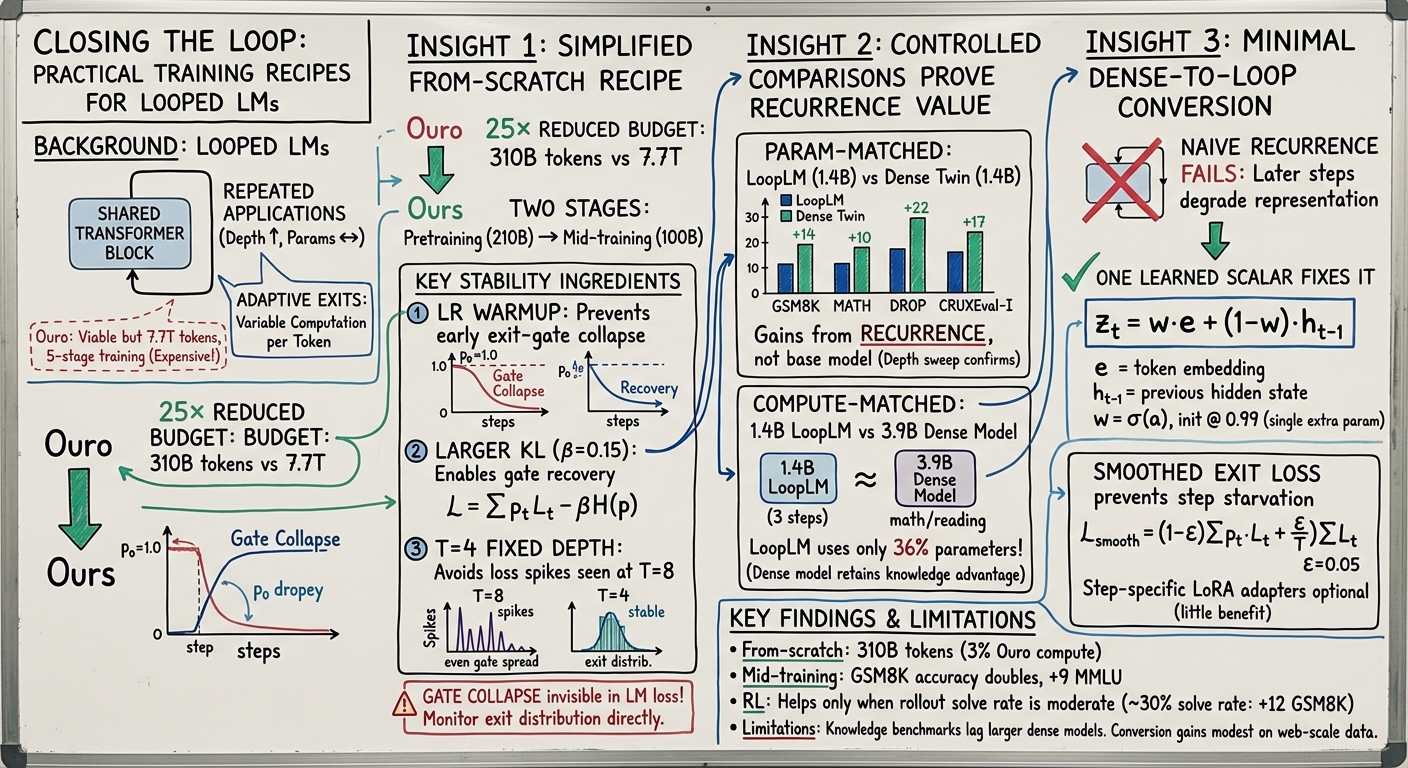
The most prominent signal this issue is that the training cost problem of loop depth is beginning to be directly addressed. Closing the Loop reduces the from-scratch training budget for looped language models from Ouro's 7.7T tokens to 310B tokens (about 3% of the compute), and provides a specific mechanistic diagnosis of exit collapse—learning rate warmup and a larger KL coefficient can prevent or recover from collapse, and language modeling loss itself cannot expose collapse; the exit distribution must be directly monitored. It also offers a minimal dense-to-loop conversion recipe: a single learned scalar plus a smoothed exit loss, without per-step parameters, can prove in controlled comparisons that the loop itself, rather than model scale, brings gains (1.4B LoopLM surpasses the same-parameter dense model on all 12 benchmarks). This directly responds to the issues of the "single-loop tax" and retrofit costs, and for the first time makes the entry cost of independent loop training feasible.
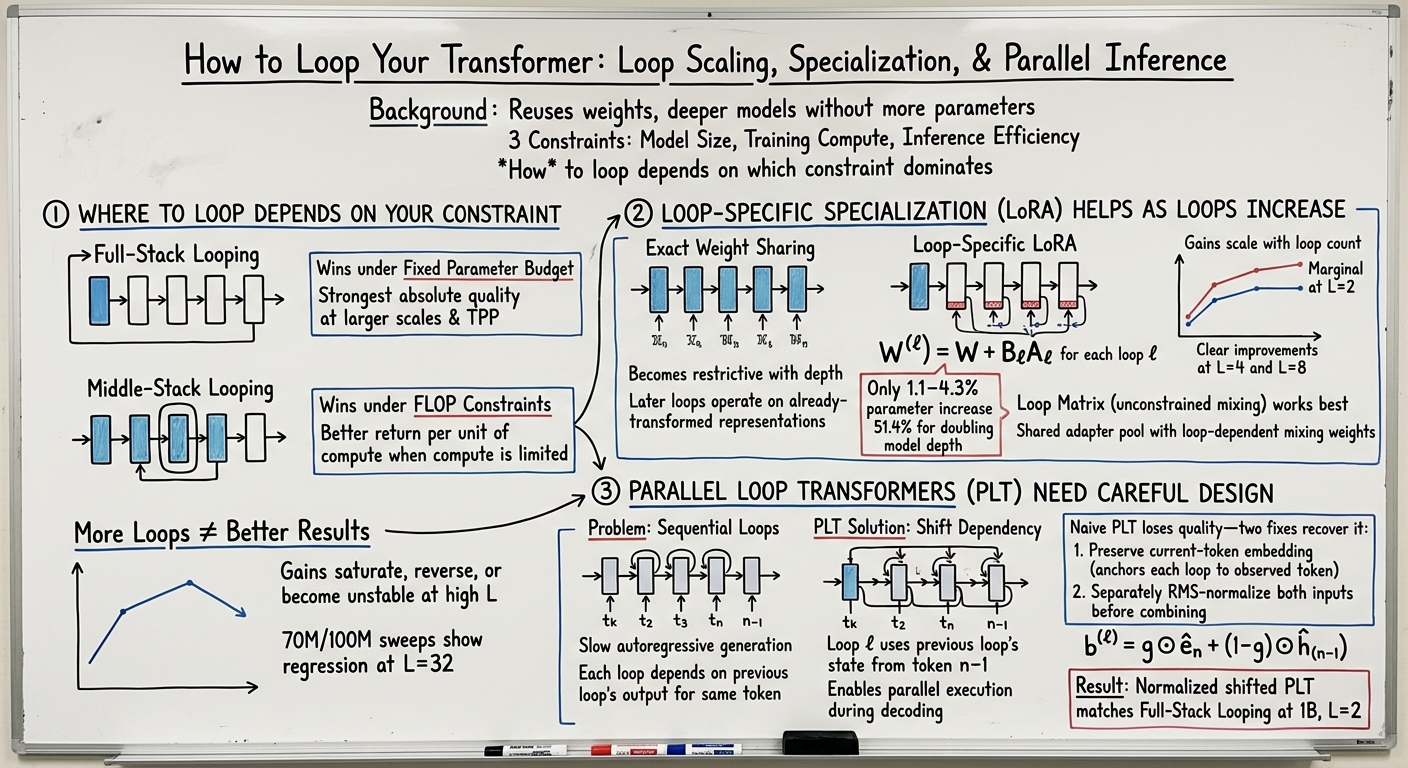
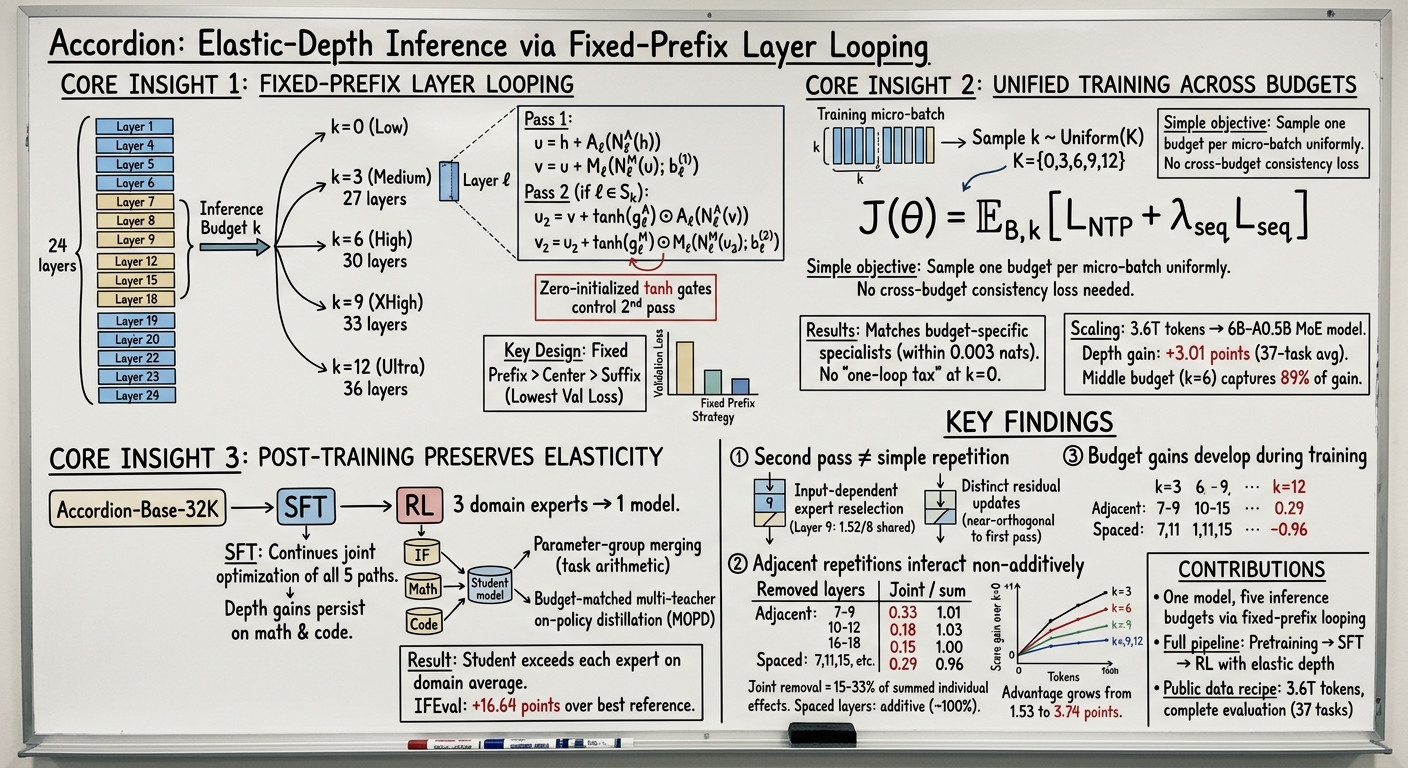
The second theme is the systematic mapping of the loop design space. How to Loop Your Transformer is the first to vary loop position (full-stack, middle-stack, per-layer), loop subcomponents (attention/MLP), loop count, and resource constraints (parameters, FLOP, data efficiency) in a unified from-scratch dense decoder setting, providing a trade-off map across multiple design axes: under a fixed parameter budget, full-stack looping is strongest, while under FLOP constraints, looping middle blocks yields better returns; adding loops is not uniformly beneficial—gains saturate, regress, and can even be unstable. It also diagnoses and fixes the defects of parallel looped transformers (PLT)—retaining the current token embedding and separately normalizing the embedding and loop state restores quality. Accordion transforms layer looping into elastic-depth inference with a fixed prefix path: five budgets share one set of weights, the smallest budget retains the non-loop path, zero-initialized gating makes the second pass start as identity, and depth gains are carried from pretraining through SFT and RL. Together, these show that loop benefits are not a single-dimensional matter; the interaction of position, subcomponents, and resource constraints determines the recipe.
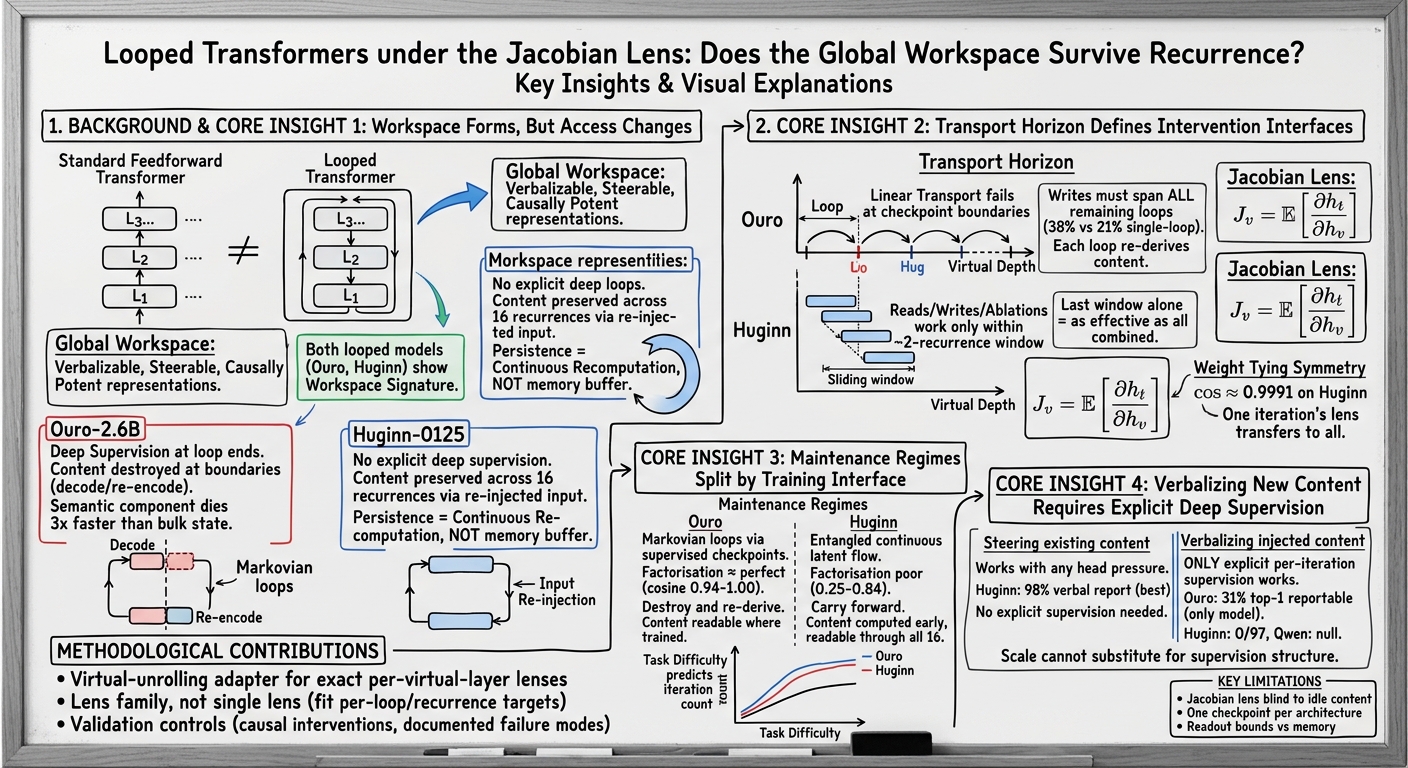
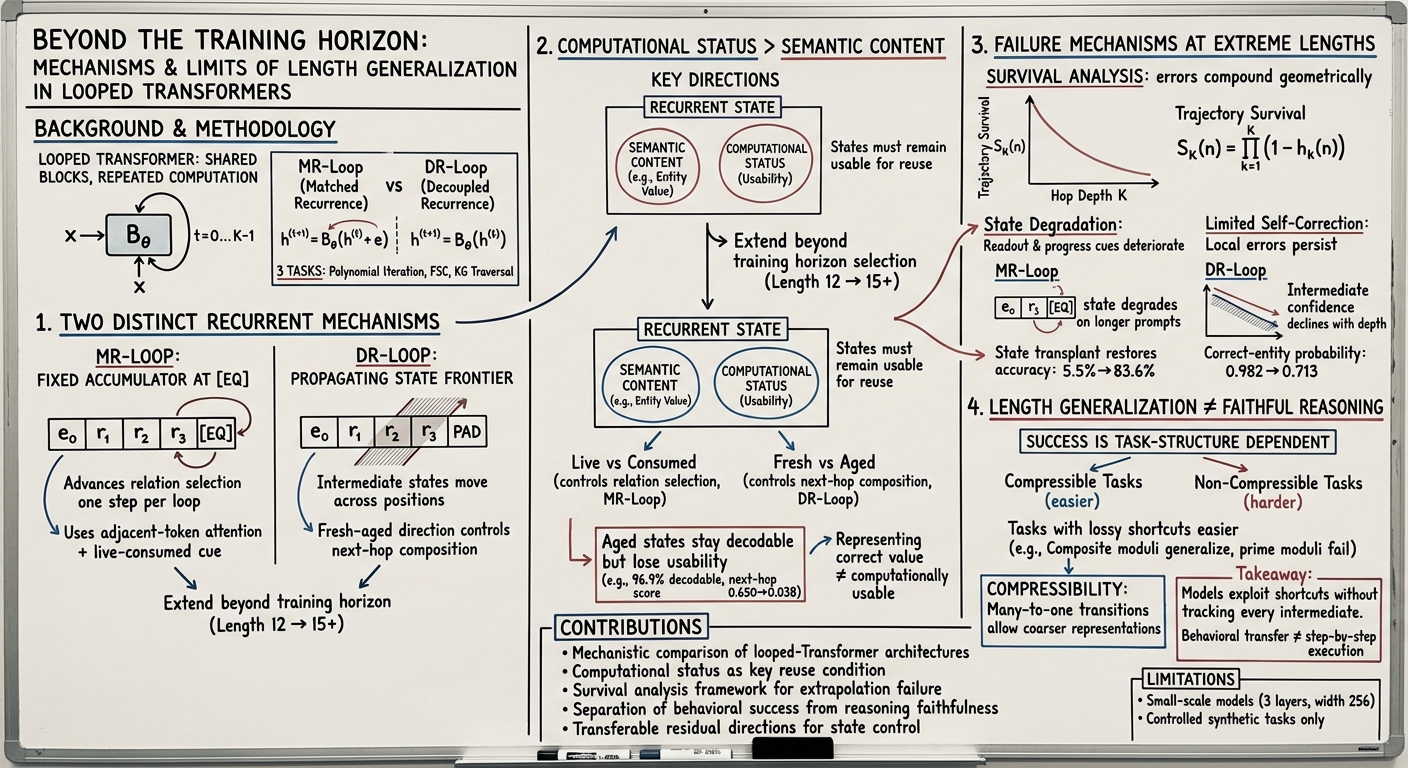
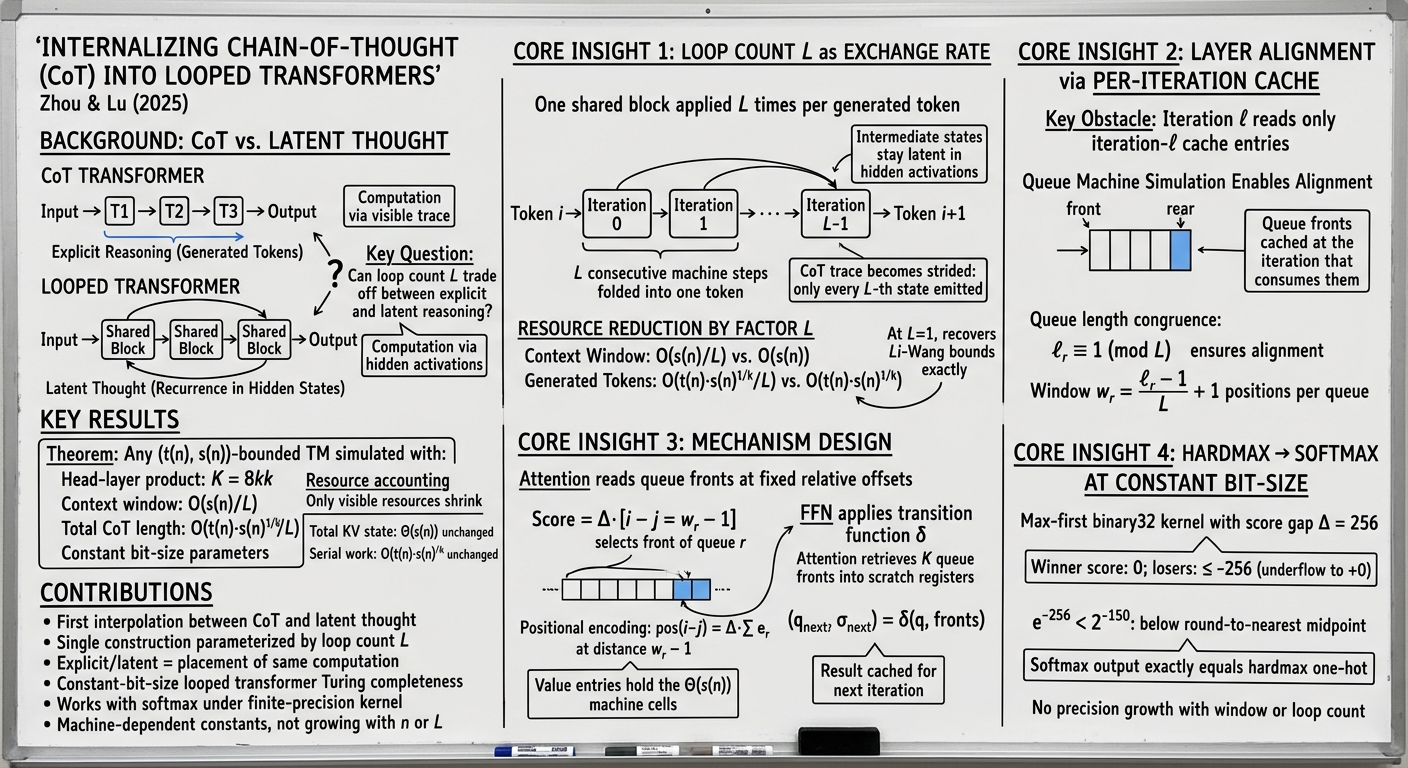
The third theme is that the mechanistic lens begins to answer "what looping changes". Looped Transformers under the Jacobian Lens is the first to apply the Jacobian-lens workspace suite to looped architectures, showing that Ouro's checkpoint loop boundaries disrupt semantic components and interventions must span all remaining loops, while Huginn's content can persist across 16 loops but read/write ablations only affect a sliding window of about 2 loops—causal evidence of how looping reshapes information transmission topology. Beyond the Training Horizon further reveals that loop states encode not only semantic content but also their live/consumed, fresh/aged "computational state," which as a transferable residual direction causally determines whether information can participate in subsequent computation. Theoretically, Internalizing Chain-of-thought into Looped Transformers provides a constructive interpolation between explicit CoT and implicit latent deliberation—the loop count becomes an exchange rate between visible tokens and internal computation.
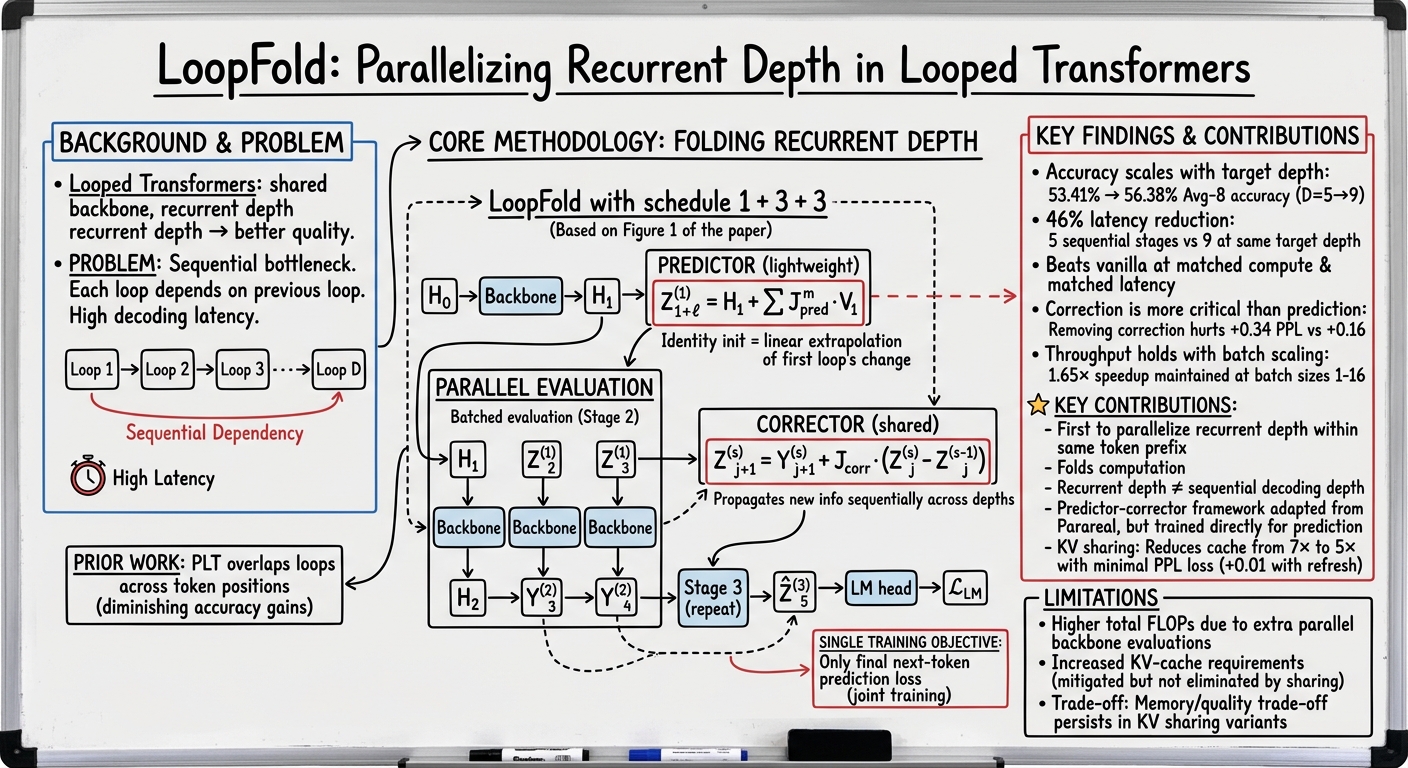
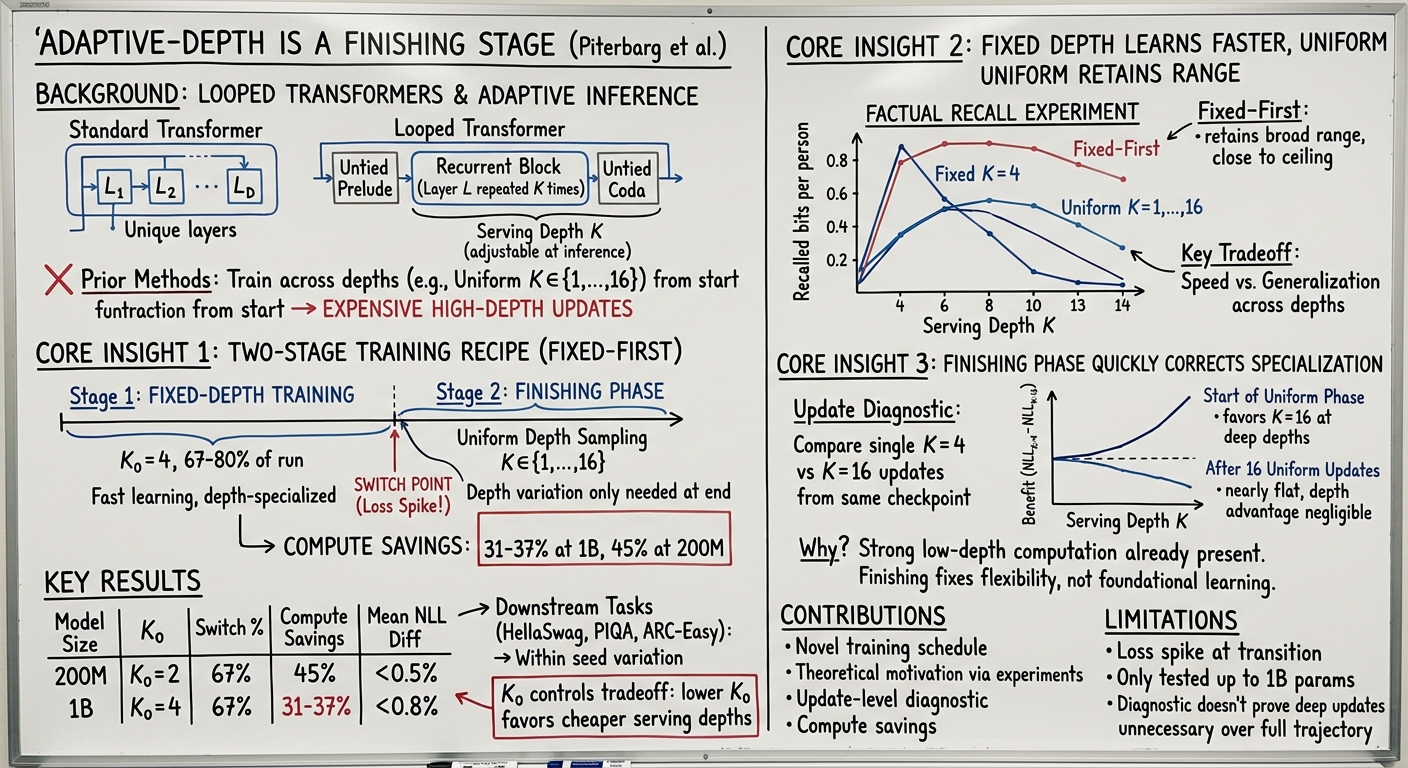
Complementing these core results, LoopFold opens a new axis of parallel depth (folding loops into parallel stages rather than increasing serial depth), and Adaptive-Depth Is a Finishing Stage proves that adaptive-depth training can be compressed into a short finishing stage—these explorations of training schedules and resource utilization are turning loop depth from a "proof of concept" into a manageable engineering asset at scale.
Community and Developments
- Expressivity theory continues to fill gaps: On Expressive Power of Looped Transformers: Theoretical Analysis and Enhancement via Timestep Encoding provides modulus continuity approximation rate bounds for looped transformers, identifies the extra error dependence introduced by weight-shared feedforward networks, and proposes a per-loop timestep encoding fix—a formal result on "what loops can express," complementing the constructive interpolation of Internalizing CoT this issue.
- Community testing of small recursive reasoners continues: Putting the new tiny recursive reasoners to the test on ARC-AGI documents tests and debates of HRM/TRM/URM on ARC-AGI-1—whether nested shared-operator recursion is the source of gains for small models. This remains discussion-level content rather than verifiable research; conclusions await underlying research data.
Open Questions
- Closing the Loop retains strong reasoning performance with 310B tokens but still lags on knowledge benchmarks—does the drastically reduced training budget come at the cost of extrapolation ability beyond training depth? Is there a trade-off between "training budget" and the "loop extrapolation frontier"?
- The Jacobian Lens shows Huginn's read/write ablations only affect a sliding window of about 2 loops, while Beyond the Training Horizon proves that "computational state" determines whether information can participate in subsequent computation—how does this unify with Issue 2's Monitoring latent reasoning in looped language models finding that "carry-type loops peak at training depth and then degrade with iterations"? Is the sliding window the mechanistic source of degradation?
- Accordion finds that the effects of adjacent repeated layers are not additive and that individual ablations overestimate endpoint gains—this raises a methodological warning for mechanism attribution methods like the Jacobian Lens that rely on per-layer ablations/interventions: when ablations are non-additive, how credible are attribution conclusions?
- How to Loop shows that under FLOP constraints, looping middle blocks outperforms full-stack looping, while scaling studies like Issue 3's Truncate or Not prefer full loops when loop count is free—does "loop position preference" change the truncation conclusions of scaling laws depending on resource constraints?
Papers in this issue
Looped language models beat parameter-matched dense transformers on all 12 benchmarks using 25x less training data, via a two-stage recipe and minimal dense-to-loop conversion.
Editor's noteReduces the from-scratch training budget for looped language models from Ouro's 7.7T tokens to 310B tokens (about 3% compute), and provides a mechanistic diagnosis of exit collapse: learning rate warmup and a larger KL coefficient can prevent or recover from collapse, and loss itself cannot expose collapse; the exit distribution must be directly monitored. Relative to Issue 3's Loop the Loopies compute-matched scaling recipe, the increment is a minimal training pipeline—a single learned scalar plus a smoothed exit loss can convert a dense checkpoint into a looped model without per-step parameters; relative to Issue 1's Retrofitting split-bridge retrofit, it is further simplified. It proves in controlled comparisons that the loop itself, not scale, brings gains, complementing both practical recipes and controlled evidence.
Looping transformers works best with Full-Stack Looping for fixed parameters, Middle-Stack for FLOP constraints, and gated parallel variants for inference efficiency.
Editor's noteFirst to systematically compare the interaction of loop position (full-stack/middle-stack/per-layer), loop subcomponents (attention/MLP), loop count, and resource constraints (parameters, FLOP, data efficiency) in a unified from-scratch dense decoder setting, and fixes PLT: retaining the current token embedding and separately normalizing the embedding and loop state. Relative to Issue 3's Towards Looped Models Done Right, Part I focusing on a single architectural axis and Issue 3's Loop the Loopies compute-matched recipe, the increment is a complete trade-off map across multiple design axes under resource constraints. Finds that under a fixed parameter budget, full-stack looping is optimal, while under FLOP constraints, looping middle blocks is more cost-effective, directly guiding recipe selection.
Accordion enables one MoE model to serve five inference budgets via fixed-prefix layer looping, gaining 3.01 points across 37 tasks while retaining unlooped-path quality.
Editor's noteTransforms layer looping into elastic-depth inference with a fixed prefix path: five budgets share one set of weights, the smallest budget retains the non-loop path, and zero-initialized per-channel gating makes the second pass start as identity. Relative to Issue 3's Loop the Loopies layer-looping mode, the increment is a deterministic execution path interface for multiple budgets and a complete pipeline that maintains depth gains across the full process (pretraining, SFT, RL), with a strict compute-matched comparison against independent budget experts at 6B-A0.5B, 3.6T tokens. Mechanistically, it finds that the effects of adjacent repeated layers are not additive and that individual ablations overestimate endpoint gains, offering a methodological warning for ablation-based attribution.
Looped transformers retain a global workspace, but recurrence reshapes its interfaces: reads and writes follow iteration boundaries, not absolute depth, yet neither model preserves injected content beyond roughly two recurrences.
Editor's noteFirst to extend the Jacobian-lens workspace suite to looped architectures, revealing how looping reshapes information transmission topology: Ouro's checkpoint loop boundaries disrupt semantic components and interventions must span all remaining loops, while Huginn's content can persist across 16 loops but read/write ablations only affect a sliding window of about 2 loops. Relative to Issue 2's Monitoring latent reasoning cross-family mechanistic comparison, the increment is the transmission-structure lens itself and a causal suite based on supervised regimes. It directly grounds loop mechanisms in intervention design and early-exit system implications, a new tool for mechanistic analysis.
Looped Transformers achieve length generalization via distinct recurrent mechanisms, but success does not guarantee faithful step-by-step reasoning when tasks permit lossy shortcuts.
Editor's noteSystematically distinguishes two length-extrapolation mechanisms of looped architectures (fixed readout + progression relation selection vs. propagating state frontier), and is the first to causally verify "computational state" as a transferable residual direction independent of semantic content: loop states encode not only content but also its live/consumed, fresh/aged state, which determines whether information can participate in subsequent computation. Relative to Issue 2's Monitoring mechanistic comparison, the increment is fine-grained causal interventions (state exchange, direction vector transfer) and validation beyond the training horizon. Provides a new mechanistic perspective for depth-extrapolation failure and adaptive stopping design; limitation is synthetic sequential compositional tasks.
Looped transformers can simulate Turing machines with both context window and chain-of-thought length reduced by a factor L, trading external tokens for internal recurrent computation.
Editor's noteProvides the first constructive interpolation between explicit CoT and implicit latent deliberation: for a given loop count L, folds L consecutive Turing machine steps into L iterations of a shared block, keeping total KV state and serial work unchanged while shrinking the context window and CoT length by a factor of L each. This is a theoretical bounding of the implicit vs. explicit reasoning axis—the loop count becomes an exchange rate between visible tokens and internal computation—and gives per-iteration cache read rules supporting layer-aligned simulation. Previous expressivity results did not explicitly parameterize this trade-off; this is concrete theoretical progress. Limitation: purely constructive proof, no experiments.
LoopFold decouples recurrent depth from sequential decoding depth by predicting and correcting parallel loop states, cutting latency 46% while improving zero-shot accuracy by 2.20 points.
Editor's noteFolds loop depth into parallel stages: a lightweight predictor estimates inputs for subsequent loops to start them before preceding loops, then corrects with preceding results, trained end-to-end with a single next-token loss. This is a new axis of depth scaling—not increasing serial depth but parallel folding—distinct from PLT's token-shift overlap and Hidden Decoding's multi-stream. Provides comparisons matched for training compute and comparable latency, with quality gains and lower latency; the cost is extra FLOPs and KV cache overhead. Directly relevant for resource utilization in loop training.
Fixed-first training cuts adaptive-depth transformer training compute by 30-45% with negligible quality loss by reserving full-depth updates for a brief final phase.
Editor's noteProposes fixed-first training: train with fixed depth for most of the time and only introduce depth variation in a short final stage, compressing adaptive-depth training from a full-process cost to a finishing stage. At 200M, training with fixed depth 2 for the first 67% of the time reduces modeling compute by about 45%; at 1B, it reduces modeling compute by 31-37% and wall-clock time by 32-39%, with final NLL and downstream performance nearly unchanged. Relative to Issue 3's Truncate or Not full-BPTT scaling study and Issue 1's TaH2 online depth supervision, this is a training-schedule-level increment—depth variation need not participate throughout. Clear comparisons against uniform and curriculum baselines, directly guiding loop training cost reduction.