Inference Efficiency of Recurrent Models: Warm-Start, Multi-Token Drafting, and Self-Distillation
Highlights
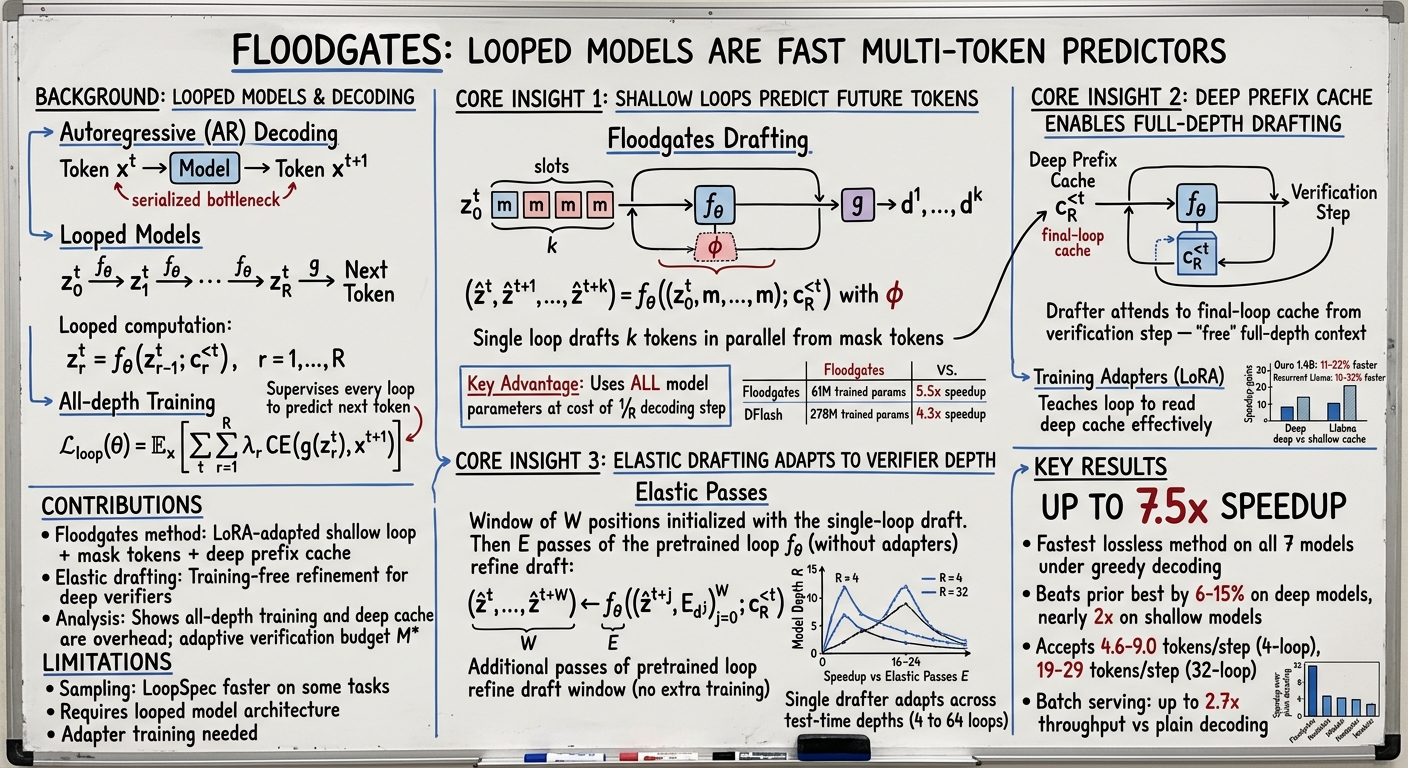
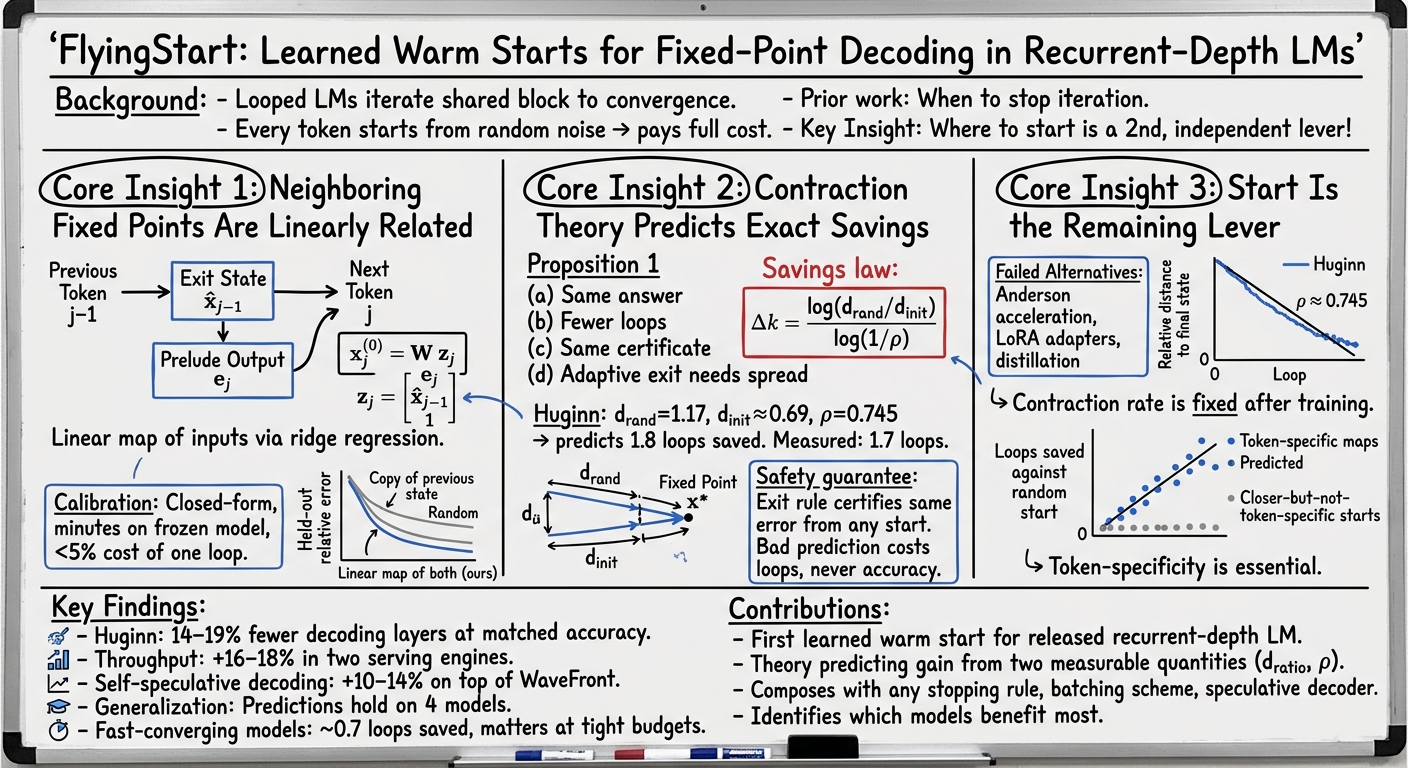
The main theme of this issue is the concentrated effort on "inference efficiency of recurrent models": no longer just asking whether recurrence buys capability, but how to make recurrence faster and more economical at serving time. The most direct is Looped Models are Fast Multi-Token Predictors: it trains shallow recurrent layers as parallel multi-token drafters (Floodgates), using low-rank adapters to draft multiple future tokens in parallel from mask tokens within a single loop, and gives the drafter full-depth computational access via deep prefix caches computed during the verification phase. Across seven models, five benchmarks, and both greedy and sampling decoding, it provides rigorous comparisons, achieving up to 7.5× speedup without loss. FlyingStart takes a different orthogonal lever—not deciding when to stop, but where to start: it uses a learned linear warm-start mapping to predict the initial state of the current token from the exit state of the previous token, and provides a theory based on contraction mappings (Proposition 1) to predict the number of saved loops, validated on four models (including pre-registered predictions on TinyLlama). PackLoop points out that under concurrent load, the bottleneck of self-speculative decoding is the layout of speculative work rather than speculation itself, redefining the cost unit from pass to row, and providing closed-form admission rules with exactness guarantees.
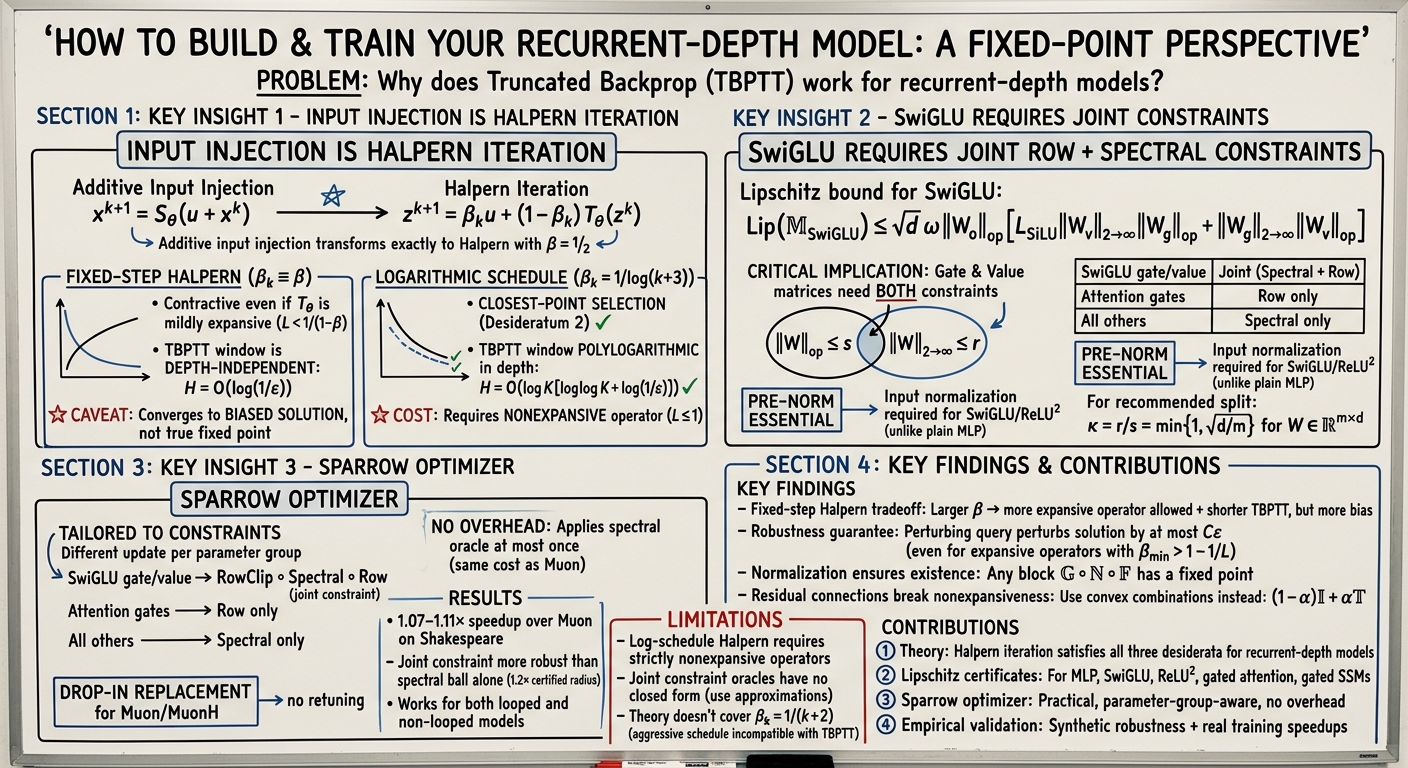
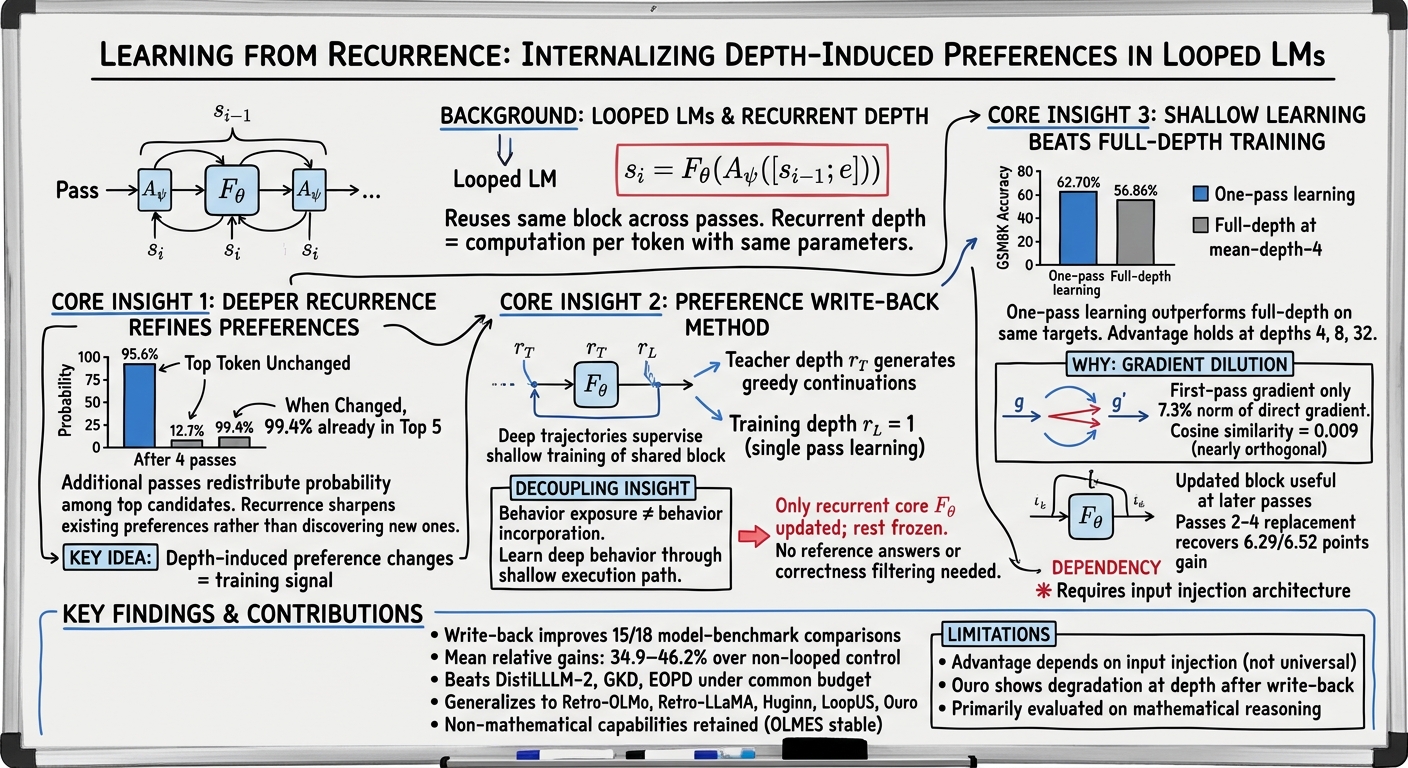
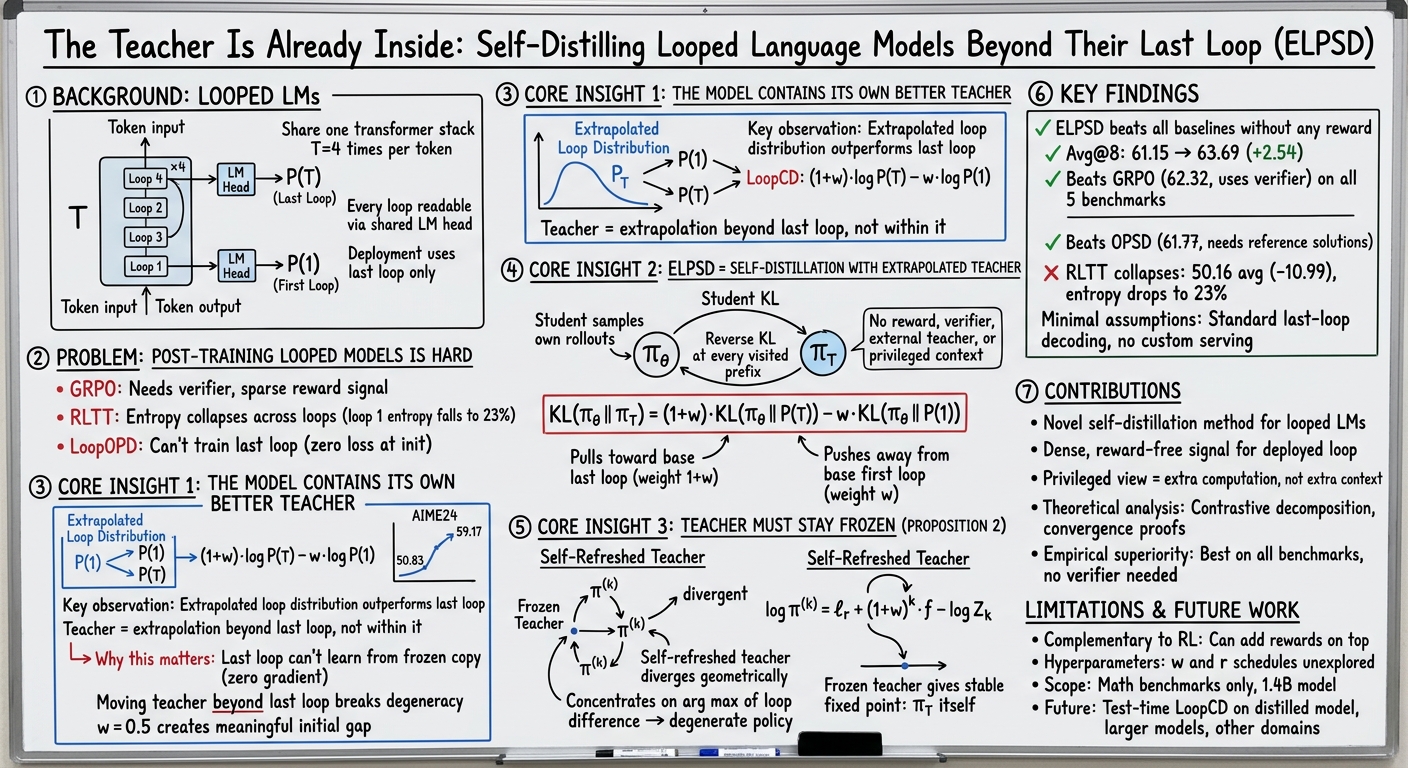
The second theme is training methods and theoretical foundations. How to build and train your recurrent-depth model is the first to strictly equate input injection with Halpern iteration, proving that with fixed step sizes and logarithmically decaying step sizes, truncated backpropagation windows require only constant and polylog depth, respectively, and derives joint row-norm and spectral-norm constraints for SwiGLU, proposing the Sparrow optimizer as a no-overhead alternative to Muon. Learning from Recurrence proposes preference write-back—using the greedy continuations produced by the recurrent model's own deeper execution as supervision, updating the shared recurrent block via only a single loop, without reference answers or correctness filtering, and systematically separating teacher/training/inference depths. The Teacher Is Already Inside directly distills the last loop onto the LoopCD extrapolation distribution that surpasses itself, solving the degenerate problem where the last loop cannot learn from its own frozen copy (loss is zero when w=0), and proves that self-refreshing extrapolation teachers diverge.
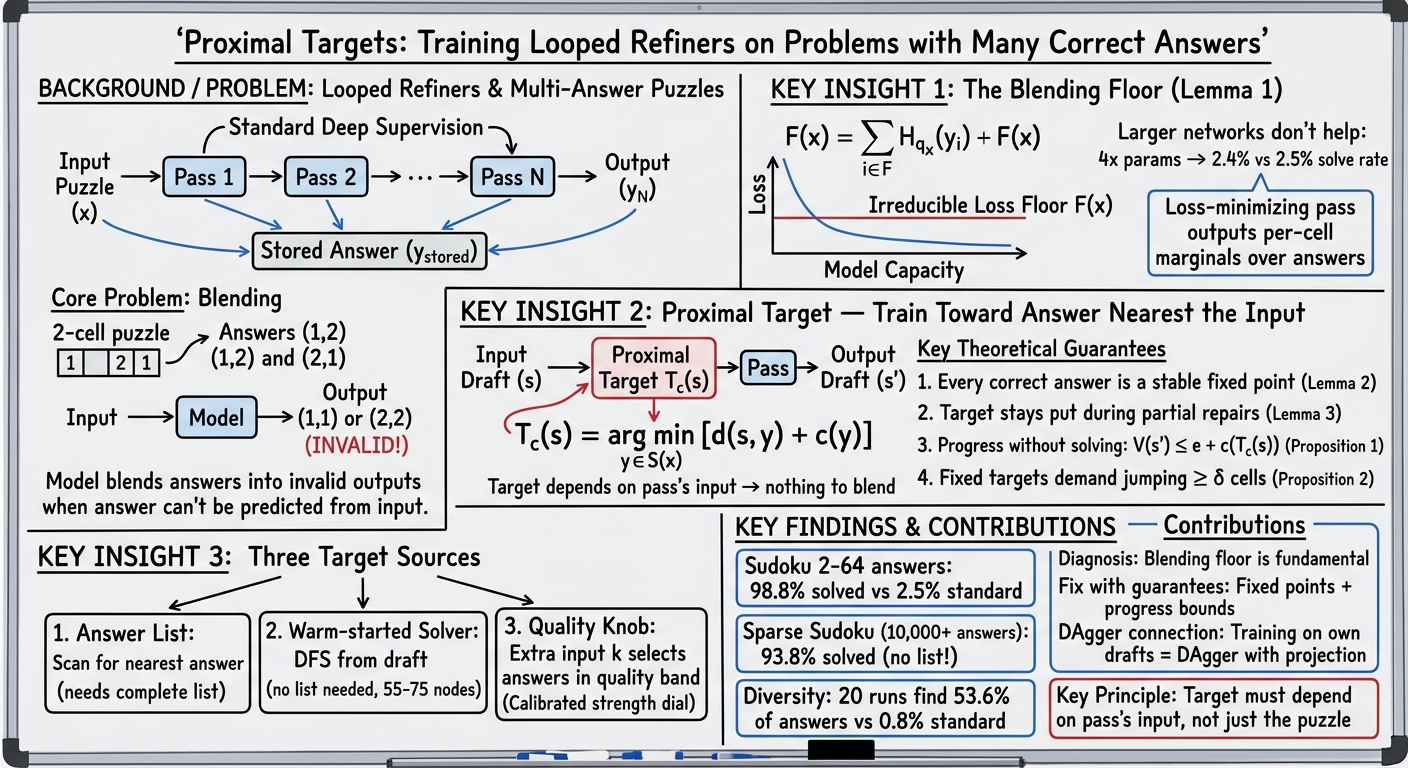
The third theme is training objectives for recursive reasoning models. Proximal Targets points out that on multi-correct-answer problems, the standard deep supervision objective (storing one answer per puzzle) causes loss-minimizing passes to mix answers into invalid grids, forming an irreducible loss lower bound (35.5 bits/puzzle on Sudoku). It proposes "proximal targets" so that each pass trains toward the correct solution closest to its own input, making each answer a fixed point and the training loss an upper bound on loop progress, improving multi-solution puzzle solving rates from 2.5% to 98.8% on Sudoku, graph coloring, and Scrabble.
On production-scale evidence, GLM-5.4 provides flagship-scale iso-parameter comparisons: on a 30B model with the same parameter count and about 10% extra training compute, the recurrent version gains the most in math/science reasoning, and average output length decreases by 10–14% (some explicit thinking is absorbed into loop depth). Inkling 2 Mini quantifies the exchange between loop count and explicit CoT: 1→3 passes extend the no-CoT serial reasoning horizon from 16 seconds to 37 seconds, and CoT shortens but remains readable.
Community and Updates
- GLM-5.4 releases the first flagship-scale Loop Transformer: in a 30B iso-parameter comparison, about 10% extra training compute from looping shortens output length by 10–14% (shorter CoT) while improving math/science reasoning—evidence at flagship scale for implicit depth as a test-time compute axis.
- Inkling 2 Mini (Thinking Machines Lab) releases a production-scale recurrent transformer where increasing loop passes both shortens explicit CoT and extends the no-CoT serial reasoning horizon (1→3 passes from 16 to 37 seconds), directly quantifying the compute exchange between loop depth and explicit reasoning, and reports that looping does not significantly reduce reasoning monitorability.
- TML-d24-varloop-research releases an open-weight model with a single checkpoint and optional loop count at inference, providing infrastructure for controlled comparisons of "loop depth vs. explicit CoT length."
- Reading the Loop mechanism walkthrough shows that hidden loop iterations carry content not present in the output text, providing concrete evidence for implicit depth replacing explicit reasoning tokens.
- Looped LM Panel recap summarizes community debates on whether deep loops equal temporal loops (CoT), the role of expressiveness proofs, how loops extrapolate, and integration with MoE and adaptive computation.
Open Questions
- FlyingStart's warm-start and Issue 7's Late Entry "late entry" compress loops from the start and end points, respectively—can they be combined? Can warm-start's contraction mapping theory be generalized as a standard audit tool for "where to start iteration" in adaptive computation?
- How to build and train proves that input injection is Halpern iteration and truncated backpropagation windows require only constant/polylog depth—how does this reconcile with Issue 3's "Truncate or Not" conclusion that full BPTT is better than truncation? Does the window theory apply only to convergent loops and fail for non-convergent models like Ouro?
- The Teacher Is Already Inside uses extrapolation distributions as training targets, and Learning from Recurrence uses depth-induced preferences as supervision—how do these "learning from own deeper execution" signals unify with Issue 7's UpLoop equal-compute pretraining recipe? Does this mean Issue 5's "There Is No Free Loop" conclusion that "adding loops post-training yields no gains" needs re-examination based on training signals?
- Proximal Targets points out target selection flaws on multi-correct-answer problems—does this explain part of the failures of recursive models on arithmetic tasks in Issue 6's "What Limits Recursive Reasoning Models"? Can proximal targets extend to multi-solution reasoning in language models (e.g., open-ended generation)?
Papers in this issue
Floodgates achieves up to 7.5x lossless decoding speedup on looped language models by using a single loop with low-rank adapters to draft multiple future tokens in parallel.
Editor's noteFirst to train shallow recurrent layers of recurrent language models as parallel multi-token drafters: low-rank adapters draft multiple future tokens in parallel from mask tokens within a single loop, and give the drafter full-depth computational access via deep prefix caches computed during verification. Relative to Issue 5's Dory self-speculative decoding and Issue 7's Late Entry, the increment is using loop depth itself as a parallel axis for multi-token prediction, and systematically proving the key contributions of full-depth supervision and deep prefix caches to draft quality, with rigorous comparisons under greedy and sampling across seven models and five benchmarks, achieving up to 7.5× lossless speedup.
FlyingStart learns a linear warm-start map for recurrent-depth language models, cutting decoding layers by 14–19% while matching accuracy and preserving the exit rule's safety certificate.
Editor's noteFirst to propose learned warm-start for released recurrent-depth models: a closed-form linear mapping predicts the initial state of the current token from the exit state of the previous token, changing the iteration start point rather than the stop point, and combining orthogonally with any stopping rule, batching, and speculative decoding. Relative to Issue 7's Late Entry and Issue 1's LoopCD contrastive decoding, the increment is providing a contraction-mapping-based theory (Proposition 1) to predict the number of saved loops, validated on four models (including pre-registered predictions on TinyLlama). Limitation: does not apply to non-convergent models like Ouro.
Input injection in recurrent-depth models is exactly Halpern iteration, enabling depth-independent truncated backpropagation windows and guiding a new Lipschitz-aware optimizer called Sparrow.
Editor's noteFirst to strictly equate input injection with Halpern iteration, proving that with fixed step sizes and logarithmically decaying step sizes, truncated backpropagation windows require only constant and polylog depth, respectively, and deriving joint row-norm and spectral-norm constraints for SwiGLU, proposing the Sparrow optimizer as a no-overhead alternative to Muon. Relative to Issue 6's Rectified Looped Transformer analytic scheduling and Issue 3's Truncate or Not truncation scaling, the increment is providing a fixed-point theoretical explanation for input injection and training guarantees under Lipschitz constraints. Limitation: nanoGPT-scale experimental size.
Preference write-back, a self-distillation method where looped language models learn from their own deeper recurrent outputs, improves reasoning accuracy by up to 46% without external supervision.
Editor's noteFirst to propose preference write-back: using the greedy continuations produced by the recurrent model's own deeper execution as supervision, updating the shared recurrent block via only a single loop, without reference answers or correctness filtering, and systematically separating teacher/training/inference depths. Relative to Issue 7's UpLoop equal-compute training and Issue 4's Internalizing CoT constructive interpolation, the increment is using depth-induced preference changes themselves as training signals, and proving that single-pass learning outperforms full-depth learning, and that updates learned in shallow layers remain effective in subsequent loops. Limitation: primarily math tasks, 1B scale.
ELPSD enables a looped language model to self-distill without rewards by training its last loop against an extrapolated contrastive teacher from its own frozen weights, beating GRPO on math benchmarks.
Editor's noteFirst to directly distill the last loop of recurrent language models onto the LoopCD extrapolation distribution that surpasses itself, solving the degenerate problem where the last loop cannot learn from its own frozen copy (loss is zero when w=0), and proving that self-refreshing extrapolation teachers diverge. Relative to Issue 1's LoopCD (test-time decoding only) and LoopOPD (training only intermediate loops), the increment is using the extrapolation distribution as a training target to directly train the deployed loop, without rewards, external teachers, or privileged context, surpassing GRPO with verifiers on five math benchmarks. Limitation: 1.4B scale, modest gains.
Training looped refiners on the correct answer nearest to each draft eliminates the blending loss floor, boosting multi-answer Sudoku solving from 2.5% to 98.8%.
Editor's noteFirst to identify the training objective flaw for loop refiner on multi-correct-answer problems: the standard deep supervision objective (storing one answer per puzzle) causes loss-minimizing passes to mix answers into invalid grids, forming an irreducible loss lower bound. The proposed proximal targets make each pass train toward the correct solution closest to its own input, making each answer a fixed point and the training loss an upper bound on loop progress. Relative to Issue 6's What Limits Recursive Reasoning Models and Issue 3's PAR, the increment is directly addressing the multi-answer target selection problem with theoretical guarantees, improving solving rates on multi-solution Sudoku from 2.5% to 98.8%. Limitation: ≤6.9M parameters, puzzle tasks.
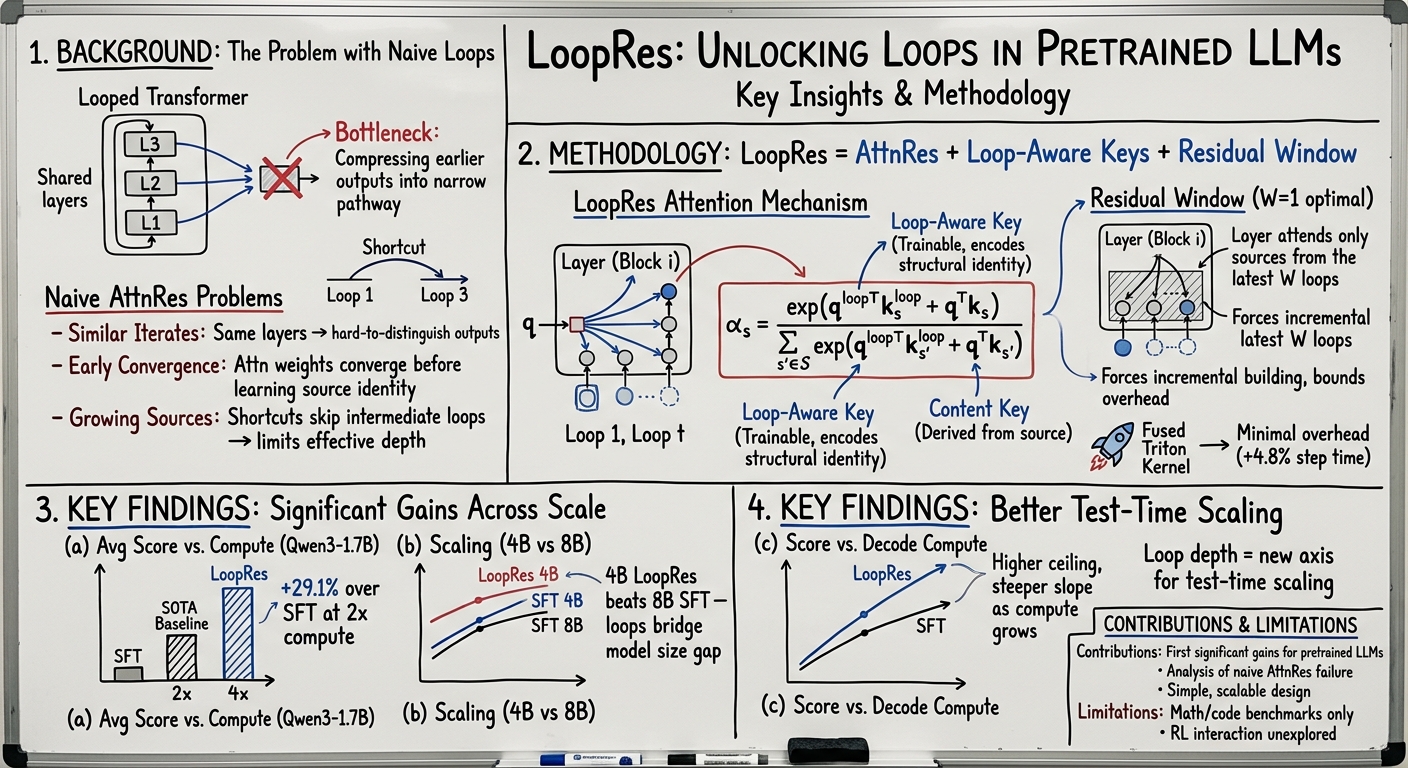
LoopRes finetunes pretrained LLMs into looped Transformers, adding loop-aware keys and residual windows to boost math and code scores by up to 29.1% over SFT.
Editor's noteAdapts attention residual to the retrofit scenario of recurrent transformers, proposing loop-aware keys and residual windows to address issues of similar loop iterations, early attention convergence, and growing source counts. Relative to Issue 5's ARLoop sliding-window depth attention, the increment is explicitly trainable loop identity keys and window restrictions, and targets retrofit rather than training from scratch, showing equal-compute improvements and test-time scaling advantages on multiple pretrained LLMs.