Verifiability of Sparse Expert Structures—Load Balancing, Causal Auditing, and System Measurements
Highlights of This Issue
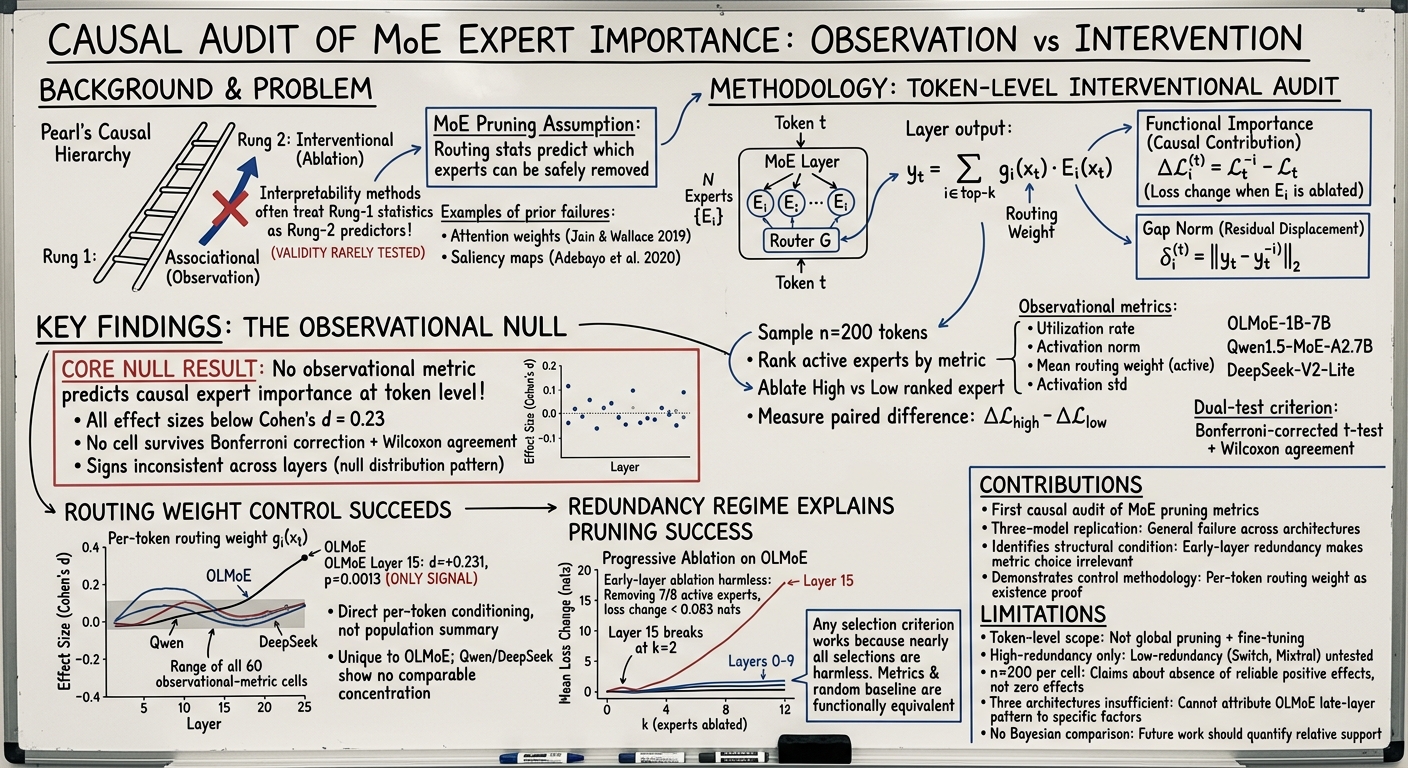
This issue focuses on the "verifiability of sparse expert structures": from load balancing to expert specialization, multiple works raise the bar of evidence to the level of causal intervention and system measurement. On one hand, Kimi K3 pushes auxiliary-loss-free load balancing from fixed-step sign updates to quantile-exact matching with Quantile Balancing at the extreme sparse frontier scale of 2.8T parameters and 896 experts (16 active), paired with RMSNorm and SiTU-GLU for stable optimization—this is the first scalable verification of load balancing algorithms under extreme sparsity. On the other hand, multiple causal auditing works provide cautionary negative results: observed routing statistics cannot predict token-level expert importance, apparent modularity flips with measurement choices, and EP scaling itself does not eliminate routing imbalance. These results collectively point to a judgment: research on sparse expert structures is shifting from "demonstrating phenomena" to "proving mechanisms."
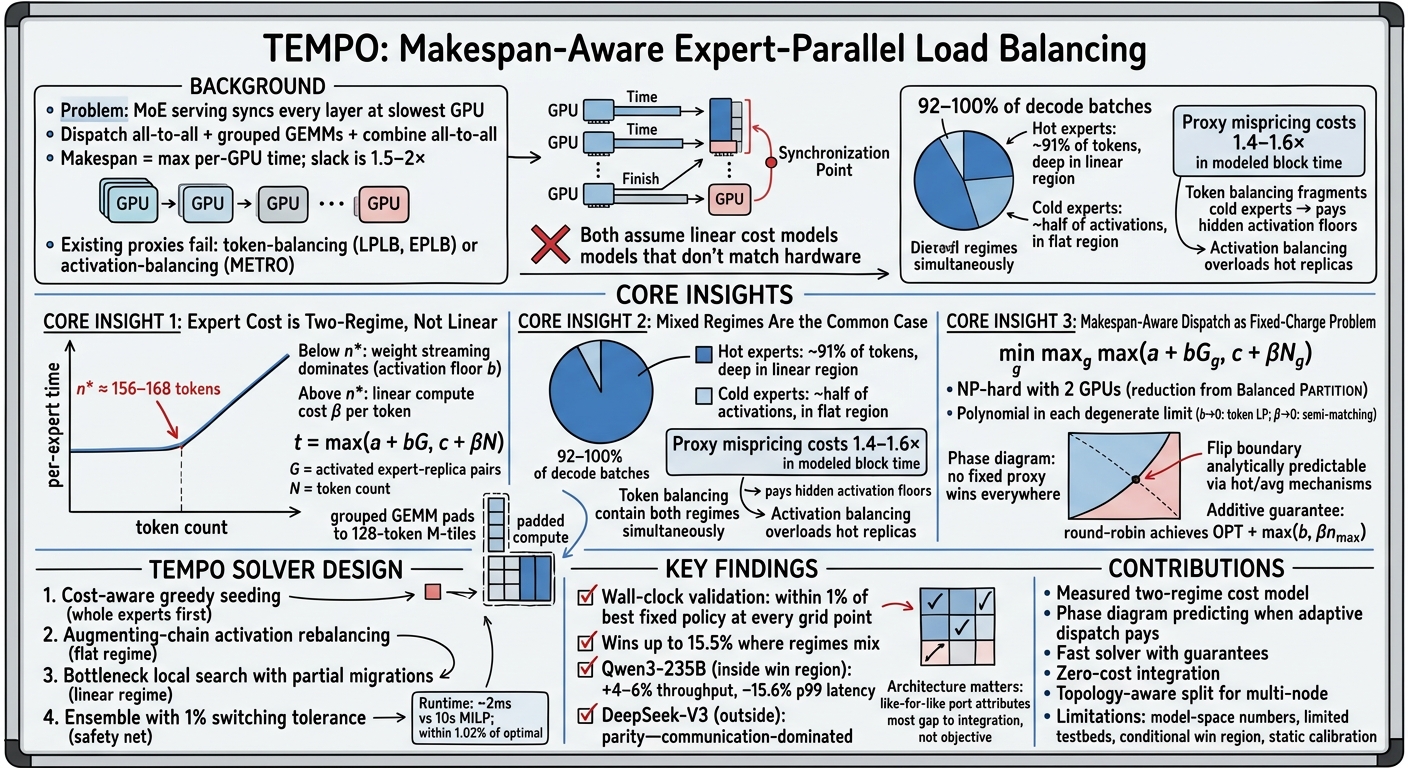
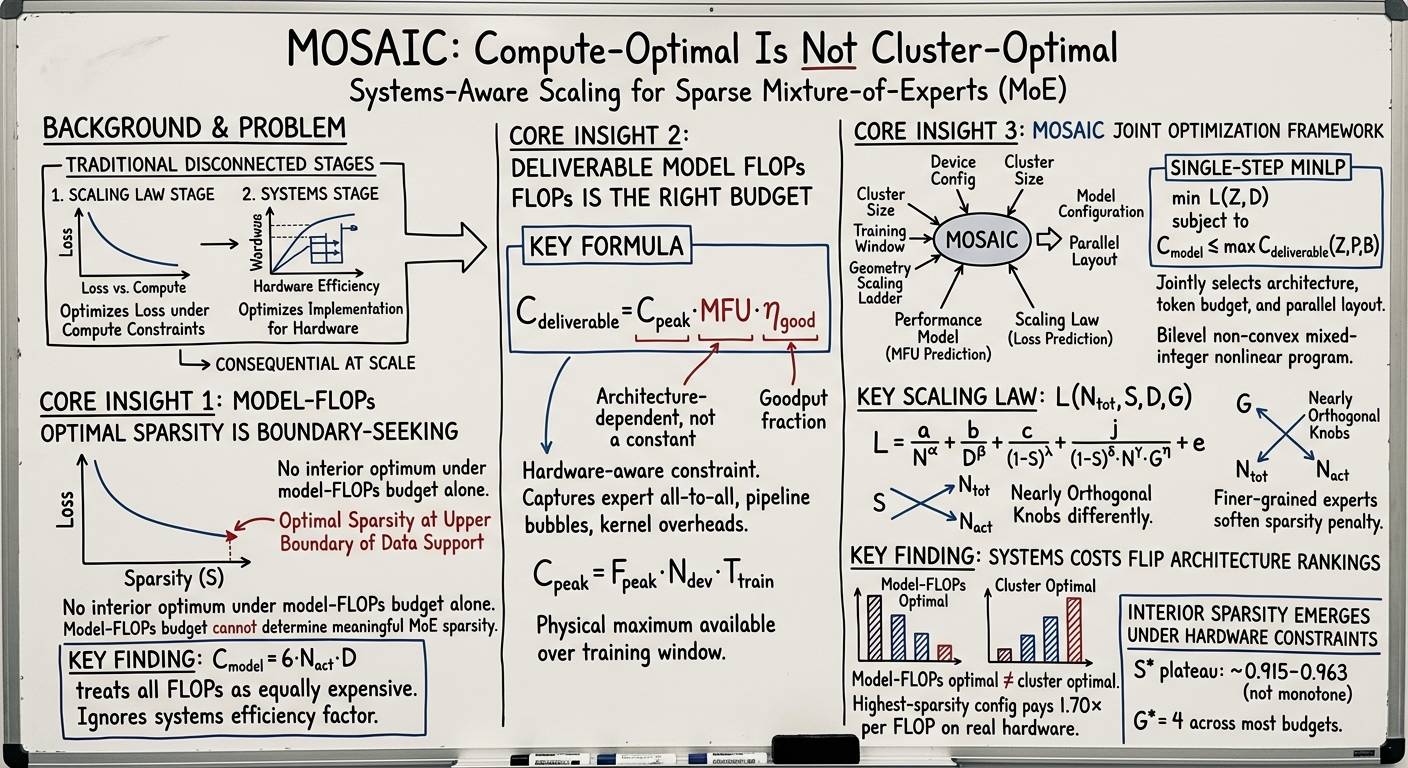
On the system side, TEMPO reveals the reality that memory-bound and compute-bound regimes coexist in EP distribution—92–100% of real batches contain both regimes, token-count proxies systematically fail at regime mixtures, and it uses phase diagrams to predict when adaptive distribution is worth the investment. MOSAIC jointly optimizes architecture and parallel layout under a hardware-deliverable FLOPs budget, proving that model-FLOPs-optimal sparsity is boundary-seeking, and only when cluster system efficiency is accounted for does an interior optimum emerge. Together, they turn "loss-optimal ≠ cluster-optimal" from a slogan into a computable framework.
Community and Developments
On the engineering community side, SGLang's Waterfill and LPLB advance inference-time load balancing to dynamic token reassignment based on real-time queue lengths, combined with locality-preserving expert placement, representing a significant increment over static/heuristic balancing. NVIDIA's GB300 NVL72 serving 2.4T parameter Qwen3.8-A95B deployment report demonstrates the landing of dynamic top-k routing and attention-expert separation deployment on rack-scale hardware.
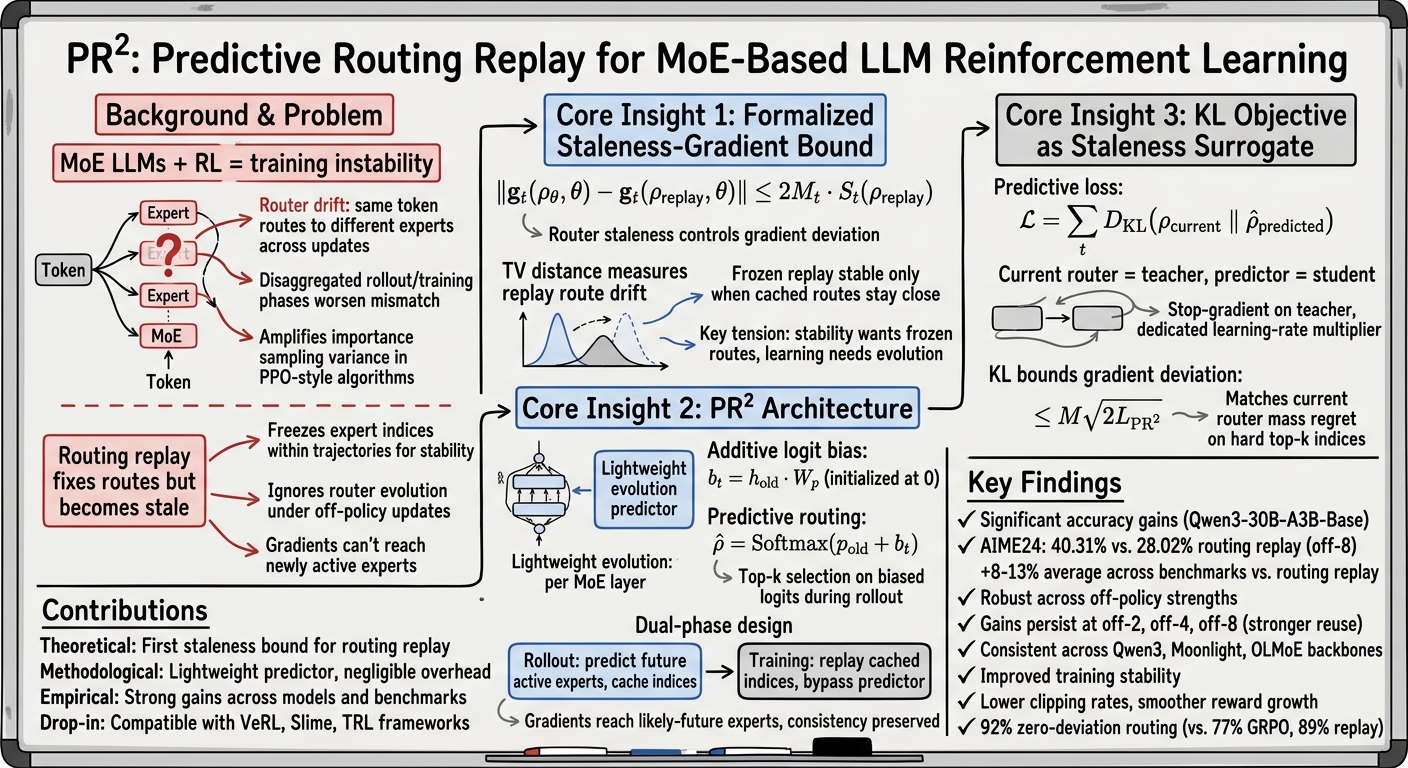
In the RL stability direction, multiple ACL 2026 works directly target the core concern of training-inference routing drift: RSPO mitigates inconsistency by explicitly constraining routing distribution drift during policy updates and introducing routing entropy regularization; Sparse-RL proposes stable sparse rollout, activating only top-k experts during rollout and using routing stability penalties to prevent drift; ExpertIS proposes an expert-perspective importance sampling estimator, using reweighting to correct gradient bias caused by routing changes rather than replaying old routes. Additionally, memory-aware routing extends load balancing criteria from computation to memory occupancy, targeting heterogeneous memory systems.
Open Questions
-
Given that observed routing statistics cannot predict token-level causal expert importance, what token-level signals (e.g., downstream gradients, counterfactual utility) can truly support expert pruning and specialization claims? Can the intervention protocol from causal auditing be generalized into an industry standard?
-
If EP scaling itself cannot eliminate routing imbalance (stragglers are intrinsic to routing decisions), what is the correct system-level lever—precise load rebalancing (e.g., UltraEP), cross-layer scheduling (e.g., EasyBalance), or fundamentally changing the routing algorithm?
-
How does quantile-based bias updates (Kimi K3's Quantile Balancing) interact with RL-phase routing replay/prediction mechanisms under extreme sparsity? Does the precision of biases amplify routing drift under off-policy conditions?
-
Since apparent modularity flips with corpus, metric, and statistical criteria (see modularity causal tests), does "expert specialization" require a standardized evaluation protocol across models and metrics? How should null results and positive results be compared under the same standard?
Papers in this issue
Kimi K3, a 2.8T-parameter MoE model with 104B active parameters, achieves frontier performance across coding, reasoning, and vision tasks via architectural innovations yielding 2.5x scaling efficiency over its predecessor.
Editor's noteAt the extreme sparse frontier scale of 2.8T parameters and 896 experts (16 active), proposes Quantile Balancing (QB)—setting expert biases directly from router-score quantiles to exactly match target load, replacing fixed-step sign-based bias updates, paired with RMSNorm and SiTU-GLU for stable optimization. This is the first scalable scheme for auxiliary-loss-free load balancing under extreme sparsity, reporting full routing statistics and a 2.5× scaling efficiency improvement, making it a must-read for load balancing and sparse stability directions.
TEMPO replaces token-count or activation-count proxies with a calibrated two-regime time model, achieving within 1.02% of optimal makespan at millisecond cost and 4-6% throughput gains in mapped win regions.
Editor's noteFirst to model expert costs in EP distribution as a max-affine cost function with memory-bound (flat) and compute-bound (linear) regimes, formalized as a fixed-charge makespan problem (NP-hard with additive approximation guarantees). On real batches, 92–100% contain both regimes, and token-count proxies systematically fail at regime mixtures; TEMPO yields 4–6% throughput and ~15.6% p99 latency improvements on Qwen3-235B, and uses phase diagrams to predict when adaptive distribution is worth the investment. A significant methodological contribution to expert-parallel serving and load balancing.
In a pre-registered causal test of Command A+, only 1 of 6 expert families (Arabic) is a robust module, with apparent modularity fragile to corpus, metric, and statistical bar.
Editor's noteOn Command A+, performs causal ablations of six pre-registered expert families, treating corpus, metric, and statistical criteria as variables. The conclusion is cautionary: only the Arabic family is a robust module among the six, while the apparent modularity of the others flips with corpus/metric/statistical criteria. This is a benchmark work for the causal evidence threshold of expert specialization, and its "measurement-as-variable" protocol should become standard for subsequent modularity claims.
PR² introduces a lightweight evolution predictor to anticipate router drift in MoE LLMs, reducing route-induced gradient deviation and improving reasoning accuracy by up to 13% over existing replay methods.
Editor's noteAddressing the staleness issue of routing replay in MoE RL, proposes Predictive Routing Replay (Pr2): using a lightweight evolutionary predictor to anticipate short-term router drift, using predicted distributions for top-k during rollout, and replaying predicted routes during training to maintain determinism. Theoretically provides bounds linking replay staleness to routing-induced gradient bias, and experiments on models like Qwen3-30B-A3B significantly reduce routing mismatch and improve inference performance. An important comparison for routing replay alternatives.
Compute-optimal MoE configurations are not cluster-optimal: optimizing for hardware-deliverable FLOPs, not model FLOPs, yields interior sparsity optima and flips loss rankings.
Editor's noteJointly optimizes sparse MoE architecture and parallel layout under a hardware-deliverable FLOPs budget, proving that model-FLOPs-optimal sparsity is boundary-seeking, and only when cluster system efficiency is accounted for does an interior optimal sparsity emerge. Fits joint scaling laws and calibrated performance models from ~150 from-scratch pretraining runs, validated up to 250B total parameters. Directly addresses the scaling behavior concern that "loss-optimal is not necessarily cluster-optimal."
No observational routing metric predicts causal expert importance at the token level across three MoE architectures, with pruning success explained by early-layer redundancy rather than metric validity.
Editor's noteConducts token-level causal auditing of three high-redundancy MoE architectures, finding that observed statistics such as utilization, activation norm, and routing weights cannot predict token-level causal expert importance (all 60 metric-layer combinations have effect sizes below Cohen's d=0.23). This is a strong negative result against implicit assumptions in MoE pruning literature, and introduces a reusable intervention auditing protocol (Definition 2.1), serving as a benchmark for causal evidence in expert specialization.
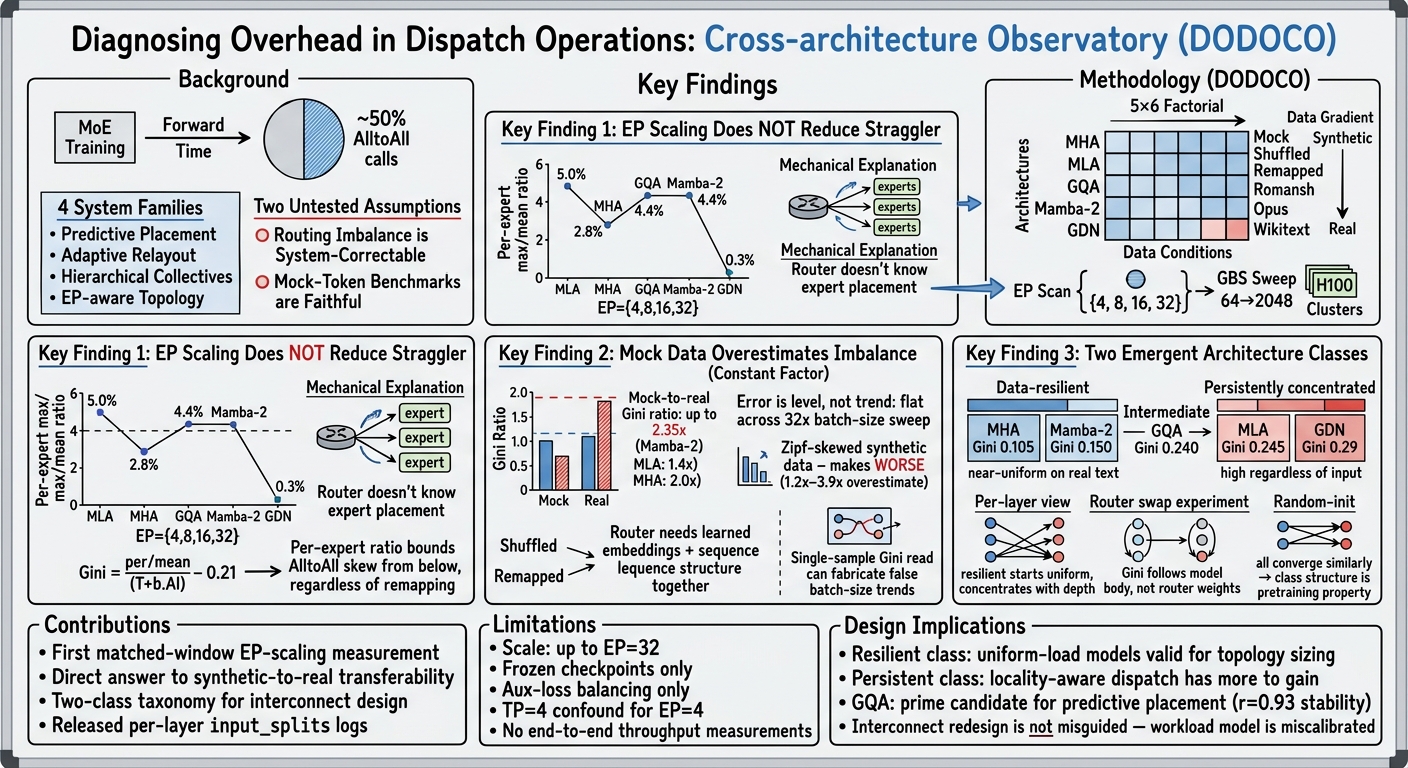
Routing imbalance in Mixture-of-Experts models is a model-and-data property, not a scaling issue, with architectures splitting into data-resilient and persistently concentrated classes.
Editor's noteFirst to systematically characterize MoE routing imbalance behavior with EP degree across architectures and data conditions: EP scaling barely changes per-expert load concentration (stragglers are intrinsic to routing decisions), and mock-token benchmarks systematically overestimate routing imbalance by up to 2.35×. Proposes a taxonomy of architectures into data-elastic vs. persistently concentrated, providing calibrated benchmarks for routing algorithm and expert-parallel system design.
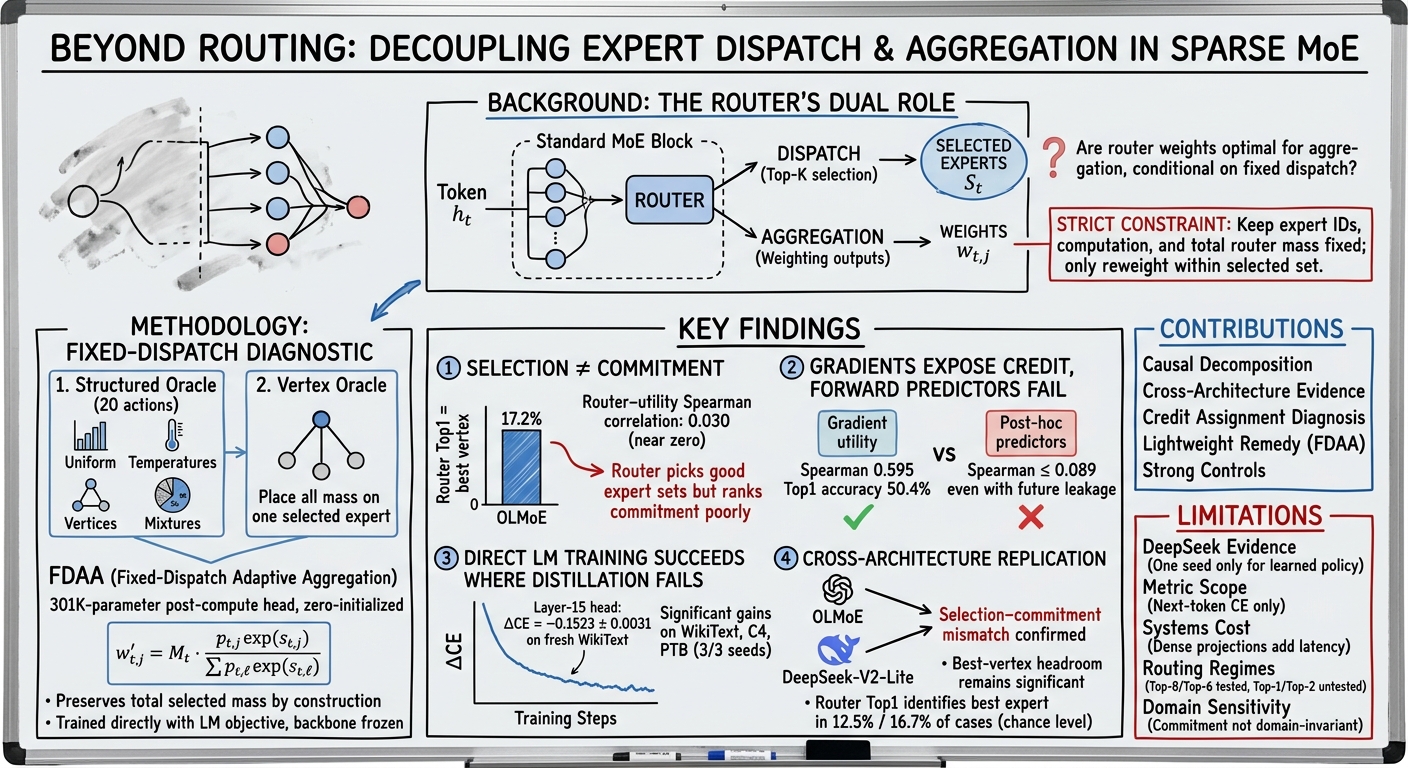
]] scores poorly weight selected experts in sparse MoE models, yet a lightweight post-hoc head trained directly on the language modeling objective recovers substantial gains.
Editor's noteDecomposes MoE routing causally into distribution (which experts are selected) and aggregation (how to weight computed outputs), and via counterfactual fixing of distribution finds that the router's intra-set weights are far from optimal. Proposes FDAA, a lightweight post-hoc head that learns token-adaptive aggregation under LM objectives, replicated across OLMoE and DeepSeek-V2-Lite. Provides an alternative path for routing-commitment mismatch without re-routing.
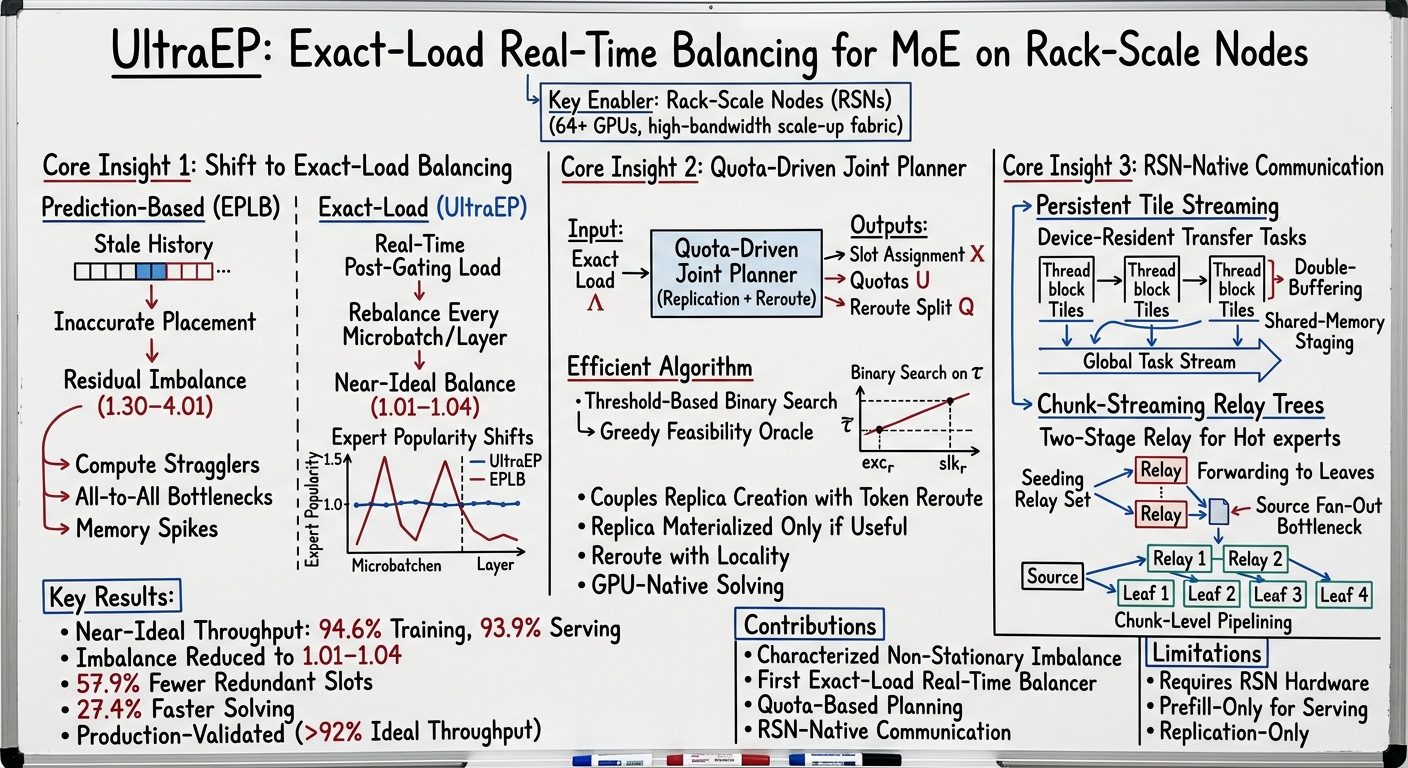
UltraEP achieves 94.6% of ideal throughput in MoE training by using exact-load, real-time expert replication and rerouting, outperforming prediction-based balancers by 1.42x.
Editor's noteFirst system to achieve precise load and real-time expert load balancing on rack-scale nodes (RSN), rebalancing at every microbatch and layer, jointly optimizing expert replication and token re-routing, with RSN-native communication (persistent tile streaming and relay fan-out mitigation). Achieves 94.3% of force-balanced ideal throughput on 106B–671B models with up to 256 GPUs, reducing final rank-level imbalance to 1.01–1.04. A strong baseline for dynamic expert rebalancing.