Controlled Baselines Counter Dynamic Routing Methods
Highlights
The main theme of this issue is "controlled baselines are countering dynamic routing methods." Two independent works have falsified the effectiveness of dynamic expert skipping and routing statistics as proxy signals, using static top-k baselines matched to measured compute and random selection controls, respectively—setting a new burden of proof for the entire dynamic routing direction. Meanwhile, train-inference consistency has been advanced to the quantization execution path, and a new load-balancing path using expert complementarity as a signal has emerged on the serving side.
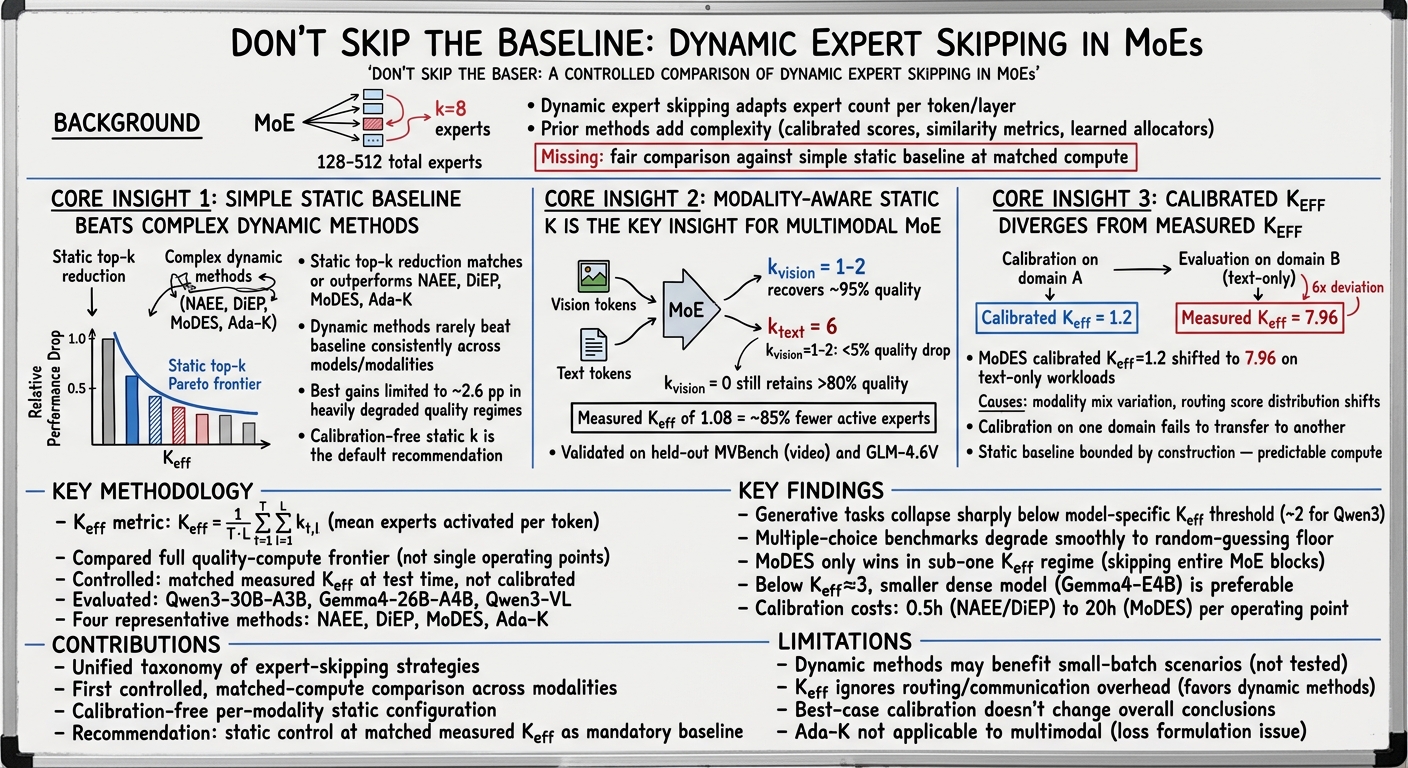
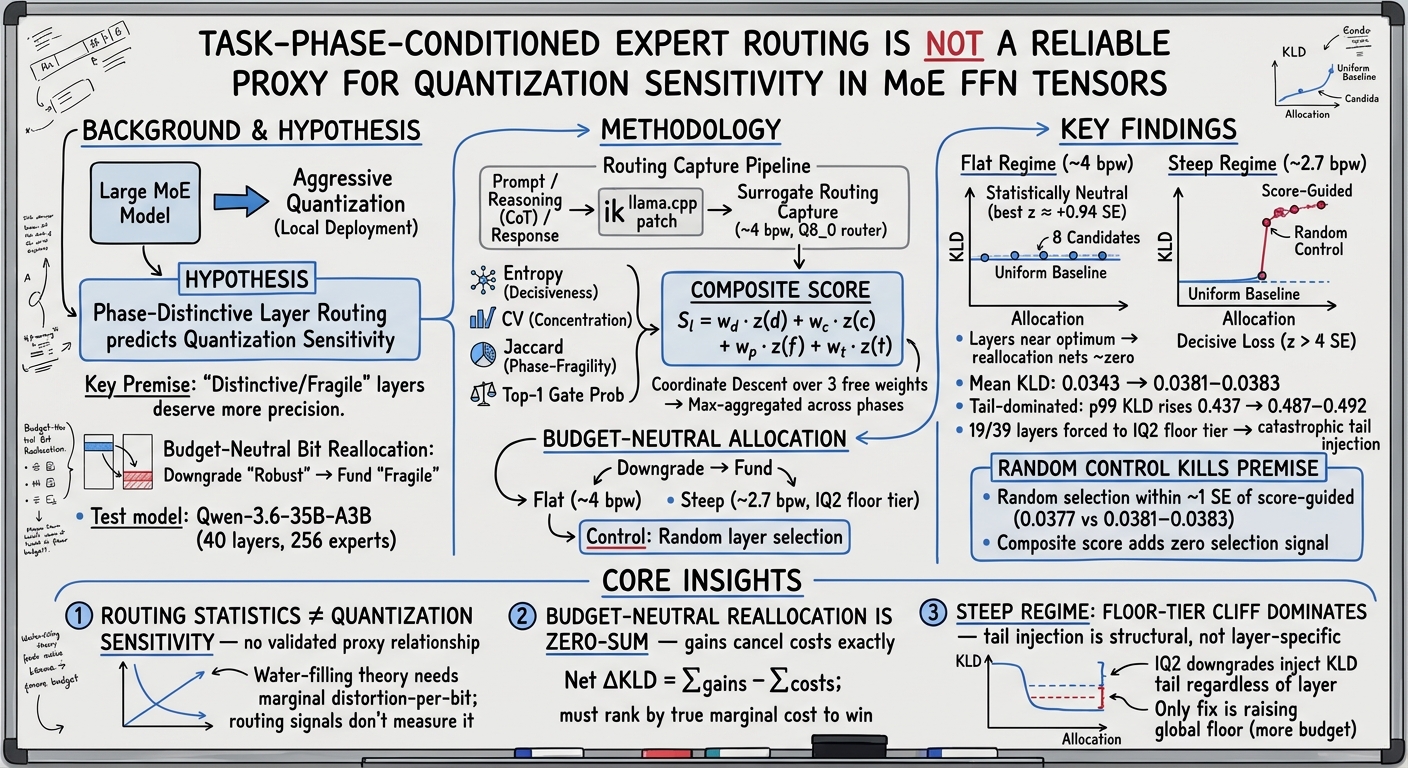
Don't Skip the Baseline establishes "matching measured compute" as the baseline that dynamic expert skipping methods must beat: under a unified taxonomy, four representative methods (NAEE, DiEP, MoDES, Ada-K) fail to consistently outperform static top-k under matched K_eff budgets, and calibrated K_eff can deviate from measured K_eff by more than 6x, directly engaging with the inference-time k-reduction and skipping routes of Issue 5's Training-Free Halving and Issue 6's ACE. Task-Phase-Conditioned Expert Routing Is Not a Reliable Proxy for Quantization Sensitivity uses random selection controls to prove that routing statistics carry no selection signal in budget-neutral mixed-precision allocation, complementing the falsification path of Issue 8's Routing Drift Alone.
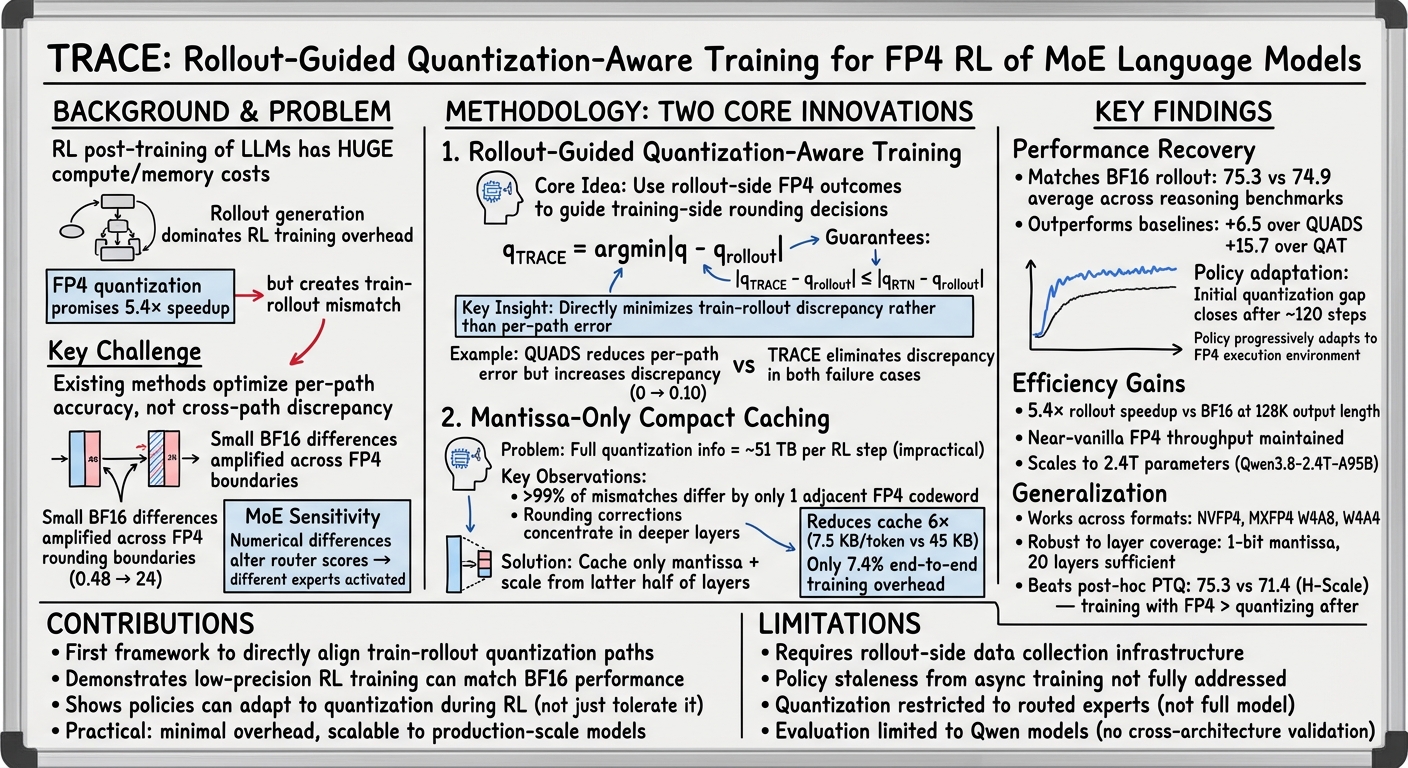
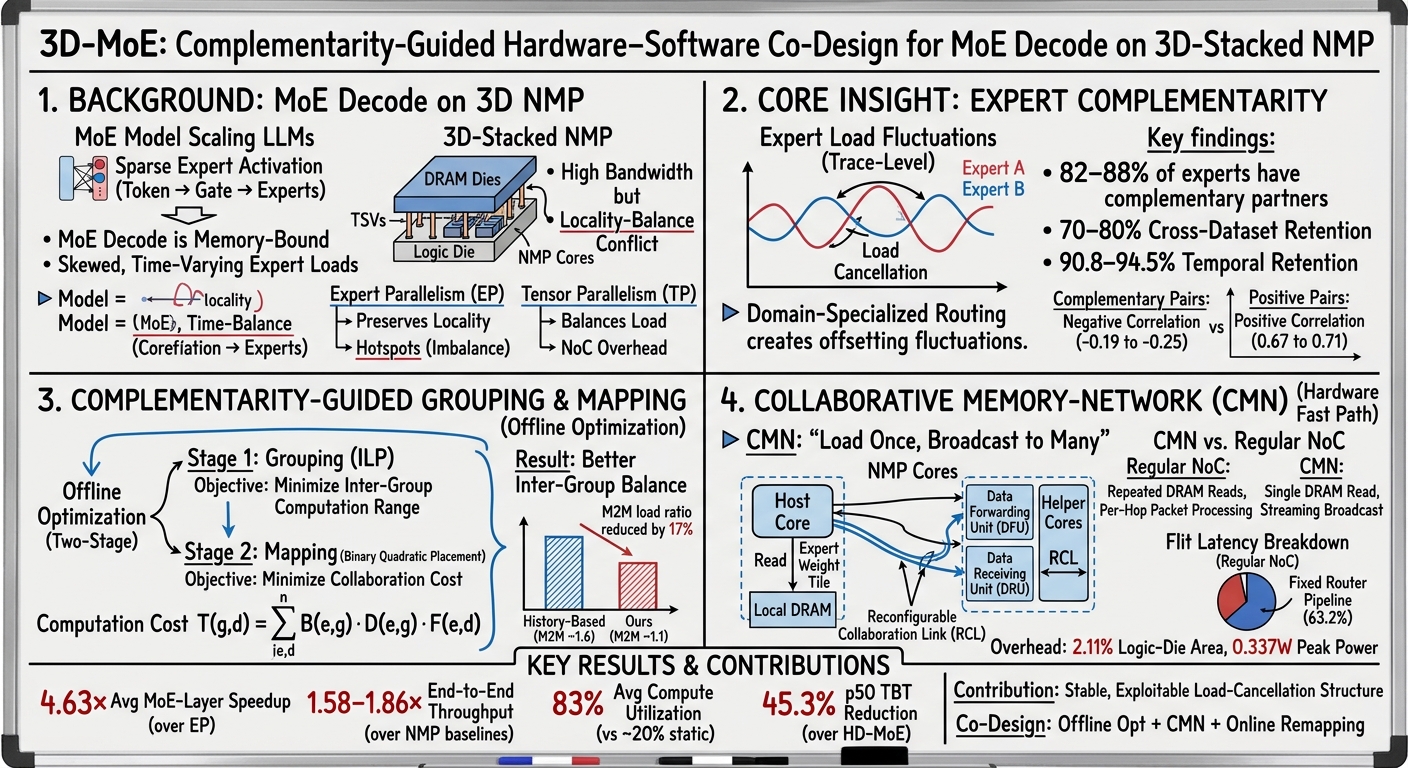
On the train-inference consistency side, TRACE advances consistency from routing decisions to the quantization execution path, using rollout-side FP4 quantization results to guide training-side rounding, providing a new contrast to Issue 10's Router Drift Control's response-level filtering and Issue 8's T1 routing replay. On the serving side, 3D-MoE is the first to use expert complementarity as an explicit signal for load balancing on 3D-stacked NMP, a new path in expert-parallel serving.
Community and Dynamics
Least-Loaded Expert Parallelism (ICML 2026) treats imbalanced routing as natural and desirable, dynamically rerouting excess tokens and corresponding expert parameters from overloaded EP devices to underloaded ones during serving, achieving up to 5x speedup and 4x peak memory reduction on gpt-oss-120b while maintaining exact MoE math—providing a new serving-side baseline for online rebalancing of redundant experts.
The Router Collapsed, Not the Experts is a conceptual commentary: it reframes the MoE redundancy debate as "router collapse rather than expert redundancy," citing Issue 3's Geometric Coupling controlled experiments (auxiliary loss increases router direction cosine similarity by nearly 3x) as mechanistic evidence, proposing that router geometry is the real failure mode. As a hypothesis generator rather than empirical results, it offers testable directions for causal intervention studies on expert specialization and load-balancing losses.
Open Questions
-
Don't Skip the Baseline proves dynamic skipping struggles to beat static top-k, but under what conditions do the gains of Issue 6's ACE and Issue 5's Training-Free Halving hold? Once K_eff calibration bias is eliminated, is the remaining value of dynamic methods only per-token load adaptivity?
-
TRACE advances consistency to the quantization rounding path, while Issue 10's Router Drift Control filters at the response level—are quantization-domain train-rollout mismatch and routing decision mismatch independent? When both exist, which alignment is more critical first?
-
3D-MoE's expert complementarity grouping relies on the stability of decoding-step load trajectories, while Issue 10's Afore relies on micro-batch-level real demand—how long does complementarity signal last under workload drift? How should the boundary between offline grouping and online remapping be set?
-
Task-Phase-Conditioned Expert Routing falsifies routing statistics as a proxy for quantization sensitivity, while Issue 8's Routing Drift Alone falsifies routing drift diagnosis in merged scenarios—when routing statistics carry no selection signal across multiple downstream tasks, what tasks can routing statistics still serve as a reliable proxy for?
Papers in this issue
Dynamic expert-skipping methods fail to consistently beat a simple static top-k baseline at matched compute, so static per-modality expert reduction is the recommended default.
Editor's noteMust-read. First controlled comparison of dynamic expert skipping methods: under budgets matched to measured compute (K_eff), compares four representative methods (NAEE, DiEP, MoDES, Ada-K) against a simple static top-k baseline, finding dynamic methods fail to consistently beat the static baseline, with calibrated K_eff deviating from measured K_eff by up to 6x. Compared to Issue 5's Training-Free Halving and Issue 6's ACE, this paper establishes "matching measured compute" as the burden of proof dynamic skipping methods must beat, reporting complete quality-compute frontiers across modalities on Gemma4-26B-A4B, Qwen3-30B-A3B, and Qwen3-VL.
TRACE achieves BF16-level reinforcement learning performance on MoE language models by directly aligning FP4 quantization between training and rollout paths, with up to 5.4x rollout speedup.
Editor's noteWorth reading. First to advance train-inference routing consistency from routing decisions to the quantization execution path: uses rollout-side FP4 quantization results to guide training-side rounding direction (selecting nearest adjacent codeword to rollout codeword rather than RTN), and caches only deep mantissa information to control communication overhead. Compared to Issue 10's Router Drift Control's response-level filtering and Issue 8's T1 routing replay, this is a new path for train-rollout alignment in the quantization domain, reporting full training dynamics with dense comparisons at 2.4T-scale MoE.
3D-MoE exploits expert complementarity—trace-level load cancellation in MoE decode—to achieve 4.63x layer speedups over expert parallelism with only 2.11% area overhead.
Editor's noteWorth reading. First to use expert complementarity (offsetting fluctuations in decoding-step load trajectories) as an explicit signal for MoE decoding load balancing on 3D-stacked NMP: offline complementary grouping and locality mapping establish coarse-grained inter-group balance, with CMN hardware fast path handling intra-group residual hotspots. Compared to Issue 10's Afore's micro-batch-level demand prefetching and Issue 9's Zepp's communication shaping, this is the first to use complementarity as a grouping signal with hardware-software co-design, reporting full routing statistics with dense comparisons.
Routing-based expert allocation fails to beat uniform quantization and performs no better than random selection, proving routing behavior is not a valid proxy for quantization sensitivity.
Editor's noteWorth reading. First systematic falsification of "task-phase-conditioned routing statistics as a proxy for MoE quantization sensitivity": builds a routing capture pipeline on Qwen-3.6-35B-A3B, uses composite sensitivity scores for budget-neutral layer-wise mixed-precision allocation, finds neutral statistics in flat regions, decisive loss in steep regions (z>4 SE), and random selection controls show no significant difference from routing-guided allocation. Compared to Issue 8's Routing Drift Alone's falsification in merged scenarios, this is the first to prove with random controls in quantization sensitivity scenarios that routing behavior statistics carry no selection signal.