Phase-Aware Expert Parallel Load Balancing
Highlights of This Issue
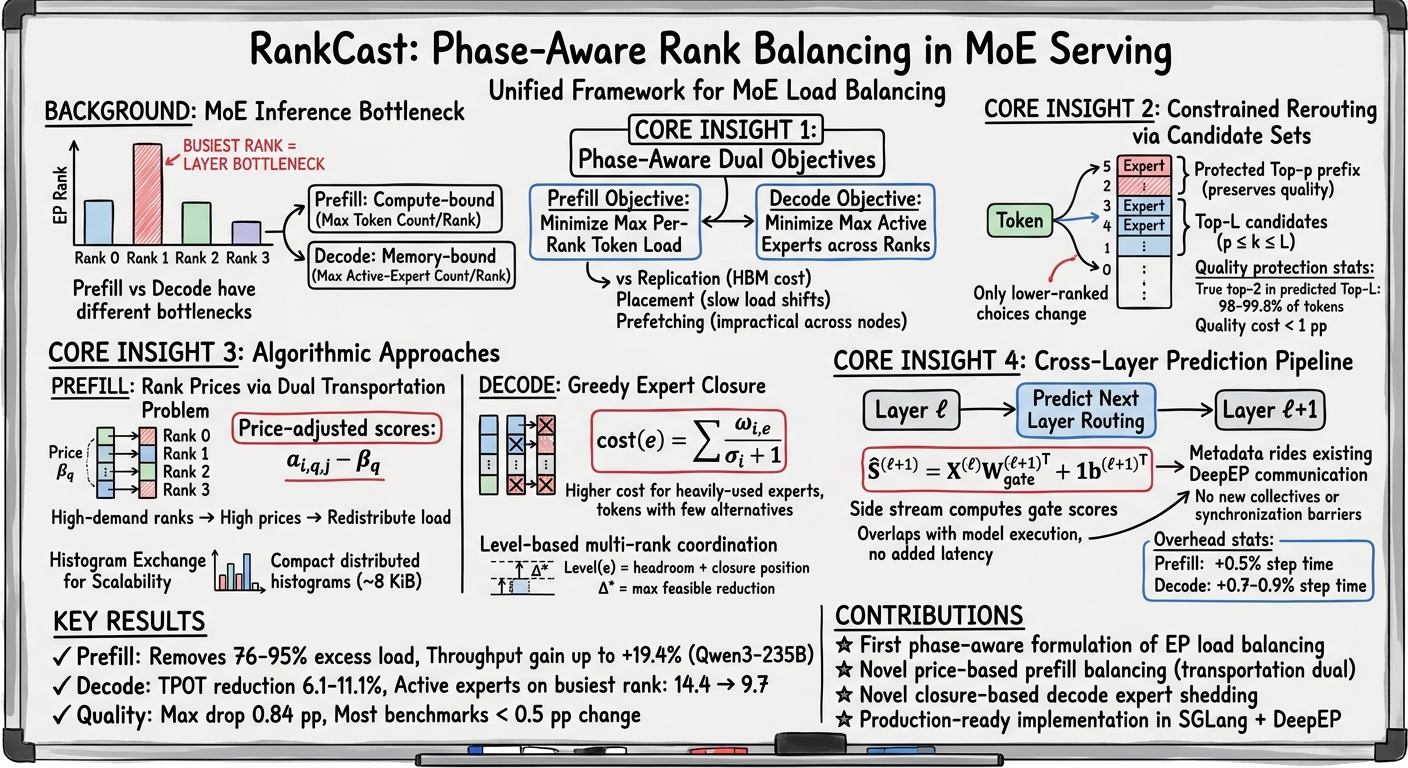
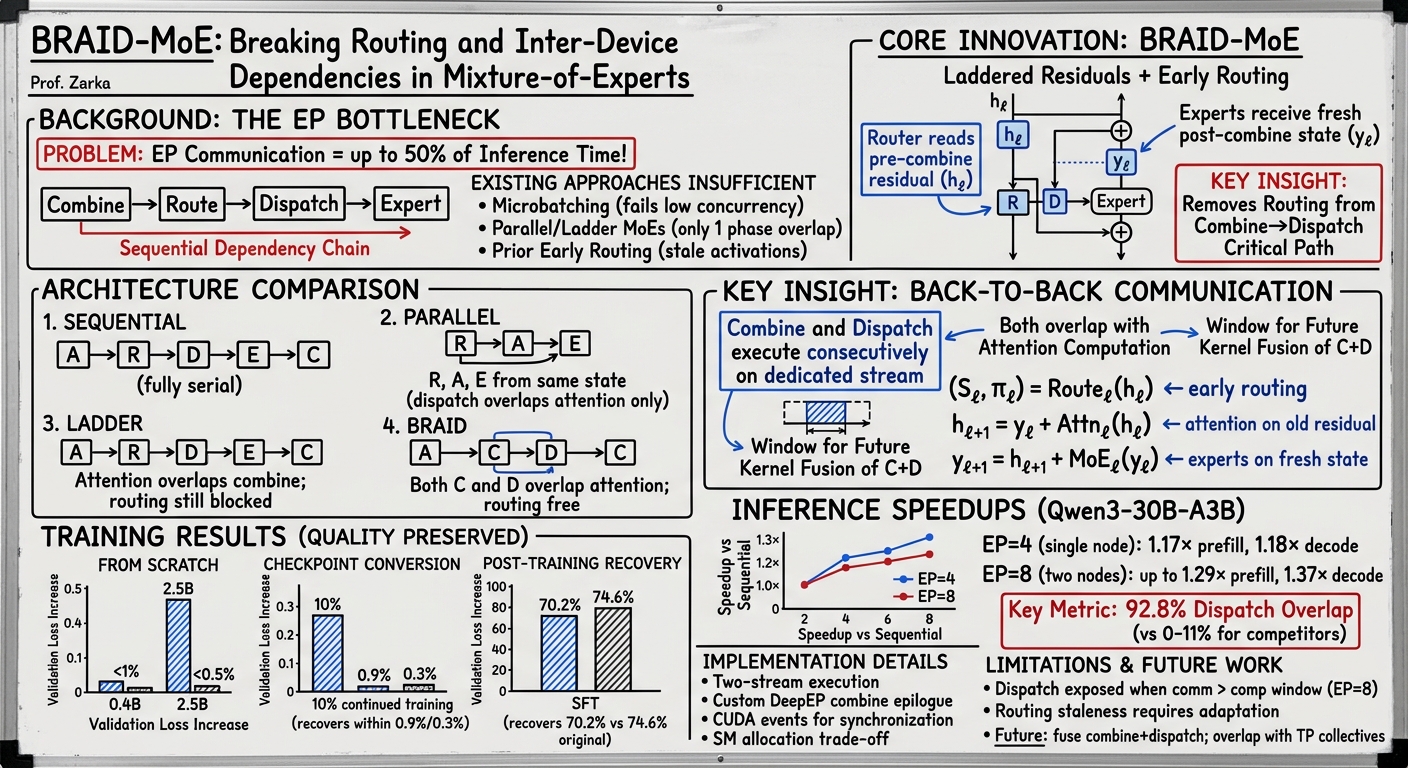
The main theme of this issue is that "load balancing for expert parallel services moves toward phase awareness, and communication bottlenecks shift from primitive optimization to architectural decoupling." RankCast is the first to explicitly distinguish the objectives of EP load balancing by prefill/decode phases: prefill is compute-bound, with latency determined by the peak token count of the busiest rank, while decode is memory-bound, with latency determined by the peak number of active experts across ranks. Under a unified constraint (protecting per-token Top-p and candidate Top-L), it solves using rank pricing and expert shutdown respectively, and uses cross-layer prediction to overlap decision-making with execution. On Qwen3-235B-A22B and Qwen3.5-397B-A17B, it removes over 75% of excess load from the busiest ranks, improves prefill input throughput by up to +19%, reduces decode per-token latency by up to -10%, with a quality cost below 1 percentage point. Meanwhile, BRAID-MoE is the first to relax EP's temporal dependencies through architectural changes rather than communication primitive optimization: ladder residuals allow combine to be deferred to the next block, and early routing computes the next layer's routing from pre-combine residuals, thereby scheduling combine and dispatch back-to-back into dedicated communication streams and overlapping with attention. On a converted Qwen3-30B-A3B, it achieves up to 1.29× speedup for prefill and 1.37× for decode. Together, these advance "expert parallel serving" from the communication primitives and idle resource utilization of Issue 15 to phase-aware objective modeling and architecture-level dependency decoupling.
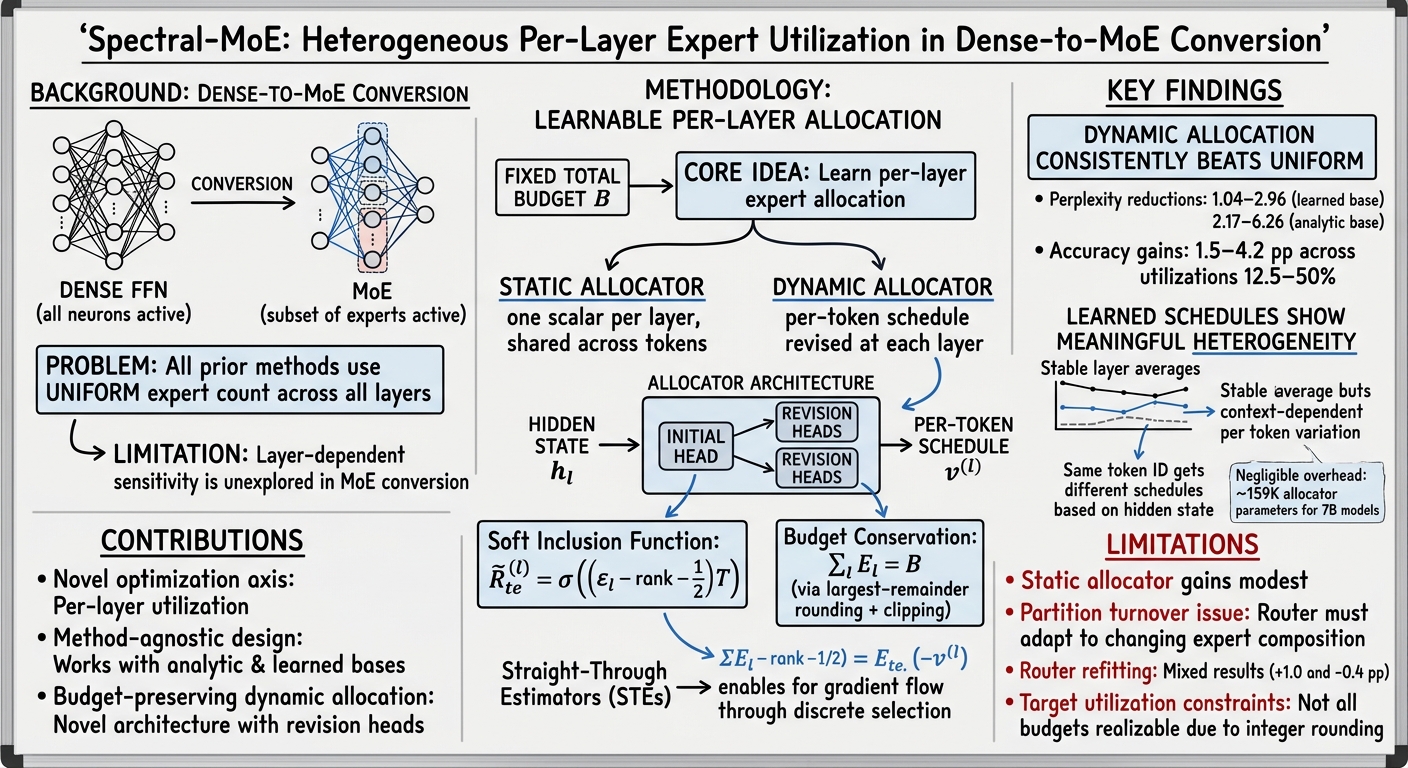
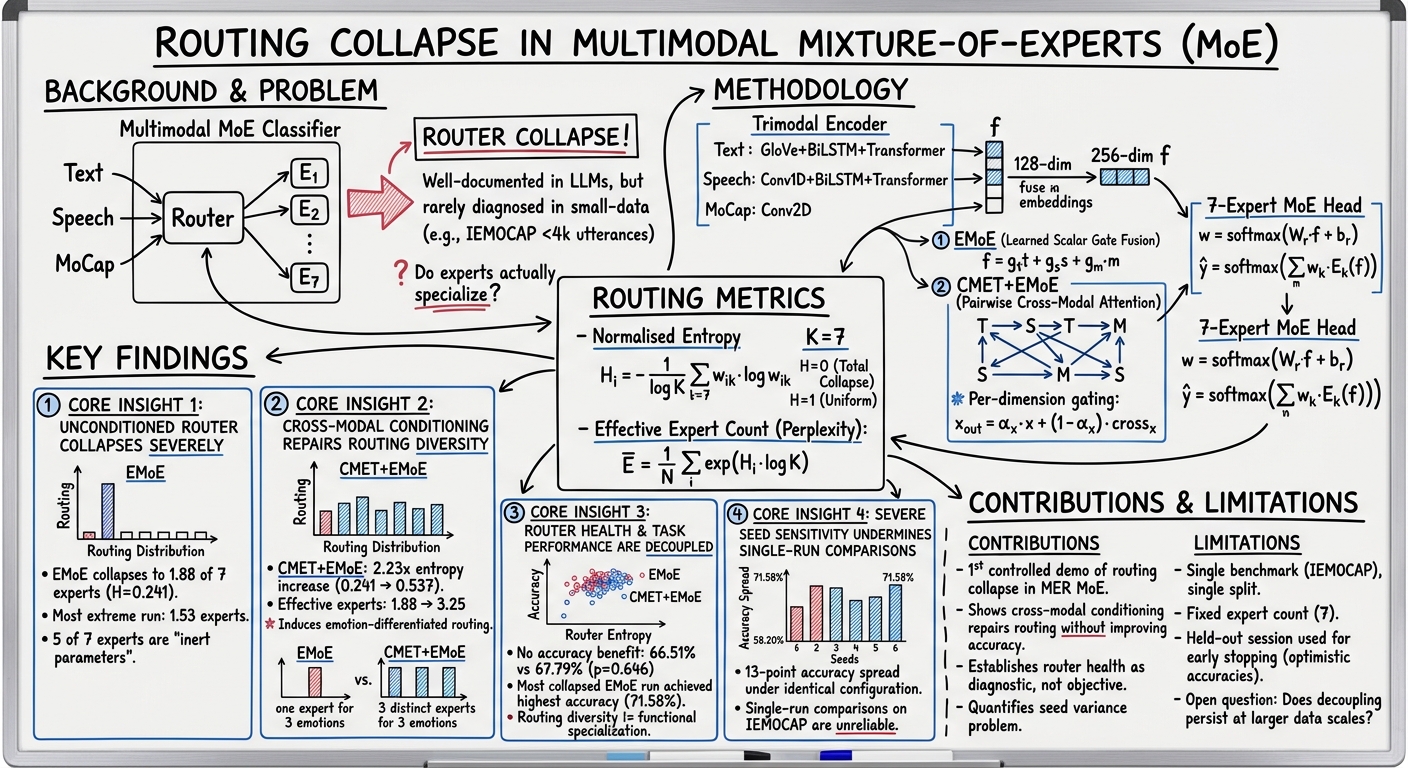
The second line is the third optimization axis for sparsity allocation and a negative result on routing health. Spectral-MoE is the first to introduce learnable per-layer utilization allocation (static per-layer scalars + dynamic per-token scheduling) in dense-to-MoE conversion, achieving heterogeneous allocation under a fixed total budget via STE and budget conservation, establishing "per-layer utilization" as the third optimization axis after expert splitting and routing. On both CMoE and DOT-MoE bases, across 12.5%/25%/50% utilization levels, dynamic allocation consistently outperforms uniform baselines. In contrast, Routing Collapse in Multimodal MoE presents a cautionary null result: cross-modal conditioning can increase routing entropy from 0.241 to 0.537 and effective experts from 1.88 to 3.25, but accuracy shows no significant difference (p=0.646), and the most collapsed run actually achieves the highest accuracy—routing health and task performance are decoupled here, providing a controlled comparison for whether fixing collapse is worthwhile.
On the specialization evidence side, Generation-Time Routing Reveals Expert Specialization That Prefill Measurements Miss directly challenges the widely cited negative result that "MoE experts do not specialize by topic": on Qwen3.5's 35B and 122B checkpoints, during prefill a generalist expert wins 18/20 domains and routing appears domain-agnostic, but during generation the winners are spread across 20 and 18 different experts, and the two mechanisms select nearly disjoint top-expert sets when token counts are matched (Jaccard 0.00–0.23). It establishes "measuring by input text (i.e., prefill routing)" as a constructive reason why negative results are underestimated, setting a new measurement window for empirical tests of expert specialization.
Community and Developments
RL at scale: GRPO and the gap between sampler and trainer summarizes the current state of handling training-inference routing inconsistency across labs: DeepSeek's Keep Routing, Xiaomi's R3, Mistral, Nemotron 3.5 Super, and others adopt routing replay, and reports that MiMo-V2.6's expert load coefficient of variation rises from 0.78 to 2.0 within the first 20 RL steps, with cold expert share increasing from 0.5% to 22% (approximately 84/384), while freezing the router can pull load back to initial levels—providing a measured snapshot of routing drift across labs. On the serving side, vLLM's DeepSeek-V4.1-Flash large-scale serving report on GB300 NVL72 gives explicit balancedness metrics for EPLB (target 0.35→0.94, draft 0.21→0.89) and notes that with Wide-EP at DEP32, draft communication overhead begins to offset the benefits of wider parallelism—contrasting with the engineering completion of elastic EP in Issue 15.
Open Questions
-
RankCast's cross-layer prediction relies on "next-layer routing being predictable from this layer's gate weights," and its rerouting is lossy (changing the experts used by tokens)—how robust is the prediction when routers use group-limited or sigmoid gating? Does lossy rerouting combined with lossless placement/replication (which the paper acknowledges as composable but does not test) still yield independent benefits?
-
BRAID-MoE's early routing computes routing decisions from pre-combine residuals—does this difference from standard architecture routing constitute a new source of training-inference routing drift? Its interaction with the FP4 RL routing consistency evaluation from Issue 13 warrants examination.
-
Spectral-MoE's dynamic per-layer utilization scheduling changes expert allocation per layer—is there an interaction between heterogeneous utilization, load balancing, and expert specialization? The paper's discussion of allocator parameters and expert allocation turnover is shallow, and its training stability boundaries are unclear.
-
Does the measurement window critique of Generation-Time Routing apply to other specialization null results—for example, this issue's multimodal collapse negative result and Issue 9's RouterInterp superposition specialization hypothesis? If specialization is only expressed during generation, both prefill-based negative results and measurements based on prefill+generation mixtures need re-examination.
Papers in this issue
RankCast removes over 75% of busiest-rank load in expert-parallel MoE serving, boosting prefill throughput up to 19% and decode speed up to 11% with under one point quality loss.
Editor's noteMust-read. First to explicitly distinguish EP load balancing objectives by prefill/decode phases: prefill minimizes peak per-rank token count, decode minimizes peak active expert count, and under a unified constraint (protecting Top-p, candidate Top-L) solves with rank pricing and expert shutdown respectively, using cross-layer prediction to overlap decision with execution. Compared to Issue 14's Relief per-layer hardware balancing engine, this is a new software solver increment for inference-time rerouting paths, removing over 75% of excess load from the busiest ranks on frontier-scale Qwen3-235B/397B, with prefill throughput up to +19% and decode TPOT down to -10%, reporting full routing statistics and dense baselines.
BRAID-MoE breaks the sequential combine-route-dispatch chain in MoE inference by routing from stale residuals, achieving up to 1.37x decode speedup with under 1% quality loss.
Editor's noteWorth reading. First to relax EP's temporal dependencies via architectural changes rather than communication primitive optimization: ladder residuals defer combine to the next block, and early routing computes next-layer routing from pre-combine residuals, scheduling combine and dispatch back-to-back into dedicated communication streams and overlapping with attention. Compared to Issue 15's NVLinkOneSided one-sided primitives and Communicate the Change activation compression, this directly modifies the model structure to create longer communication windows, achieving up to 1.29× prefill and 1.37× decode on a converted Qwen3-30B-A3B, and can retrofit existing checkpoints.
Spectral-MoE learns per-layer expert utilization budgets during dense-to-MoE conversion, improving accuracy by up to 5.8 points and perplexity by up to 2.96 points over uniform allocation.
Editor's noteWorth reading. First to introduce learnable per-layer utilization allocation (static per-layer scalars + dynamic per-token scheduling) in dense-to-MoE conversion, achieving heterogeneous allocation under a fixed total budget via STE and budget conservation, establishing 'per-layer utilization' as the third optimization axis after expert splitting and routing. Compared to Issue 12's You Only Need 2/3 uniform truncation and Issue 11's Don't Skip the Baseline static top-k baselines, this consistently outperforms uniform baselines on both CMoE and DOT-MoE bases across 12.5%/25%/50% utilization levels, reporting full routing statistics and dense baselines.
Cross-modal attention repairs MoE router collapse (entropy 2.23x, p=0.035) but yields no accuracy benefit, revealing expert specialization as illusory in low-resource emotion recognition.
Editor's noteWorth reading. First to demonstrate with controlled comparison that fixing routing collapse may not yield benefits: cross-modal conditioning increases routing entropy from 0.241 to 0.537 and effective experts from 1.88 to 3.25, but accuracy shows no significant difference (p=0.646), and the most collapsed run actually achieves the highest accuracy—routing health and task performance are decoupled here. Compared to Issue 14's MoE Pretraining layout-induced routing drift, this operates in a different regime of small-data multimodal classification, and its 13-seed dispersion is an important caution against single-run comparisons; its small scale (7 experts, IEMOCAP) is a limitation.
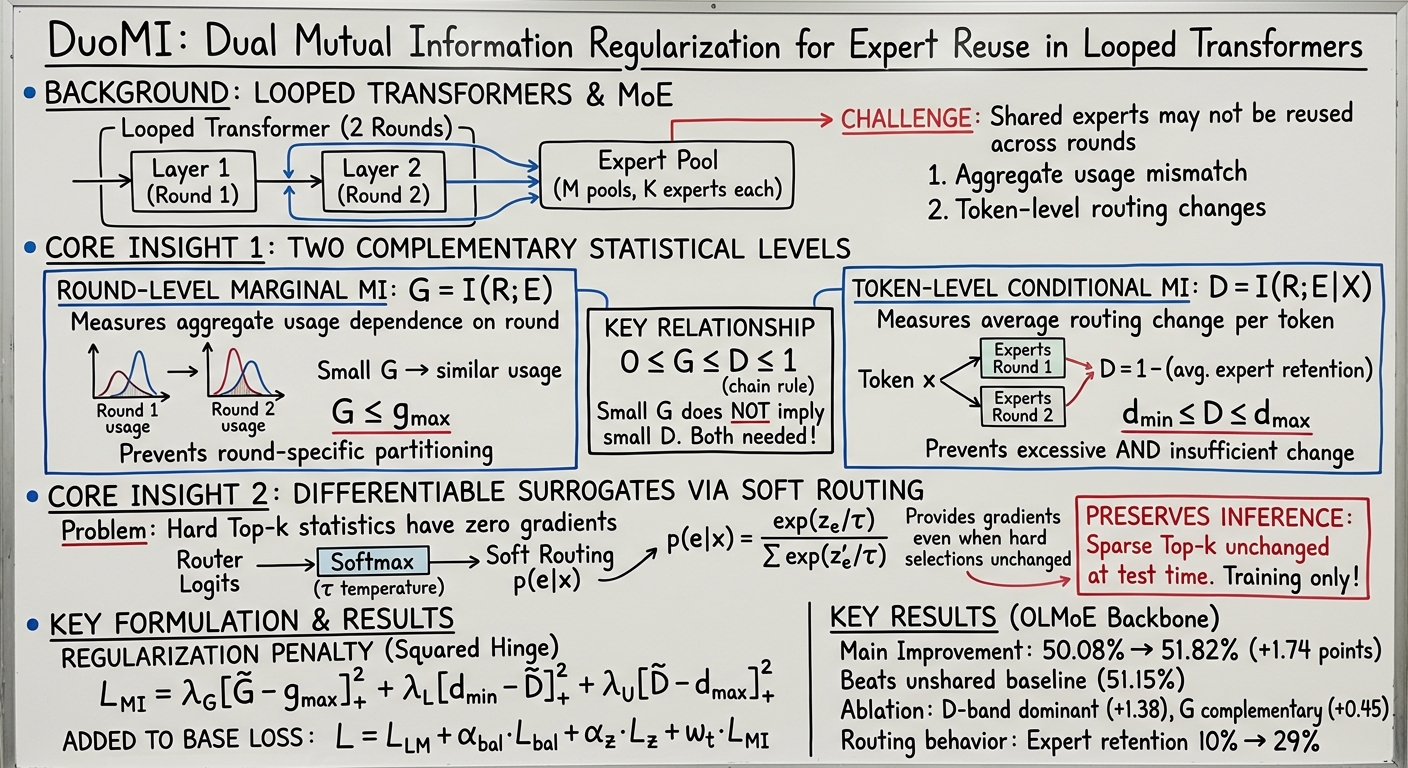
DuoMI, a dual mutual information regularizer controlling both aggregate and token-level expert reuse across rounds, boosts looped MoE Transformers by 1.74 points, surpassing even unshared baselines.
Editor's noteWorth reading. First to formalize cross-round expert reuse in looped MoE as two mutual information quantities: round-level marginal mutual information constrains how aggregated expert usage depends on round, and token-level conditional mutual information constrains the routing variation range for the same token across rounds, without changing inference routing. Compared to Issue 15's Rethinking MoE Load Balancing control-theoretic perspective, this focuses on cross-round routing reuse in a shared expert pool rather than load, reporting full routing statistics (G~, D~, hard retention) and dense baselines on an OLMoE-1B-7B derived model; its small scale is a limitation.