Boundaries of Load-Balancing Enforcement: Soft Anchoring and Renormalization
Highlights
The main theme of this issue is the boundaries of load-balancing enforcement: multiple independent works examine the cost of the default configuration of pushing routing toward uniformity from different angles, and propose two alternative paths: soft anchoring and renormalization.
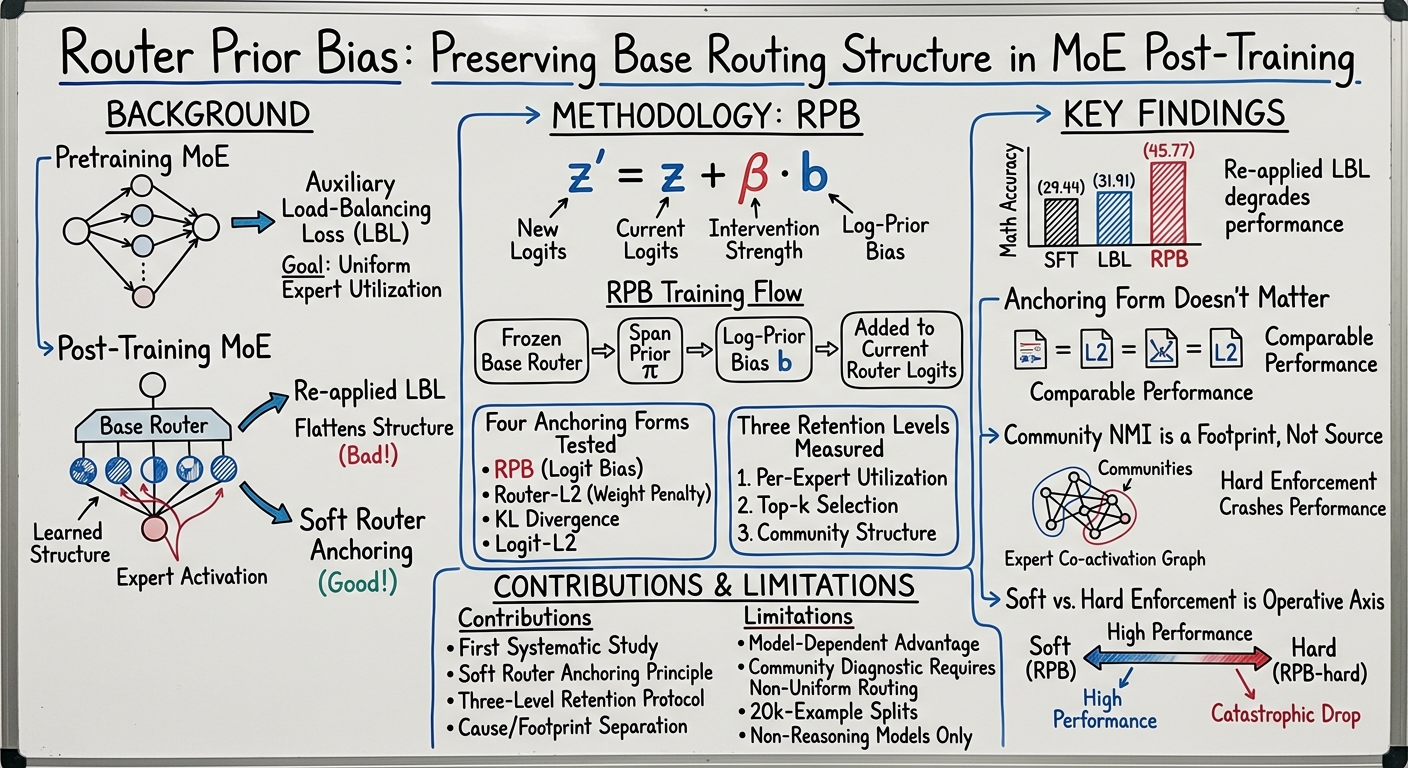
On the training side, Router Prior Bias directly challenges the default practice of re-imposing auxiliary load-balancing loss (LBL) during post-training: the pre-trained router has already encoded non-uniform expert co-activation structures, and re-imposing a uniform objective flattens it. The authors propose soft router anchoring, which pulls router logits toward the frozen base router's prior while keeping the router trainable. On Moonlight-16B-A3B math post-training, it significantly outperforms re-imposing LBL with in-domain accuracy of 45.77 vs. 31.91, while retaining more out-of-domain capability. The key increment is using intervention controls (soft vs. hard, intra-community vs. inter-community shuffling) to separate constraint strength from prior content, proving that community structure is a footprint of soft enforcement rather than a source of benefit—this provides a causal decomposition for the routing preservation problem following PR² and ReLibra in Issue 2.
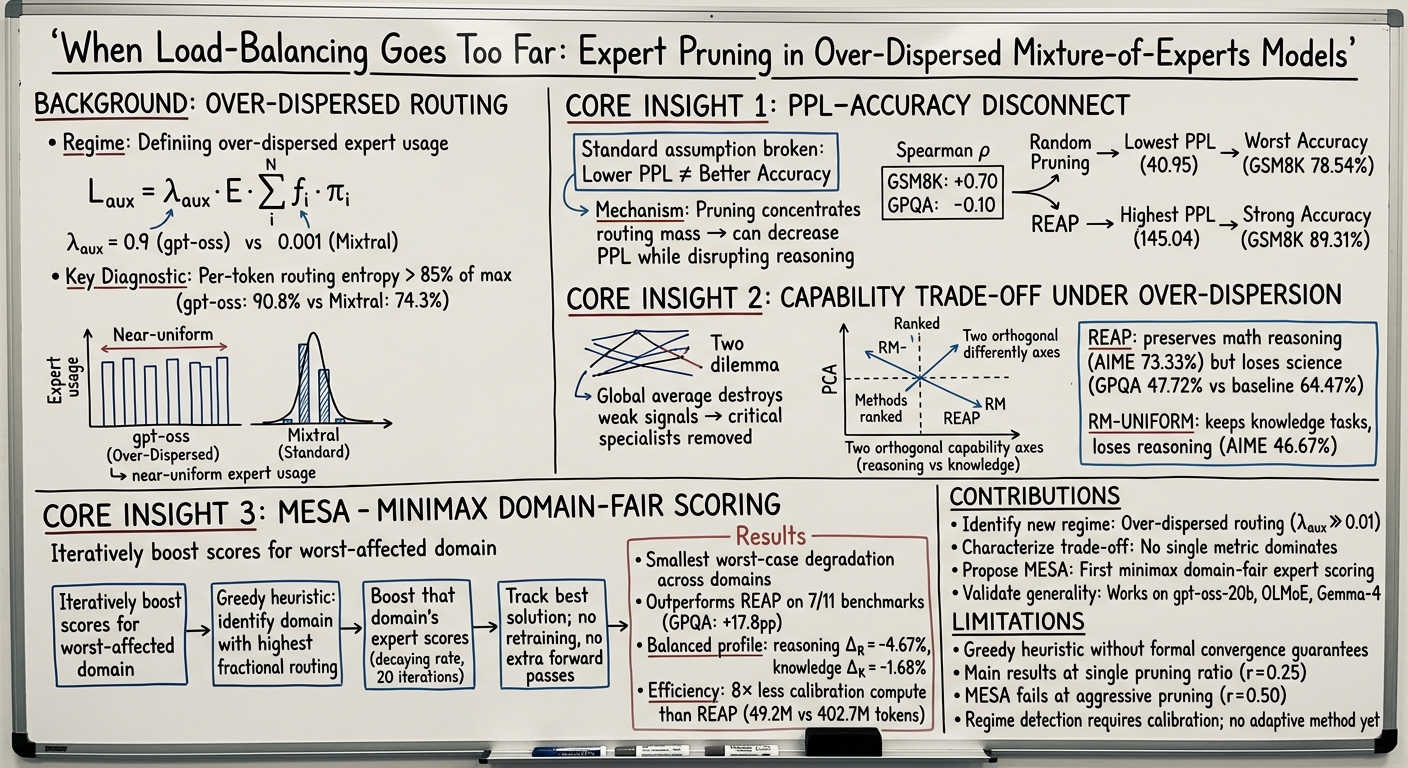
On the pruning side, When Load-Balancing Goes Too Far characterizes the unique mechanism of over-dispersed routing (induced by λ_aux=0.9): the router distributes tokens nearly uniformly across all experts, causing perplexity and task accuracy to decouple, global importance signals to fail, and pruning metrics to exhibit capability trade-offs between reasoning and knowledge tasks. This corroborates the findings from Launch-Bound in Issue 3 (routing fidelity and output quality are separable) and From Observation to Intervention in Issue 1 (observational statistics cannot predict causal importance), extending the cost of over-balancing from training to the serving side.
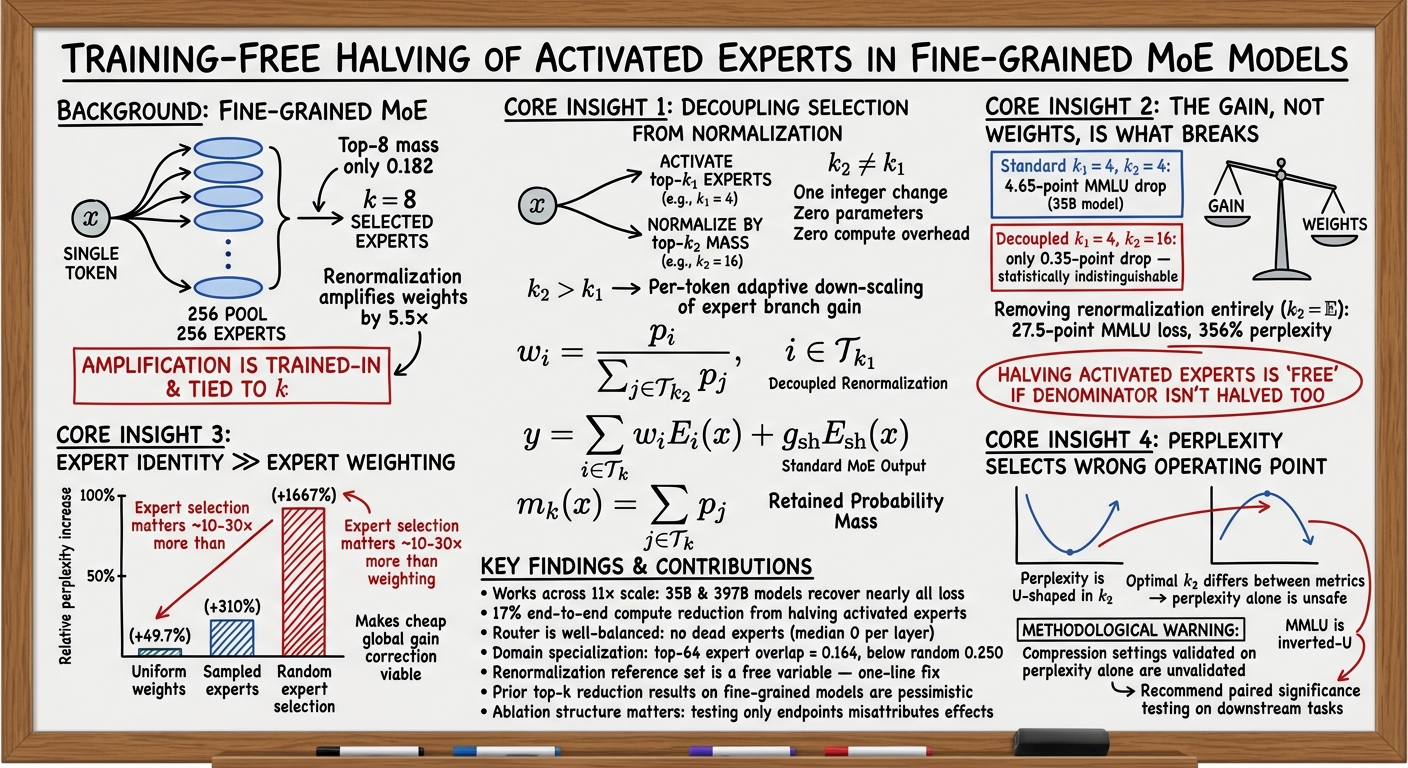
On the inference side, Training-Free Halving discovers that MoE renormalization implicitly calibrates expert output gains to the training top-k: the performance loss when reducing k mainly comes from gain mismatch rather than expert capacity loss. By decoupling the number of activated experts (k1) from the renormalization denominator (k2), they halve activated experts without training and with almost no loss (MMLU drops only 0.35 points on Qwen3.6-35B), and reproduce this on the 11× larger Qwen3.5-397B-A17B. They find that perplexity and downstream tasks prefer different k2, offering a methodological warning for compression hyperparameter selection.
Community and Dynamics
On the engineering implementation side of routing replay, vLLM's vime framework reports quantitative gains from R3 routing replay in a production-grade decoupled training-inference RL pipeline: for Qwen3-30B-A3B, enabling R3 reduces train-rollout logprob mismatch from about 0.019 to about 0.013. NVIDIA's NeMo-RL documentation records the engineering implementation of R3 replaying rollout routing choices in Megatron forward passes to eliminate mismatch, noting it is only wired on the Megatron+vLLM path and disabled by default. Both are implementations of routing replay in production frameworks, complementing the soft anchoring of Router Prior Bias in this issue—replay addresses rollout-training mismatch, while soft anchoring addresses the problem of routing structure being flattened by uniformization during post-training.
Open Questions
-
The soft anchoring in Router Prior Bias pulls the router toward the base prior, while Training-Free Halving proves that the renormalization denominator itself carries gain calibration—are the prior strength of soft anchoring and the reference set of renormalization mathematically equivalent? Can they be unified into a continuous spectrum of routing structure preservation?
-
When Load-Balancing Goes Too Far proves that pruning metrics fail under over-dispersed routing—does bias-based balancing without auxiliary loss (such as Quantile Balancing in Kimi K3 from Issue 1) also induce similar over-dispersion? Is there a quantifiable safe interval between precise matching of target load in bias-based balancing and over-dispersion?
-
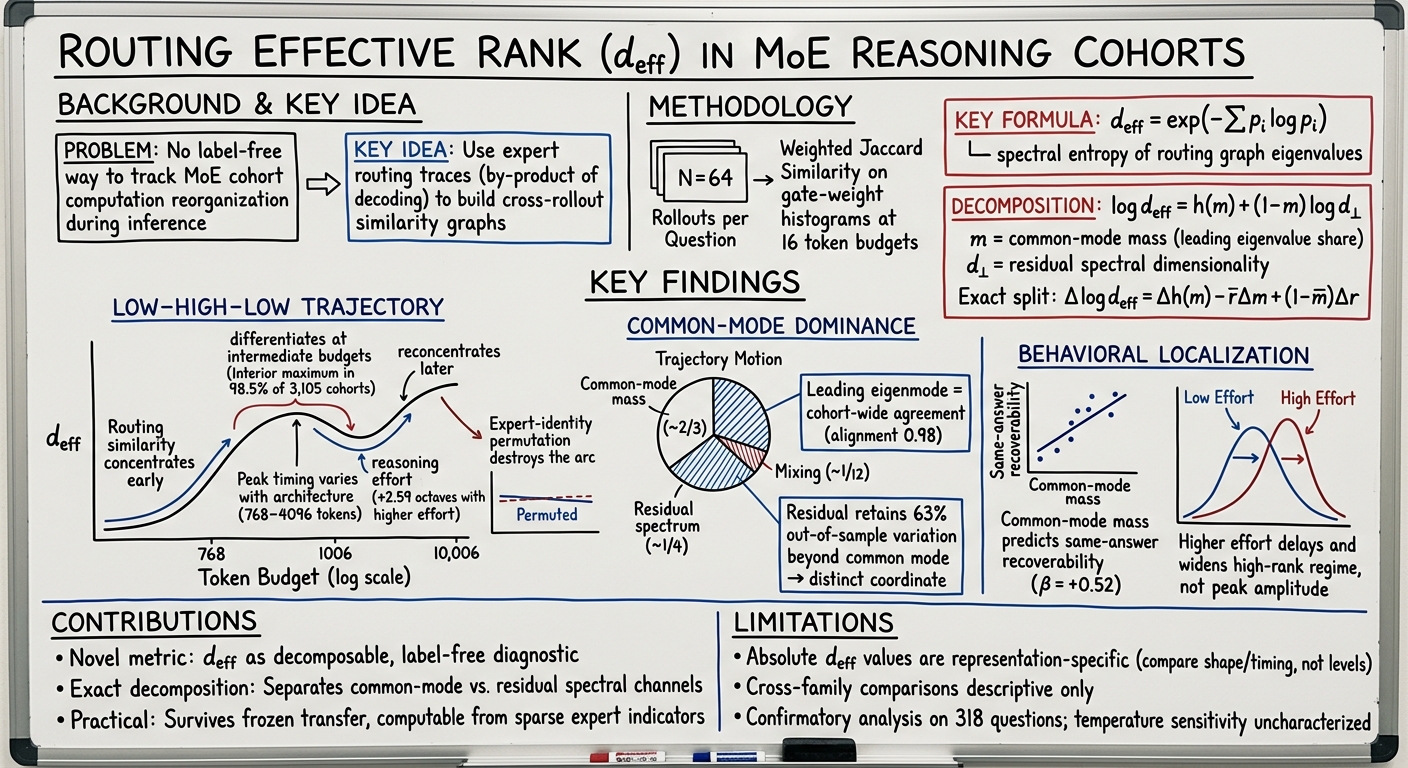
Routing Effective Rank reports a low-high-low trajectory in routing effective rank across inference groups—is this dynamic related to training-inference routing drift? Is the peak of routing differentiation during rollout the moment when routing replay needs the highest fidelity?
-
Multiple works in this issue point to the idea that routing structure should be preserved rather than enforced—but to what extent? Do soft anchoring, renormalization reference sets, and the routing-invisible subspace intervention in RARE from Issue 4 share a consistent definition of routing structure?
Papers in this issue
Decoupling the router's renormalization reference set from the number of activated experts makes top-4 sparsity nearly lossless, turning a 4.65-point MMLU drop into 0.35.
Editor's noteMust-read. For the first time, decouples the denominator (reference set) of MoE renormalization from the number of activated experts, proposing a k1/k2 dual-parameter scheme, proving that performance loss when reducing k mainly comes from gain mismatch rather than expert capacity loss, and finding that perplexity and downstream tasks have inconsistent optimal choices for k2. Compared to the routing-invisible subspace intervention in RARE from Issue 4, this paper directly operates on the renormalization denominator at inference time without training or parameter modification, offering a new alternative path for training-inference routing consistency, and reports routing statistics and dense baselines on Qwen3.6-35B and the 11× larger Qwen3.5-397B.
Router Prior Bias, a soft logit anchoring to the frozen base router, outperforms load-balancing and unanchored fine-tuning in MoE post-training by preserving inherited routing structure.
Editor's noteMust-read. Directly challenges the default practice of re-imposing auxiliary load-balancing loss during post-training: proposes soft router anchoring, pulling router logits toward the frozen base router's prior while keeping the router trainable, significantly outperforming re-imposed LBL on Moonlight-16B-A3B math post-training (45.77 vs. 31.91). Compared to routing replay in PR² and ReLibra from Issue 2, this paper systematically separates constraint strength from prior content using intervention controls (soft vs. hard, intra-community vs. inter-community shuffling), proving that community structure is a footprint of soft enforcement rather than a source of benefit, and provides a three-level preservation protocol with applicability conditions.
Over-dispersed MoE routing breaks perplexity as a quality signal and creates domain trade-offs, which MESA's minimax expert scoring mitigates by protecting worst-affected domains.
Editor's noteWorth reading. For the first time, systematically characterizes over-dispersed routing (induced by λ_aux=0.9) as a unique mechanism for expert pruning: under this mechanism, perplexity and task accuracy decouple, global importance signals fail, and pruning metrics exhibit capability trade-offs between reasoning and knowledge tasks. Compared to Launch-Bound from Issue 3 and From Observation to Intervention from Issue 1, this paper uses routing entropy as a diagnostic tool and proposes a domain-aware minimax pruning method MESA for this mechanism, validating domain unfairness on gpt-oss-20B—a direct negative result of excessive load-balancing enforcement.
Routing effective rank from expert-routing traces reveals a reproducible low-high-low trajectory in Mixture-of-Experts reasoning cohorts, with common-mode mass driving two-thirds of the spectral motion.
Editor's noteWorth reading. For the first time, uses routing effective rank as a dynamic diagnostic metric for MoE inference groups, characterizing a low-high-low trajectory from concentration to differentiation and back to concentration across ten MoE configurations and five benchmarks (with an internal maximum in 98.5% of 3105 model-problem groups), and provides precise decomposition to locate behavior. Compared to the causal audit in Issue 1 focusing on expert importance, this paper shifts to group-level dynamics of routing effective rank, and uses pre-registered protocols and prediction ladders as robustness checks, adding new evidence standards for expert specialization.
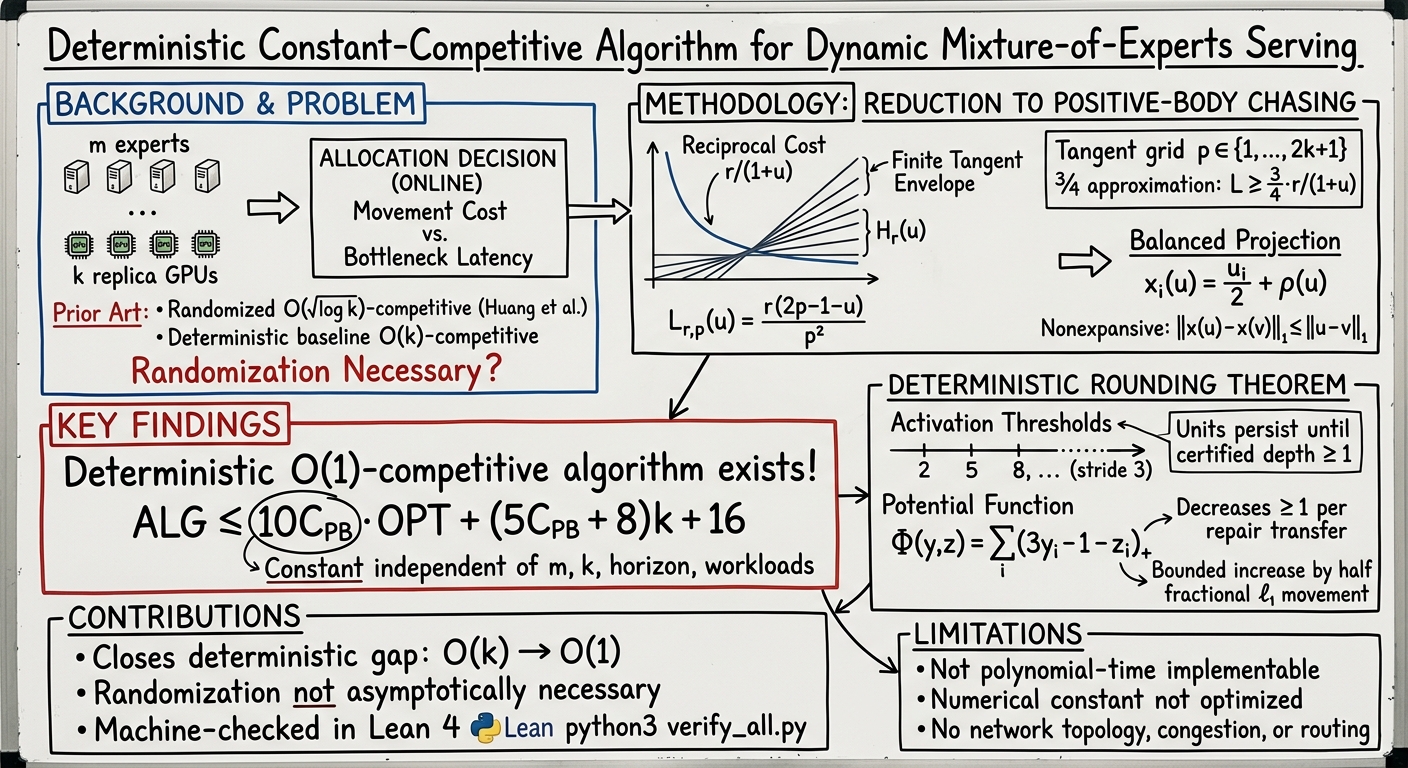
A deterministic O(1)-competitive algorithm for dynamic mixture-of-experts serving is proven, matching randomized performance and closing the deterministic gap.
Editor's noteWorth reading. Advances online replica allocation for dynamic MoE serving from randomized O(√log k) competitive ratio to deterministic O(1) competitive ratio, replacing randomized rounding with a new deterministic path rounding theorem (service distortion 3, movement additive 6k), and provides Lean 4 machine verification. Compared to the randomized algorithm in Mixture-of-Experts Serving from Issue 3, this is the first proof of a deterministic constant competitive ratio without relying on randomization, setting a tighter theoretical baseline for dynamic expert reconfiguration; the limitation is that it abstracts network topology and routing.
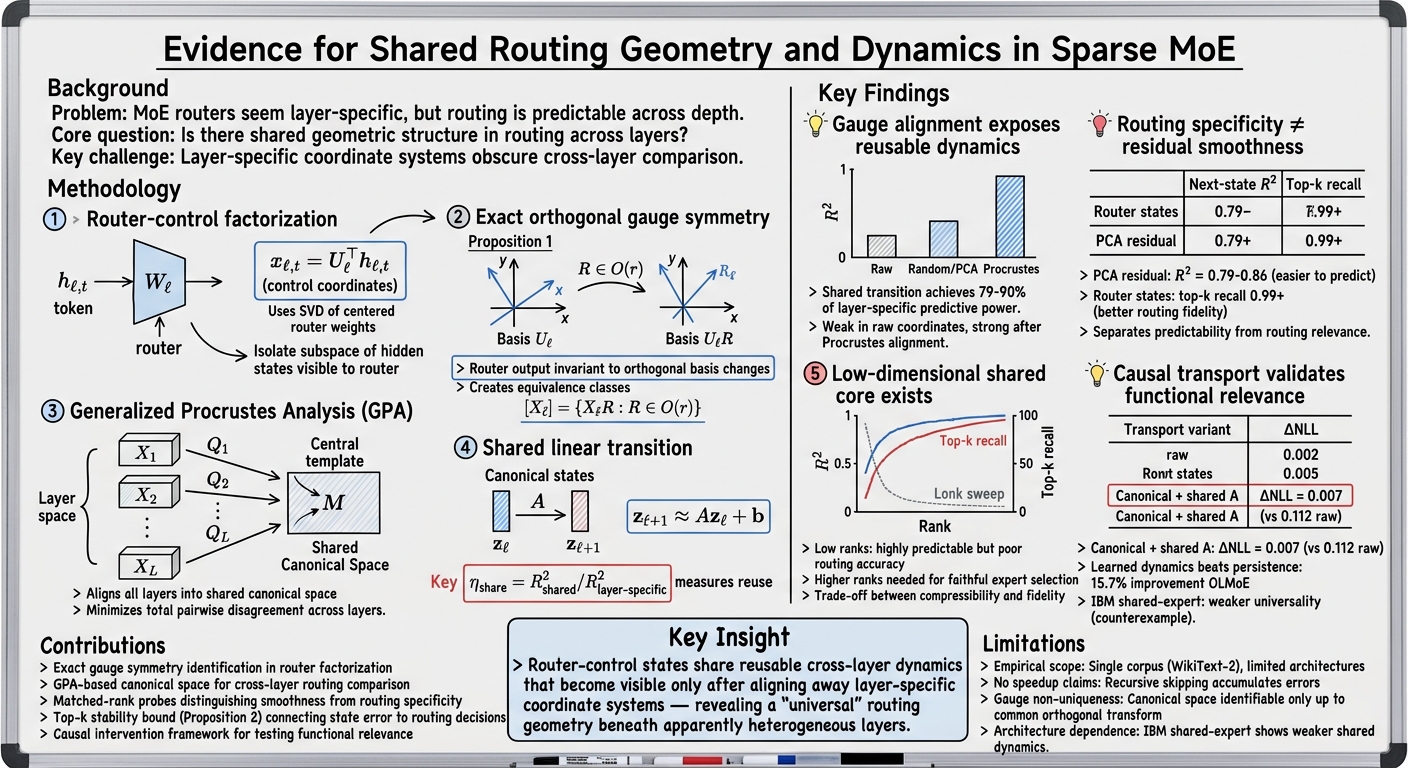
After orthogonal gauge alignment, router-control states across MoE layers share a low-dimensional dynamical core, where a single linear transition captures most of layer-specific predictive power.
Editor's noteWorth reading. For the first time, formalizes the orthogonal gauge freedom of router control subspaces, using generalized orthogonal Procrustes analysis to align routing states across layers into a unified canonical coordinate system, revealing shared linear dynamics across layers (a single transition captures 79–90% R² of layer-specific models). Compared to the intra-layer router-expert coupling in Geometric Coupling from Issue 3 and the routing-invisible subspace in RARE from Issue 4, this paper is the first to align router control subspaces at a cross-layer scale, and uses matched-rank readout controls to distinguish generic residual smoothing from routing-specific information; limitations include small scale and no actual speedup gains.
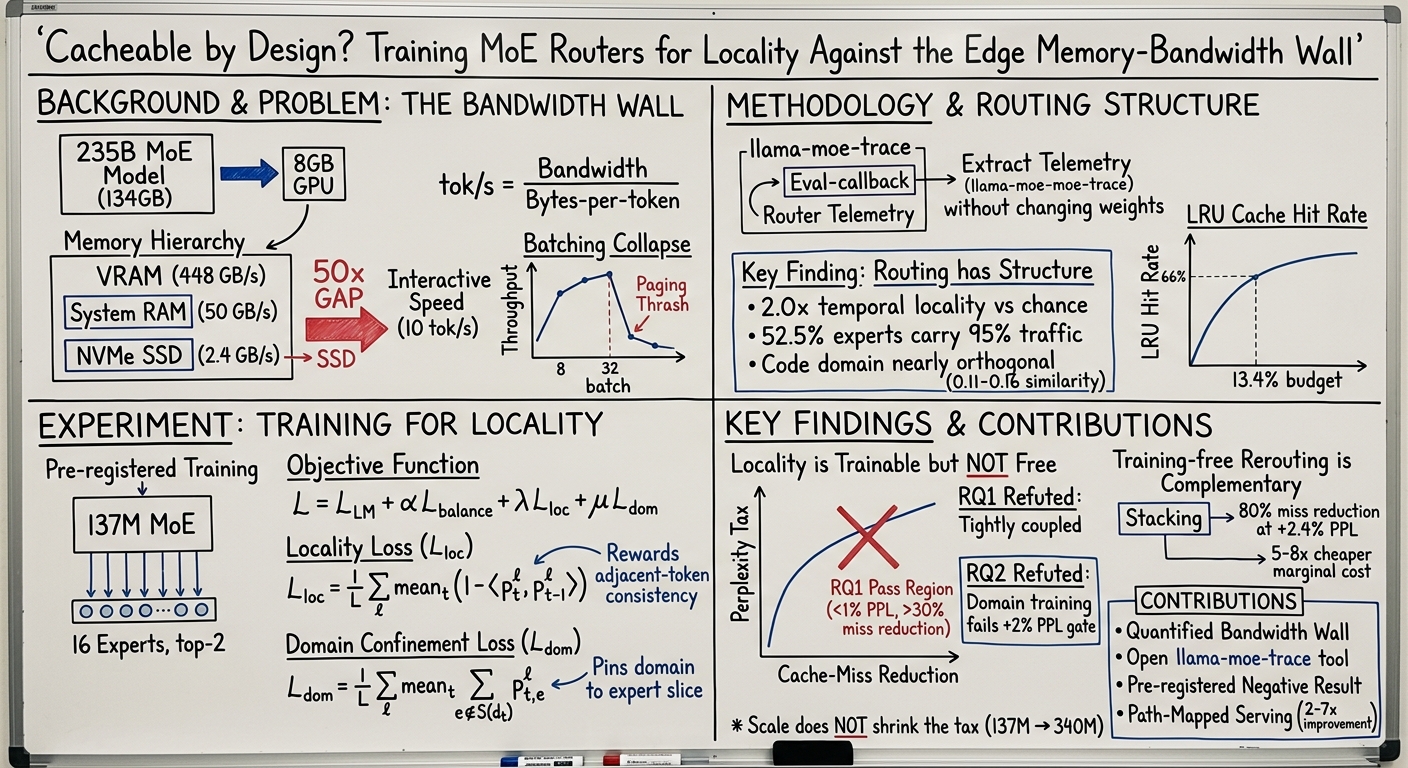
Training routers for cache locality cuts MoE cache misses by up to 60% but always costs perplexity, with no weight satisfying strict quality gates.
Editor's noteWorth reading. With a pre-registered strict joint criterion (cache miss reduction ≥30% and perplexity loss ≤1%), tests adjacent token routing consistency loss and domain constraint loss on 137M/340M multi-domain corpora, yielding a negative result: locality training can reduce cache misses to 60% but perplexity cost is tightly coupled, no weight satisfies the joint threshold, and the cost increases rather than decreases at 340M scale. Compared to RARE from Issue 4 and FreeBalance from Issue 3, this paper rigorously falsifies cacheability as a trainable attribute, and finds complementarity between training-time locality and inference-time cache-aware rerouting (achieving up to 80% miss reduction when combined).