Route Diversity: A New Axis for Post-Training Data Selection
Highlights of This Issue
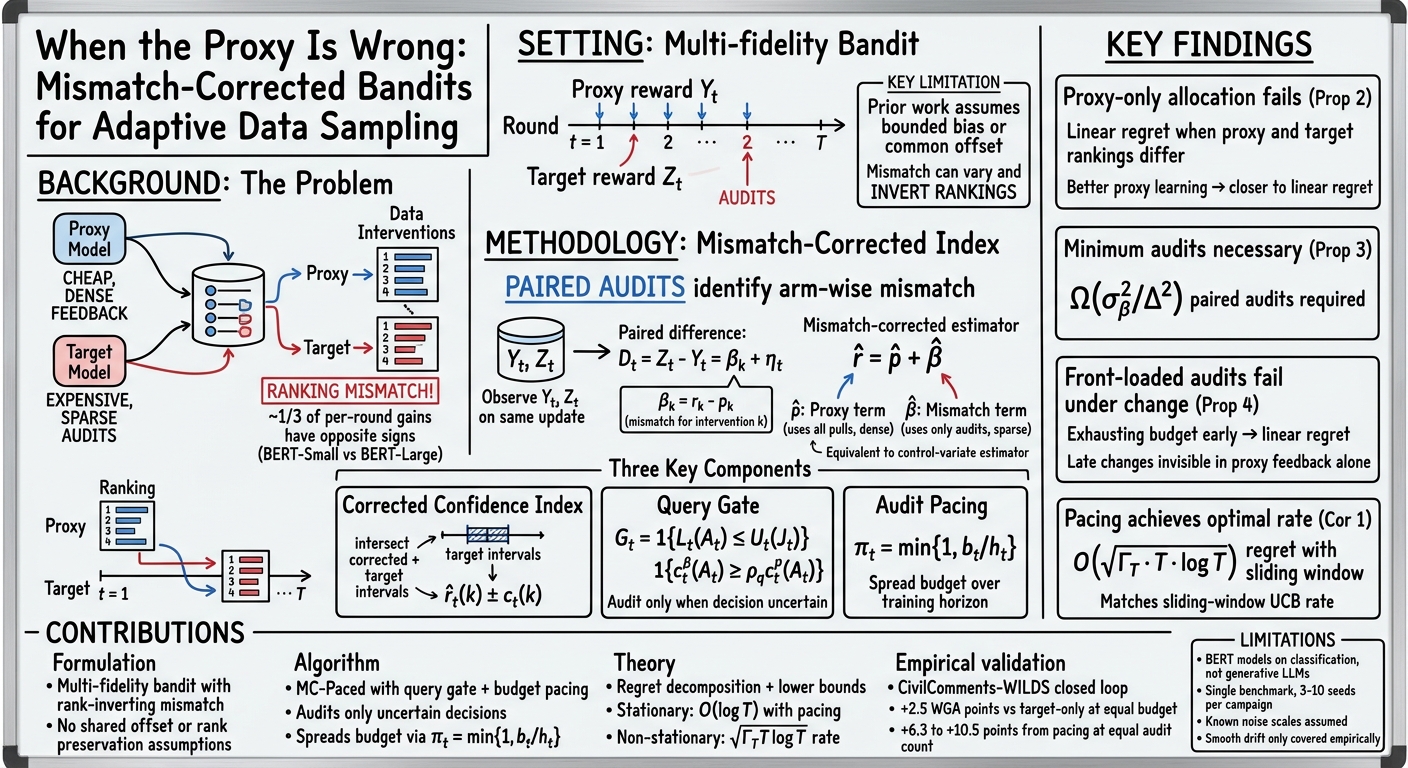
The clearest signal this issue is that "proxy→target extrapolation" has evolved from an empirical recipe into a research subject with a theoretical framework. When the Proxy Is Wrong is the first to model proxy–target mismatch as a bandit problem with arm-dependent, possibly order-reversing mismatches: it uses paired audits to estimate mismatch, query gating and audit pacing to control budget, and proves that upfront audits incur linear regret under non-stationary regimes, while paced audits achieve sliding-window UCB rates (When the Proxy Is Wrong: Mismatch-Corrected Bandits for Adaptive Data Sampling). This advances allocation methods like DoReMi/RegMix, which assume proxy–target alignment or co-shift, into a framework where "mismatch itself can be estimated and corrected in a paced manner," complementing Issue 15's Repetition Mismatch, which attributes "why small-scale mixing experiments do not transfer" to repetition regime mismatch—both point to the same conclusion: systematic bias between proxy and target is a core confounder in mixing decisions, not negligible noise.
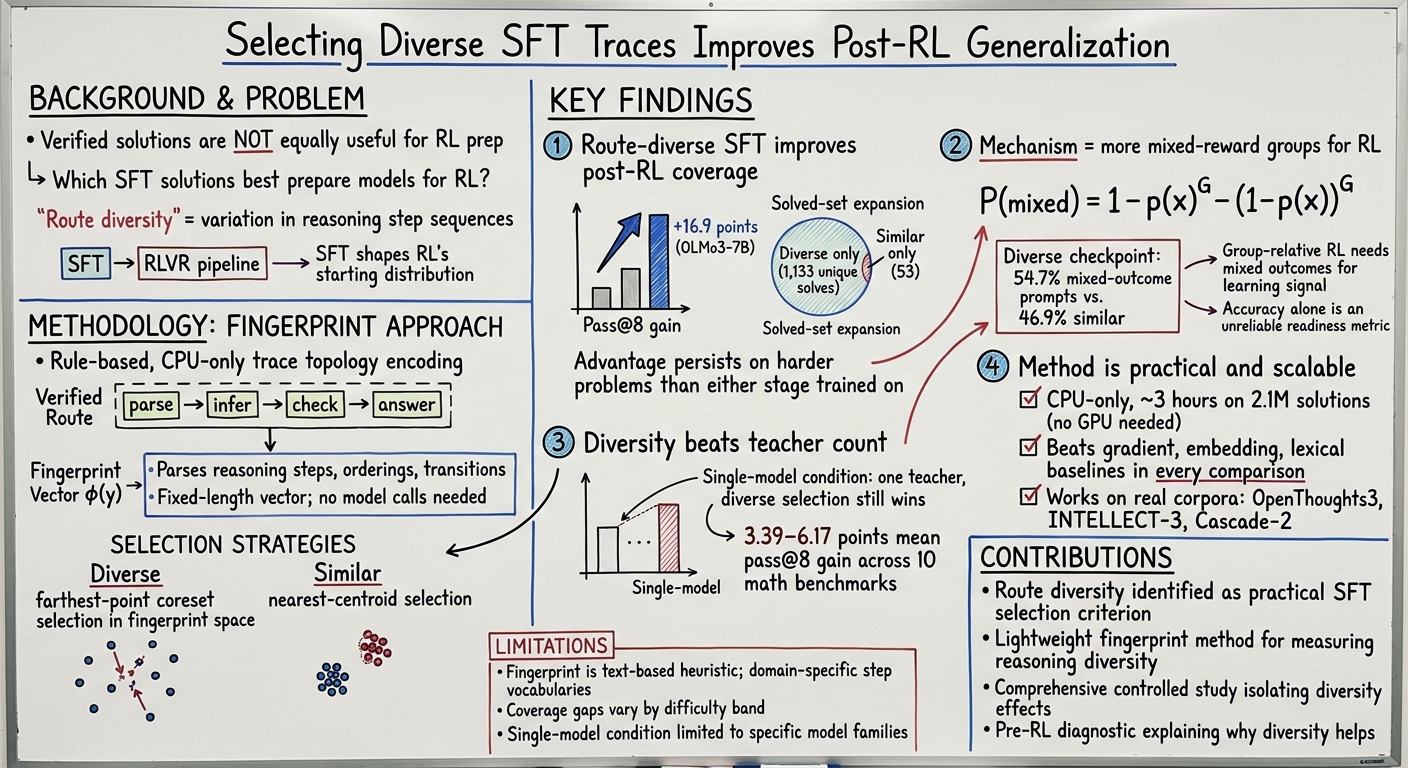
A new axis independent of quality and coverage emerges in post-training data selection. Selecting Diverse SFT Traces is the first to use "reasoning path topology diversity" as an explicit criterion for SFT selection, using model-free regularized fingerprints (event frequency, tree structure, path statistics) and farthest-point clustering, demonstrating on OLMo3-7B with post-RL pass@k as the criterion that route-diverse selection improves held-out environment coverage (+16.9 points, and +3.39–6.17 points under single-model conditions), and providing a pre-RL mixed-reward diagnostic to explain the mechanism (Selecting Diverse SFT Traces Improves Post-RL Generalization). Relative to Issue 15's DeGMatch gradient-based deconfounded selection, the increment is treating "route diversity of multiple solutions to the same problem" as an independent selection axis, and directly responding to Issue 14's DataFlex-RL negative conclusion of "no gain from data strategies" with post-RL upper bounds.
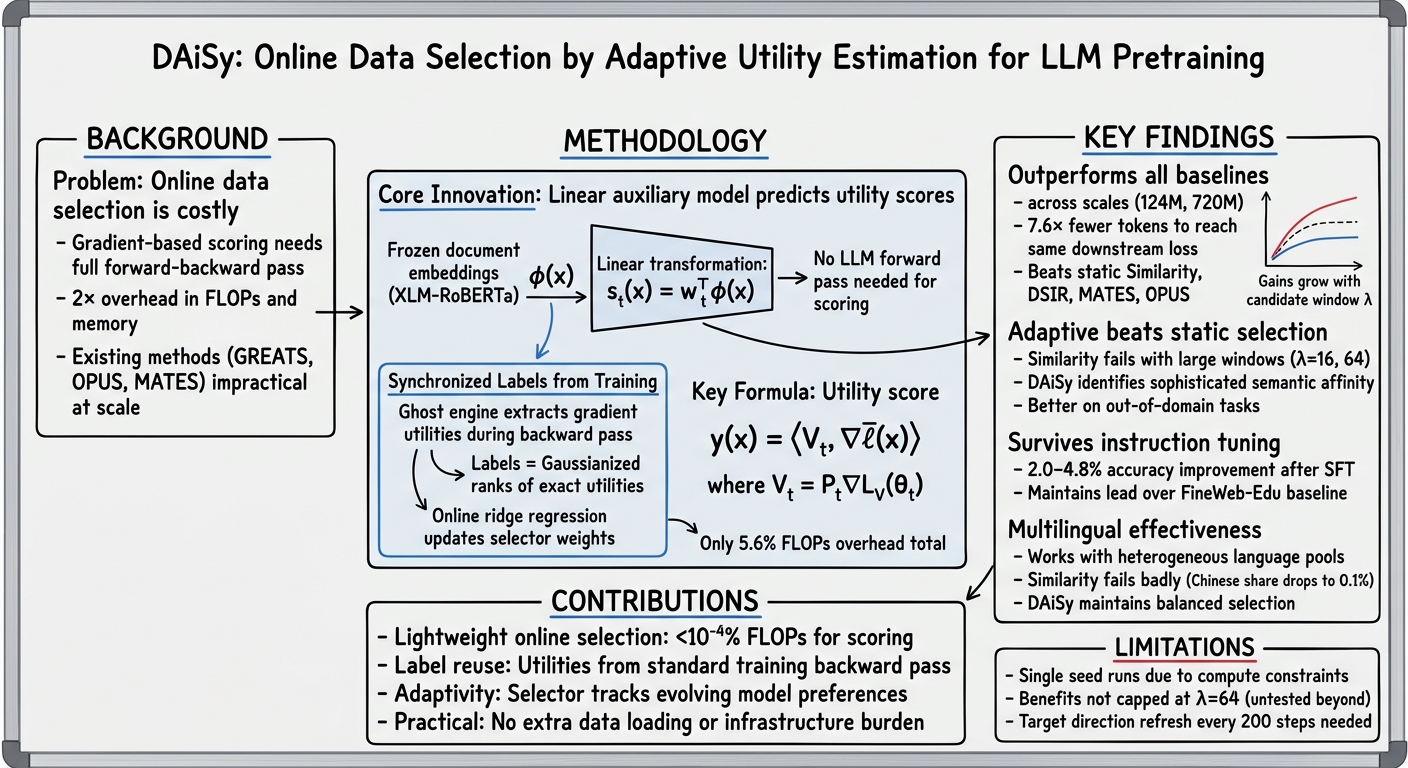
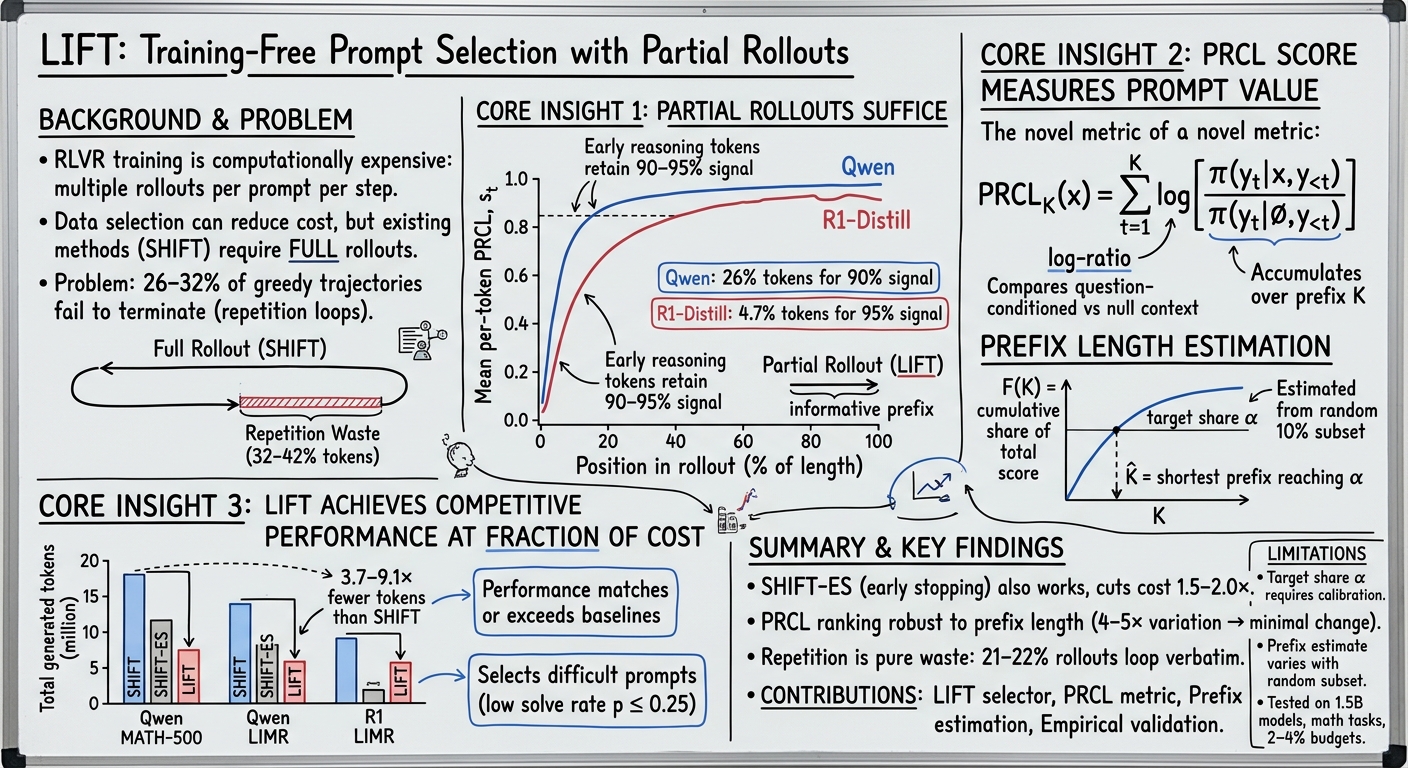
Selection cost itself becomes a research subject. DAiSy replaces gradient-based utility scoring in online data selection with a lightweight linear regressor based on frozen document embeddings, eliminating the full forward-backward propagation cost per candidate document (about 5.6% FLOPs vs 2× FLOPs), and systematically studies the role of selector memory length and redundancy penalty in data-constrained scenarios (DAiSy: Online Data Selection by Adaptive Utility Estimation for LLM Pretraining); LIFT proves that partial rollout prefixes suffice to retain the signal for RLVR prompt selection, using PRCL scores (token-level log-likelihood ratio accumulation based on PVI ideas) for training-free selection, reducing selection cost by 3.7–9.1× compared to SHIFT, which relies on full trajectories (LIFT: Training-Free Prompt Selection for Efficient RL With Partial Rollouts). These two compress the cost of data selection along two dimensions: "selector's own overhead" and "rollout length required for scoring."
Community and Dynamics
On the community side, two practical surveys use "post-training ceiling" as a recipe criterion. One reviews mid-training data selection rules in 2025–26 open-weight model reports (setting repetition caps for high-memorization sources, per-source mixing based on scaling-law experiments), and explicitly evaluates recipes by post-training ceiling rather than base loss (Reading Open-Weight Recipes, Part 2: What 2025–26 Model Reports Disclose About Midtraining); another, with a 20T token data pipeline, replaces hard filtering with small-model scaling-law mixing search, explicitly treating document extraction quality as a data axis and reporting pass@k and RL trainability (Scaling Marin's Open LLM Pre-Training). Both are secondary surveys or practical signals rather than controlled experiments, and should be treated as recipe hypotheses to validate on runs of ≥1B parameters. On the synthetic data collapse side, a survey gives two sharp quantitative thresholds—overparameterized models have a non-vanishing error floor even with <1% synthetic contamination, and in interpolation settings the optimal real-data weight converges to the inverse of the golden ratio, about 0.618 (Why synthetic data can quietly collapse a model)—but lacks evidence at ≥1B scale, so it should be treated as a hypothesis-generation pointer.
Open Questions
- Can the audit pacing principle of When the Proxy Is Wrong transfer to generative LLM pretraining? Its arm-dependent mismatch assumption is validated on BERT classification, but can the mismatch between proxy (small-model loss) and target (post-training ceiling) in real corpus mixing be stably estimated via paired audits, and can the gain of paced audits under drift be reproduced at ≥1B scale?
- Are route diversity and Issue 15's DeGMatch gradient deconfounding mechanistically equivalent—do "route topologies of multiple solutions to the same problem" and "group-level gradient principal directions" capture the same type of signal missed by quality/coverage? Can both be merged into a single selector and directly compared against Issue 14's DataFlex-RL strong negative baseline?
- Does DAiSy's lightweight linear selector maintain utility prediction accuracy at ≥1B scale and on broader data pools? How do its memory length and redundancy penalty adjustments interact with Issue 9's "What Is a Repeated Token Worth?" geometry of repetition value?
- Does LIFT's partial rollout signal retain selection quality at larger scales and broader task domains? How does its conclusion of "limited impact of repeated tokens" reconcile with Issue 10's Scaling Repeated-Data repetition regularization findings?
Papers in this issue
Selecting diverse reasoning routes from verified solutions for SFT improves post-RL generalization by up to 16.9 points, outperforming all baselines via a CPU-only, model-free fingerprint.
Editor's noteFirst to use "reasoning path topology diversity" as an explicit criterion for SFT data selection, proposing model-free regularized fingerprints (event frequency, tree structure, path statistics) and farthest-point clustering selection, demonstrating under fixed budget and matched recipe that route-diverse selection improves post-RL coverage (OLMo3-7B held-out environment pass@8 +16.9 points, +3.39–6.17 points under single-model conditions), and providing a pre-RL mixed-reward diagnostic (diverse checkpoints produce mixed results on 54.7% vs 46.9% prompts) to explain the mechanism. Relative to Issue 15's DeGMatch gradient deconfounded selection, the increment is treating "route diversity of multiple solutions to the same problem" as an independent axis from quality/coverage, and directly responding to Issue 14's DataFlex-RL negative conclusion of "no gain from data strategies" with post-RL pass@k as the criterion. Limitations are that the criterion is still benchmark coverage rather than RL trainability itself, mostly single-seed, and no direct comparison with DataFlex-RL, but as positive evidence for "diversity selection" it is worth reading.
Mismatch-corrected bandits with paired audits and paced querying repair proxy-target ranking inversions, achieving optimal regret and improving worst-group accuracy by up to 10.5 points.
Editor's noteFirst to model proxy–target mismatch as a bandit problem with arm-dependent, possibly order-reversing mismatches: uses paired audits to estimate mismatch, query gating and audit pacing to control budget, and proves that upfront audits incur linear regret under non-stationary regimes, while paced audits achieve sliding-window UCB rates. Relative to allocation methods like DoReMi/RegMix that assume proxy–target alignment or co-shift, the increment is treating "mismatch itself" as an explicit research subject and providing audit pacing principles, complementing Issue 15's Repetition Mismatch on repetition regime mismatch. Limitation is that the scale stops at BERT (335M) classification tasks rather than generative LLM pretraining, but as a methodological framework for proxy→target extrapolation it is worth reading.
DAiSy enables practical online data selection for LLM pretraining by predicting gradient-based utility scores with a linear model, achieving 7.6x data efficiency at only 5.6% extra FLOPs.
Editor's noteFirst to replace gradient-based utility scoring in online data selection with a lightweight linear regressor based on frozen document embeddings, eliminating the full forward-backward propagation cost per candidate document (about 5.6% FLOPs vs 2× FLOPs), and systematically studies the role of selector memory length (γ) and redundancy penalty in data-constrained scenarios. Relative to Issue 9's LESSER focusing on the cost of output-layer gradient features, the increment is treating the computational overhead of the online selector itself as a research subject and providing an actionable lightweight alternative, with improvements surviving instruction fine-tuning. Limitation is that the scale stops at 720M and the criterion is mainly downstream benchmarks without involving post-training ceiling, but as a methodological contribution it is worth reading.
LIFT enables training-free prompt selection for RLVR using partial reasoning rollouts, cutting selection cost by up to 9.1x while matching full-trajectory methods' downstream performance.
Editor's noteFirst to propose training-free RLVR data selection using partial rollout prefixes (rather than full trajectories): PRCL scores accumulate token-level log-likelihood ratios of problem-conditioned vs empty-context based on PVI ideas, with a two-stage process to estimate prefix length from random subsets. Relative to Issue 15's GIST and Issue 14's DataFlex-RL focusing on RLVR data strategies, the increment is treating "partial rollouts suffice to retain selection signal" as an explicit research subject, reducing selection cost by 3.7–9.1× compared to SHIFT and quantifying the limited impact of repeated tokens on selection quality. Limitations are the small scale (1.5B), math-only domain, and non-significant gains in some settings, but as evidence for cost reduction in training-free selectors it is worth reading.