Base Loss Optimal ≠ Post-Training Optimal: An Empirical Moment of Criterion Reversal
Highlights of This Issue
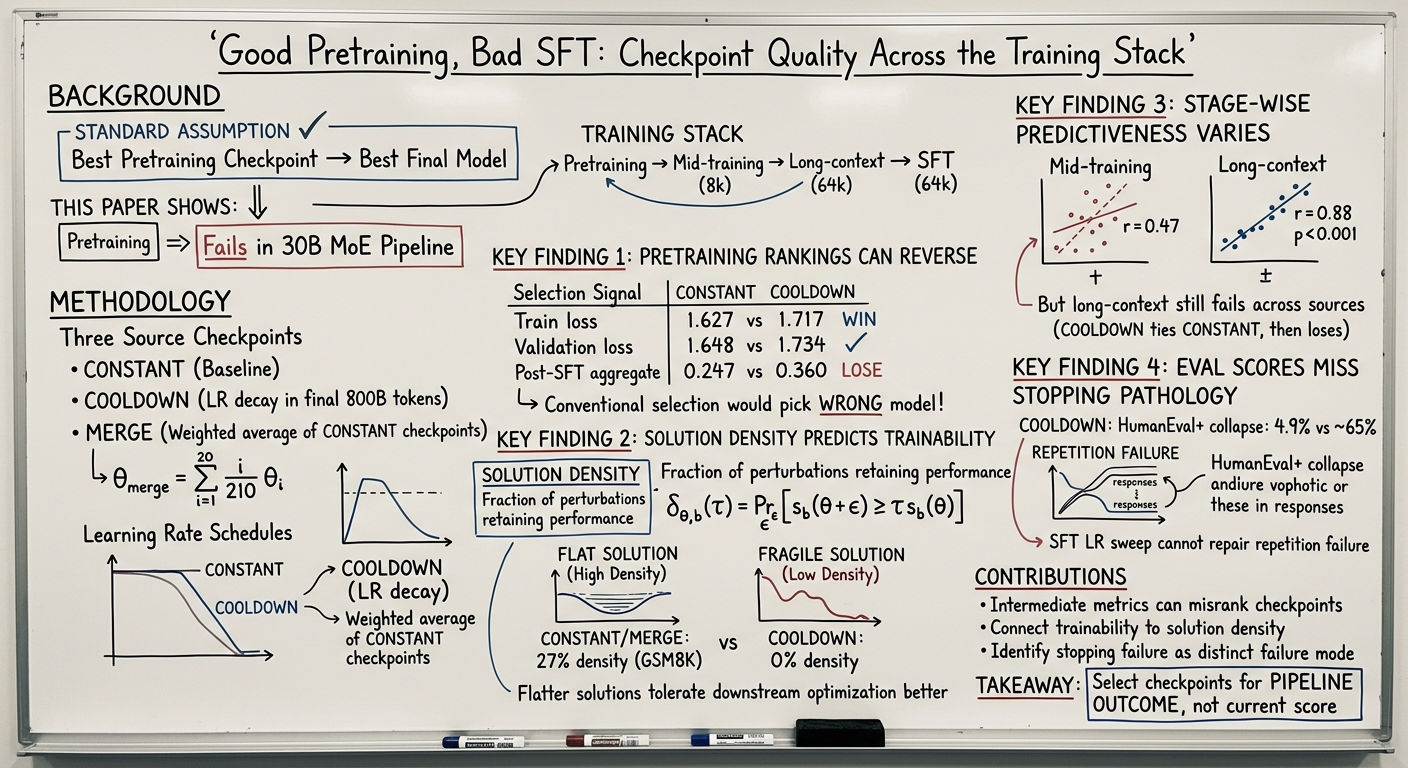
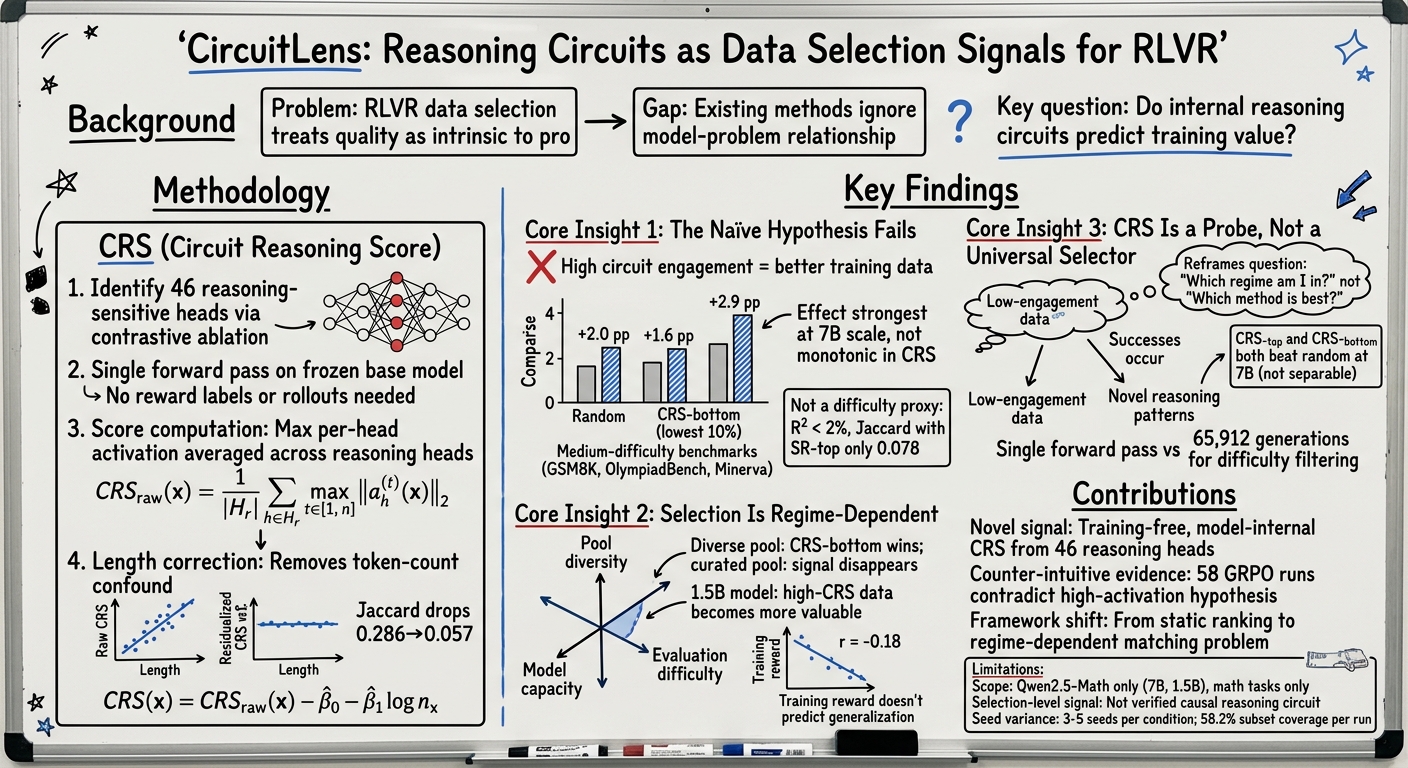
This issue brings the most direct empirical endorsement of the "post-training upper bound" criterion. One work, on a full 30B MoE training pipeline, found that checkpoints selected as "optimal" by base loss or base benchmarks may actually perform worse after full downstream SFT, and that what truly determines post-training performance is the checkpoint's "solution density"—the ability to maintain downstream performance under local weight perturbations (Good Pretraining, Bad SFT). This provides real-scale validation for the pretraining→RL scaling law established in toy board-game domains by Understanding Reasoning from Pretraining to Post-Training (Issue 3), and advances "evaluating data recipes by post-training upper bound rather than base loss" from a methodological claim to an actionable checkpoint selection criterion. Under the same criterion, RLVR data selection is shown to be "regime-dependent" rather than reducible to a static quality ranking—selection signals based on reasoning-circuit activation strength outperform at low participation quantiles rather than high ones (CircuitLens), suggesting that post-training data value depends heavily on the specific state of the model and data pool.
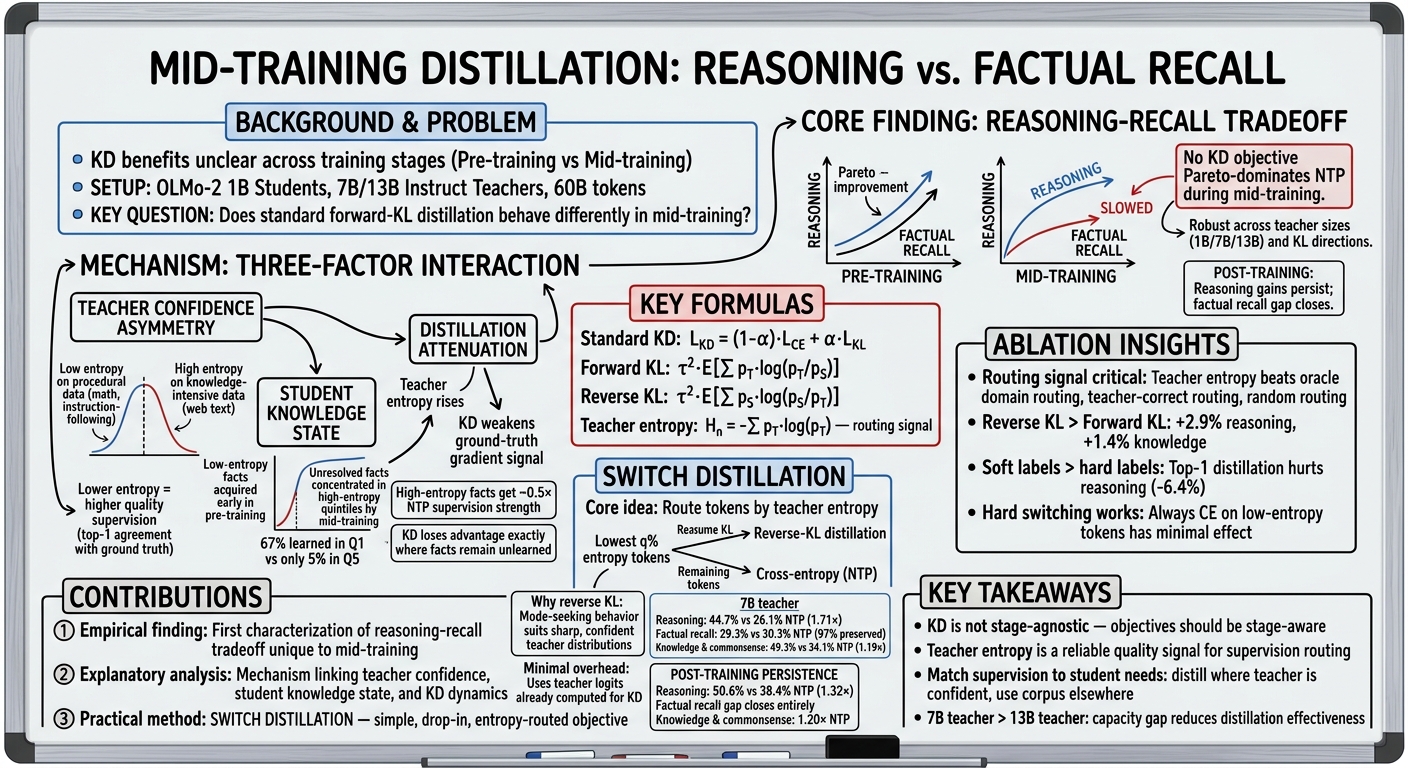
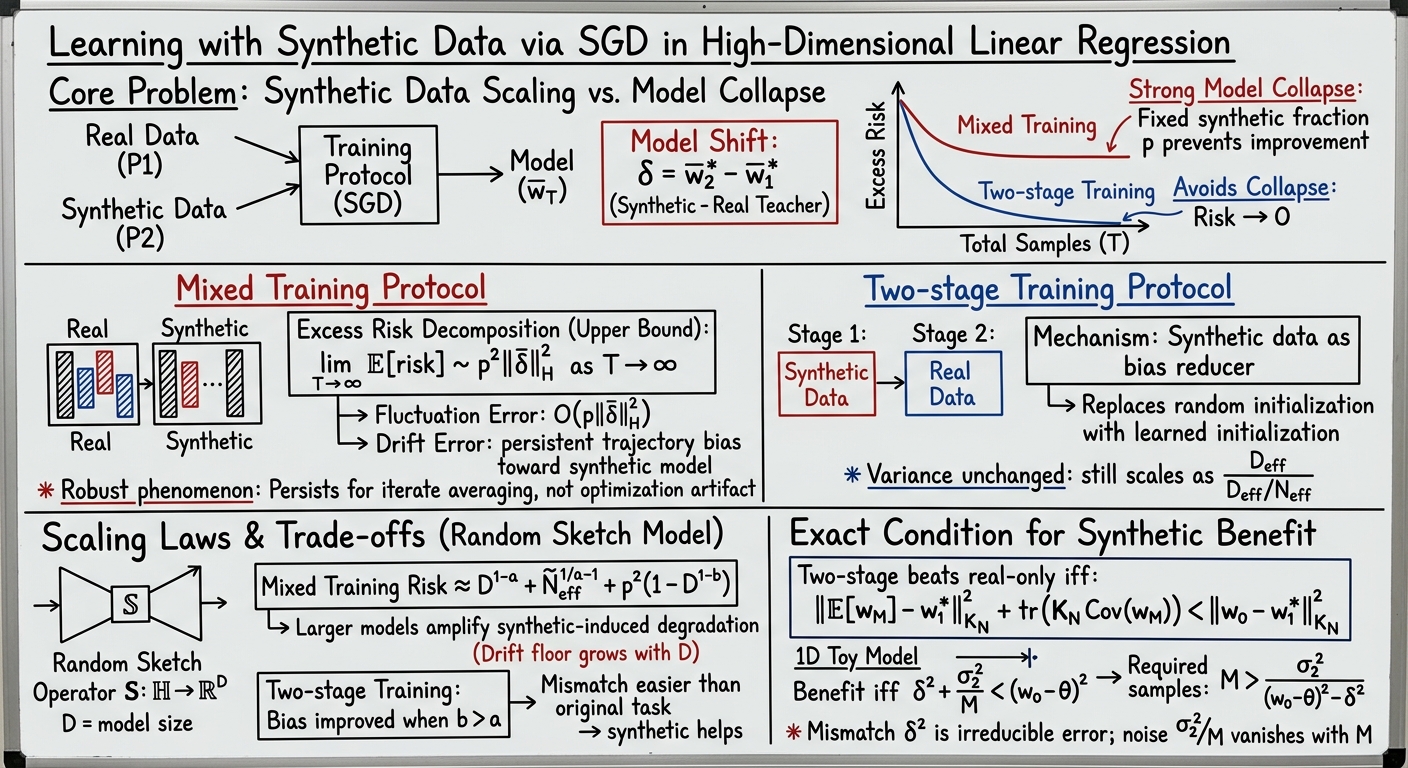
Mid-training data selection gains a new lever this issue: treating the distillation objective itself as a supervision source. One work systematically characterizes the starkly different behavior of knowledge distillation in mid-training versus pretraining—standard forward-KL distillation improves both reasoning and factual recall during pretraining, but during mid-training it improves reasoning at the cost of factual recall, with the mechanism lying in asymmetric teacher entropy across procedural/knowledge-dense domains and students learning low-entropy facts first. The proposed Switch Distillation uses teacher predictive entropy as a token-level routing signal, applying reverse-KL distillation only to low-entropy tokens, and in controlled experiments with a 1B student, 7B/13B teachers, and 60B tokens, it significantly improves the reasoning-recall trade-off, with gains persisting after full post-training (SFT+DPO+RLVR) (Knowledge Distillation During Mid-Training). Relative to Beyond Solvability (Issue 4), which uses learnability as a prior for RL data selection, and MIRA (Issue 3), which uses source-aware rubrics for mid-training data selection, the increment here is using "teacher entropy" as a token-level routing signal for mid-training supervision. On the synthetic data side, a theoretical work provides exact finite-sample bounds in high-dimensional linear regression, showing that mixed training induces strong model collapse, while a "synthetic-first, real-later" two-stage training can avoid the collapse lower bound, and that larger models amplify synthetic degradation under mixed training (Learning with Synthetic Data via SGD)—offering a theoretical complement to empirical findings on training-protocol choices for synthetic data.
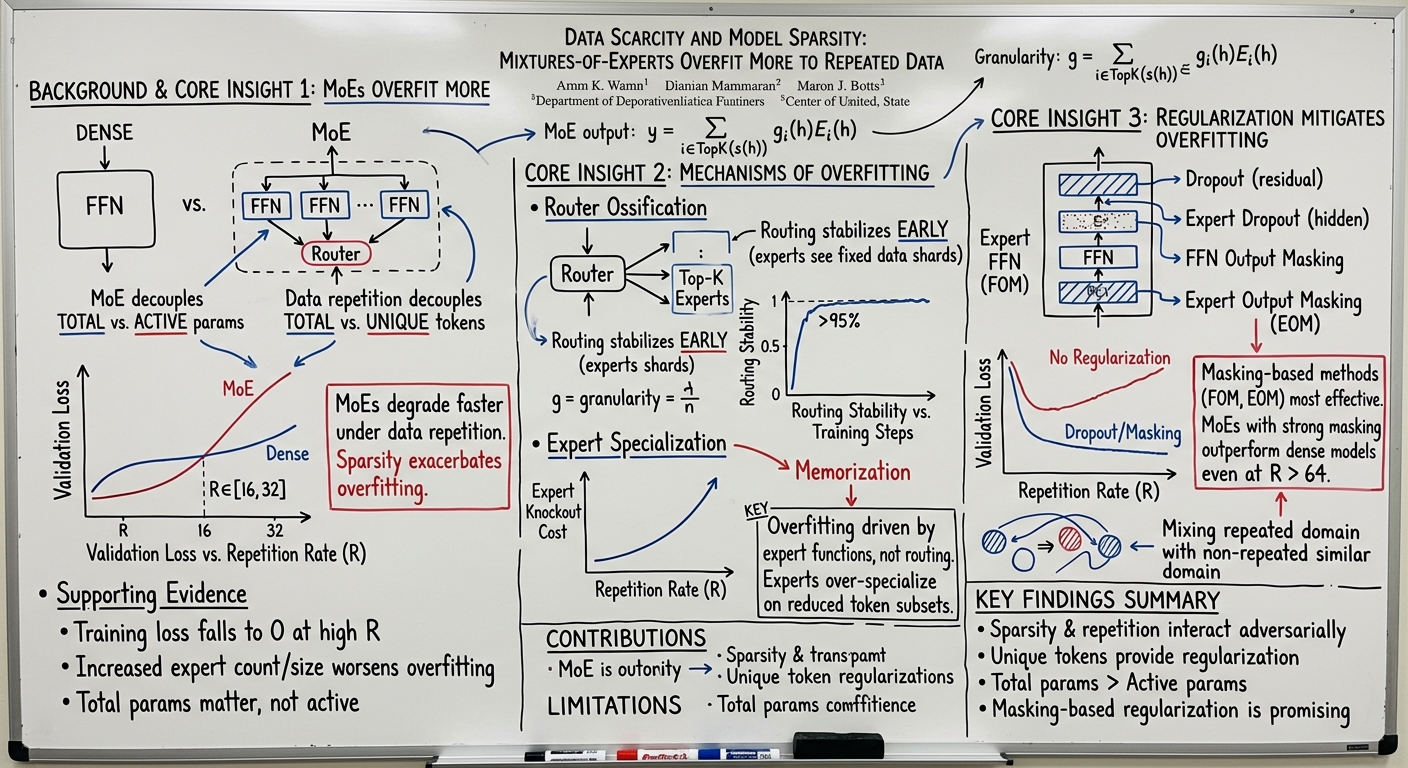
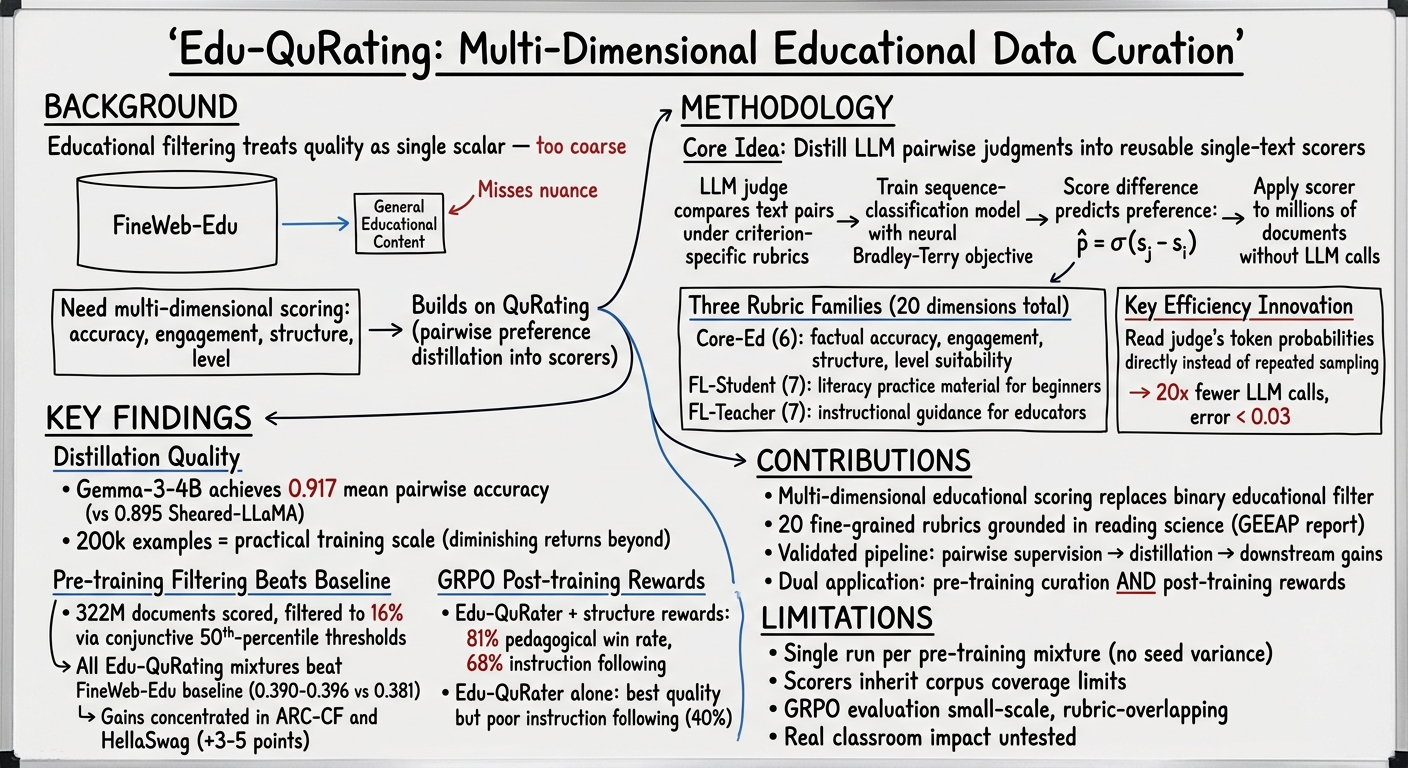
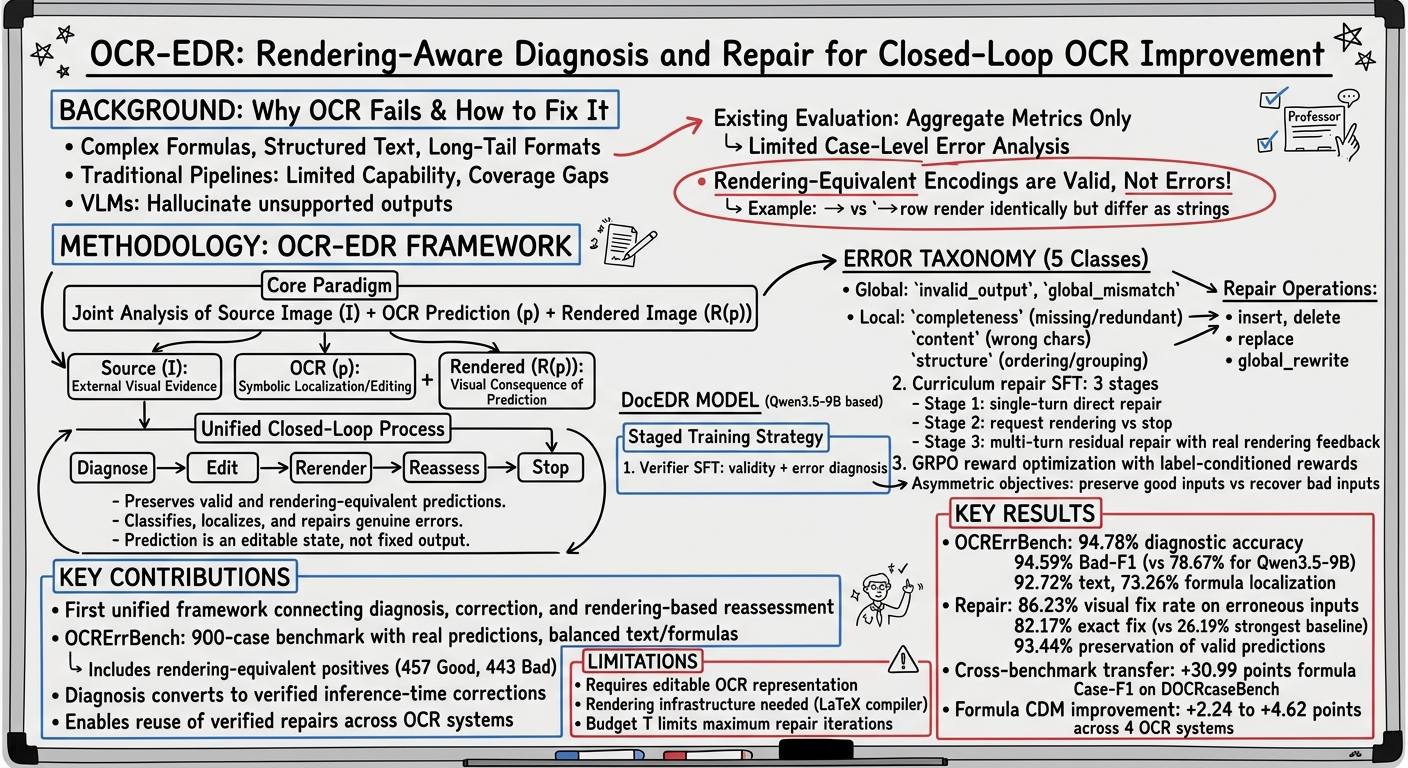
In data-scarcity and repetition, this issue adds a previously overlooked moderating variable: model sparsity. One work explicitly couples MoE sparsity with repetition harm for the first time, finding that MoEs overfit repeated data more severely than compute-matched dense models, that the optimal repetition count decreases with the number of experts, and that harm is driven mainly by total parameter count rather than activated parameters (Data Scarcity and Model Sparsity). This directly responds to the dense-model repetition scaling law in Internal Data Repetition (Issue 1), introducing sparsity into data-scarcity decisions. The document-extraction quality axis also advances: a rendering-aware, closed-loop OCR diagnosis-repair framework uses "rendering equivalence" as the criterion for preserving valid predictions, significantly improving formula recognition on a 9B model (OCR-EDR); a multidimensional educational-quality scorer decomposes QuRating's single scalar quality into actionable 20-dimensional educational axes, used simultaneously for pretraining filtering and GRPO rewards (Edu-QuRating).
Community and Dynamics
A noteworthy evaluation perspective emerges on the document-extraction quality axis: practitioners separate "layout fidelity" from character accuracy as an independent data-quality dimension, orthogonal to CER, and argue it independently affects downstream extraction (OCR Benchmarks & Real-World Documents). This provides a second actionable axis for evaluating parser outputs when building corpora from PDFs/scans. At the community level, a practitioner commentary observes that "pretraining progress is mostly coming from data" (Pretraining progress is mostly coming from data); while offering no new empirics, it reflects that data curation and synthetic-data boundaries are becoming a community focus.
Open Questions
- How do the mechanism and transferability of "solution density" as a checkpoint selection criterion (Good Pretraining, Bad SFT) hold? Why would base loss and post-training performance be inversely correlated, and is solution density still a reliable predictor at larger scales and under different architectures?
- To what extent does Switch Distillation's teacher-entropy routing hold? How does the optimal distillation ratio vary with teacher scale, domain, and training stage, and can the routing signal generalize to other distillation objectives?
- Is the conclusion that MoEs overfit repeated data more severely robust at larger scales and with more regularization? Can the sparsity-repetition-capacity coupling be incorporated into existing data-scarcity scaling laws?
- Does CircuitLens's finding that "low participation quantiles are better" and its regime dependence imply that RLVR data selection is fundamentally unsolvable with a single static signal? Under what conditions are mechanism-level signals and difficulty/quality signals complementary?
Papers in this issue
Pretraining loss and benchmark scores fail to predict post-SFT performance, as a checkpoint with worse pretraining metrics yields better final models after supervised fine-tuning.
Editor's noteProvides direct evidence on a full 30B MoE pipeline that "base-loss-optimal checkpoints perform worse after downstream SFT," and identifies solution density as the true determinant of post-training performance. Relative to the toy board-game pretraining→RL scaling law in *Understanding Reasoning from Pretraining to Post-Training* (Issue 3), the increment is advancing "evaluating data recipes by post-training upper bound" to real-scale controlled validation, directly challenging default assumptions in base-loss-centric scaling laws and mixing studies.
Knowledge distillation during mid-training boosts reasoning but slows factual recall; entropy-based token routing (SWITCH DISTILLATION) preserves both.
Editor's noteFirst systematic characterization of knowledge distillation's starkly different behavior in mid-training versus pretraining: forward-KL distillation sacrifices factual recall for reasoning gains during mid-training, and proposes Switch Distillation with teacher entropy as a routing signal to mitigate this trade-off at the token level. Relative to *Beyond Solvability* (Issue 4) and MIRA (Issue 3), which treat data selection as the lever, the increment is treating the distillation objective itself as a mid-training supervision source, with evidence covering a 1B student, 7B/13B teachers, 60B tokens, and full post-training (SFT+DPO+RLVR).
Mixture-of-Experts models overfit repeated data faster than dense Transformers, losing their advantage by 32x repetition, but dropout and output masking can restore it even at 64x.
Editor's noteFirst explicit coupling of MoE sparsity with repetition harm, finding that MoEs overfit repeated data more severely than compute-matched dense models, that optimal repetition decreases with expert count, and that harm is driven by total parameters. Relative to the dense-model repetition scaling law in *Internal Data Repetition* (Issue 1), the increment is introducing sparsity as a moderating variable with mechanism analysis (early routing fixation, expert over-specialization), providing a new criterion for data-scarcity allocation decisions under MoE architectures.
Selecting low-reasoning-circuit-engagement problems for RLVR training improves generalization on medium-difficulty math benchmarks, reversing the assumption that higher engagement yields better data.
Editor's noteProposes an RLVR data-selection signal based on reasoning-circuit activation strength and reports the counterintuitive finding that low participation quantiles outperform high ones, and that RLVR data selection is regime-dependent rather than a static quality ranking. Relative to *Beyond Solvability* (Issue 4), which uses learnability as a prior, the increment is a mechanism-level signal and a direct test of the assumption that static signals can capture data value, serving as a methodological reference for post-training data selection.
Edu-QuRating distills pairwise LLM preferences into multi-dimensional single-text scorers across 20 educational criteria, improving pre-training data filtering and GRPO reward modeling beyond single-scalar baselines.
Editor's noteAdvances QuRating's single scalar quality into 20-dimensional educational axes and, for the first time, uses the same scorer for both pretraining corpus filtering and GRPO rewards. Relative to CausalMix/DecoupleMix (Issue 4) for mixing optimization, the increment is explicit multidimensional quality decomposition and the "filtering already-educational corpora" setting, with controlled pretraining evidence at 1B scale and 45B tokens, directly responding to the "post-training upper bound" criterion.
OCR-EDR introduces a rendering-aware closed-loop framework that diagnoses and repairs OCR errors while preserving valid outputs, boosting formula accuracy by up to 31 points.
Editor's noteProposes a rendering-aware, closed-loop OCR diagnosis-repair framework, using "rendering equivalence" as the criterion for preserving valid predictions, and builds the OCRErrBench benchmark and DocEDR model. Relative to the source-traceable benchmark in *PureDocBench* (Issue 1), the increment is advancing from evaluation to an executable repair loop, providing tools to convert OCR errors into verified corrections for the document-extraction quality axis.
Mixed training with synthetic data causes strong model collapse with a non-vanishing error floor, while two-stage training avoids it entirely by using synthetic data as initialization.
Editor's noteProvides exact finite-sample bounds for synthetic-data training in high-dimensional linear regression, showing that mixed training induces strong model collapse, while a "synthetic-first, real-later" two-stage training avoids the collapse lower bound, and that larger models amplify synthetic degradation under mixed training. Relative to the empirical repetition-harm study in *Internal Data Repetition* (Issue 1), the increment is theoretically deriving the decisive role of training protocol (mixed vs. two-stage) in synthetic-data benefits, providing a theoretical basis for the boundaries of synthetic-data gains.