Optimizer State Memory: New Focus on Low-Bit Storage and Sensitivity Diagnosis
Highlights of This Issue
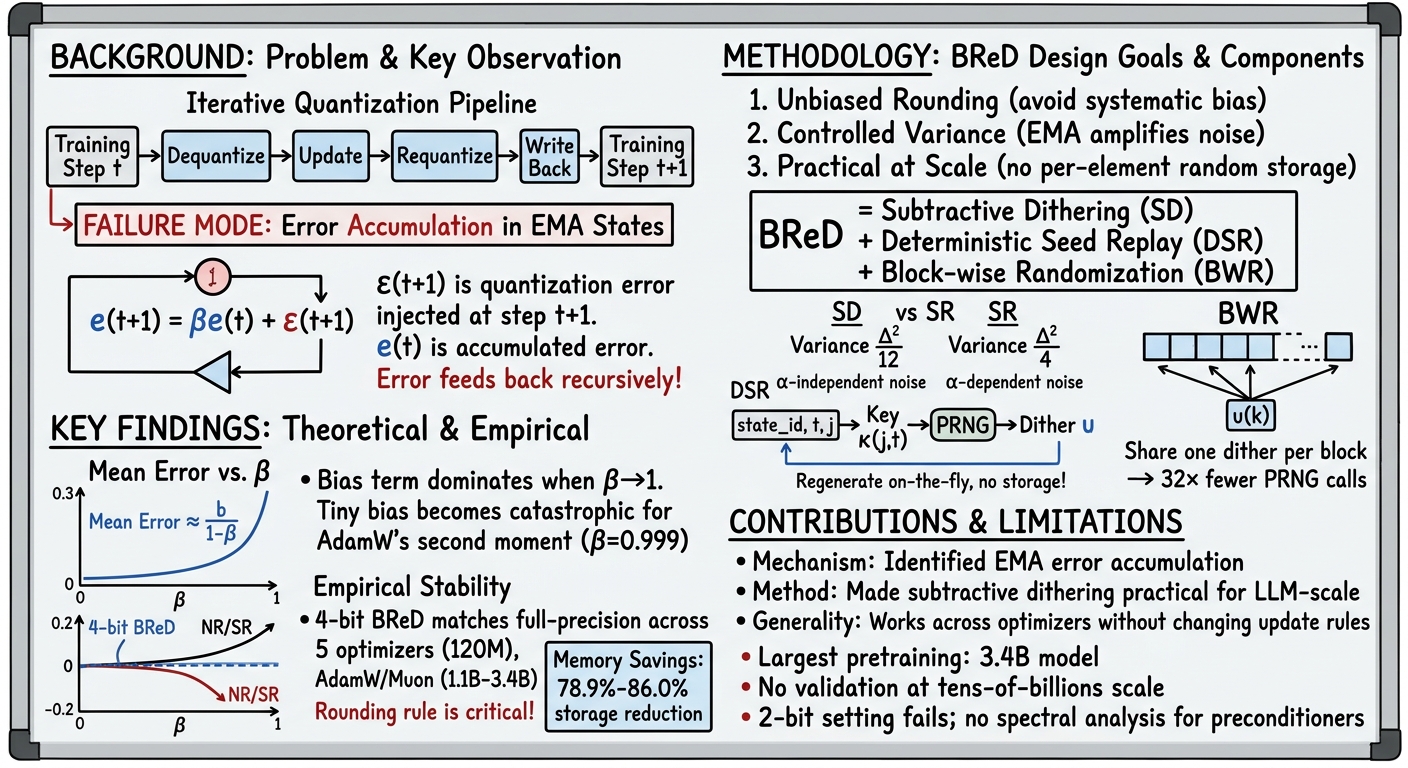
The most concentrated thread in this issue is treating the optimizer state itself as the research object: the accumulation of rounding errors in low-bit storage and the sources of pretraining sensitivity. BReD (https://arxiv.org/abs/2611.33951) is the first to introduce the classical subtractive dithering system into low-bit storage of EMA optimizer states, pointing out its failure mode—when the EMA state is recursively updated via exponential moving average, quantization errors are recursively fed back into subsequent updates, causing bias errors to accumulate over time and high-variance errors to be amplified (especially when the EMA decay factor is close to 1). It addresses practical issues in large-scale training through deterministic seed replay and block-shared dithering values, validated on five optimizers (AdamW, Muon, NAdamW, SOAP, MARS) and multiple scales from 120M to 3.4B, with 4-bit PPL shift ≤0.5 and downstream average change within 0.7 points. Compared to Issue 12's The Role of Quantization in Loss Spikes, which focused on Adam-induced logit mean drift, this paper focuses on the accumulation mechanism of rounding errors in EMA state storage and does not alter the optimizer update rules.
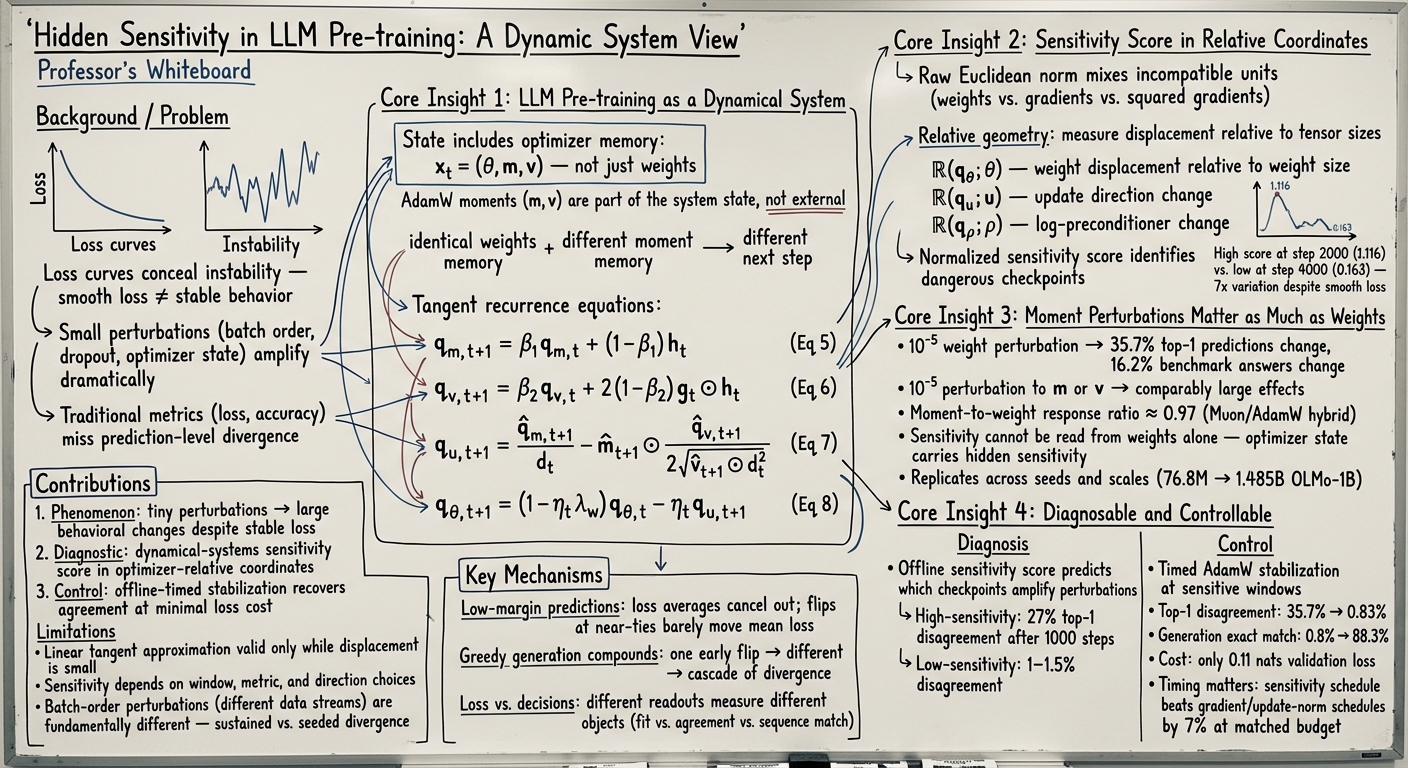
Complementarily, Hidden Sensitivity (https://arxiv.org/abs/2611.28830) models LLM pretraining as a non-autonomous dynamical system where weights and Adam optimizer states co-evolve, defining a normalized sensitivity score in optimizer-relative coordinates, and proves the existence of a sensitive window when loss is smooth: a 10^-5 weight perturbation changes 35.7% of top-1 predictions after 200 steps while validation loss remains almost unchanged, and perturbations to Adam's first/second moments are as important as weight perturbations. Compared to Issue 12's focus on quantization error and loss spikes, this paper is the first to treat optimizer state memory itself as a source of sensitivity and provides an offline scheduled stabilization intervention (0.11-nat cost for 88.3% generation consistency).
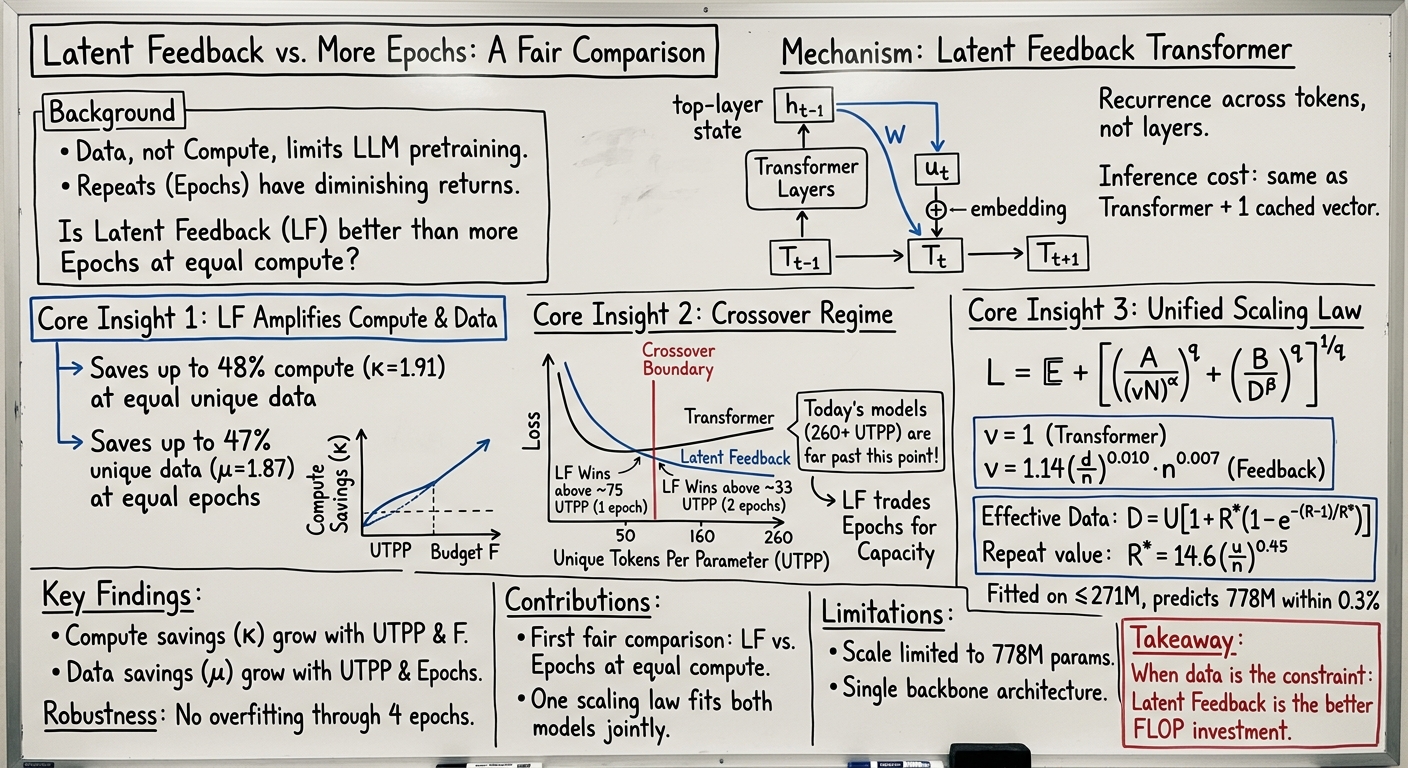
On the data-limited scaling law side, Latent Feedback (https://arxiv.org/abs/2611.20404) is the first to systematically compare latent feedback (cross-token top-layer state feedback) with vanilla Transformer under data-limited settings, training multiple epochs at the same FLOPs, fitting a unified scaling law that models latent feedback as an effective parameter multiplier, and providing compute multipliers and data multipliers to characterize its benefits as UTPP and repetition count increase. Compared to Issue 10's Revisiting the 16x Pretraining Compute Gap, which focused on data efficiency of diffusion vs AR, this paper is the first to provide separate compute-matched and data-matched reports for latent feedback architectures, and on a held-out 778M model (3.3× the largest fitted scale), it predicts loss with 0.13% average error and correctly predicts the winner sign in 6/7 rows.
Community and Updates
- Open Models Almanac published a review of optimizer stability across frontier lab reports (https://models.inteligile.com/articles/adamw-muon-optimizers.html), summarizing Muon-vs-AdamW stability and loss spike evidence from DeepSeek V4, Qwen3.8, Moonshot K2, NVIDIA, and others: Qwen reported 183 spikes per 10k steps with AdamW on a 25B test model, while Muon never triggered clipping; K2 reported that attention logit explosion is "more frequent with Muon, less with AdamW" and introduced MuonClip. Such cross-model comparisons provide horizontal validation for optimizer stability claims, but original training curves and hyperparameter details need to be verified in each lab's first-hand reports.
- Open Athena released first-hand records of frontier-scale pretraining runs (https://openathena.ai/blog/scaling-marins-open-llm-pre-training/), focusing on batch ramping and deterministic data loaders to avoid loss spikes, with "how recipes change with scale" as the core—their Delphi scaling suite predicts a 535B hero run with 300× extrapolation. This is an engineering narrative of stability rather than systematic research, but the engineering details on batch scheduling and spike debugging are valuable references.
Open Questions
- Latent Feedback's unified scaling law models latent feedback as an effective parameter multiplier, but the authors state they did not compare with recurrent-depth models, and the held-out 778M only provides three independent signs. Can latent feedback and recurrent depth/weight sharing be unified under the same "effective parameter" framework, or are they fundamentally different mechanisms?
- BReD's EMA error accumulation theory is most severe when the decay factor is close to 1 (long-term momentum). How does this trade off with the trend that the benefits of low-bit optimizer state compression grow with scale? Is the variance amplification of error accumulation still negligible at larger scales and longer training?
- Hidden Sensitivity's sensitivity score shows no significant incremental advantage for endpoint prediction in cross-seed validation (Table 6). Is the localization of the sensitive window sensitive to seed/data order, and can offline scheduled stabilization be reliably triggered at arbitrary checkpoints?
Papers in this issue
Latent feedback transformers cut compute by up to 48% and data by 47%, with a scaling law predicting these gains when unique data per parameter exceeds ~75 tokens.
Editor's noteFirst to systematically compare latent feedback (cross-token top-layer state feedback) with vanilla Transformer under data-limited settings, training multiple epochs at the same FLOPs, fitting a unified scaling law that models latent feedback as an effective parameter multiplier, and providing compute multipliers and data multipliers to characterize benefits as UTPP and repetition count increase. Compared to Issue 10's Revisiting the 16x Pretraining Compute Gap, which focused on data efficiency of diffusion vs AR, this paper is the first to provide separate compute-matched and data-matched reports for latent feedback, and on a held-out 778M (3.3× the largest fitted scale), it predicts loss with 0.13% average error and correctly predicts the winner sign in 6/7 rows. Limitations: scale up to 778M, held-out only three independent signs.
BReD eliminates bias in low-bit EMA optimizer state quantization via subtractive dithering with seed replay, enabling stable 4-bit training across optimizers and scales.
Editor's noteFirst to introduce the classical subtractive dithering system into low-bit storage of EMA optimizer states, pointing out its failure mode—EMA recursive updates cause quantization errors to be recursively fed back, bias errors accumulate, and high-variance errors are amplified (most severe when decay factor is close to 1), and solving large-scale practical issues with deterministic seed replay and block-shared dithering values. Compared to Issue 12's The Role of Quantization in Loss Spikes, which focused on Adam-induced logit mean drift, this paper focuses on the accumulation mechanism of rounding errors in EMA state storage and does not alter optimizer update rules, validated on five optimizers (AdamW, Muon, NAdamW, SOAP, MARS) and multiple scales from 120M to 3.4B, reporting PPL shift and downstream changes. Limitations: scale up to 3.4B, no extrapolation residuals reported.
Tiny weight perturbations amplify into divergent LLM predictions despite unchanged validation loss, and sensitivity-timed stabilization restores 88.3% generation agreement at only 0.11 nats cost.
Editor's noteFirst to model LLM pretraining as a non-autonomous dynamical system where weights and Adam optimizer states co-evolve, defining a normalized sensitivity score in optimizer-relative coordinates, and proving the existence of a sensitive window when loss is smooth: a 10^-5 weight perturbation changes 35.7% of top-1 predictions after 200 steps while validation loss remains almost unchanged, and perturbations to Adam's first/second moments are as important as weight perturbations. Compared to Issue 12's The Role of Quantization in Loss Spikes, which focused on quantization error and loss spikes, this paper is the first to treat optimizer state memory itself as a source of sensitivity and provides an offline scheduled stabilization intervention (0.11-nat cost for 88.3% generation consistency). Limitations: scale up to 1.485B, sensitivity score's incremental advantage for endpoint prediction is not significant in cross-seed validation.