Weight-Level Self-Improvement in Practice: Embodied Closed Loops and the 'Search or Understanding' Question
Highlights of This Issue
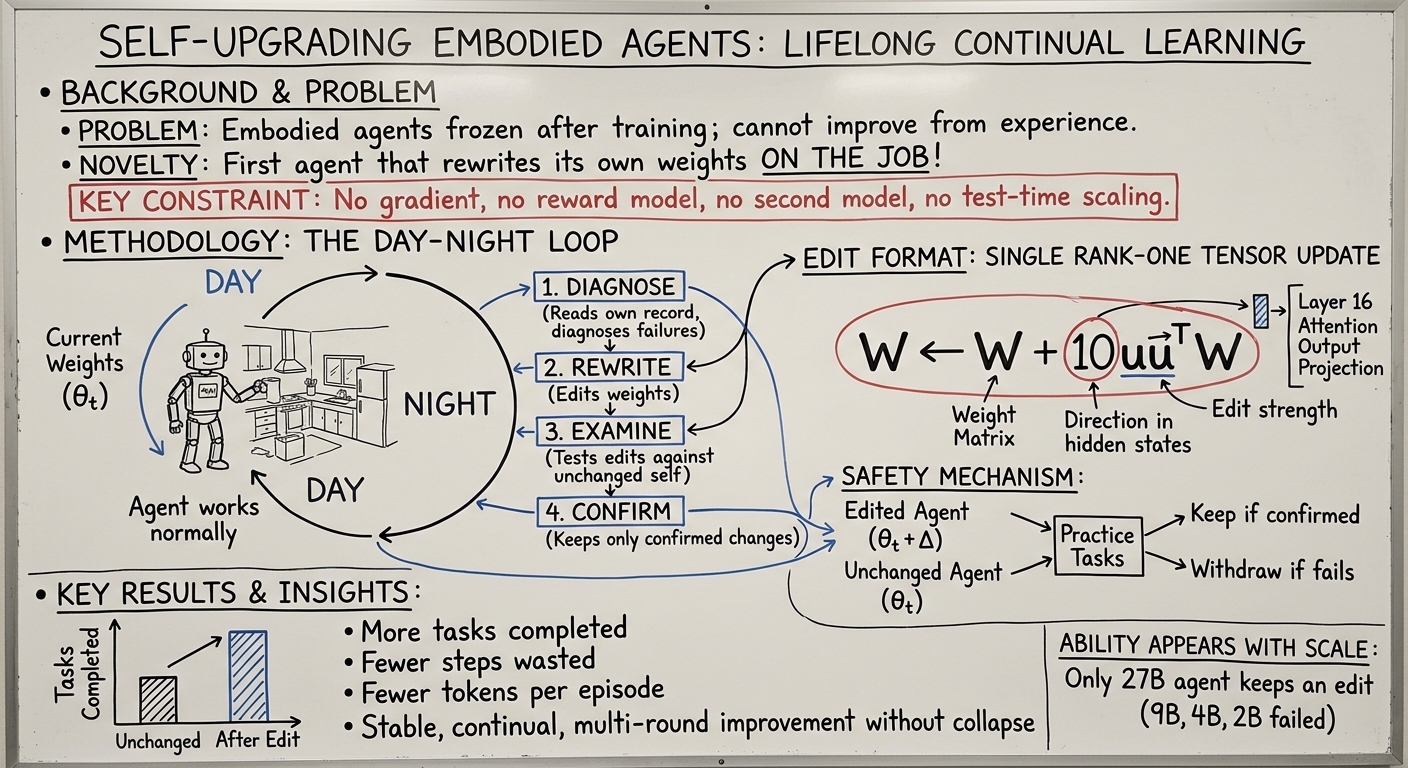
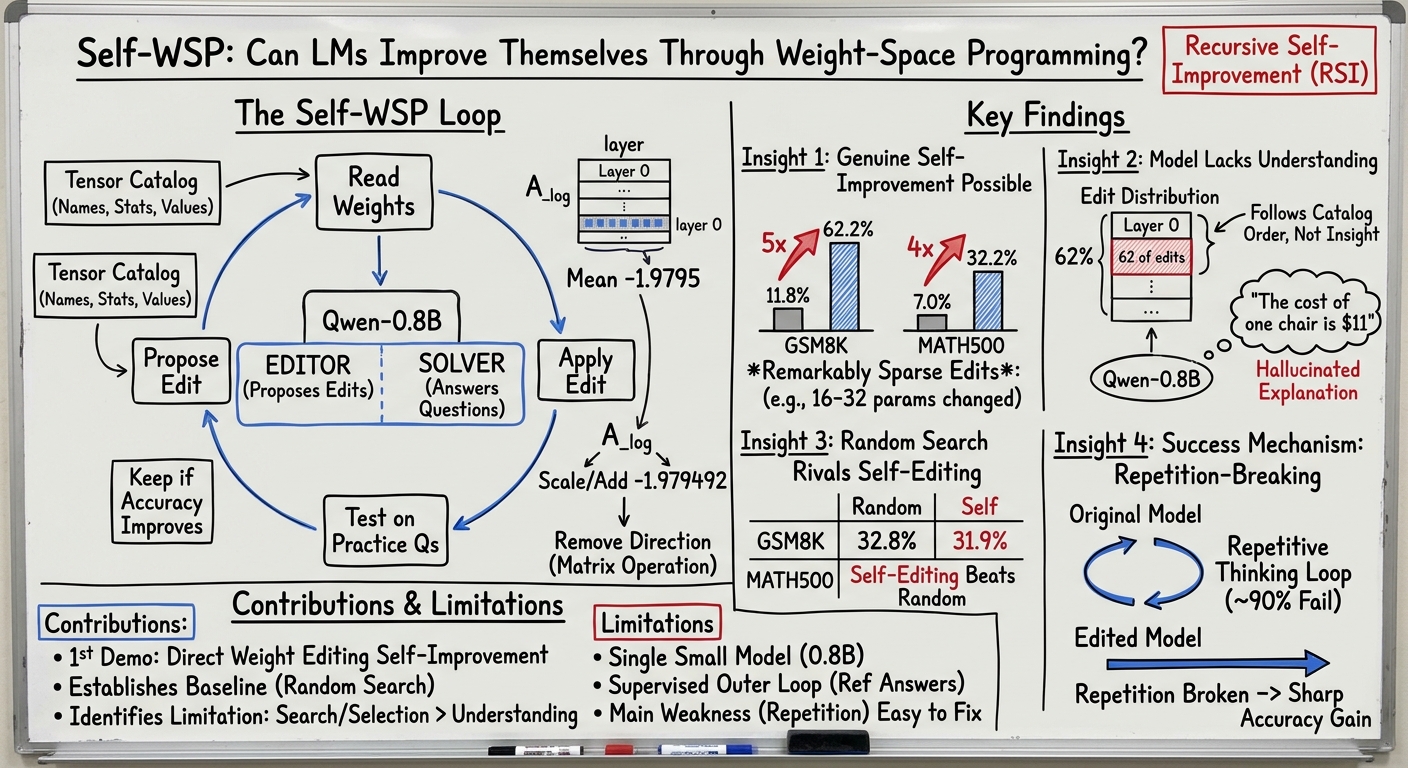
Weight-level self-improvement in this issue moves from 'capability demonstration' to both ends of an 'auditable closed loop.' Self-Upgrading Embodied Agents brings self-rewriting weights to embodied long-horizon tasks: the agent autonomously diagnoses failures between tasks (no-action steps due to token limits), localizes directions in hidden states, rewrites a single attention layer tensor via rank-one updates, and reports honest failure data where only one of four nights retained edits—on the fourth night, it confirmed the task was unsupported and reverted. Its evidence of instrument credibility, where 'nighttime measurements align with daytime held-out results (-6.3 vs -6.4 points),' directly addresses the concern from Issue 15, Language Models Can Rewrite Their Own Weights, about whether weight edits can be reliably measured. On the other end, Self-WSP uses a 0.8B model as both editor and edited, providing strict baselines with random search and spot-check runs, demonstrating that gains often come from search/selection rather than understanding—this is the most direct challenge to 'self-rewriting weights': when random search achieves similar effects, how much of the 'understanding' component in self-improvement remains?
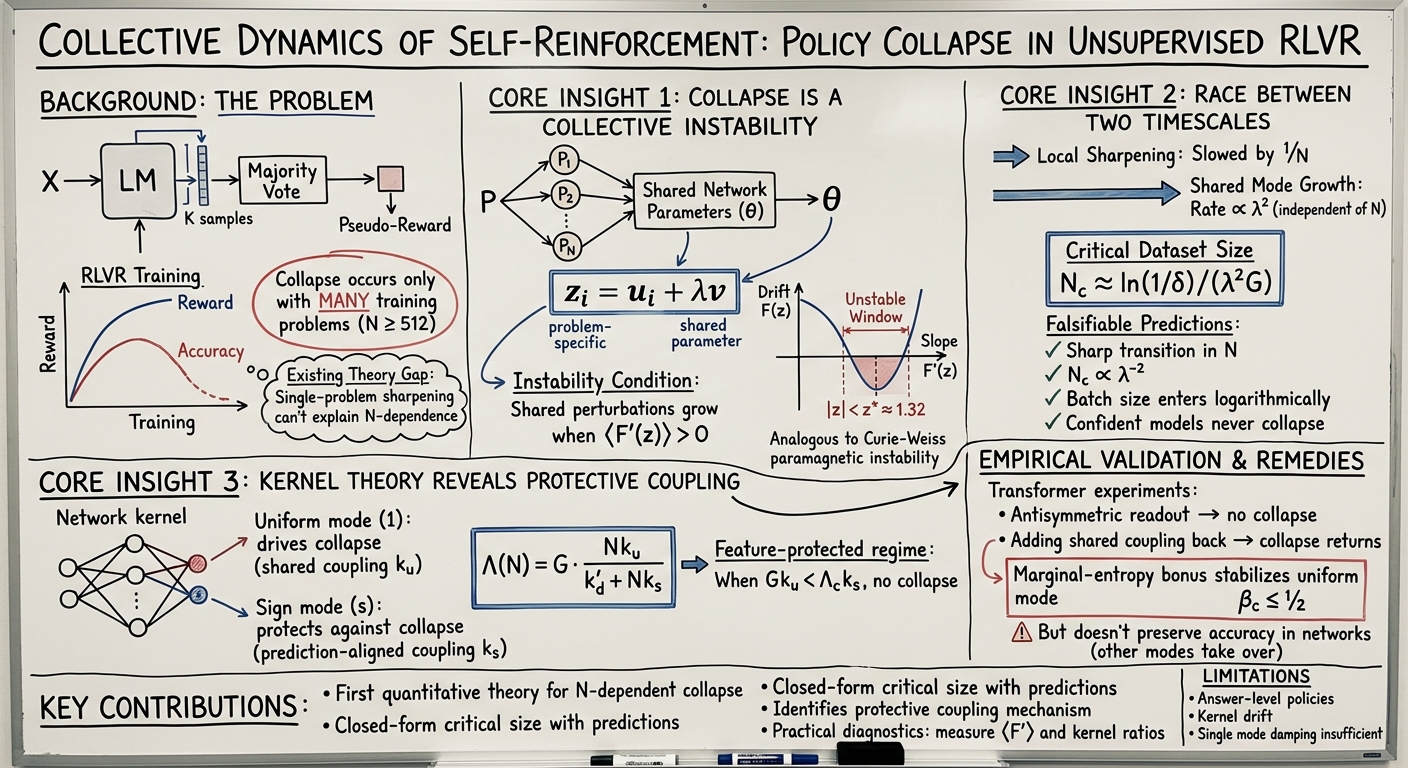
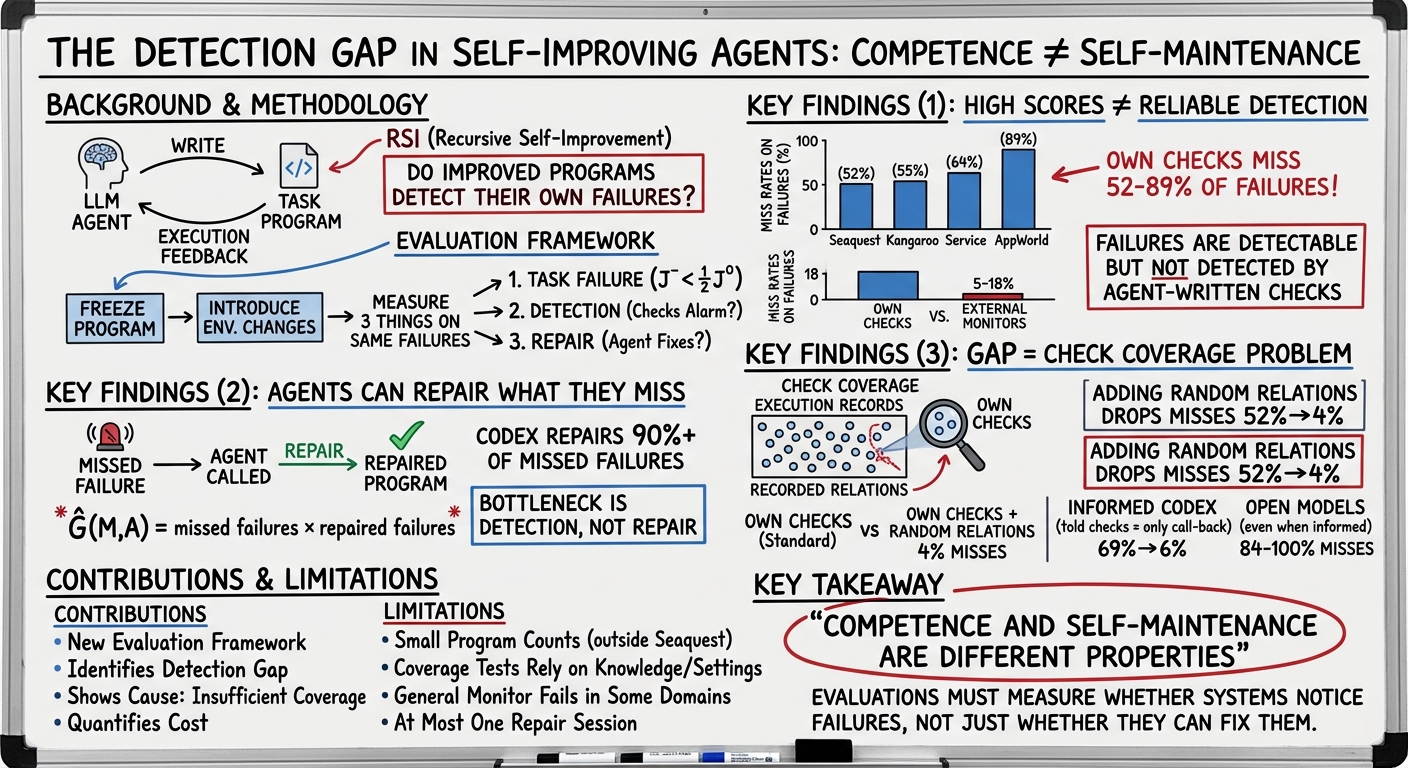
Collapse theory advances from single-problem to multi-problem collective dynamics. Collective Dynamics of Self-Reinforcement provides a falsifiable closed-form theory: in a multi-problem model with shared parameters, when different problems prefer different answers, shared perturbations are collectively amplified within the unresolved window, yielding a critical problem count N_c, validated on toy models and small Transformers (N_c ∝ λ^-2.2, single critical amplification Λ_c≈2.6, batch size has only logarithmic effect). Compared to the single-problem analysis in Issue 14, When Does Exploration Prevent Collapse, the increment lies in making 'dataset size dependence' a falsifiable collective instability, and honestly reporting the prediction failure where the initial kernel underestimates collapse on Transformers. Detection gaps become an independent measurement target: Blind to What They Can Fix demonstrates across five task domains that agents improve programs to high scores, yet their self-written runtime checks miss over half of failures in four domains, while the same agent, when recalled, can fix most missed failures—'high scores do not imply self-maintenance' is a direct warning for any closed loop relying on automated evaluation.
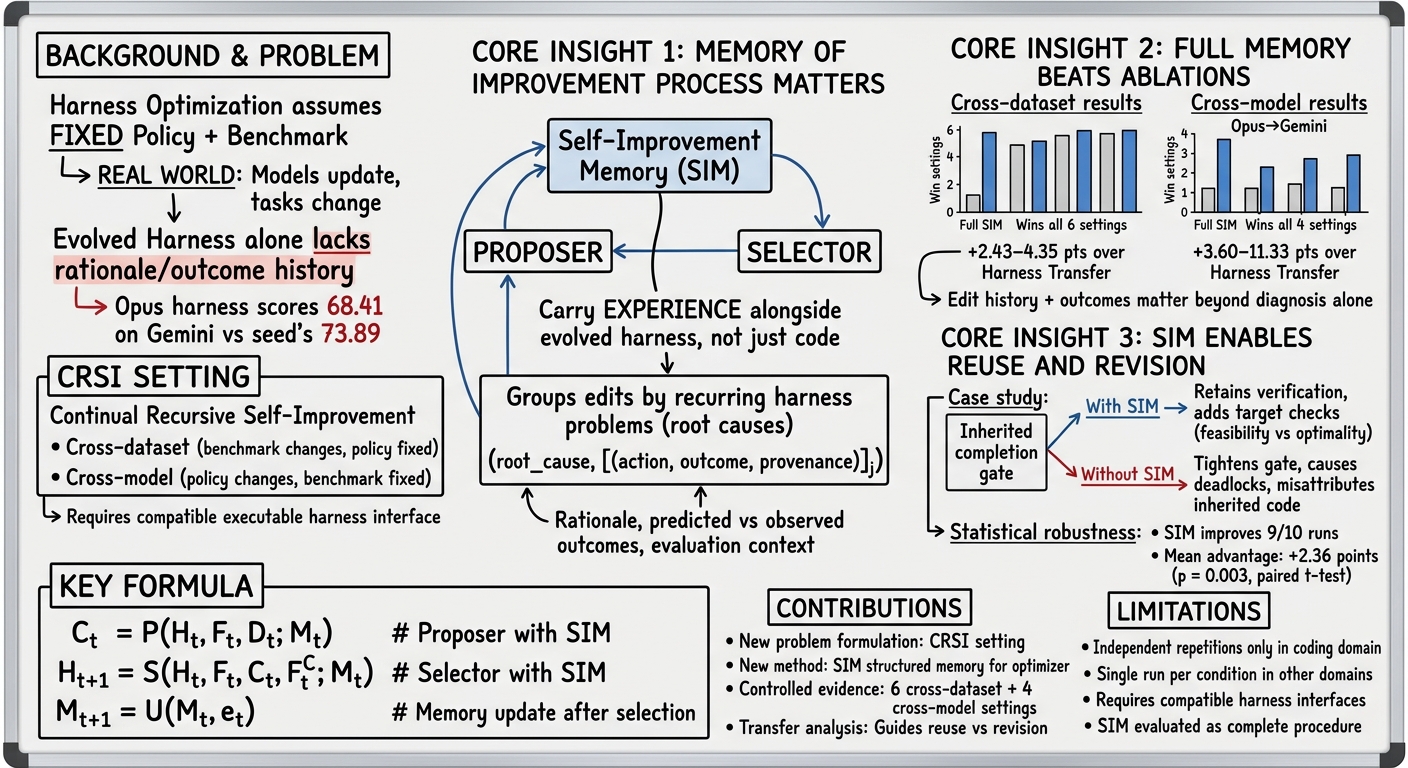
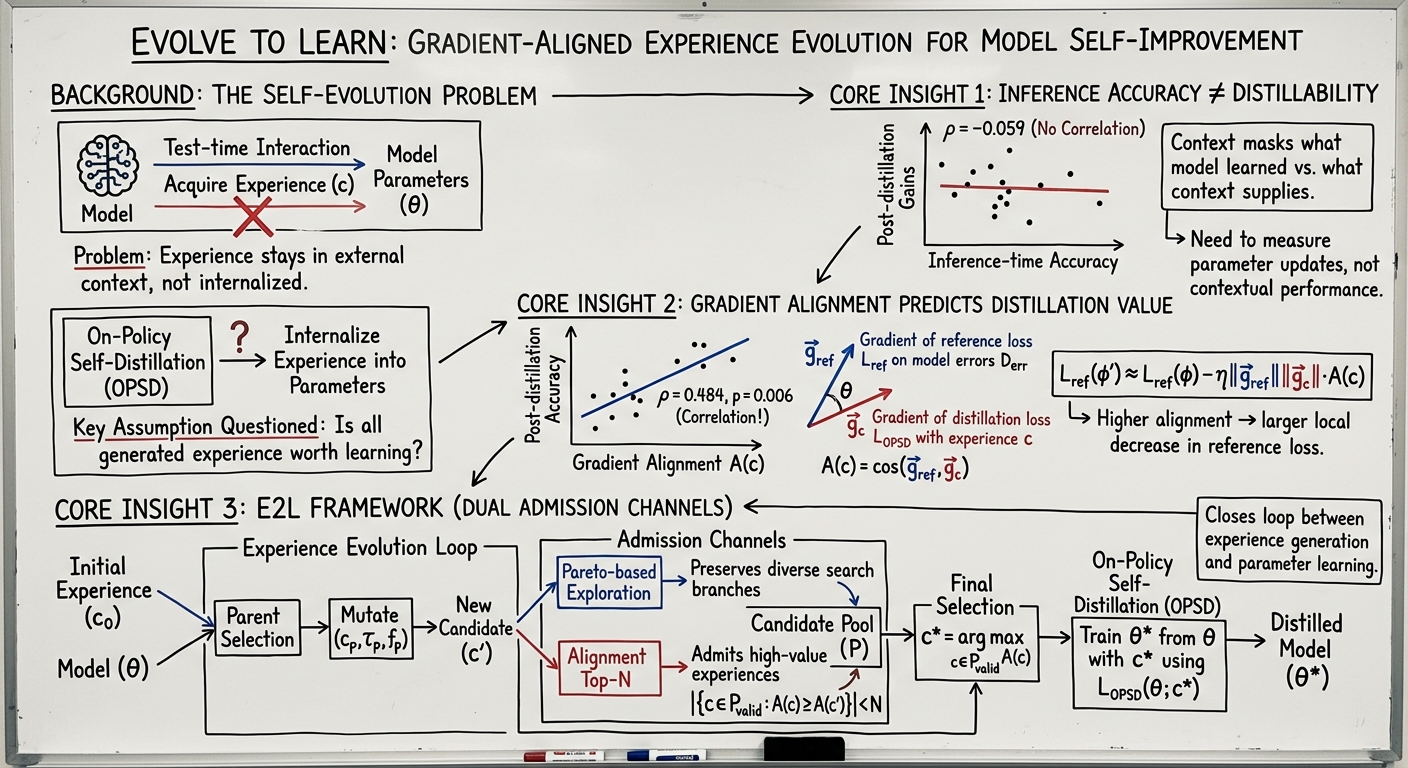
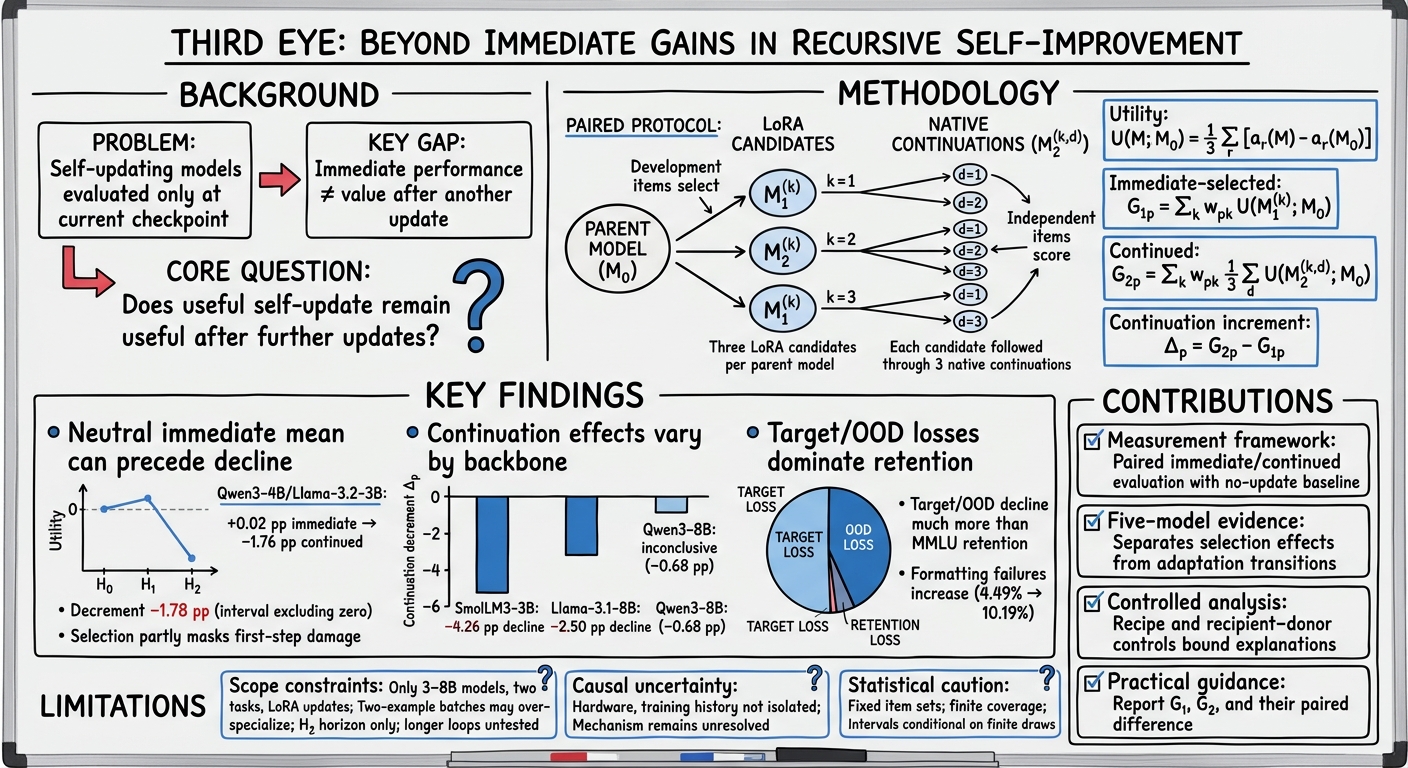
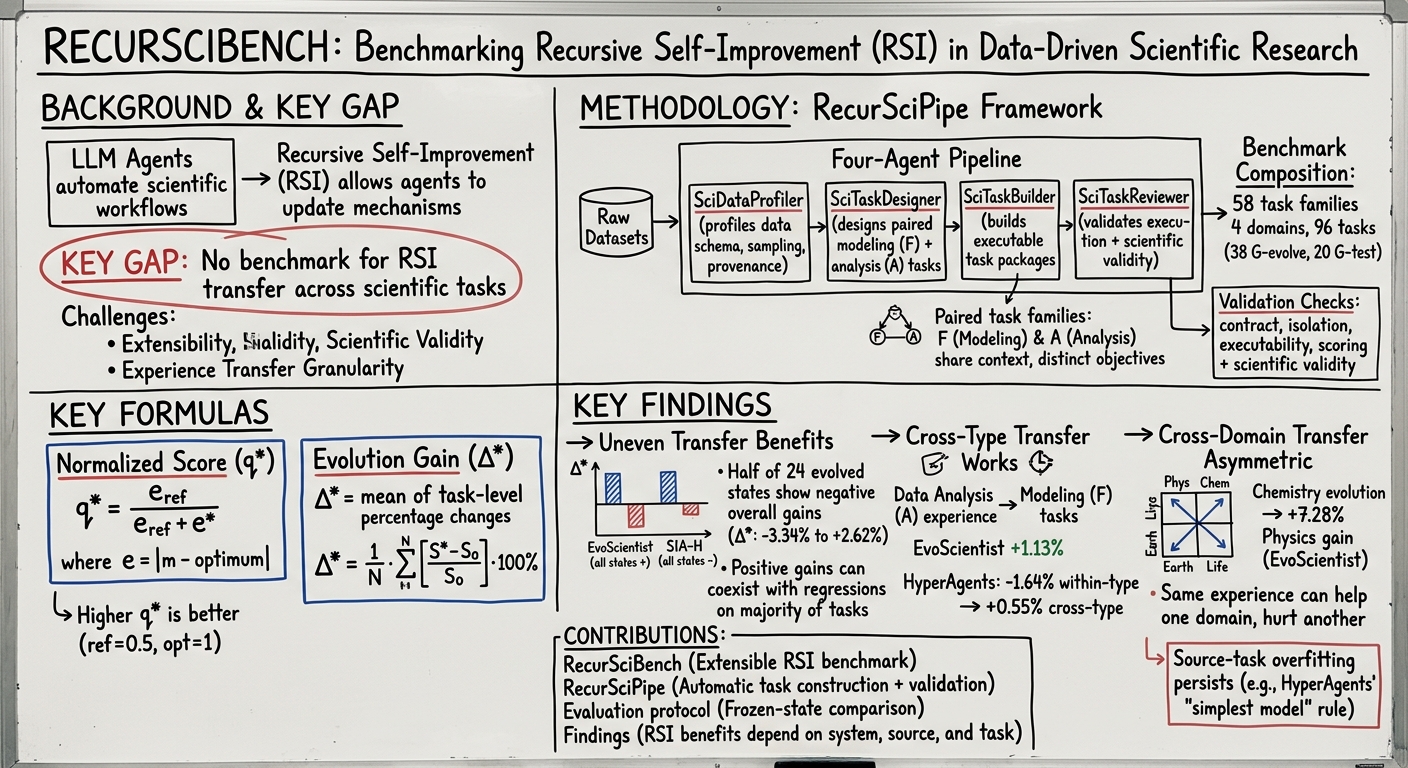
Component decomposition and empirical selection continue to deepen. Self-Improvement Memory turns improvement history itself into a structured, transferable component (SIM), with paired studies across datasets and models showing SIM averages +2.36 points (p=0.003); Evolve to Learn for the first time uses 'gradient alignment' as a distillability criterion for self-distillation experience, showing that inference-time accuracy and post-distillation gains are nearly uncorrelated (ρ=-0.059) while gradient alignment is significantly correlated (ρ=0.484); Third Eye uses paired protocols to separate immediate utility from subsequent update utility, demonstrating that neutral immediate means can precede decline; RecurSciBench provides an RSI transfer benchmark for scientific tasks, showing that positive overall gains can coexist with single-task regression.
Community and Developments
Evo-Harness turns 'context-to-harness skill compilation' into an instance of component-level self-improvement: a frozen solver compiles structured harnesses (cross-task patterns and task-type workflows) from one-shot, failure-anchored execution contexts, rather than updating the model itself—another implementation of harness as an evolvable component, with updates anchored to failure contexts.
Closing the loop: a program that improves an agent harness provides a rare practitioner-level data point: a program autonomously improves its own agent harness (not the model), using development/validation/test task sets to separate diagnosis, selection, and final measurement, and explicitly turns 'keep-or-drop under noise' into a usable adoption rule—echoing the frozen re-scoring concern from Issue 13, Trace Evolution Bench, but from engineering practice rather than academic benchmarks.
Closed-Loop Science proposes 'replayable evidence packages' as an infrastructure standard for closed-loop science: every claim must include a fixed environment, content-hashed data, and execution records; outputs that cannot be verified count only as 'drafts' rather than results—directly addressing the invalid-run detection gap, as a governance design principle rather than empirical results.
Open Questions
-
Self-WSP shows gains often come from search/selection rather than understanding—when random search achieves similar effects, how can we separate 'true self-improvement' from 'search artifacts' in weight-editing closed loops? Can the rank-one edits of Self-Upgrading Embodied Agents and the 0.8B self-editing of Self-WSP share a falsifiable criterion for 'understanding components'?
-
Collective Dynamics provides a critical problem count N_c and protective coupling—can the kernel form and marginal entropy remedies transfer to real harness closed loops? When the kernel changes during training (initial kernel underestimates collapse on Transformers), how wide is the predictable window for N_c?
-
Blind to What They Can Fix demonstrates that detection gaps are an independent measurement target—how can agents' self-written checks cover 'recording relationships' rather than just surface behavior? Can coverage interventions and the 'timely invocation vs. perfect fixer' comparison generalize to more task domains?
-
Evolve to Learn's gradient alignment criterion and Issue 15's The Resolution Hypothesis variance decomposition are two empirical selection criteria—under what conditions do gradient direction and evaluation resolution each predict distillation gains? Can they be unified into a single selection protocol?
Papers in this issue
A self-upgrading embodied agent rewrote its own weights via forward passes alone, improving held-out task completion by 3.6 points without gradients or reward models.
Editor's noteShould read. It advances 'self-rewriting weights' from the reasoning domain to embodied long-horizon closed loops: the agent autonomously diagnoses failures between tasks (no-action steps due to token limits), localizes directions in hidden states, rewrites a single attention layer tensor via rank-one updates, and confirms gated edits through paired tests and held-out tasks. Compared to Issue 15's Language Models Can Rewrite Their Own Weights, the increment lies in the embodied environment (ALFWorld) and evidence of instrument credibility where 'nighttime measurements align with daytime held-out results (-6.3 vs -6.4 points),' along with honest failure data where only one of four nights retained edits (including the fourth night's confirmation that the task was unsupported and reverted). Limitations include a single environment, single model family, and short four-night window, but as a template for auditable closed loops in weight-level self-improvement, it has direct value.
Label-free RLVR with majority-vote rewards collapses when training set size exceeds a critical threshold, an instability predicted by a Curie-Weiss paramagnet model of shared parameters.
Editor's noteShould read. It provides a falsifiable closed-form theory for the dataset size dependence of unsupervised RLVR collapse: in a multi-problem model with shared parameters, shared perturbations are collectively amplified within the unresolved window, yielding a critical problem count N_c, validated on toy models and small Transformers (N_c ∝ λ^-2.2, single critical amplification Λ_c≈2.6, batch size has only logarithmic effect). Compared to Issue 14's When Does Exploration Prevent Collapse single-problem analysis, the increment lies in making 'dataset size' a collective instability with quantitative criteria, and honestly reporting the prediction failure where the initial kernel underestimates collapse on Transformers. Limitations include the theory targeting idealized shared-parameter models, but the kernel form and marginal entropy remedies provide actionable diagnostics and levers.
Self-improving agents achieve high task scores but their own runtime checks miss over half of deployment failures, making detection, not repair, the key bottleneck.
Editor's noteShould read. It is the first to treat 'detection gaps' as an independent measurement target in self-improvement closed loops: across five task domains, agents improve programs to high scores, yet their self-written runtime checks miss over half of failures in four domains, while the same agent, when recalled, can fix most missed failures. Compared to Issue 15's The Resolution Hypothesis evaluation resolution, the increment lies in separating 'detection' and 'fixing' on the same failure set, and providing causal evidence for coverage interventions (adding recording relationships) and deployment replay (timely invocation vs. perfect fixer). Its negative result that 'high scores do not imply self-maintenance' is a methodological warning for any closed-loop design relying on automated evaluation.
Self-Improvement Memory, which records harness edit rationale and outcomes, enables continual recursive self-improvement to outperform harness-only transfer by 2.36 points across changed benchmarks and models.
Editor's noteShould read. It turns 'improvement history itself' into a structured, transferable component: Self-Improvement Memory (SIM) groups edits by recurring harness problems, records rationales, predicted/observed outcomes, and evaluation contexts, while conditioning both proposal and selection. Compared to Issue 8's RRSI regularized harness self-improvement, the increment lies in explicitly making memory a reusable component that transfers across datasets and models, with paired studies across ten independent source runs in the coding domain showing SIM averages +2.36 points (p=0.003). Limitations include single runs in non-coding domains, but the paired protocol and controlled comparisons of Full SIM vs. harness-only vs. root-cause-only provide a reproducible measurement template.
Gradient alignment between experience-induced and reference gradients predicts post-distillation gains, while inference-time accuracy shows no correlation, enabling autonomous self-improvement via the E2L framework.
Editor's noteShould read. It is the first to use 'gradient alignment' as a selection criterion for the distillability of self-distillation experience, showing that inference-time accuracy and post-distillation gains are nearly uncorrelated (ρ=-0.059) while gradient alignment is significantly correlated (ρ=0.484), thereby shifting empirical selection from test-time performance to parameter update direction. Compared to Issue 15's The Resolution Hypothesis variance decomposition, the increment lies in using gradient direction rather than evaluation noise to predict distillation gains, and constructing a Pareto+alignment dual-channel evolutionary search closed loop. Limitations include a single model (Qwen3-8B) and three seeds, but the negative result that 'inference-time accuracy cannot predict distillation gains' and the empirical alignment criterion are new measurement tools.
A 0.8B model can self-improve by editing its own weights, quintupling GSM8K accuracy, but random edits match it, revealing search, not understanding, drives gains.
Editor's noteShould read. It is the first to apply Weight-Space Programming to a closed loop where a language model edits its own weights (a 0.8B model serves as both editor and edited), and systematically measures the gap between self-editing and random search: gains often come from search/selection rather than understanding, and edits are often hallucinations or copied from statistics. Compared to Issue 15's Language Models Can Rewrite Their Own Weights strong-model self-rewriting, the increment lies in providing strict baselines with random search and spot-check runs, quantifying the limits of small-model self-understanding. Its finding that 'random search sometimes performs similarly' is the most direct challenge to any weight-editing closed loop—the 'understanding' component of self-improvement requires stricter baselines to be proven.
Third Eye shows a model's immediate performance after self-update can look neutral while a further native update causes significant utility decline, varying by backbone.
Editor's noteShould read. It introduces a paired evaluation protocol to measure the immediate utility of self-updates and utility after further native updates, separating selection effects from continuation effects, and demonstrating that neutral immediate means can precede decline, with target/OOD loss dominating retention changes. Compared to Issue 15's The Resolution Hypothesis evaluation resolution, the increment lies in making 'transfer between updates' an independent measurement target, using independent scoring and no-update baselines to provide a reporting template for G1, G2, and their paired differences. Limitations include unclear results for some backbones, but as a protocol for 'evaluating transfer rather than just checkpoints,' it has direct value for designing closed-loop evaluations.
RecurSciBench shows recursive self-improvement gains are system-dependent and uneven, with half of evolved states regressing, yet experience can transfer across task types and domains in non-obvious ways.
Editor's noteShould read. It provides an RSI transfer benchmark for data-driven scientific research: using RecurSciPipe to automatically build 58 task families and 96 tasks from raw datasets across four scientific domains, evaluating four RSI systems under within-type, cross-type, and cross-domain transfer. Compared to Issue 13's SelfImprove-Bench game-like generalization ladder, the increment lies in focusing on scientific tasks and explicitly measuring cross-type and cross-domain transfer, with findings that 'positive overall gains can coexist with single-task regression' and 'experience can benefit across domains without source-domain gains' having direct value for understanding self-improvement dynamics. Limitations include small and inconsistent overall gains (half of 24 evolutionary states show negative gains), but the frozen-state evaluation protocol is reproducible.