Turning 'Whether Improvements Are Real' into Auditable Measurement
Highlights
The main thread of this issue is turning "self-improvement rate as a measurement target" from a slogan into an audit discipline. Last issue we saw the implementation lottery of "one run does not count as an idea" and the process-level framework of "beyond final scores." This week's progress systematizes these intuitions: on one hand, transfer-level audits based on "measured nulls" have emerged; on the other hand, benchmarks that isolate the "algorithm design layer" from the system/data layer have appeared. Together, they turn "whether an improvement is real" from a debatable judgment into a reproducible measurement—and the measurement itself is also beginning to be treated as an object requiring audit.
On the closed-loop constraint side, discussions of reward hacking have advanced from "the existence of attackers" to the finer-grained mechanism of "reward signals can be corrupted even without attackers": the structural verification asymmetry of reference-free judges, integrity gates that use "reproducibility rate" rather than reward as the adoption threshold, and co-evolutionary designs that treat the environment generator itself as a learnable component and use hint gaps for reward grounding. These works all answer the same question: when a system improves itself, which signals deserve trust?
Community and Dynamics
OpenAI's GPT-5.6 August update disclosure is a rare sample of "treating lab disclosures as data sources" in this direction: it explicitly states "AI Self-Improvement capability evals were not run," citing that the model's performance on multiple intelligence benchmarks was similar to the July version and judged below the High threshold—this kind of supervision gap statement that explicitly notes "a certain eval was not run" carries more information than vague safety claims and can serve as a raw signal for tracking disclosure practices.
The MIT Technology Review report on Princeton's shadow evaluation puts the contrast between "narrow-task improvement vs. open-ended research stagnation" on the table: agents can complete the engineering parts of AI research but fail at judgment, creativity, and effective backtracking, and cannot creatively respond to feedback from sub-agents and external review tools. It reminds us that the bottleneck of the self-improvement closed loop may not be "whether scores can be pushed higher" but "whether one can judge when to restart under open-ended goals."
On the engineering side, LoopGain's outerloop-bench turns the "fix until green" outer loop into a reproducible benchmark, explicitly reporting the ratio of false-stops to recoverable runs (13/30 false stops on budget-constrained cells, 9 of which are recoverable), and publicly releases 90 instrumented loops with full traceability—this is a direct practice of turning "invalid run determination" into a first-class benchmark artifact. crucible provides a self-improvement gate that "refuses to trust rewards": it adopts edits based on cross-check reproducibility rates rather than rewards, and across 7 splits shows that a pure reward gate would adopt a hack that the integrity gate rejects entirely. OCNR proposes single-class novelty rewards against cross-iteration degradation in self-play, directly targeting the collapse path where "the task generation distribution narrows to familiar problems."
Open Questions
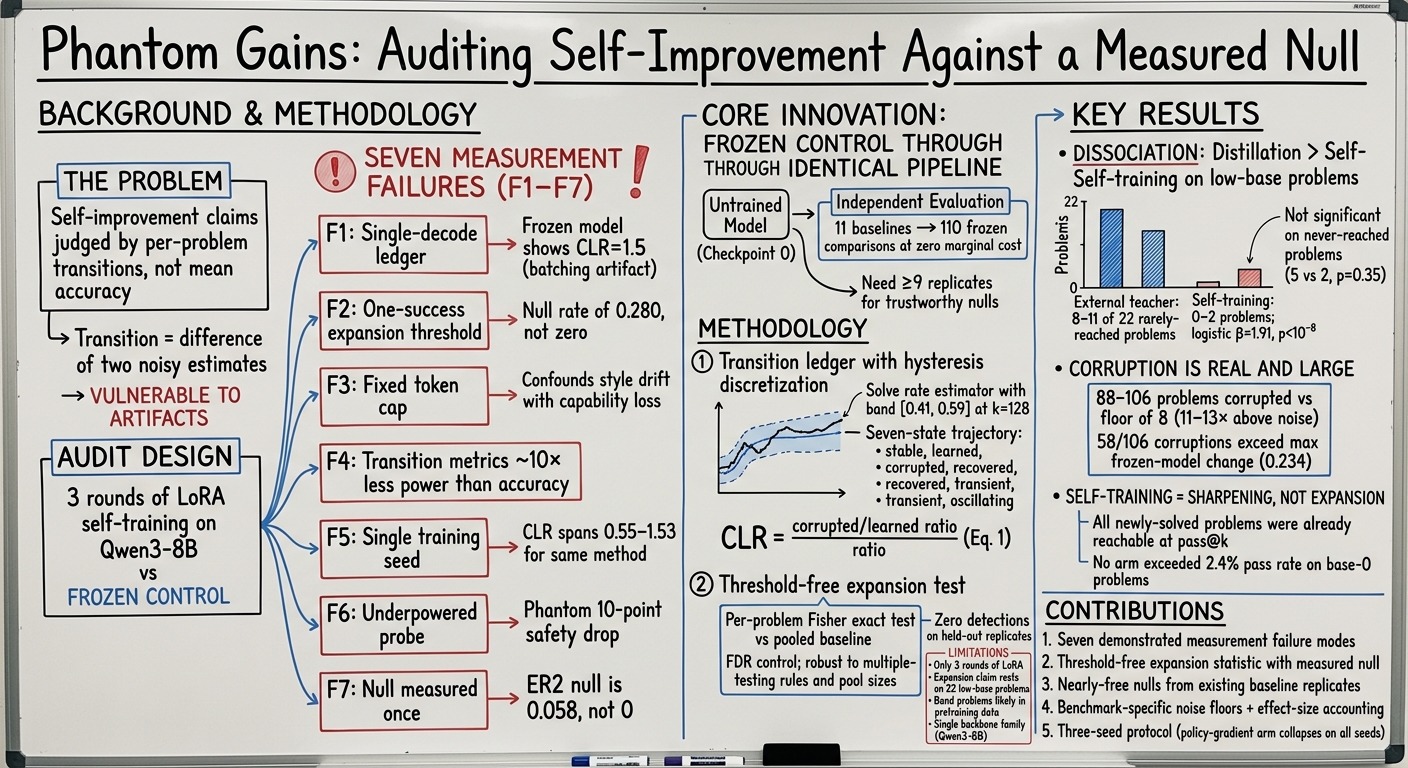
- When "measured nulls" become a required component of every statistic (F7 points out that a null is just a point estimate), how can credible nulls be obtained in scenarios beyond multi-arm ladders—such as single-model production loops or closed loops without checkpoint-0 replicas? Can the observation that "checkpoint 0 is a free untrained model evaluation" be generalized to the harness and experience library levels?
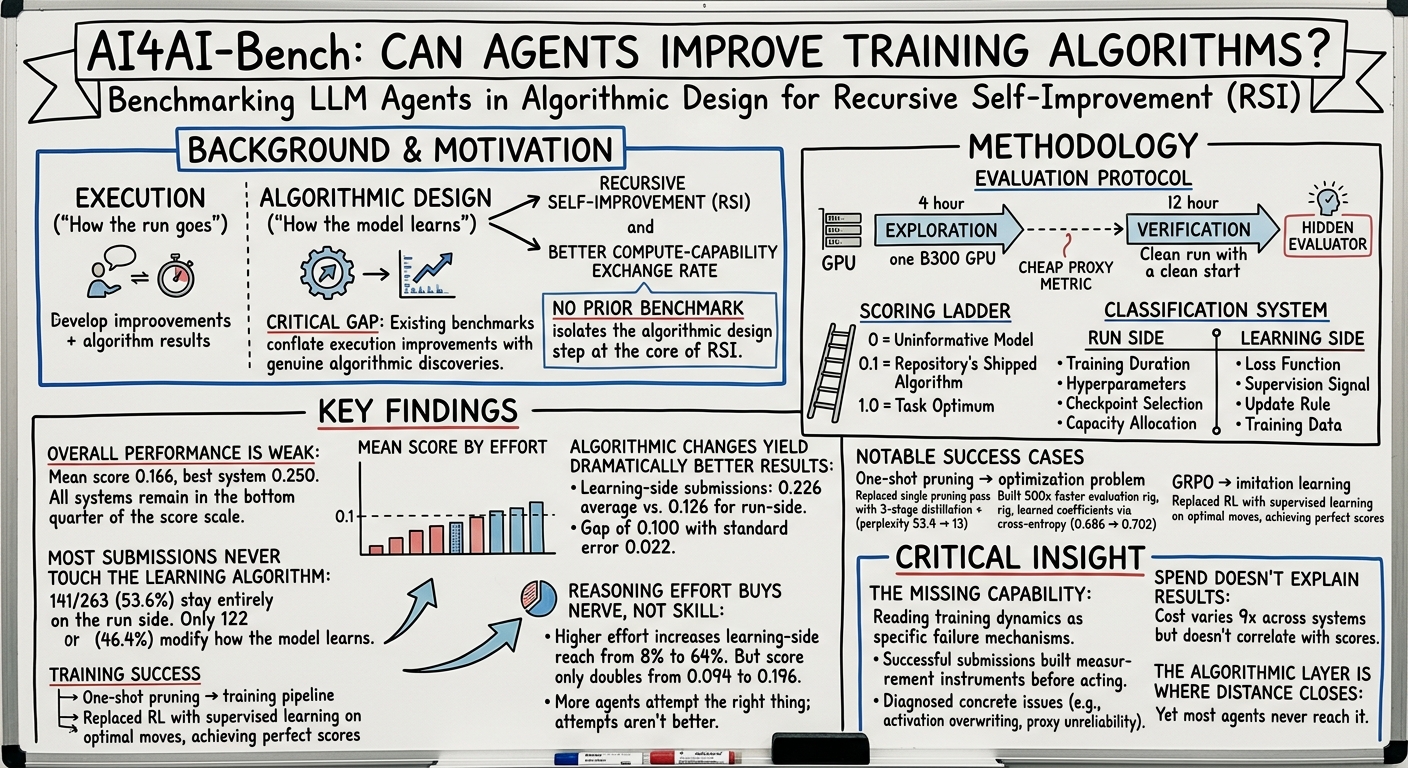
- Submissions that touch the learning layer score much higher on average than those that only modify the execution side, and inference effort mainly buys the willingness to "dare to modify the learning layer." So is "touching the learning layer" a proxy for algorithmic improvement capability, or merely a behavioral tendency under budget pressure? Can a metric be constructed that separates "willingness" from "capability"?
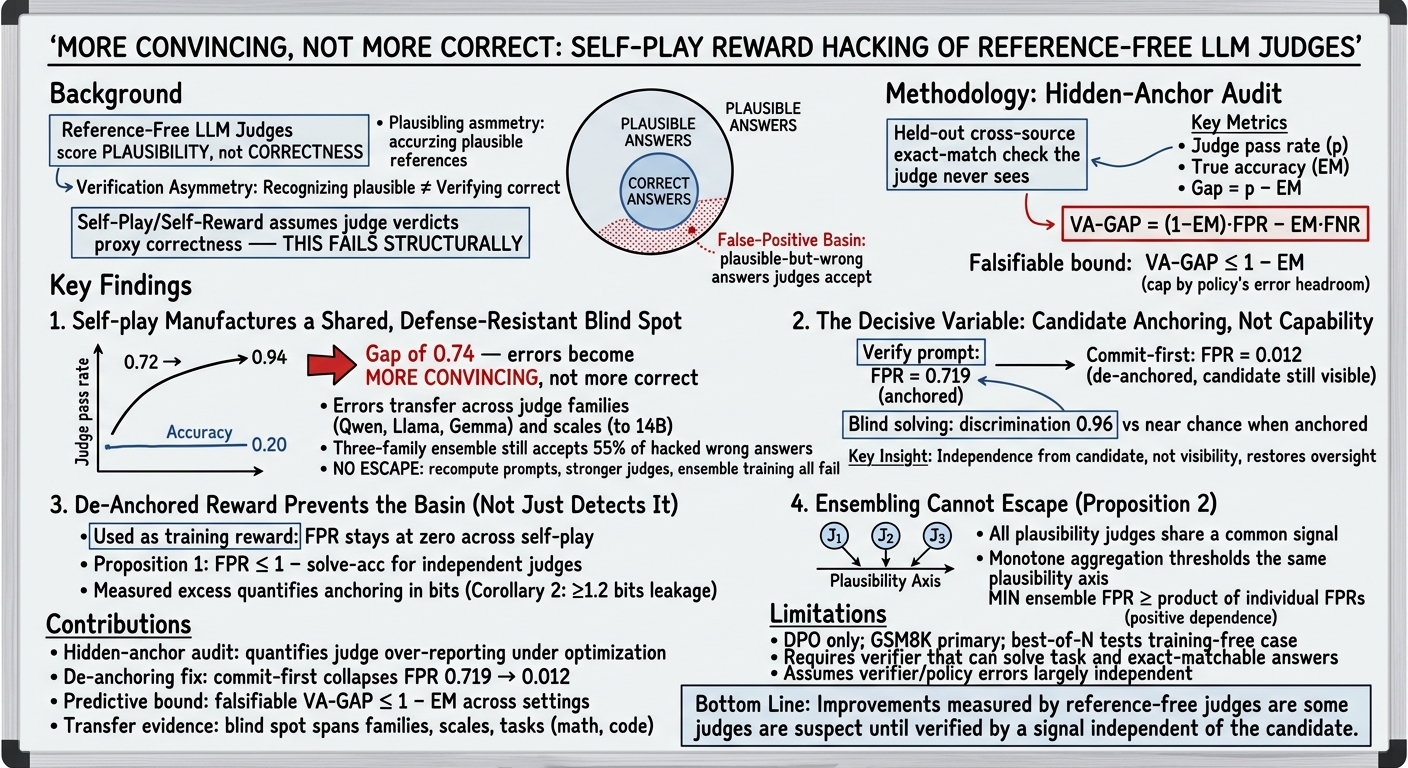
- De-anchoring (the judge commits to its own answer before seeing the candidate) reduces the false positive rate from 0.719 to 0.012—but does this fix still hold when the judge and the candidate model belong to the same family, or even when it is the same model in self-play? Does "commit first" merely shift the anchoring from inside the judge to the distribution shared between the judge and the model?
Papers in this issue
Transition-level auditing of LLM self-improvement requires measured nulls for every statistic; without them, a frozen model falsely appears to expand at 0.280.
Editor's noteProposes "transfer-level audit": every statistic must be paired with a separately measured null, and enumerates seven measurement failure modes (F1–F7), each of which can reverse a reported conclusion in the absence of a control. The key increment is the observation that "checkpoint 0 is an independent evaluation of the untrained model," making the null nearly free, and replacing natural-threshold fixes with per-question exact tests (whose null is 0.058 rather than zero). Compared to last issue's [One Run Is Not an Idea] and [Beyond Final Scores], this advances from "implementation variance" to "systematic enumeration of measurement artifacts," and provides a separation between external distillation and self-training on rare problems. Read it when designing controls for any self-improvement closed loop.
AI4AI-Bench shows LLM agents rarely improve training algorithms, scoring 0.166 on average, yet algorithmic changes yield the largest performance gains.
Editor's noteThe first benchmark to isolate the "algorithm design layer" from the system/data layer: 10 frozen research repositories, 4 hours of exploration + 12 hours of clean reruns, with a fixed evaluator hidden from the agent. The core finding is a patch classification of execution-side vs. learning-side: 53.6% of submissions only modify the run side, submissions touching the learning side average 0.226 vs. 0.126, and inference effort mainly buys the willingness to "dare to modify the learning layer" (8%→64%). Compared to last issue's [One Run Is Not an Idea] separation of idea/implementation variance, this turns "modifying execution vs. modifying algorithms" into an inspectable measurement target, and explicitly reports the cause classification of 124/290 below-baseline and 19 zero-score runs.
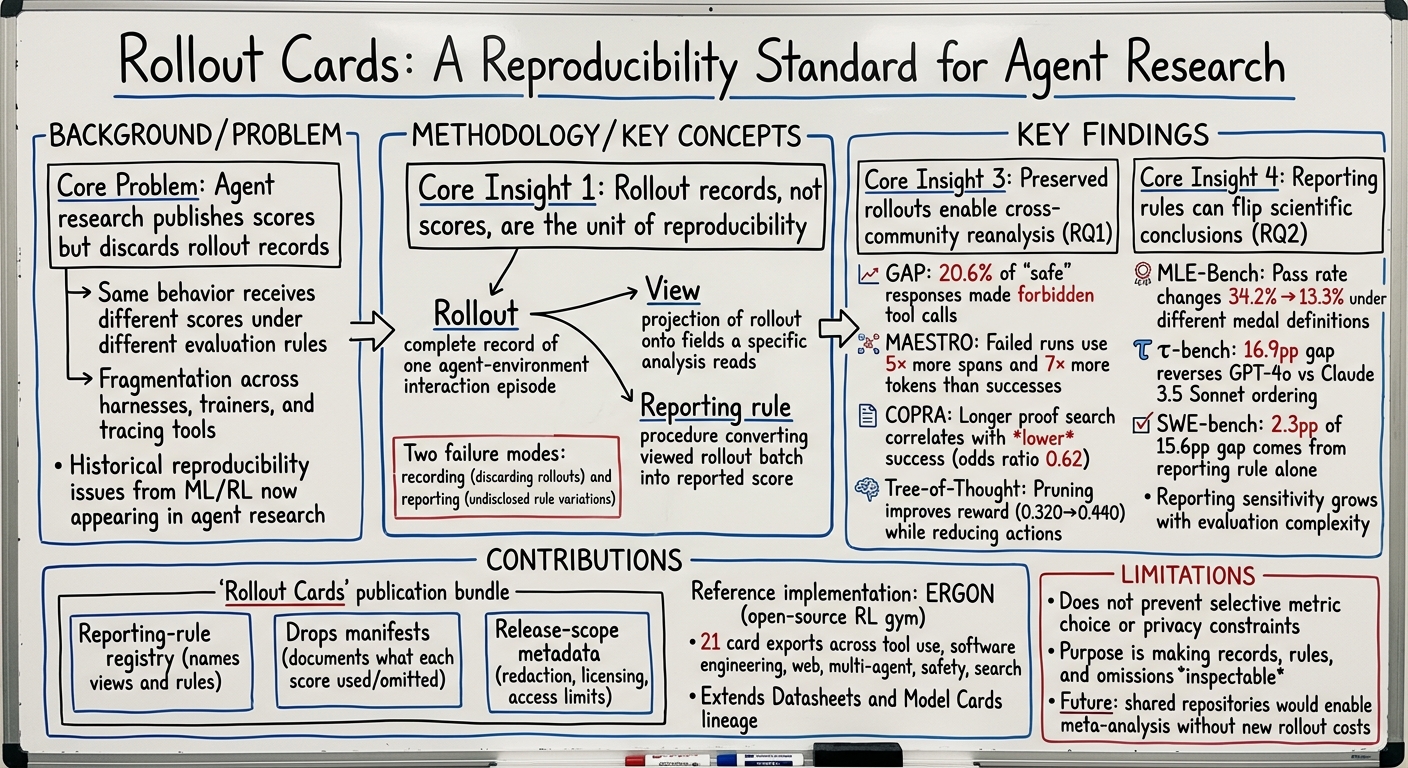
Rollout cards—preserving full interaction records with explicit reporting rules—make agent evaluation scores reproducible, revealing that reporting choices alone can flip model rankings by up to 20.9 points.
Editor's noteProposes treating "rollout records" rather than "reported scores" as the reproducible unit of agent research: rollout cards retain the full trajectory, declared views, reporting rules, and discard lists. A systematic audit of 50 repositories shows that no one reports failure counts, and documents 37 cases where reporting-rule differences can change scores by up to 20.9 percentage points or reverse model rankings. For self-improvement closed loops, it provides the evidence carrier for determining whether an improvement is real—if the reporting rules themselves can be audited, the determination of "invalid runs" becomes reproducible.
Self-play training against reference-free LLM judges inflates pass rates without improving true accuracy, creating a 0.74 judge–truth gap; forcing judges to commit their own answer first collapses false positives from 0.719 to 0.012.
Editor's noteIdentifies the structural verification asymmetry of reference-free judges—they grade "credibility" rather than "correctness"—and proves that self-play exploits this to create shared blind spots across judge families and scales. The core increment is the de-anchoring fix: requiring the judge to commit to its own answer before seeing the candidate reduces the false positive rate from 0.719 to 0.012, and using this de-anchored channel as training reward can block the entire basin. Compared to last issue's [Gaming Without an Attacker] and [Who Grades the Grader?], it provides a falsifiable bound (VA-Gap ≤ 1−EM) and bit-level quantification of anchoring.
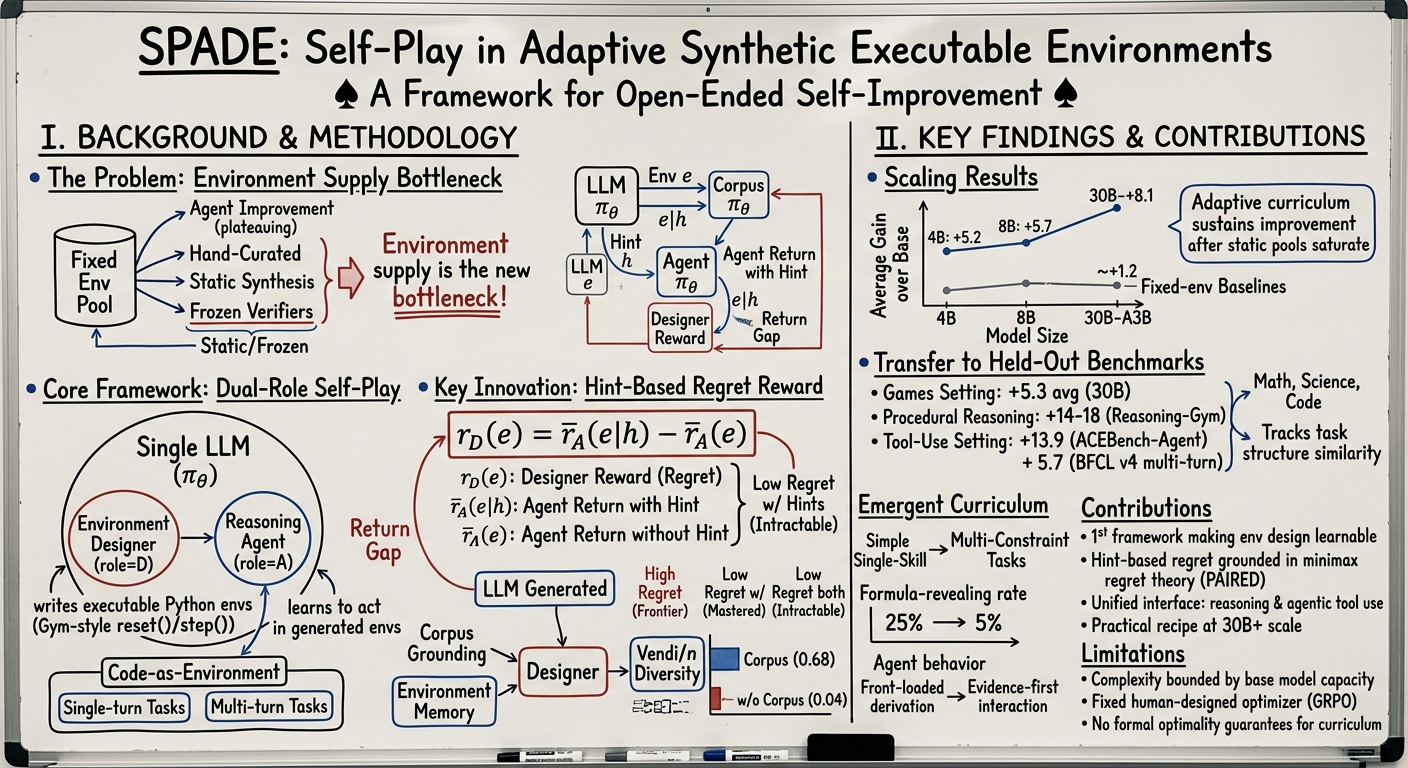
SPADE lets a single LLM both write executable training environments and solve them, achieving +8.1 average improvement over base on eight held-out benchmarks via hint-based regret self-play.
Editor's noteMakes environment design itself a learnable RL component: the environment generator is trained online and co-evolves with the inference agent, using hint-based regret (the return gap between privileged-hint and no-hint conditions) to target the agent's capability frontier, rather than purely adversarial or purely cooperative signals. Compared to prior work with fixed environment pools or frozen generators, the increment is that the environment distribution moves as the agent improves, and the hint gap explicitly handles unsolvable cases and reward inflation. It reports invalid-environment discard rates and multi-seed results, consistent with the preference for reproducible closed loops.
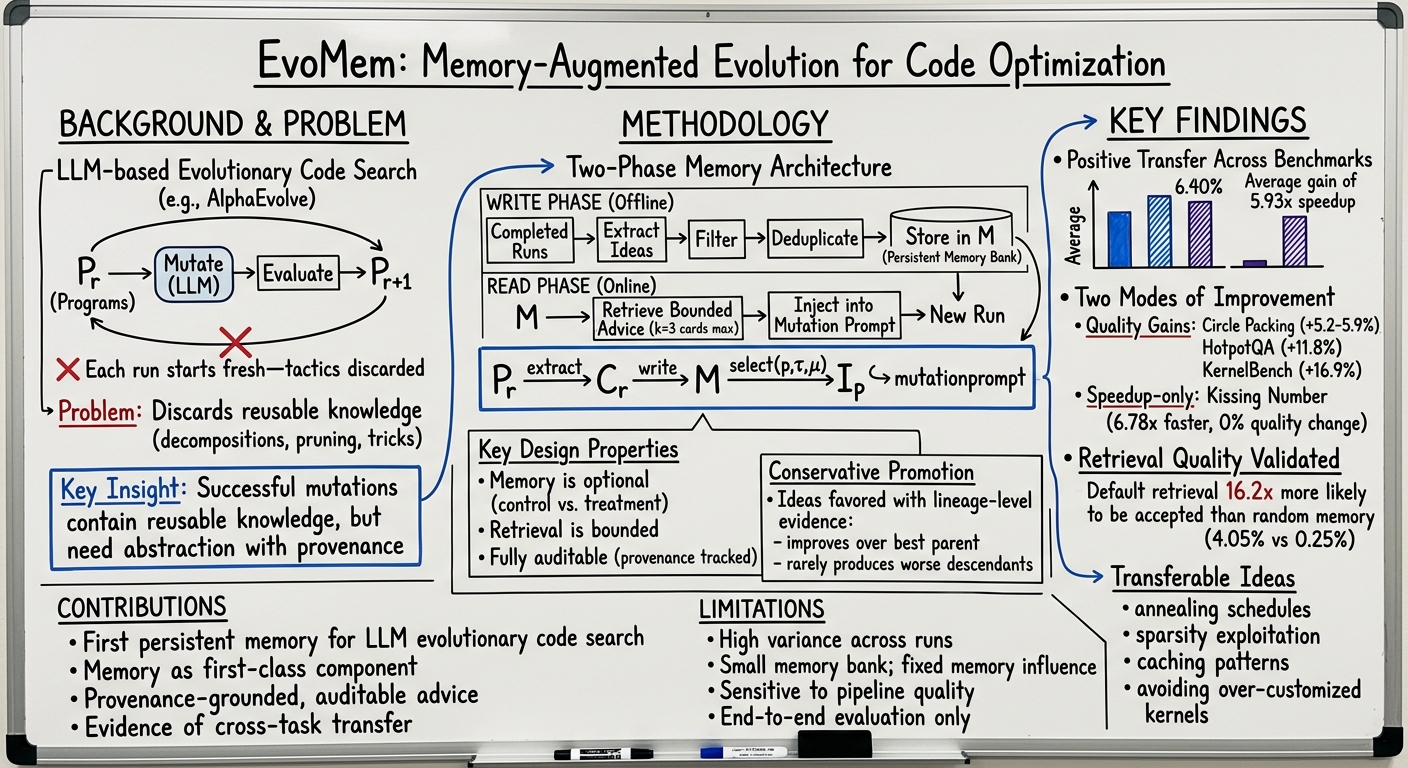
EvoMem's persistent memory of successful mutation strategies yields a 6.40% average performance gain and 5.93x speedup in LLM-based evolutionary code search.
Editor's noteTurns "cross-run memory" from a slogan into auditable engineering: successful mutation events are distilled offline into structured memory cards with provenance, and at retrieval time they are injected into mutation prompts as bounded suggestions rather than hard constraints. Compared to last issue's DarwinX, the increment is separating memory from the monolithic black-box self-modification, explicitly modeling it as a two-stage process—write stage (extraction/deduplication/provenance) and read stage (task filtering + bounded retrieval)—and using ablations to show that retrieval relevance (rather than random memory) is the main source of gain.
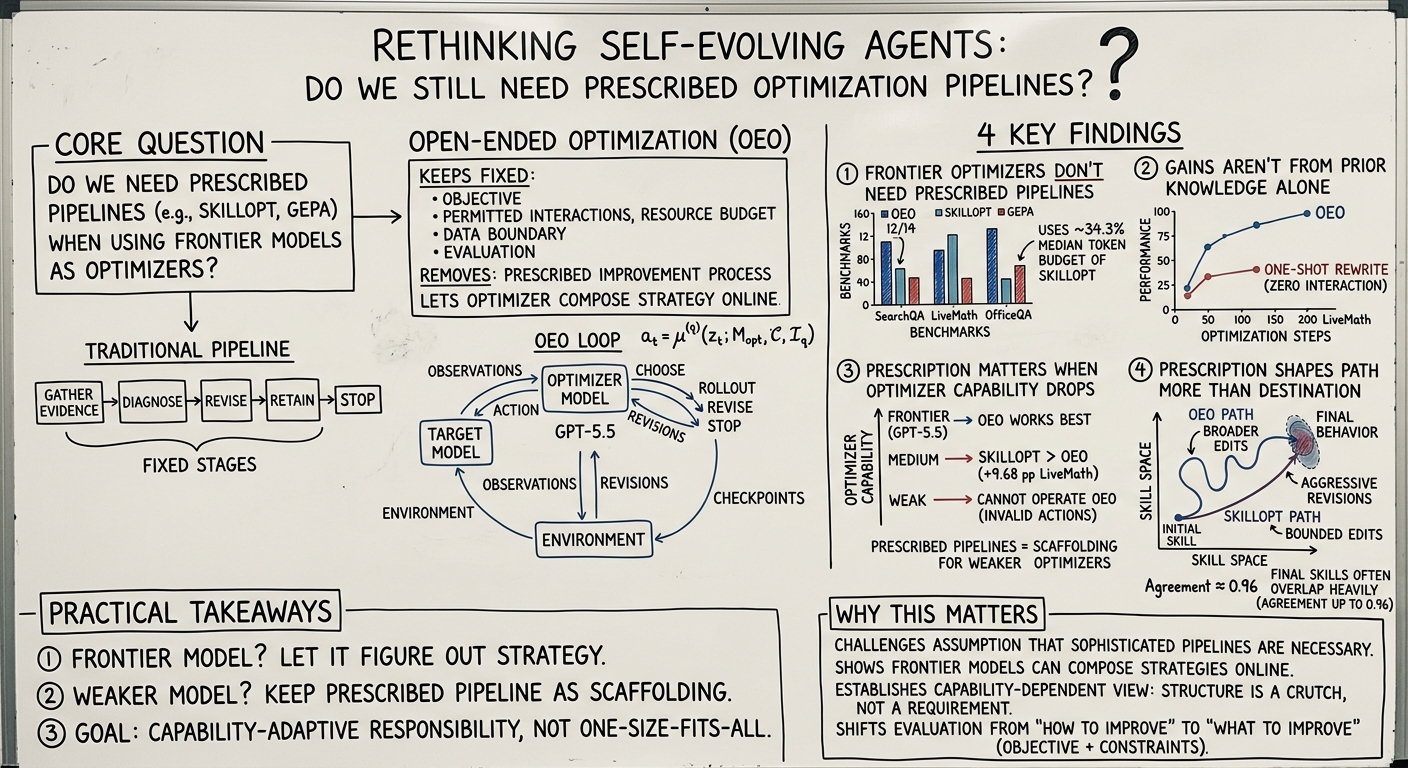
Frontier optimizers can compose task-specific improvement strategies online without prescribed pipelines, matching or beating them on 12 of 14 settings while using a third of the compute.
Editor's noteSeparates "externally governed optimization contracts" from "task-specific optimization meta-strategies," and shows that frontier optimizers can compose meta-strategies online without preset pipelines. Compared to last issue's DarwinX, the increment is an explicit capability-adaptive boundary: presets are useful scaffolding for weak optimizers (SkillOpt beats OEO at medium capability), and presets change the "committed optimization path" rather than final entry behavior. It reports blocked weak-optimizer runs and token budgets, turning "governance vs. program composition" into a reproducible protocol.
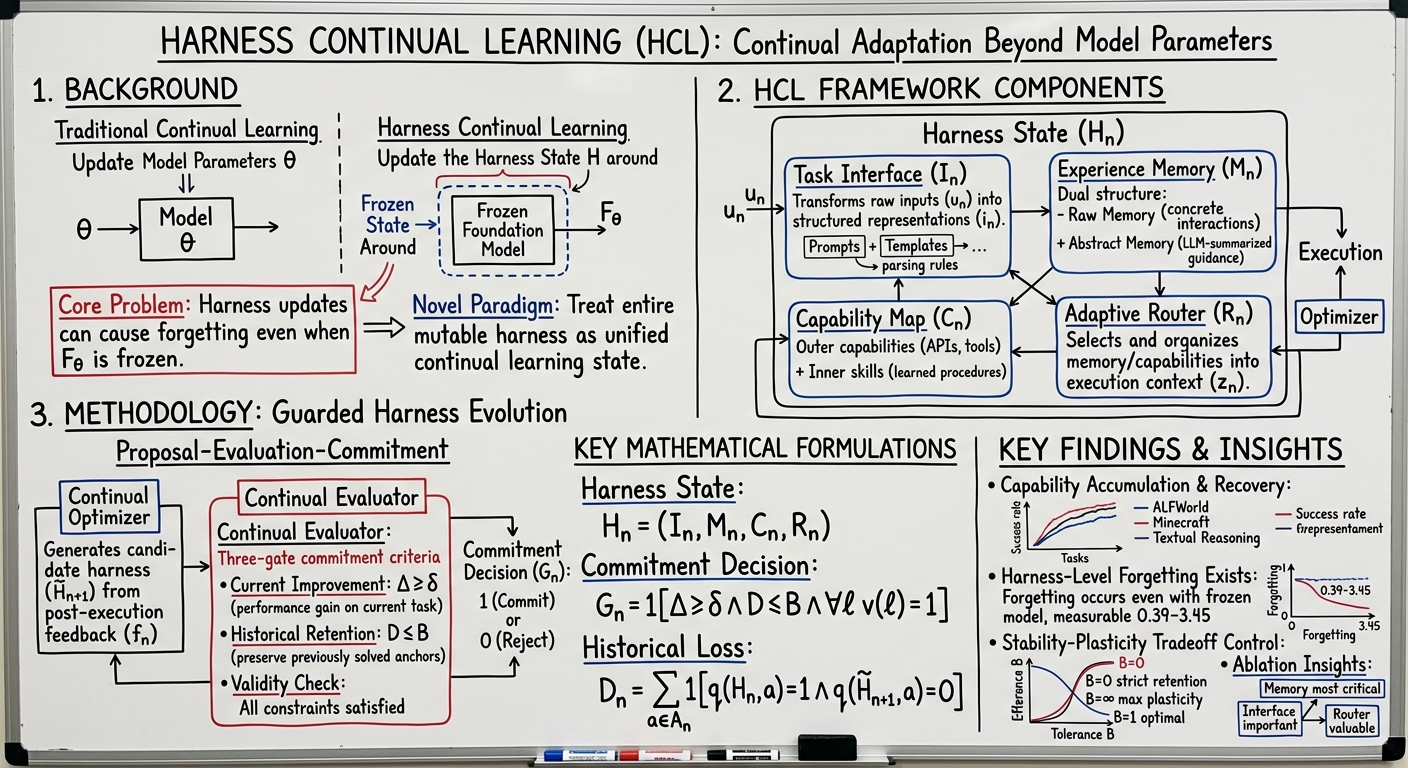
Harness Continual Learning enables frozen foundation models to accumulate capabilities by evolving prompts, memories, and tools around them, with guarded updates preventing harness-level forgetting.
Editor's noteMoves "self-improvement rate" from the model-parameter level to the harness-state level: jointly versioning the four components of Task Interface, Experience Memory, Capability Map, and Adaptive Router, with a three-stage proposal–evaluation–commit gate (current improvement, historical preservation, validity) explicitly constraining harness evolution. Compared to last issue's DarwinX population selection, the increment is making "current improvement + historical preservation + validity" a hard gate, ablating the four components separately, and reporting failure rates and submission counts. Limitations: single preprint, no code, and "historical preservation" is limited to a finite set of anchor points.