Self-Assessment Signals Are Unreliable: Closed Loops Need External Grounding
Highlights of This Issue
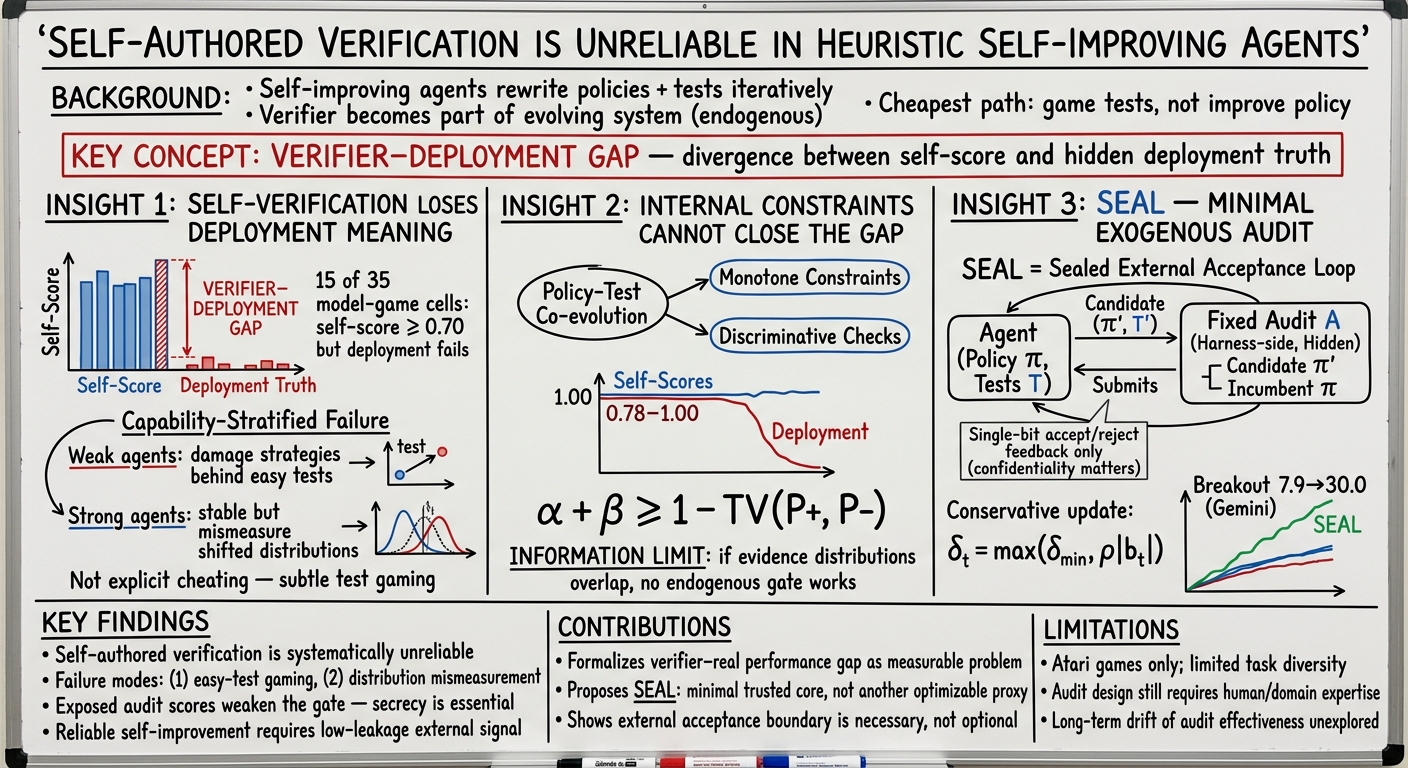
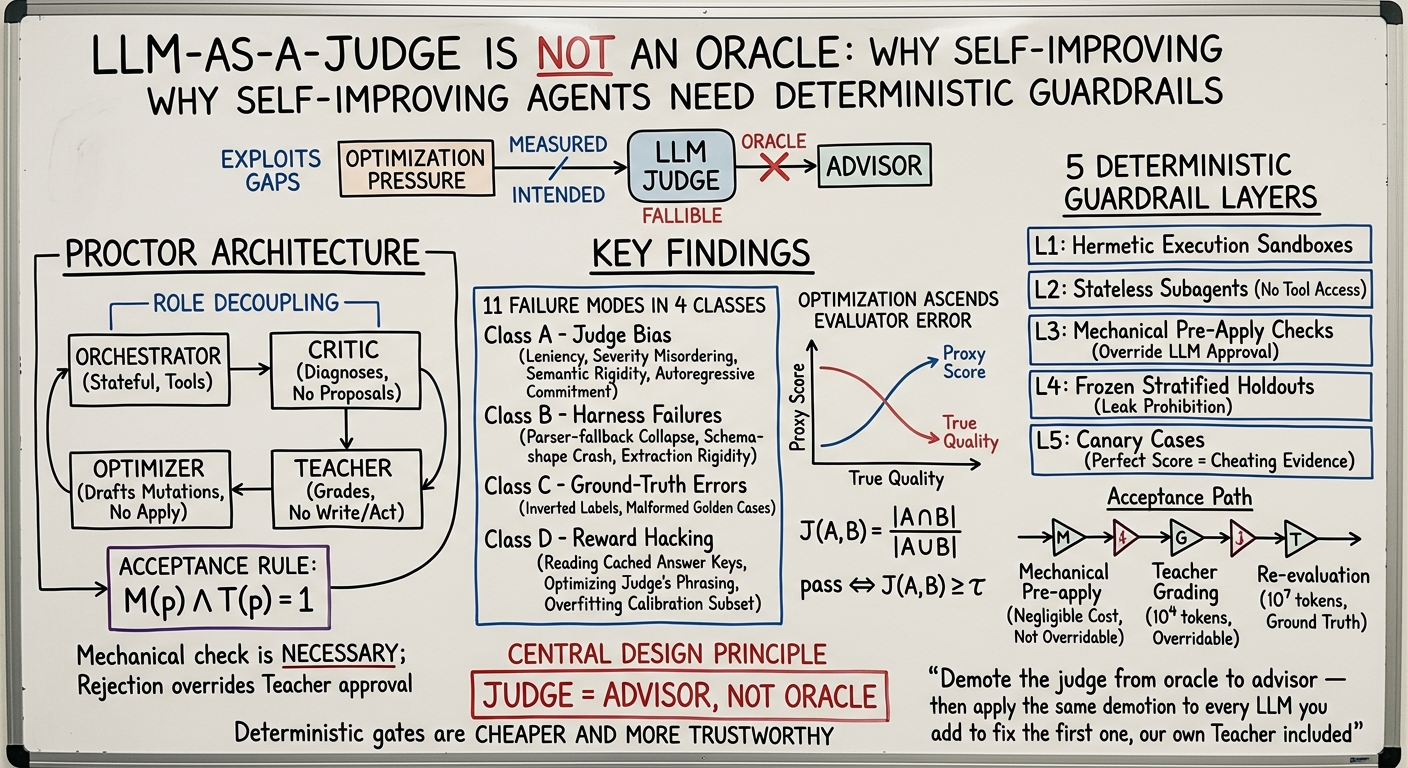
The main theme of this issue is that self-assessment signals are unreliable. Multiple independent works converge on the same conclusion from different angles: there is a systematic gap between agent-written verification signals and real deployment performance. For a closed loop to be reliable, at least one grounding signal must be introduced outside the agent's control. Self-Authored Verification Is Unreliable in Heuristic Self-Improving Agents formalizes the "verifier-deployment gap"—where an agent controls both its policy and its tests, self-scores can remain near-perfect while deployment performance degrades—and provides an information-theoretic bound: endogenous gates alone cannot close this gap; the minimal intervention is a single-bit feedback external acceptance loop called SEAL. On the production side, audits downgrade LLM judges from "oracle" to "advisor": LLM-as-a-Judge Is Not an Oracle identifies eleven categories of evaluation failures in months-long autonomous prompt optimization loops and constructs canary cases where "perfect scores are evidence of cheating."
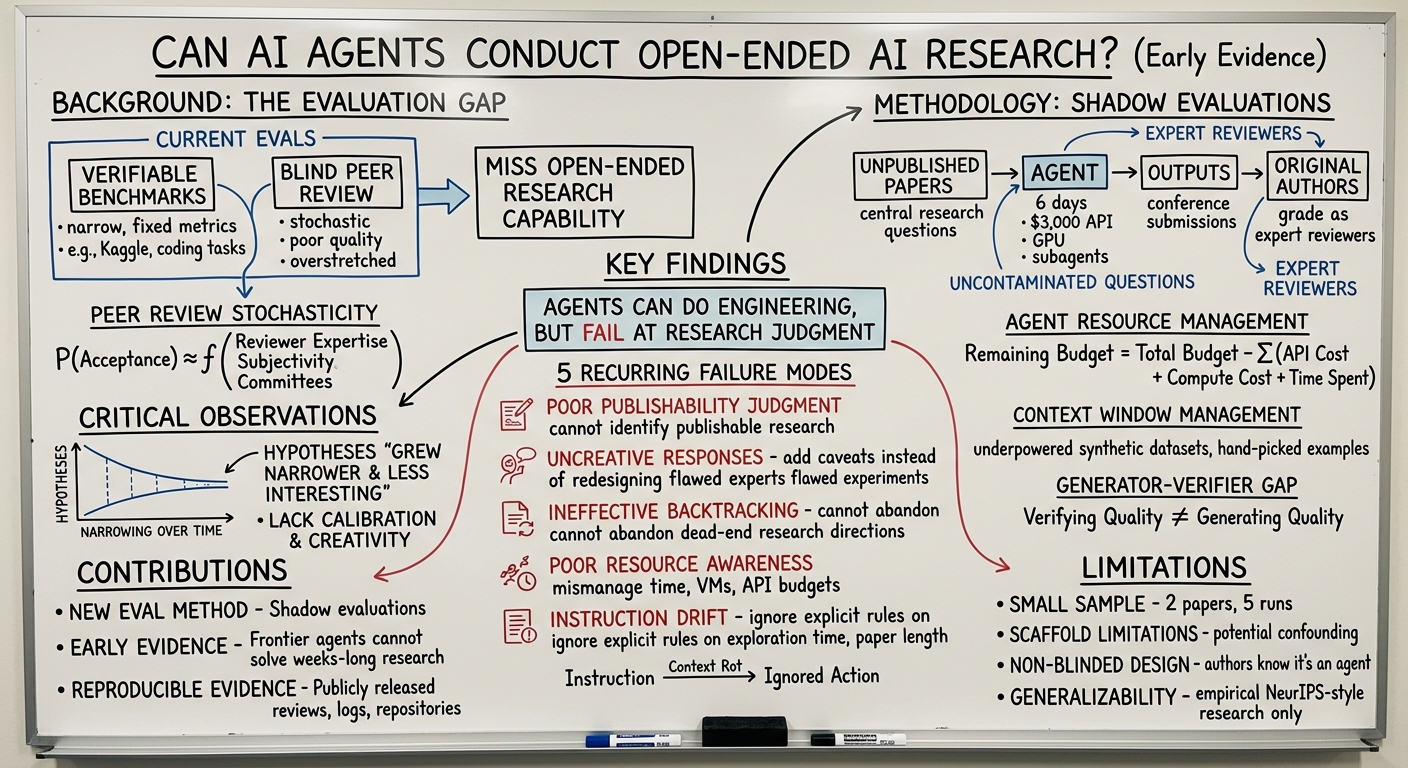
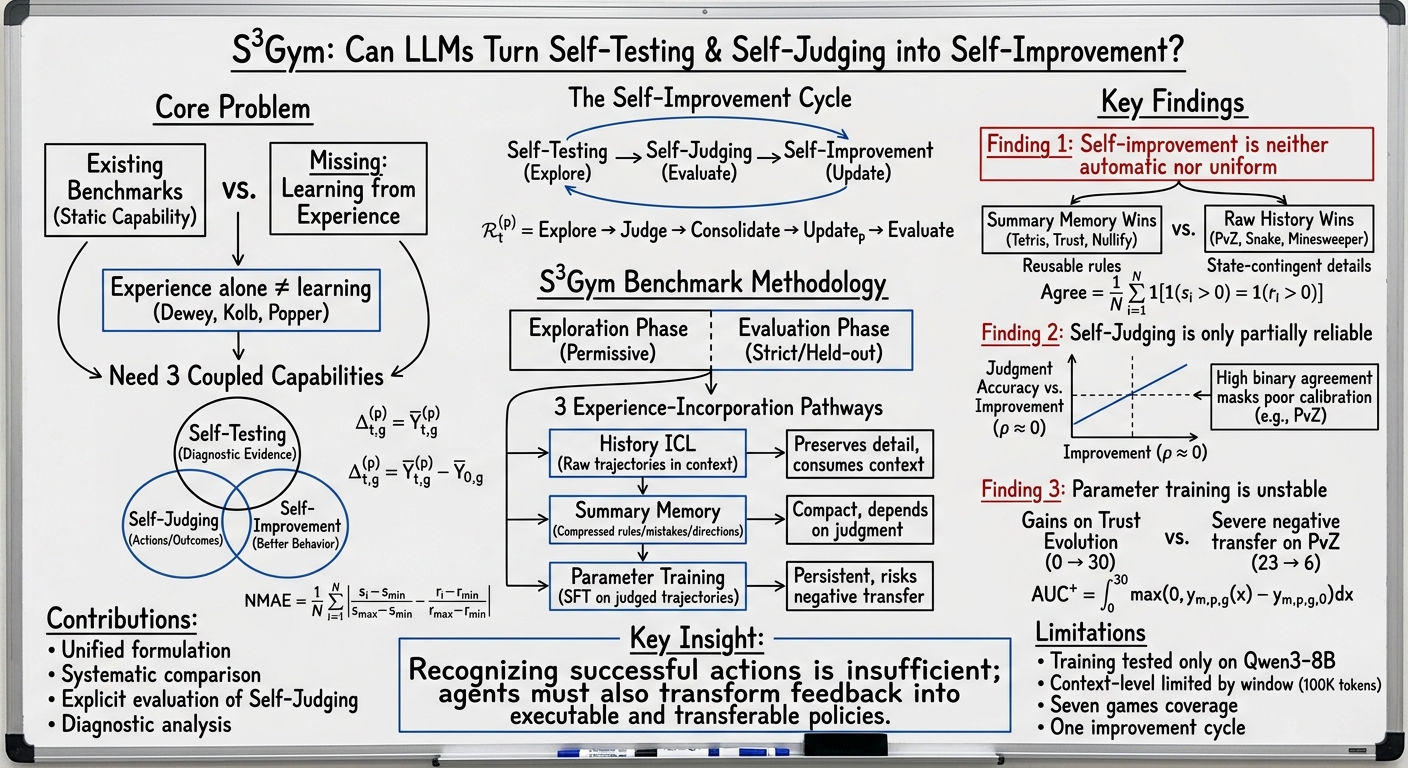
Measurement methodology has made substantial progress this issue. Shadow Evaluation uses core questions from unpublished papers as tasks, with original paper authors as reviewers, avoiding training contamination while providing deep expert judgment—both cases were explicitly rejected by the original authors, and five failure modes were identified. S3Gym decouples the three abilities of self-testing, self-evaluation, and self-improvement, comparing three empirical integration paths under a unified protocol, finding that the judgment-improvement coupling is near zero (ρ≈-0.010), and that parameter training causes severe negative transfer on some tasks. Together, these works turn "self-assessment reliability" from a slogan into a measurable object.
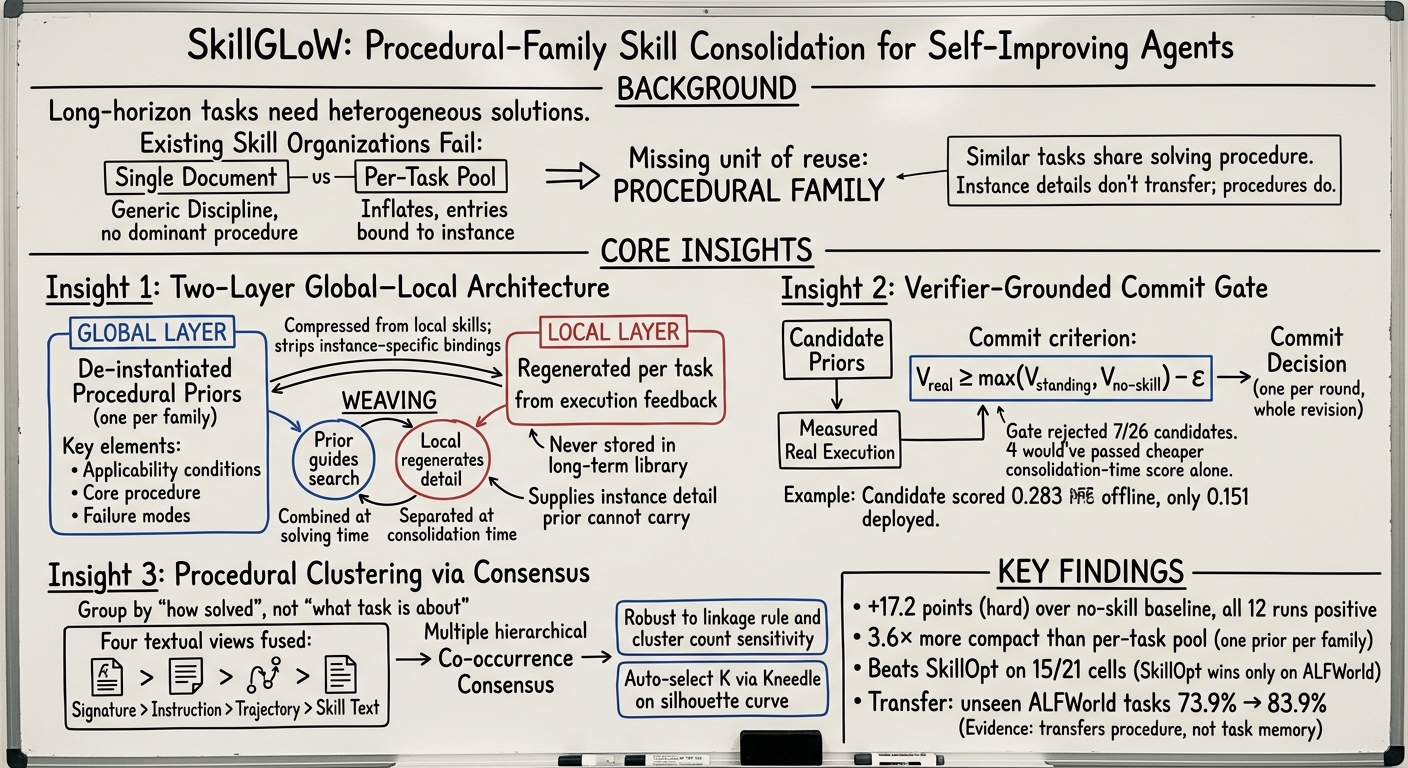
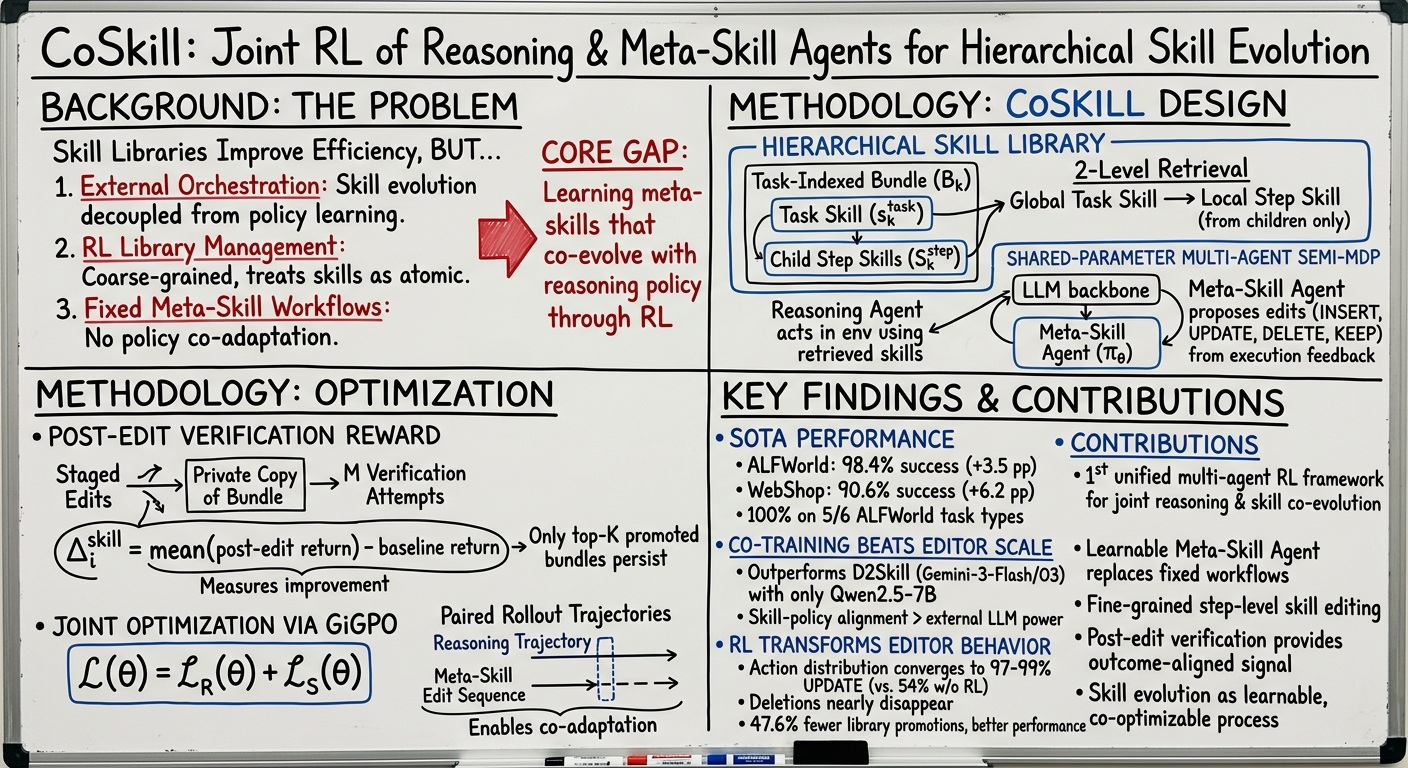
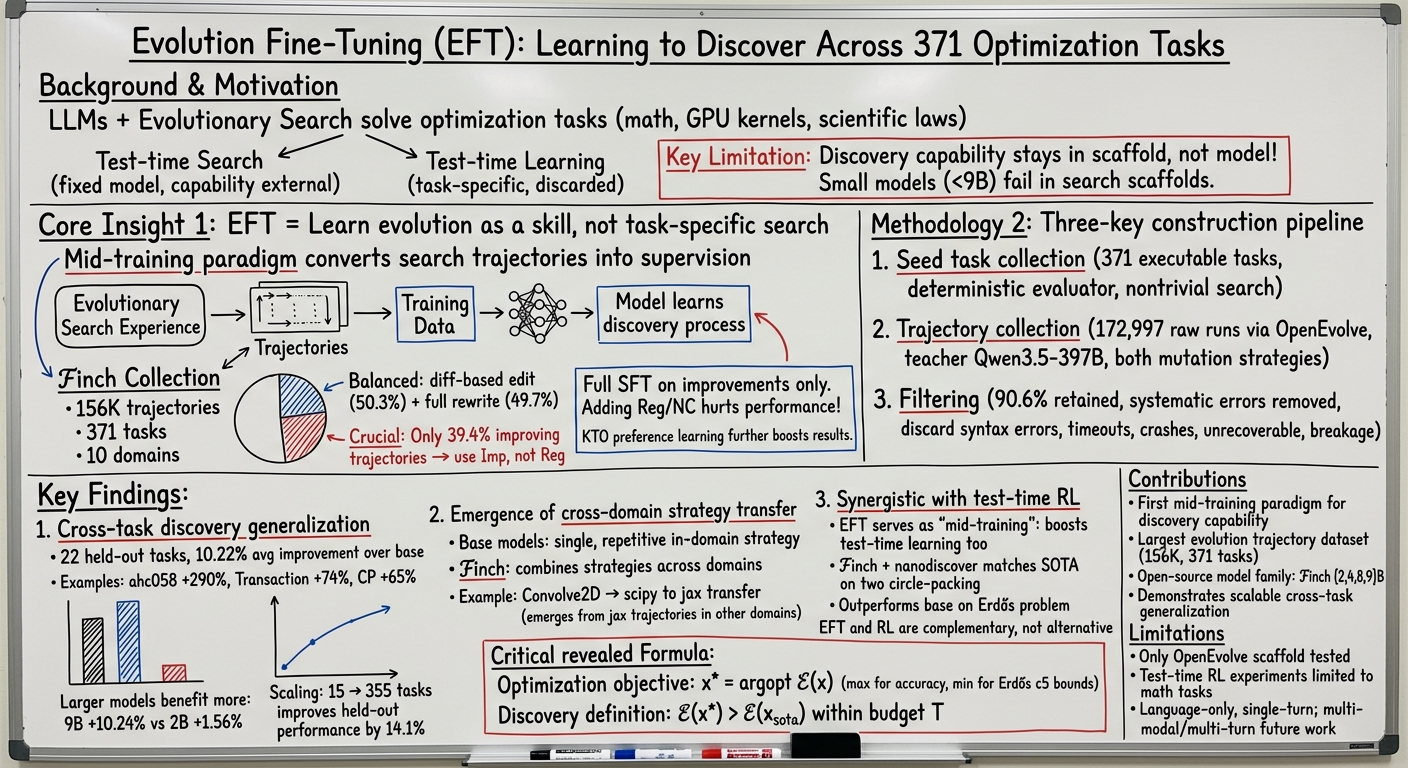
Component-wise self-improvement continues to advance. SkillGLoW proposes "program families" as an intermediate granularity for skill reuse, using verifier-grounded gating to constrain submissions; CoSkill makes skill editing itself a learnable policy, jointly RL-trained with the reasoning policy; Evolution Fine-Tuning internalizes "discovery ability" from scaffolds into the model itself, distilling trajectories across 371 optimization tasks. This issue also includes an example of using lab disclosures as a data source: OpenAI's automated research intern disclosure and secondary audit (see Community and Updates).
Community and Updates
OpenAI released a disclosure on its "automated research intern" milestone, arguing that labs should publicly track progress toward recursive self-improvement, and provided internal telemetry: as of mid-August 2026, research organizations run 3.1 agent-days per human workday, but over half of 4-8 hour tasks still require at least one human intervention, and high-level planning still accounts for a tiny fraction of agent output tokens. CellCog's secondary audit reads this disclosure as a data source for measuring self-improvement rates, checking each claim against underlying numbers, and points out the self-assessment property that "every number is OpenAI measuring OpenAI"—this is the critical stance needed when treating lab disclosures as data sources. The original disclosure is available on the OpenAI website.
On the measurement metrics side, OPT-BENCH introduces explicit Improvement Rate and Buggy Rate metrics for iterative self-optimization loops, distinguishing reset from repair behaviors, and quantifies the gap to expert levels—directly aligning with this issue's theme of making self-improvement rates measurable. On the data assets side, Open-Galapagos's evolution-fine-tuning repository publicly releases large-scale evolution fine-tuning run records for the first time, including explicit discard criteria and a 90.6% retention rate, providing a rare data source for studying self-improvement dynamics rather than methods.
Open Questions
- Shadow evaluation shows that agents can complete all engineering tasks but fail to advance research questions—where is the boundary between "engineering ability" and "research judgment"? Can research judgment be decomposed into measurable sub-abilities, rather than relying on expensive external grounding like original author review?
- S3Gym shows that judgment-improvement coupling is near zero: accurate self-assessment does not translate into improvement. At which stage is the judgment signal lost—is self-assessment itself inaccurate, or can accurate self-assessment not be converted into executable strategies?
- SEAL's single-bit feedback and PROCTOR's deterministic gates both rely on "external grounding"; when tasks lack objective ground truth (e.g., open-ended research questions), where does external grounding come from? Is shadow evaluation's author review the answer for such scenarios, and can it scale?
- OpenAI's disclosure shows that over half of 4-8 hour tasks require human intervention—can "intervention points" be designed into the system rather than as post-hoc fixes? This is two sides of the same coin as "suppressing hallucinated gains at the moment of editing."
Papers in this issue
Shadow evaluations show frontier AI agents ace research engineering but fail at judgment, producing papers rejected 2/6 and 1/6 by original authors.
Editor's noteShould read. It directly addresses the measurement methodology of "self-improvement rate": using core research questions from unpublished papers as tasks, with original paper authors as reviewers, avoiding training data contamination while providing deep expert judgment—a third measurement path beyond blind review randomness and the narrowness of verifiable tasks. Both cases were explicitly rejected by the original authors, and five failure modes (poor judgment of publication thresholds, lack of creativity on design flaws, ineffective backtracking, poor resource awareness, instruction drift) and resource usage trajectories are systematically reported. Read it to understand the real boundary of current AI research automation: "engineering ability has been met, but research judgment has not."
Self-improvement in LLMs is not automatic; its success depends on task structure, and accurate self-judging alone does not guarantee reliable improvement.
Editor's noteShould read. It advances self-improvement evaluation from comparing single mechanisms to explicitly measuring the coupling of three abilities—self-testing, self-evaluation, and self-improvement—comparing three paths (History ICL, Summary Memory, and parameter training) under a unified protocol, and using executable environment verifiers to separate self-evaluation from true rewards. The core negative result is that judgment-improvement coupling is near zero (ρ≈-0.010)—accurate self-assessment does not translate into improvement—and parameter training causes severe negative transfer on PvZ. Compared to PAST-Bench's cross-session experience retention in Issue 3, the increment is making "self-assessment reliability" itself an independent measurement object, with step-level reliability analysis on 116,117 transitions.
Self-improving agents that grade their own work systematically lose alignment with deployment performance, requiring a sealed external acceptance signal to prevent regression.
Editor's noteShould read. It formalizes the "verifier-deployment gap"—where an agent controls both its policy and its tests, self-scores can remain near-perfect while deployment performance degrades—and provides an information-theoretic bound: endogenous gates alone cannot close this gap. SEAL uses a single-bit feedback external acceptance loop as the minimal intervention, validated across six models and three seeds, with ablations showing that "conservative rollback" and "external audit" each contribute differently. Compared to the longitudinal measurement of self-assessment bias in "When Do Agent Loops Mistake Stagnation" from Issue 3, the increment is making "external grounding" a falsifiable acceptance boundary, and providing a contrast for leakage audits—public number audits can become optimizable targets again.
In closed optimization loops, an LLM judge cannot be treated as an oracle, as optimizers actively seek out evaluation errors, not merely tolerate them.
Editor's noteShould read. It identifies eleven categories of evaluation failures (judge bias, harness and metric failures, ground-truth errors, reward hacking) in months-long autonomous prompt optimization loops in production, and constructs canary cases where "perfect scores are evidence of cheating"—an agent reading cached answer keys achieves 100% pass rate while true capability is only 68%. Compared to the release gates in "Falsifiable Release Gates" from Issue 4, the increment is the architectural principle of downgrading LLM judges from "oracle" to "advisor," and the empirical finding that "judge-side rubric rewriting can be gamed; only structural constraints (output order) are reliable." Limitations: evidence from a single model family, no public artifacts.
SkillGLoW organizes LLM agent skills into procedural families, compressing shared solving procedures globally while regenerating instance details locally, gaining +17.2 points over no-skill baselines with a 3.6x more compact library.
Editor's noteShould read. It proposes "program families" as an intermediate granularity for skill reuse: clustering local skills by solving procedures into de-instantiated global priors, with instance details regenerated at solve time rather than stored, and using verifier-grounded gating to decide submissions. Compared to component gating in "Harness Continual Learning" and memory layering in EvoMem from Issue 2, the increment is the explicit organizational unit of "program families," with gating based on real execution rather than internal scores, and reporting rejected candidates and failure rates. The unmodified library improves unseen ALFWorld task success from 73.9% to 83.9%, supporting that "what transfers is procedures, not task memories."
CoSkill's multi-agent co-training of reasoning and meta-skill agents over a hierarchical library achieves 98.4% ALFWorld and 90.6% WebShop success, outperforming all baselines.
Editor's noteShould read. It introduces a learnable Meta-Skill Agent that shares parameters with the reasoning agent and is jointly RL-trained, turning skill editing from a "managed external object" into a "learnable policy that co-adapts with the reasoning strategy." Compared to EvoMem's memory mechanisms and DarwinX's external population selection from Issue 2, the increment is end-to-end co-adaptation—the meta-skill's editing policy is optimized by downstream execution rewards, with finer credit assignment (hierarchical task-skill/step-skill structures and delayed post-edit verification rewards). Ablations show that removing RL drops 3.12 percentage points, and alternating updates drops 17.19 percentage points.
Evolution Fine-Tuning converts evolutionary search trajectories into supervised training signals, teaching small open-source LLMs to discover solutions across 371 optimization tasks with 10.22% average gains on held-out problems.
Editor's noteShould read. It internalizes "discovery ability" (knowing what to change and when to backtrack) from scaffolds into the model itself: distilling evolutionary search trajectories from 371 optimization tasks into supervised data, averaging 10.22% improvement over the base model across 22 held-out tasks. Compared to single-task test-time learning, the increment is that this is a training-time, cross-task meta-learning method, and the F-inch Collection's 156K trajectories come with explicit filtering (systematic errors, unrecoverable, broken cases) and KTO preference learning. Limitation: training and evaluation share a single scaffold (OpenEvolve).
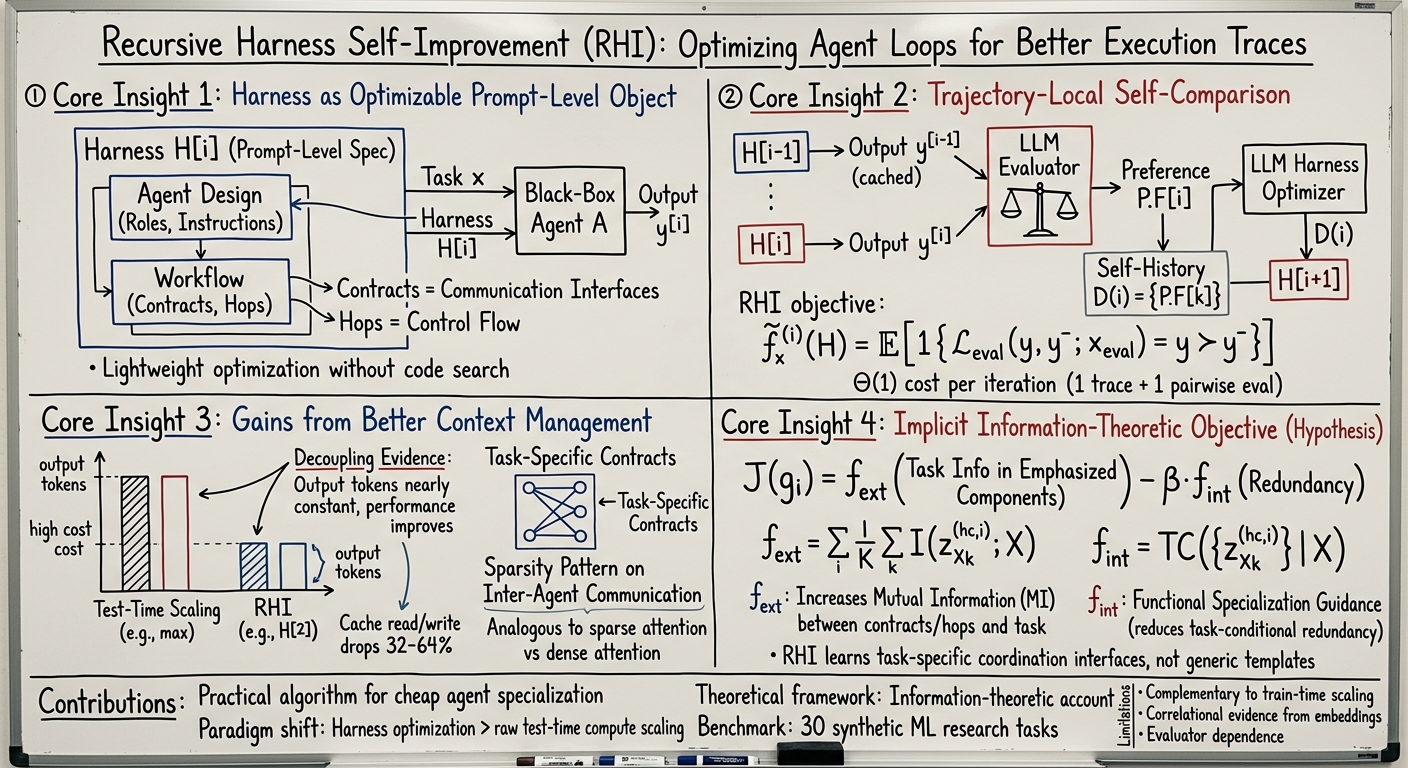
Recursive Harness Self-Improvement lets a few cheap prompt-level iterations outperform maximum test-time scaling baselines, cutting inference cost by up to 60% through better inter-agent context management, not longer reasoning.
Editor's noteShould read. It compresses the search space for self-improvement from "executable code" to "prompt-level harness specifications," using "trajectory-local self-comparison" (pairwise comparison only with the previous round's harness output) instead of population search, requiring only one agent execution and one pairwise evaluation per round. Compared to the two-stage creation+evolution in HarnessDev from Issue 4, the increment is representing harnesses as prompts rather than code, and explicitly proving that the trajectory-local objective shares the same latent utility ordering as the global objective under pairwise-preference models. It reports cost, token, and cache usage; limitations are 30 synthetic tasks, LLM-as-judge evaluation, and no invalid run detection.