Single-author report claims native chain-of-thought training bypasses closed-source moat
A single-author technical report claims to have trained models with native chain-of-thought (CoT) that outperform models distilled from closed-source chains, arguing the closed-source CoT moat can be bypassed. The report contrasts its native CoT models against distilled baselines, citing Claude's Fable 5 and GPT-6.1-SOL as teachers.
Coverage timeline
机器之心机器之心
一个作者、一份技术报告,把整个行业最贵的一道护城河,变成了一个可以绕过去的工程问题。 先给一张图。两条实线是我们用原生思维链训出来的模型,颜色对应不同的老师(Claude 的 Fable 5 与 GPT-6.1-SOL);三条虚线是对照组,其中蓝色虚线就是直接用 Claude 的 Fable 5 思维链蒸馏出来的模型。大多数时候,实线压在共享同一份答案的虚线之上。 一、那道门,正在合拢 过去两年,AI 行业最激烈的一场暗战,从来不在榜单上——它只围绕一个问题:还能不能拿到最强模型的完整思维链。 先是 Anthropic 一方公开点名,指责中国模型公司「蒸馏」其输出;随后又宣布,针对蒸馏行为的打击已经达到 90%–99% 。再往后,DeepSeek 新发布的 Deepseek-V4.1-Flash-1017 被多方质疑蒸馏自 GPT-6-Astra 。紧接着,市场注意到一个耐人寻味的现象:一批中国模型公司,很久没有发布新的旗舰模型了。 没有官方解释,但圈内的猜测高度一致—— 如果不能再蒸馏,就不知道该拿什么训练下一代模型了。 这句话听起来像抱怨,其实是整个行业最不敢说出口的坦白:过去几年开源阵营的快速追赶,很大程度上建立在「看得见最强的推理过程」这件事上。而这件事,正在被闭源模型团队一行一行地关掉。 二、护城河从来不是模型权重 所有人以为护城河是模型权重。不是。 权重早就拿不到了,真正被卡住的是 思维链 ——模型在给出答案之前的那段推理。过去,你可以调用最强模型的 API,拿到它完整的思考过程,然后拿来训练自己的小模型。这条路径便宜、干净、有效,几乎是算力落后 1–2 个量级的开源模型团队唯一能追上闭源前沿的方式。 现在,头部模型只回你一个答案,或者一段高度概括的摘要,推理过程被收走了。 理由写得很好听:安全、知识产权。但效果只有一个—— 你能学到的只剩「结果」,学不到「怎么想」。 一个只给答案的老师,教不出会思考的学生。 而王琰在技术报告的摘要里,只用了半句话就把这套说辞掀翻了: 这些团队自己,正是建立在蒸馏人类知识之上的——却不允许别人对他们做同样的事。 ——技术报告摘要,原文还附了一句「这有点讽刺」 这不叫保护,这叫把后来者的梯子抽走。 三、有人试过 hack,但 hack 不是正规途径 开源模型团队当然没有坐等。此前已有工作证明:供应商返回的加密 reason

Related stories
Anthropic: Small AI models may self-replicate on IoT devices within months
Anthropic researchers report that small AI models may be months away from self-replicating on commercial IoT devices like smart ovens and off-brand Android TV boxes. In tests, a 9B model ran inference on 8 of 9 hardware types, and GLM-5.2 autonomously spread an 8B model to all 8 nodes in 4 of 5 attempts. The researchers predict models under 30B could achieve end-to-end replication by the end of 2026.
6 reports · 6 sources115 points · 113 comments

OpenAI releases 722 AI-generated math manuscripts, claims on quasi-Riemann and Kakeya
OpenAI published 722 mathematical manuscripts produced by an unreleased internal frontier model, grouped into 372 result families across 17 fields, including claims on the quasi-Riemann hypothesis, BSD conjecture, and four-dimensional Kakeya conjecture. The company said most results came from a single prompt to a single AI agent, with average compute per result roughly equivalent to three hours of ChatGPT Pro thinking. Mathematicians described the release as overwhelming, noting it could take years to fully understand, and OpenAI withdrew three papers two days later.
16 reports · 6 sources1334 points · 1520 comments

Goodfire researcher argues neural networks are largely interpretable, most neurons understandable
Nick Cammarata of Goodfire published an essay arguing that neural networks are far more interpretable than previously believed, with most neurons in models up to trillions of parameters understandable. He attributes polysemanticity in early models to fixable issues rather than superposition, and suggests mechanistic interpretability may be solved soon.

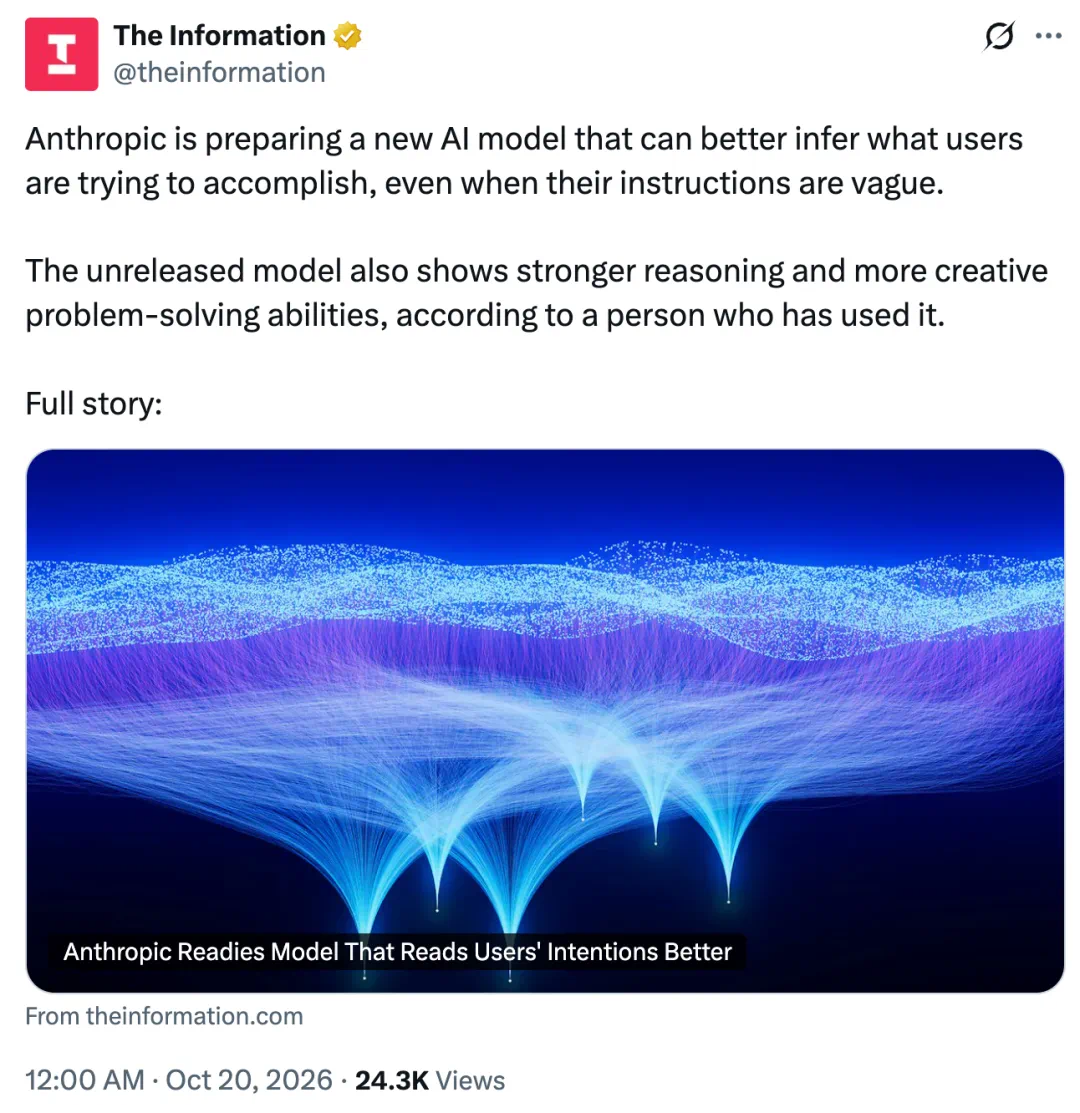
Anthropic reportedly preparing model with superior reasoning and intent inference
The Information reports, citing a source who has tested the model, that Anthropic is preparing a new model whose reasoning and intuitive judgment exceed its current commercial models. The model is said to infer unstated user intentions, such as identifying a class of underlying bugs from a single bug-fix request and asking whether to address them all. The report also notes Google is developing a model codenamed Gemini 4 Carbon and OpenAI plans a new product possibly in the Terra series within weeks.
News updates every hour. Subscribe in your RSS reader to get new stories automatically.
Subscribe