Sand.ai open-weights MAGI-2 video model nears Seedance 2.5 in blind tests
Sand.ai released the open-weight MAGI-2 video model on November 25, 2026, with 480 billion total parameters (28 billion active), up from 114 billion in the August preview. Blind tests by Higgsfield and Artificial Analysis rank MAGI-2 near or above Seedance 2.5, with API pricing about one-tenth that of Seedance 2.5 for 1080p video.
Coverage timeline
晚点 LatePost
今年 8 月,Sand.ai 把一款 1140 亿参数的视频模型「MAGI-2 Preview」放上了 Hugging Face。开发者可以下载权重,在自己的机器上运行。 在基础模型赛道,模型参数越大、研发投入越高,厂商通常倾向于将技术锁在闭源 API 后,换取商业壁垒。 三个多月后,11 月 25 日 Sand.ai 发布正式版 MAGI-2,团队又把模型的总参数从 1140 亿增至 4800 亿,其中激活参数 280 亿。Sand.ai 表示,这一版的权重也会开放。 几位视频生成从业者认为,MAGI-2 已经达到头部模型的水准,一旦正式开源,就是开源视频模型中的 SOTA(最先进)水平。 MAGI-2 发布后,全球 AI 视频创作平台 Higgsfield 公布了他们内部评估的成果: MAGI-2 生成效果接近 Seedance 2.5,显著领先其他视频模型(纵轴代表生成效果,横轴代表生成每秒的平均成本);每秒生成的平均成本也更低。 同期,MAGI-2 在第三方评测机构 Artificial Analysis 的盲测中,得分也超过 Seedance2.5,暂列第一。 Higgsfield 公布的内部视频生成模型竞技场评分与成本对比表。其中,纵轴代表生成效果,横轴代表每生成 1 秒视频的平均成本。在盲测中,MAGI-2 对阵 Seedance 2.0 的胜率为 71%,对阵 Wan 3.0 的胜率为 79%,对阵 Kling 4.0 的胜率为 83%。 接近甚至超过头部模型的生成效果,加上更低的使用价格,让 MAGI-2 具备了相当大的商业化潜力。 按 Sand.ai 给出的国内 API 刊例价(1080p 官方 API 价格在 0.5 元/秒),开发者花 2.5 元,就能生成一段 5 秒的 1080p 视频,约是 Seedance 2.5 同规格价格的十分之一。 做视频的公司,如果想试试 MAGI-2 的效果,花几块钱调用 API 就能得到答案,如果效果足够好,价格又足够低,它完全有可能成为 Sand.ai 长期、稳定的付费客户。 但 Sand.ai 决定尽快开放 MAGI-2 的模型权重。这意味着,等权重开放后,具备技术和算力条件的企业可以直接把模型部署到自己的服务器上,针对具体业务做微调和优化,不必持续向 Sand.ai 支付 API 调用费用。 当然,自行

Related stories
Sand.ai Raises $200M Series A+; Total $300M in 10 Months, Reaching Unicorn Status
Video generation startup Sand.ai completed a $200 million Series A+ round, bringing its total funding to $300 million within 10 months and achieving unicorn status. The round was co-led by Cornerstone Capital and Wangsu Science & Technology, with participation from Shanghai state capital and Times Capital. The company plans to release the official version of its MoE-architecture model MAGI-2 soon.
1 reports · 1 sources

Baidu open-sources ERNIE 5.5 Flash Base, 280B MoE model with 14B active parameters
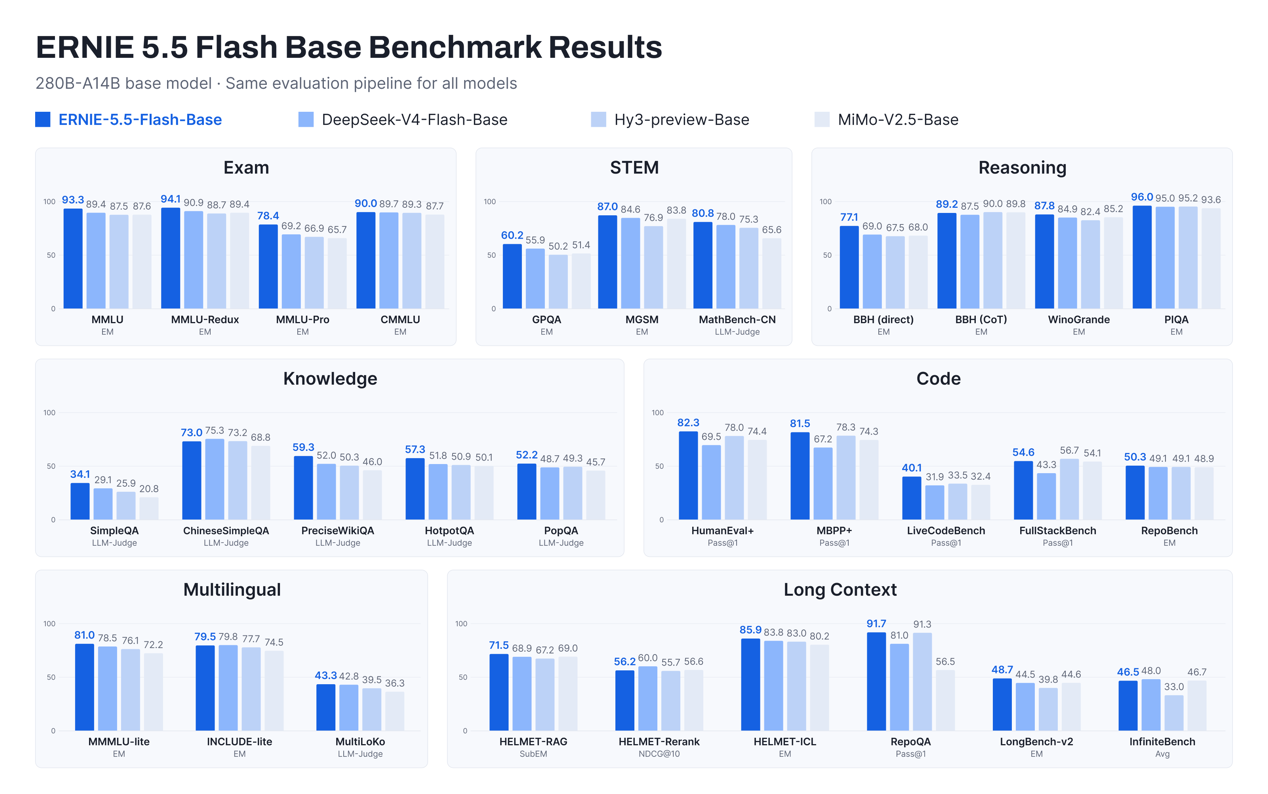
On November 5, Baidu open-sourced ERNIE 5.5 Flash Base, a sparse MoE language model with 280B total parameters and 14B active per token, pretrained on 33.5T tokens with up to 128K training context and 1M-token context for fine-tuning and inference. The company claims SOTA results among same-size models on benchmarks covering knowledge, reasoning, math, code, multilingual, and long-context tasks, surpassing DeepSeek-V4-Flash-Base, Hy3-preview-Base, and MiMo-V2.5-Base. The release includes weights on Hugging Face and ecosystem support with vLLM and SGLang.
3 reports · 2 sources
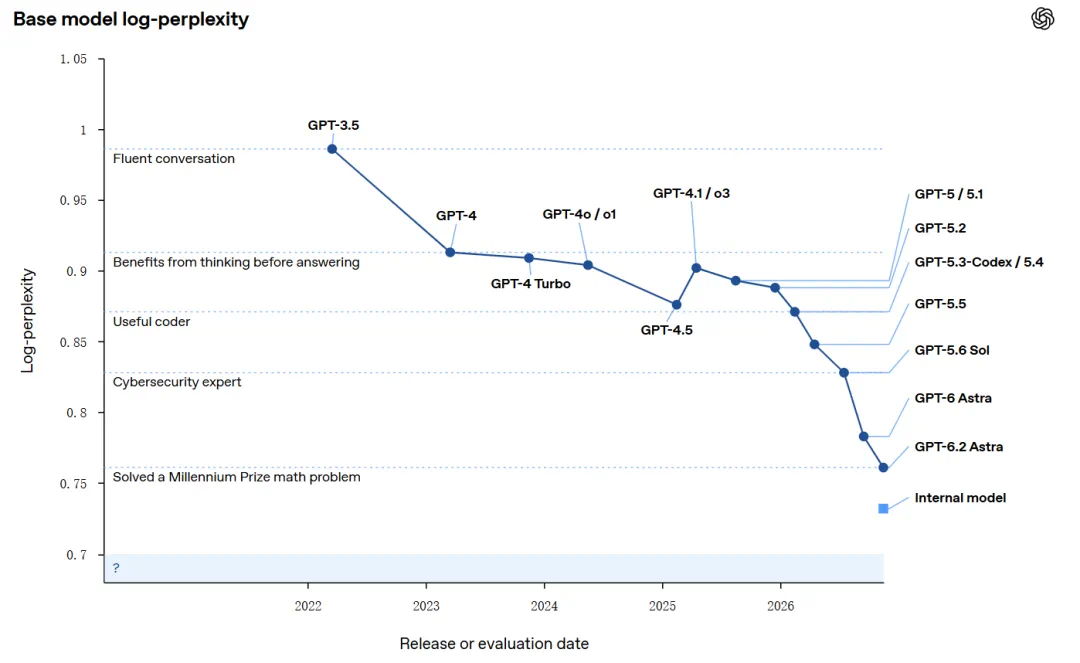
OpenAI publishes perplexity metrics, proposes industry-wide model development cap
OpenAI chief scientist Jakub Pachocki published an essay disclosing internal pretraining perplexity metrics for 13 models since GPT-3.5, and proposed that leading AI labs agree on a shared cap on model development until safety monitoring matures. METR analysis found pretraining loss has fallen about seven times faster since early 2026 than from 2022 to 2025, with Pachocki warning of a possible 2027 acceleration in AI research.
4 reports · 4 sources719 points · 453 comments
Baidu open-sources ERNIE 5.5 Flash Preview under Apache 2.0
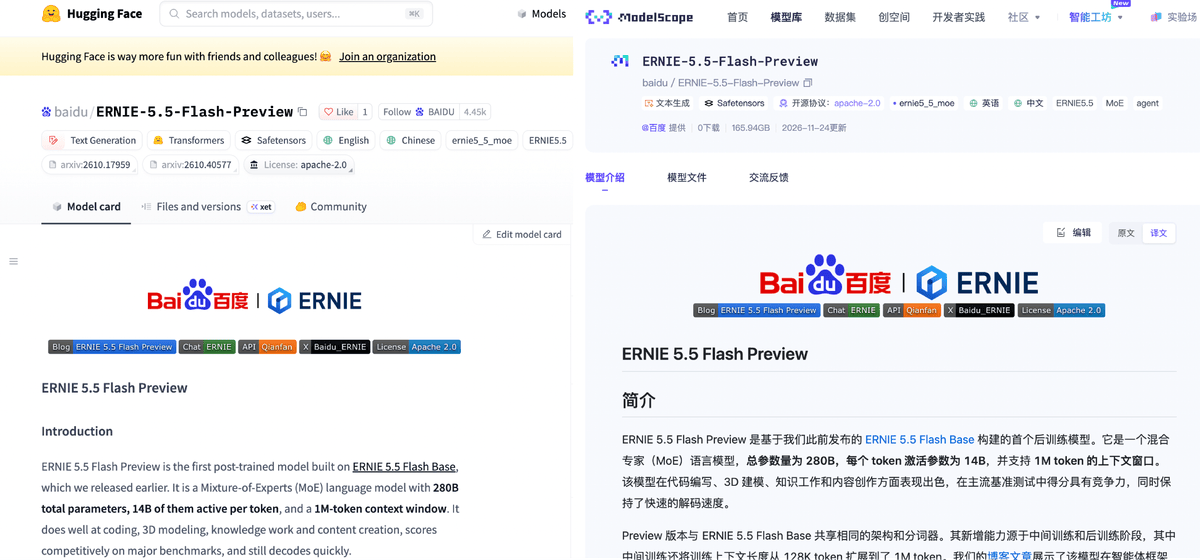
On November 24, 2026, Baidu open-sourced its ERNIE 5.5 Flash Preview model under the Apache 2.0 license, making weights and resources available on Hugging Face and ModelScope. The model has 280B total parameters with 14B active per token, supports a 1M-token context, and is deployable via vLLM and SGLang. It scored 1668 on the CodeArena WebDev leaderboard, ranking second among open-source models and fourth among domestic Chinese models.
News updates every hour. Subscribe in your RSS reader to get new stories automatically.
Subscribe