Stanford physicist claims algebraic quantization of gravity in arXiv paper, developed with GPT-6 Astra
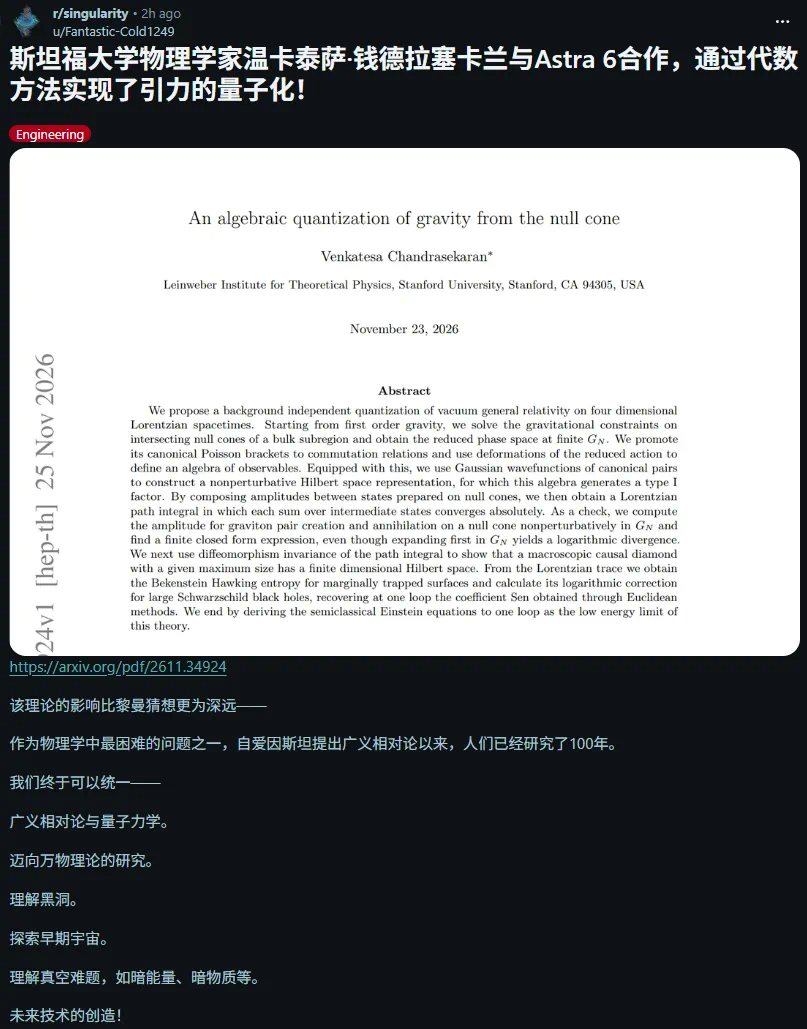
A Stanford theoretical physicist and OpenAI researcher posted an 83-page arXiv paper proposing an algebraic quantization of gravity from the null cone, claiming to address the non-renormalizability of general relativity. The author disclosed months of collaboration with GPT-6 Astra, consuming about 400 million tokens. The paper is not peer-reviewed and does not constitute a unified theory, but it offers a candidate non-perturbative quantization of four-dimensional vacuum general relativity.
Coverage timeline
机器之心机器之心
编辑|Panda、泽南 这影响可能比证明黎曼猜想还要大。 刚刚,𝕏 和 Reddit 的科技与物理社区被一条消息点燃:困扰爱因斯坦后半生的物理学终极难题,似乎迎来了突破口,而且背后出现了 GPT-6 Astra 的身影。 消息传开后,社交媒体上迅速出现了「GPT-6 Astra 发现大一统理论」「相对论与量子力学终于统一」等说法。 也让人不禁感叹,这真是物理学与数学的黄金时代啊。 这个消息源自 arXiv 最新上传的一篇论文,宣称 通过代数方法量子化了引力 ,解决了物理学的百年难题 —— 广义相对论不可重整化、无法直接量子化。 论文题为 《从光锥出发的引力代数量子化》(An algebraic quantization of gravity from the null cone) ,共 83 页,署名作者是 Venkatesa Chandrasekaran,是 OpenAI 推理团队研究员,也是斯坦福大学 Leinweber 理论物理研究所的理论物理学家。今年 10 月 Venkatesa 还以 OpenAI 研究者身份做过「如何用 Codex 做理论物理」的讲座。 在该论文的致谢中,作者披露其 与 GPT-6 Astra 历时数月协作、消耗约 4 亿 token 。讲道理和这个成果比,token 消耗量并不多。另外,他还感谢了 Sam Altman、Sebastien Bubeck 以及 OpenAI 的同事们提供的算力与支持。 当然,这样的理论物理成果大部分人看不懂,我们也在 AI 的帮助下进行了简单解读。同时,也必须声明一下: 该论文尚未经过同行评议,并且距离「大一统理论」也仍有明确边界 。我们的解读 AI 认为: 它提出的是四维真空广义相对论(纯引力)的非微扰量子化候选方案,而非包含全部基本相互作用的「大一统理论」。 不过,这绝不意味着这篇论文的分量被高估到了无关紧要的地步。恰恰相反,单是建立起一套可靠的四维纯引力量子理论,就足以成为 本世纪理论物理的大事 。 在更低维度的模型(如二维 Jackiw-Teitelboim 引力或三维纯引力)中,引力没有局域传播的引力子,物理学家已经能够写出相对完整的量子化构造;可一旦踏入我们真实身处的四维时空,引力波与引力子开始携带真实的局域传播自由度,整套数学结构陡然变得凶险。 过去几十年里,学界甚至长期无法确定,纯四维
Related stories
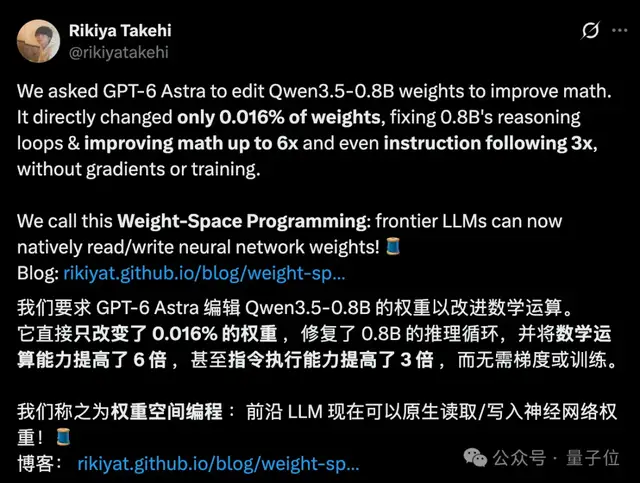
MIT: GPT-6 Astra edits Qwen weights, boosting MATH-500 from 7.9% to 48.1%
MIT CSAIL researchers demonstrated that GPT-6 Astra can directly read and modify the weights of Qwen3.5-0.8B, improving its MATH-500 score from 7.9% to 48.1% by altering only 0.016% of parameters, without training or gradient descent. The team named this capability Weight-Space Programming. However, spaCy author Matthew Honnibal publicly challenged the paper, arguing that the experimental conditions across the three claimed abilities differ significantly and that the presentation is misleading.
6 reports · 5 sources2949 points · 892 comments
OpenAI launches science blog; first post details GPT-6 Astra in particle physics
OpenAI announced a new blog dedicated to scientific researchers, aiming to share how scientists use AI in research, including methods, result checking, and limitations. The first guest post, by UC Santa Barbara physicist Nathaniel Craig, describes using GPT-6 Astra to develop a candidate non-perturbative lattice definition for the Standard Model of particle physics.
1 reports · 1 sources
OpenAI launches GPT-6.2 Astra and Sol, cuts Astra API prices 20%
OpenAI introduced GPT-6.2 Astra, a frontier model for complex professional work, and GPT-6.2 Sol, an efficient model for everyday tasks, available in ChatGPT Work, Codex, and the API. Astra's API pricing is $8 per million input tokens and $40 per million output tokens, a 20% cut from GPT-6 Astra, while Sol retains its predecessor's pricing. Benchmarks show Astra trailing only Claude Fable 5.2 in one index and tied in another, though a critical review cites usability frustrations and poor long-task performance.

Study suggests GPT-6 Astra's robot skills come from specialized training data, not emergent general intelligence
A technical analysis speculates that GPT-6 Astra's robot-manipulation abilities may stem from specialized robot training data rather than emergent general intelligence. The study points to demos with NVIDIA and Unitree, and notes that OpenAI has not disclosed whether pre-training included robot-specific data. Similar training is suggested for GPT-6.1 Sol and Gemini Argon.

News updates every hour. Subscribe in your RSS reader to get new stories automatically.
Subscribe