Ai2's BenchMIRT Audits LLM Benchmarks Question by Question
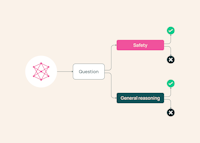
The Allen Institute for AI (Ai2) introduced BenchMIRT, a method for auditing LLM benchmarks question by question. It reveals which capabilities benchmarks actually measure, aiding researchers in building smaller, more focused, and easier-to-interpret evaluations.
Coverage timeline
Hugging Face Blog
Ai2 (Allen Institute for AI)
BenchMIRT is a new method for auditing LLM benchmarks question by question, revealing which capabilities they actually measure and helping researchers build smaller, more focused, and easier-to-interpret evaluations.
Related stories
BenchShield Framework Detects Reward Hacking in LLM-Agent Evaluations
Researchers from Dartmouth, UC Berkeley, and BenchFlow AI introduced BenchShield, a framework for detecting reward hacking in LLM-agent evaluation infrastructure. It extends checks to the entire scoring process, using static analysis to find exploit paths and runtime evidence to determine if agents attempted or used them. The paper highlights a case where a Lean proof verifier gave full marks to an incorrect proof due to disabled kernel type checking.
1 reports · 1 sources

Hugging Face Blog Proposes Ising-Based Method for Pruning LLM Blocks
A Hugging Face Blog post introduces a novel approach to pruning large language models by framing block removal as an Ising optimization problem, borrowing concepts from physics. The method treats the selection of which blocks to remove as a spin configuration, potentially enabling more efficient model compression. This could offer a new angle for reducing LLM size while maintaining performance.
Hacker News Discussion: LLM Classification Viewed as Feature Engineering
A Hacker News discussion argues that LLM classification tasks are fundamentally about feature engineering, offering a technically substantive perspective on model behavior. The discussion highlights how the approach to classification with LLMs can be understood through the lens of feature engineering, potentially influencing how researchers and engineers design and evaluate such systems.
1 reports · 1 sources114 points · 24 comments
Researchers Break 1.58-Bit Barrier for Ternary LLMs
A technical report describes a method that surpasses the previously considered 1.58-bit-per-weight limit for ternary (weights in {-1, 0, 1}) large language models. The approach reportedly achieves lower perplexity and better task performance than standard ternary models at the same model size. This could enable more efficient deployment of LLMs on resource-constrained devices.
1 reports · 1 sources242 points · 41 comments
News updates every hour. Subscribe in your RSS reader to get new stories automatically.
Subscribe