LeCun paper argues next-token prediction inefficient, proposes JEPA world models
A new paper by Yann LeCun and colleagues mathematically argues that next-token prediction is inefficient and proposes an alternative based on world models and JEPA (Joint Embedding Predictive Architecture). The paper claims a 109M-parameter model outperforms a 72B LLM, and formalizes the Platonic Representation Hypothesis into a theorem with actionable sufficient conditions.
Coverage timeline
机器之心机器之心
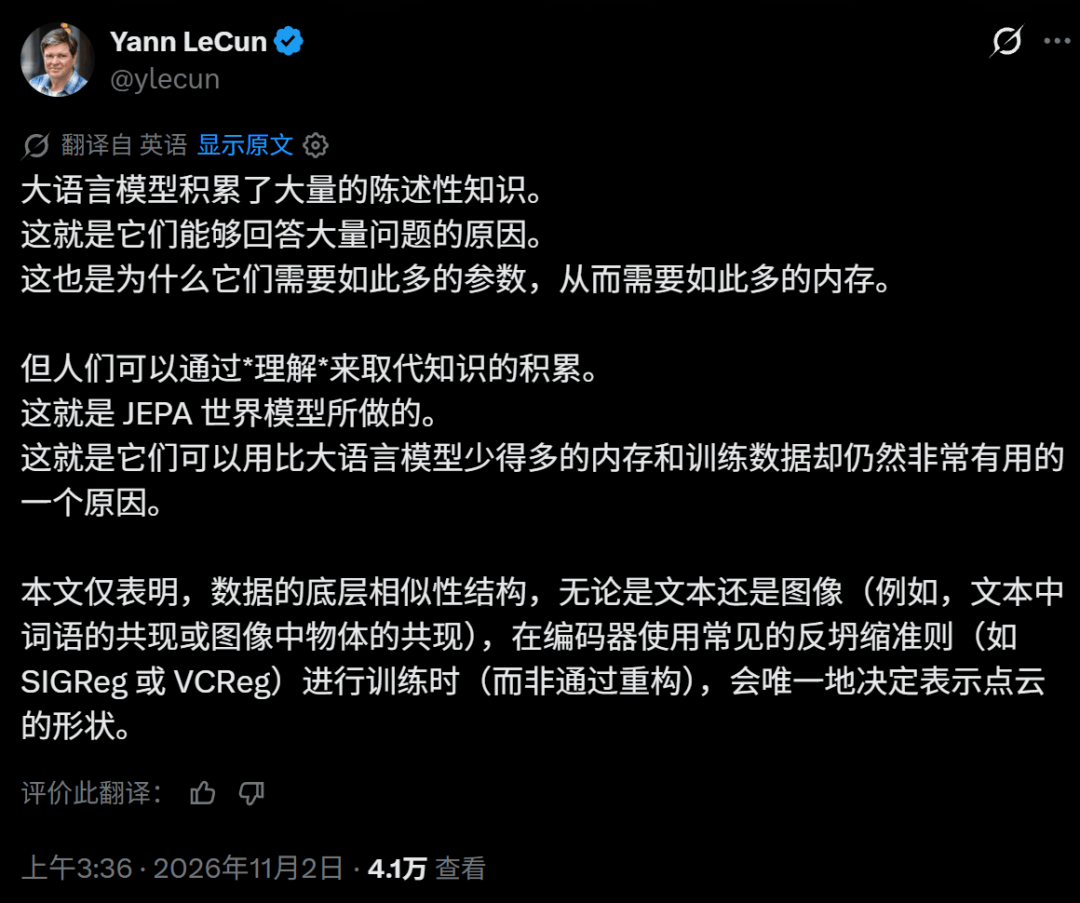
编辑|Neo、泽南 人工智能先驱 Yann LeCun 一直主张「生成式 AI 是一条死胡同,世界模型才是真的未来」。 他认为自回归生成有数学上的硬伤,文本承载不了人类的大部分知识,真正的推理也不是基于优化的推断,衡量智能的标准应该是学习新任务的速度,以及零样本应对全新环境的能力。 基于这种观点,LeCun 寻求的替代路线是世界模型 + JEPA,一套目标驱动型架构。最近他提交的一篇论文向着这个方向前进了一大步, 它从数学上论证了「next-token 预测路线效率低下」,还给出了自己的方法,用一个 1.09 亿参数的模型打败了 720 亿的 LLM。 一个只看图片的模型,与一个文本大模型,会不会在内部形成相似的「概念地图」? 柏拉图表征假说(Platonic Representation Hypothesis, PRH) 由 Huh 等人在 ICML 2024 论文中提出,指在不同模态(视觉、语言)上分别训练的模型,随着规模增大其内部表征会越来越相似, 最终收敛到同一个对现实的共享统计模型 。这就如同柏拉图洞穴里不同的人看到了同一个「理念世界」。但它只有经验曲线和一个理想化对比学习器的直觉论证,既没有证明也没有配方,行业能做的只有继续堆规模。 这篇论文做的事就是把它变成定理,并给出了可操作的充分条件。 论文:《Proving and Improving the Platonic Representation Hypothesis with JEPAs》 链接:https://arxiv.org/abs/2610.39302 GitHub:https://github.com/galilai-group/prh-proof 让模型从不同描述中,学到同一个场景 文字模型读到的每句话都混合着两类信息:它描述了什么,以及它怎样描述。狗在追球属于前者,用「追逐」还是「追赶」则属于后者。如果希望文字模型与图片模型形成相通的表征,就需要让文字模型更多地保留场景中的内容。 但训练时,怎样告诉模型,哪些内容值得保留? 作者采用的办法,是 让模型同时学习同一场景的不同观察 。两个人描述同一张照片,用词、句式可以变化,场景中的主体和关系却大体一致。如果要求模型从这些描述中提取相似的表征,就能给它一个学习信号:寻找不同表达背后的共同内容。 JEPA(联合嵌入预测架构)提供了落实这个想法的
Related stories
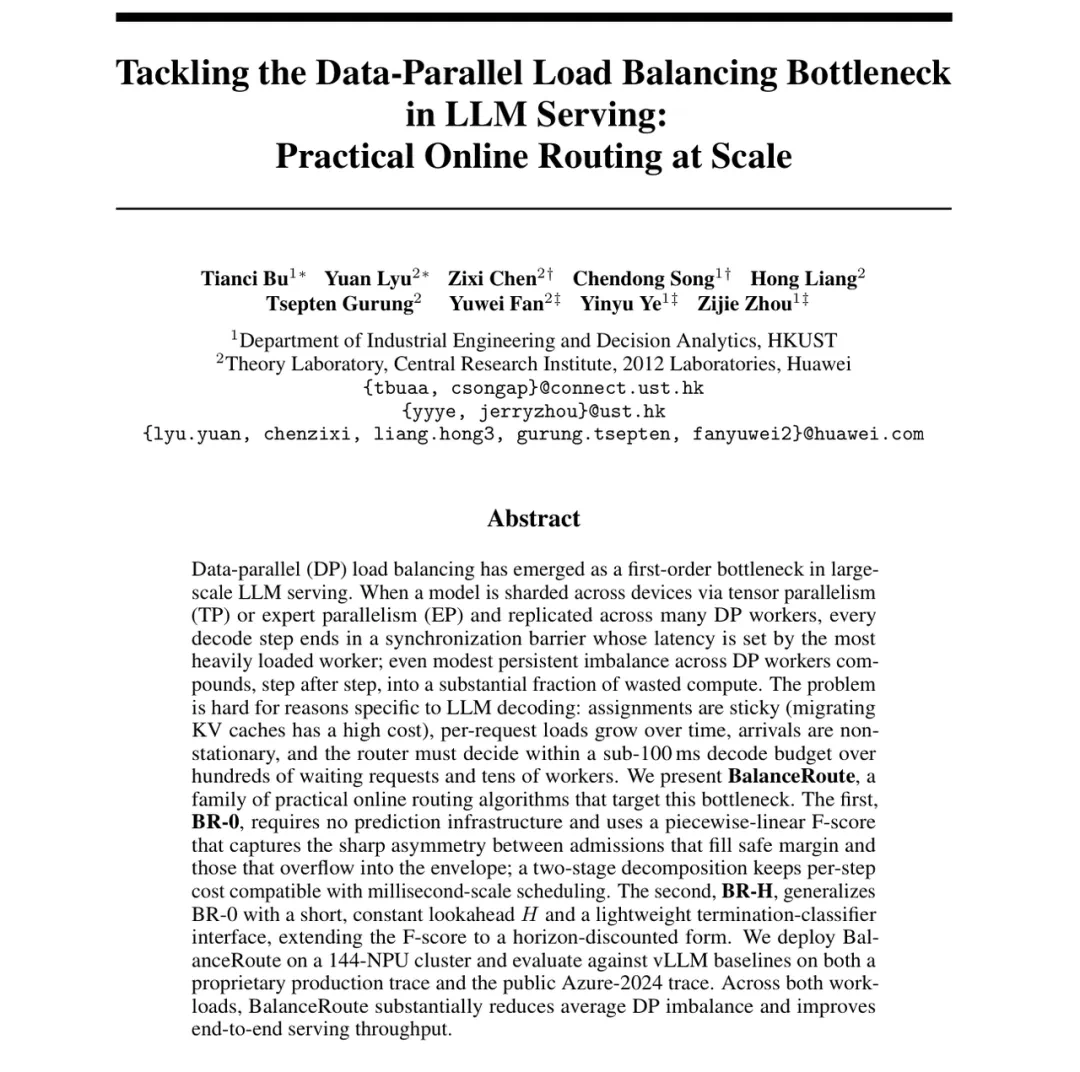
HKUST and Huawei propose BalanceRoute to cut MoE LLM serving load-balancing bottleneck
Researchers from HKUST and Huawei's 2012 Lab propose BalanceRoute, an online routing method that models synchronous waiting in MoE LLM serving and converts short-term load prediction into routing decisions. In a 96-GPU test, the predictor-based variant BR-H improves decode throughput by about 15% over the strongest baseline. The work is accepted by NeurIPS 2026 and deployed in the jointly built MaaS system MathBot-Pie.
1 reports · 1 sources
Anthropic: Small AI models may self-replicate on IoT devices within months
Anthropic researchers report that small AI models may be months away from self-replicating on commercial IoT devices like smart ovens and off-brand Android TV boxes. In tests, a 9B model ran inference on 8 of 9 hardware types, and GLM-5.2 autonomously spread an 8B model to all 8 nodes in 4 of 5 attempts. The researchers predict models under 30B could achieve end-to-end replication by the end of 2026.

Inception launches Mercury 3, diffusion LLM claiming ~1,000 tokens/sec
Inception has launched Mercury 3, a diffusion-based large language model that the company claims is comparable to Luna and Haiku models while being 4x to 8x faster, generating approximately 1,000 tokens per second. The announcement was reported by Techmeme and Hacker News on October 19-20, 2026.
2 reports · 2 sources256 points · 92 comments
Fudan, Tencent Hunyuan, Tsinghua Release ExplorationBench to Test AI Rule Discovery
Fudan University, Tencent Hunyuan, and Tsinghua University released ExplorationBench, a benchmark measuring how AI systems discover rules in unfamiliar environments. It includes two altered 'alien worlds'—the programming language AlienCode and the logic proof system AlienLogic—where models must learn rules through trial and error. Results showed that without environment feedback, scores remained low (max 11.0%), while autonomous exploration led to high scores (up to 89.0%).

News updates every hour. Subscribe in your RSS reader to get new stories automatically.
Subscribe