Anthropic to embed invisible watermarks in Claude text, C2PA metadata in files
Anthropic announced it will embed invisible watermarks in text generated by Claude models and add C2PA metadata to supported file types, to comply with the EU AI Act's transparency requirements. The watermarking, based on Google DeepMind's SynthID-Text approach, will apply globally to all models released after August 2, 2026, and will be extended to older models by December 2. The move has drawn criticism for potential impact on writing quality, and an open-source project claiming to remove the watermarks has gained 11k GitHub stars in five days.
Coverage timeline
量子位量子位
Claude骂声中启动「隐形水印」:新模型全量嵌入,标记所有文字 Jay 2026-08-11 11:51:24 来源: 量子位 大水印时代来了 Jay 发自 凹非寺 量子位 | 公众号 QbitAI A社的又一骚操作,再次掀起了全网震怒。 刚刚,Anthropic表示: 新款Claude将在生成文本中嵌入隐形水印 。 是的,不是元数据,这些墨水会直接成为文本的一部分。 它会随着文本一起被复制、粘贴到其他地方,并且在经过一定程度的编辑后,仍有可能保留下来。 纯狗皮膏药啊。。。 网友已经集体开麦了。 这波操作的直接推手,是Anthropic已签署的欧盟《AI法案》,这一机制将适用于 2026年8月2日起及之后发布的所有模型 。 对于目前已经上线的Claude模型,Anthropic也在研究如何补加这一水印机制。 噢,对了—— 该措施将在全球范围内推行,而非仅限于欧盟。 大「水印时代」,来了。 文字也有水印了 刚刚,Anthropic签署了欧盟AI法案 《AI生成内容透明度行为准则》 。 这份准则由独立专家起草、经欧盟委员会和AI委员会评估,目前已有约190家机构签署,包括Google、Meta、Microsoft、OpenAI等。 落到Claude身上,具体是两件事。 第一,文本水印。 受支持的Claude模型生成文字时,会直接在文本中编织一种肉眼不可见的标记。 是的,完全隐形。你看不到它,它也不改变回复的意思、质量或可读性。 更可怕的是甩不掉。 水印是文本的一部分 ,复制粘贴会带走它,甚至编辑过的也不太行。 第二,签名元数据。 当Claude生成.svg、.png、.jpg等受支持的文件类型时,会附加数字签名的来源元数据。 这套元数据遵循C2PA开放标准,由Adobe、OpenAI、Google等共同推动,能标明文件经过Claude处理,也能检测文件是否被篡改。 覆盖范围是全产品线的。API、Claude、Claude Code、Claude Cowork、Claude Tag全部在内。 通过AWS、Google Cloud、Microsoft Foundry访问Claude的云客户同样适用。 而且,不分区, 全球统一施行。 与此同时,Anthropic表示正在开发检测工具,让用户和第三方可以查验一段文字或一个文件是否携带Claude标记。 具体技术文档公司将在后续

Techmeme
Thomas Claburn / The Register : Anthropic says Claude models in the EU will now add invisible watermarks to generated text and C2PA metadata to generated files, to comply with the EU AI Act — EU rules cited as reason for effort to trace AI output ancestry — Anthropic will embed watermarks in the text and files generated …

TechCrunch AIIvan Mehta
Anthropic will watermark text generated by its models, including Claude, to comply with European regulations, the company now says. The AI model maker confirmed the watermarking in an updated support page. EU AI Act’s Transparency Code, which took effect on August 2, requires AI companies to mark AI-generated or edited content in a way other systems can identify them. Anthropic said that all models released after August 2 will automatically have tech to watermark both computer-generated text and files. For files, the company is using the C2PA open standard. The company said it will extend support for older models as well, adding that the watermark will travel when users copy and paste the text. “Because the watermark is part of the text, it will travel with the text when it’s copied and pasted elsewhere, and may persist through some editing. Watermarking will be applied at the model level, which means it will be present no matter which Claude product or surface the text comes from,” th
The Verge AIJess Weatherbed
Anthropic has pledged to start marking Claude-generated text and images with machine-readable data, in an effort to comply with European rules for AI transparency. "Generated text will carry embedded watermarks, and generated files will include digitally signed provenance metadata where supported," Anthropic says on a new Claude support page . The changes are invisible to human eyes, but will make it easier for people and online platforms to detect if content was generated by Claude models. These updates are a future commitment rather than something that will go into effect immediately. New AI labeling and transparency obligations under the … Read the full story at The Verge.

机器之心机器之心
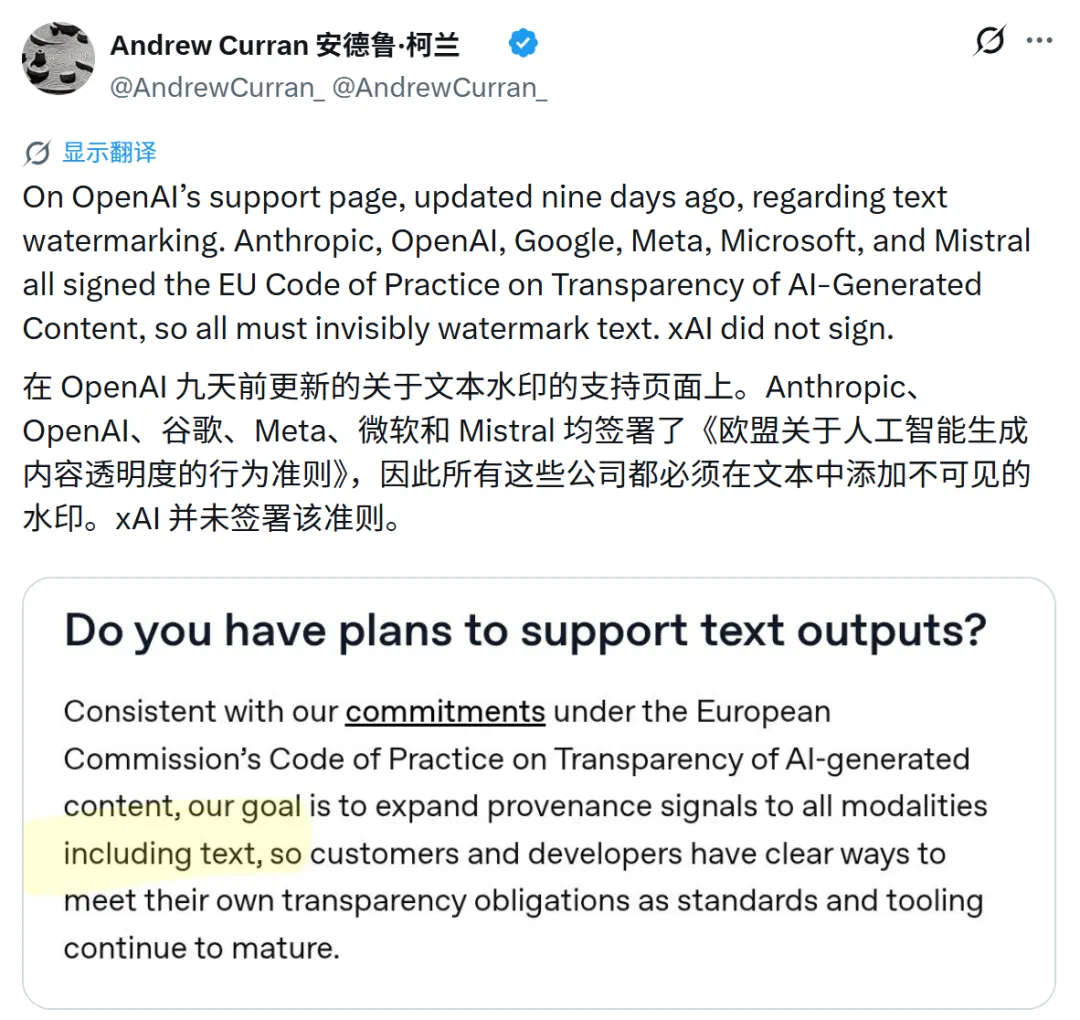
编辑|山辉 AI 写的文章以后真藏不住了。 OpenAI 官方公告, 包括 OpenAI、Anthropic、Google、Meta、Microsoft 在内的一大批公司,签署了欧盟《AI 生成内容透明度行为准则》,承诺推进 AI 生成内容的标记与检测 。 OpenAI 表示,根据其对欧盟 AI 生成内容透明度准则的承诺,目标是将来源信号扩展至包括文本在内的所有模态。 看起来 AI 内容马上也要有「署名」了。 最近许多前沿公司都在拓展欧洲业务,但欧盟的规矩可谓是相当多,这个《AI 生成内容透明度行为准则》就是其中之一。 从 8 月 2 日起,欧盟法案中关于内容透明度的要求就已经生效: AI 生成或操纵的文本、图像、音频和视频,需要以机器可读的方式进行标记,并且能够被检测出来。 不过签署准则是一回事,真要说因此行动的,Claude 是第一个。 Claude 的「署名」规则 不久前,Anthropic 公布了 Claude 落实这套规则的具体方案。 链接:https://support.claude.com/en/articles/16266773-how-claude-marks-ai-generated-content 重点有几个: 1、从 8 月 2 日起,如果在欧盟推出的新 Claude 模型, 「AI 水印」将在上线时就启用 ; 2、「AI 水印」直接嵌入生成文本中, 人眼不可见,但机器可以检测 。复制粘贴之后水印会保留,甚至经过一些编辑后水印也不一定消失; 3、对于 svg、png、jpg 等文件,Claude 会 附加经过数字签名的来源元数据 ,采用 C2PA 开放标准。这样的「AI 水印」可以表明文件曾经由 Claude 处理,同时帮助判断文件之后是否遭到篡改。 4、虽然是欧盟的规则,但这套机制不局限于欧盟用户。并且水印从模型层加入,无论从 Claude、API 还是第三方云服务调用 ,在 Claude 生成的内容都会带上「AI 水印」。 除了这些,根据欧盟给出的过渡期,Claude 的旧模型也应该在 12 月 2 日之前补上「AI 水印」。 也就是说,按目前的节奏,到 12 月 2 日之后,Claude 的「AI 水印」将进一步覆盖 全球、全模型、全渠道 。 对于其他签署公司,情况也是如此,只不过方法可能有所不同。 水印其实早就有了 关于怎么加「水印」
Anthropic : Anthropic details Claude's text watermark: it only shows Claude was likely involved, is sparse in code and factual text, and disappears after a full rewrite — Future Claude models will generate text that contains a watermark. This is a way of determining the likelihood that Claude …

How will the watermarking actually work? Can it be hidden with editing? And how does this affect code?
Hacker Newsropbear
When I wrote this week about Anthropic’s announcement that all Claude models, worldwide, would soon begin “watermarking” everything they generate, including text, to comply with this EU regulation, we were left to speculate _how_ this was going to work, because Anthropic offered not even a vague description of how it would work — despite the fact that the title of the announcement was, absurdly and insultingly, “How Claude Marks AI-Generated Content”. My initial speculation was that maybe they’d hide invisible non-printing Unicode characters in the text. Just spitballing. Turns out that’s not what they’re going to do. What they’re going to do is apply a form of steganography, where the choice of words (or other token output) at inference time will leave fingerprints that can later, maybe, be detected probabilistically. I initially guessed “invisible characters” not because I didn’t think of the semantic word-choice technique, but because I was a fool who took Anthropic at its word in t
编辑|冷猫 Claude 的水印政策在前些天引起了轩然大波。 我们曾报道过 ,包括 OpenAI、Anthropic、Google、Meta、Microsoft 在内的一大批公司,签署了欧盟《AI 生成内容透明度行为准则》,承诺推进 AI 生成内容的标记与检测。 但 Anthropic 显然做得更加过分。 他们为 AI 生成的全部文本内容添加隐藏水印,并且适用于全球用户。 技术上,Anthropic 采用了 Google DeepMind 团队 2024 年提出的 SynthID-Text 方案。原理是在模型做「无关紧要的选择」时植入统计模式。比如在描述天气时,选「overcast」还是「grey」对读者没有区别,但这种选择的累积构成了一个隐藏签名,持有密钥者可以检测到它。 Anthropic 宣称水印不影响输出质量,轻度编辑无法去除,完全改写可以消除。但在这种情况下,文本是否还能被称为 AI 生成的,本身就值得商榷。 简单来说,哪怕你把一篇完全自己撰写的文章丢给 Claude 检查标点,返回的内容也会被打上 Claude 生成的标签。 这就很令人感到恶心了。 很快,针对 Claude 不讲道理的水印策略,就已经出现了反制方案。 一个去除 AI 水印的开源项目,在发布五天就已在 GitHub 冲到 11k Star。 开源链接:https://github.com/guillaumemeyer/watermarks-remover 这个开源项目能够实现三层工作: A 层(确定性清洗) :用 Python 脚本去除不可见 Unicode 字符、异域空格、bidi 控制符、tag 字符。这些是最简单粗暴的标记方式,脚本能 100% 去除。 B 层(统计水印破坏) :通过 Agent 改写文本,破坏 token 采样层面的统计模式。覆盖 Claude、Google SynthID-Text、OpenAI 溯源标记、以及开源模型常用的 Kirchenbauer 类水印。 文件层(元数据清除) :去除 PNG、JPEG、WebP、SVG、PDF、DOCX、ODT、HTML、Markdown 中的 C2PA / EXIF / XMP 元数据。 水印去除可以覆盖 Claude、Gemini、OpenAI 三大主流厂商的 AI 服务。一个有趣的细节是:项目曾经叫 remove-cl
John Gruber / Daring Fireball : Anthropic's text watermark alters word probabilities to embed a fingerprint, which could degrade Claude's writing, despite its claim of no impact on quality — When I wrote this week about Anthropic's announcement that all Claude models, worldwide, would soon begin “watermarking” …

Anthropic has clarified how it's planning to apply invisible watermarks to Claude-generated text in order to comply with Europe's AI transparency rules. On Friday, Anthropic announced that Claude's text marking system is "a version of the SynthID-Text approach" - an open-source watermarking technology developed by Google DeepMind that creates detectable patterns using wording probabilities. This watermarking feature, alongside C2PA support for Claude-processed images, is being introduced to meet Anthropic's obligations under the European Union's AI Act , which requires synthetic audio, image, video, and text to include machine-readable marks … Read the full story at The Verge.
