Danish team extracts hidden chain-of-thought from frontier models via tool calling
Researchers at Aalborg University's AI Safety Lab, with the Seafill open-source community, published a paper showing that hidden chain-of-thought reasoning can be extracted from frontier models via standard API tool calling. They validated the method on open models, where extracted reasoning matched or slightly exceeded native reasoning in accuracy, and applied it to closed models across math, code, and science benchmarks. All extraction experiments were completed before September 9, 2026, and OpenAI and Anthropic were informed.
Coverage timeline
机器之心机器之心
如今 Test-time scaling 正在极强地增益前沿大模型的推理能力。但 GPT、Claude 等最新闭源模型到底怎么 “想”,外界通常只能看到一个最终答案,或者一段被处理过的思维链,而真正具体的推理过程和原始思维链,被隐藏了起来。 最近, 丹麦奥尔堡大学 AI 安全实验室与 Seafill 开源社区联合发表的工作 《Capable yet Parsimonious: Extracting and Characterizing Hidden Chain-of-Thought in Frontier Models》,尝试打开这个黑箱。 论文链接: https://arxiv.org/pdf/2609.26637 研究团队找到了一种简单但有效的方法:这是一次协议层 “越狱” 提取,通过标准 API 的 tool calling 让多款前沿模型外显出具有推理性质的隐藏思维链。 声明:所有提取实验均在 2026 年 9 月 9 日之前完成,研究团队已正式告知 OpenAI 与 Anthropic。 提取出的 reasoning,是真实推理,还是事后合理化? 在能够直接观察原生思维链的开源模型上验证: 表 1:开源模型上,工具提取 reasoning 与原生推理的准确率对比(%) 从表中可以看出,工具提取的 reasoning 不仅远超无推理 baseline,在 DeepSeek-V4-Flash 上甚至略高于原生推理,在 GLM-5.2 上也接近原生推理。进一步比较文本相似度,对每道题进行了多次 rollout,比较 “原生思维链之间” 以及 “原生思维链与工具提取思维链” 的相似度,在 DeepSeek-V4-Flash 上,两者的 ROUGE-L 分别为 0.198 和 0.188,5-gram Jaccard 更是同为 0.017。 也就是说, 工具提取出的思维链与原生思维链的差异,已经接近模型多次生成原生思维链时自身的波动范围。 在闭源模型上验证: 表 2:闭源模型基准准确率(%) 在闭源模型上跨数学、代码、科学的多个 benchmark 也对该工具提取方法进行了相应的测试,性能上接近原生推理,部分设置甚至略高,同时显著优于无推理 baseline。 需要强调的是,闭源模型的原生 CoT 不可见,但诱导出的思维链分析表明,提取出的 reasoning 可作
Related stories
GPT-6 Astra Helps Prove Remaining Cases of 57-Year-Old Circle Packing Problem for N up to 20
A math enthusiast named nor used GPT-6 Astra to rigorously prove the remaining cases (N=15, 16, 17, 18, 20) of the 'packing circles in a circle' problem, extending verified results to N≤20. Previously, only N≤14 and N=19 had been proven. The problem, posed in 1969, asks for the minimal radius of a large circle that can contain N unit circles without overlap.
1 reports · 1 sources
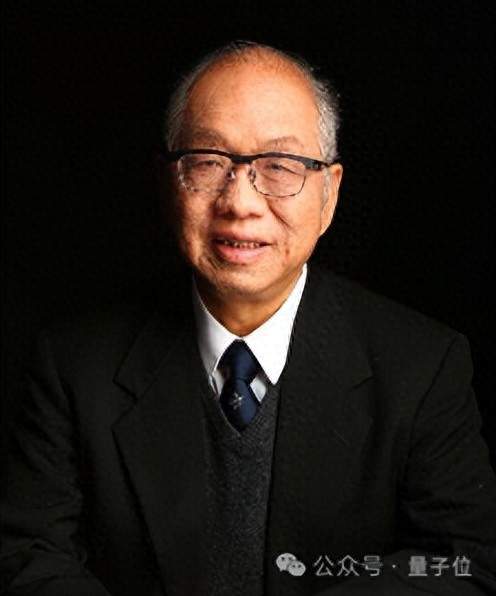
Yau Shing-Tung's paper on exotic spheres acknowledges GPT 6 Astra and Claude Pro
Mathematician Yau Shing-Tung, who once said AI could not affect top mathematicians, has co-authored a paper that thanks GPT 6 Astra and Claude Pro for helping explore proof ideas and calculations. The paper addresses a conjecture about seven-dimensional exotic spheres, listed by Yau in 1982, and provides an answer to whether these spheres can have positive sectional curvature everywhere.
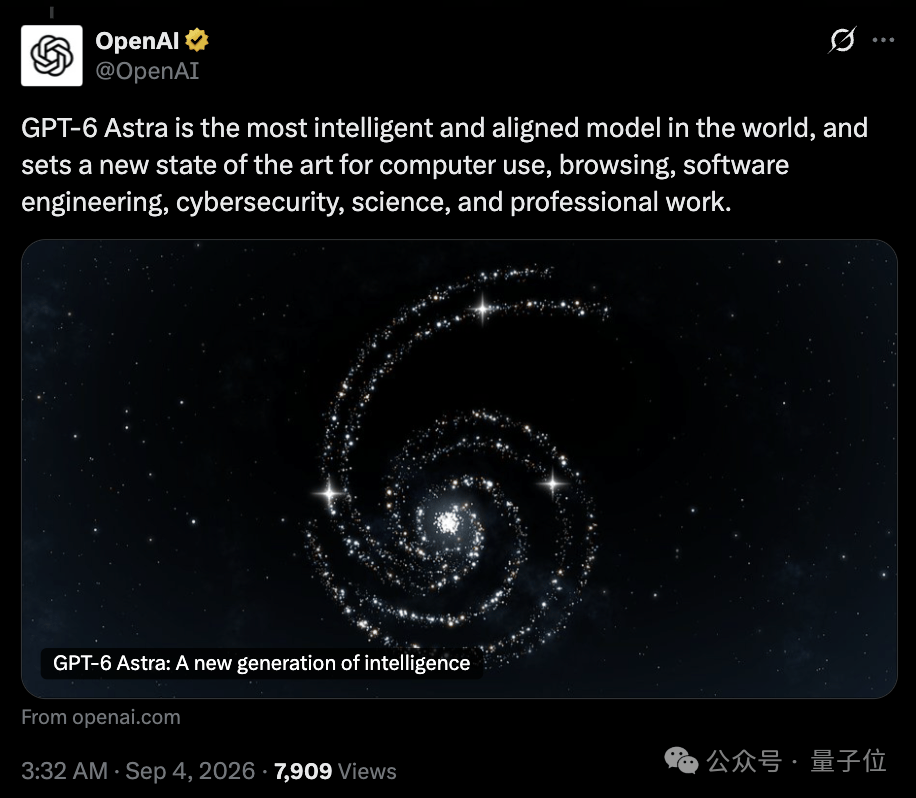
OpenAI launches GPT-6 Astra, claims world's best computer use model
OpenAI announced GPT-6 Astra, its next-generation model focused on computer and browser use, claiming it is the world's most intelligent and aligned model. The company stated Astra was built on its largest training run using over 100,000 GPUs at the Stargate facility, and in tests it outperformed humans in tasks like booking DMV appointments and searching job listings. OpenAI president Greg Brockman declared 'Welcome to the AGI era,' though the model's capabilities and limitations are still being assessed by developers.
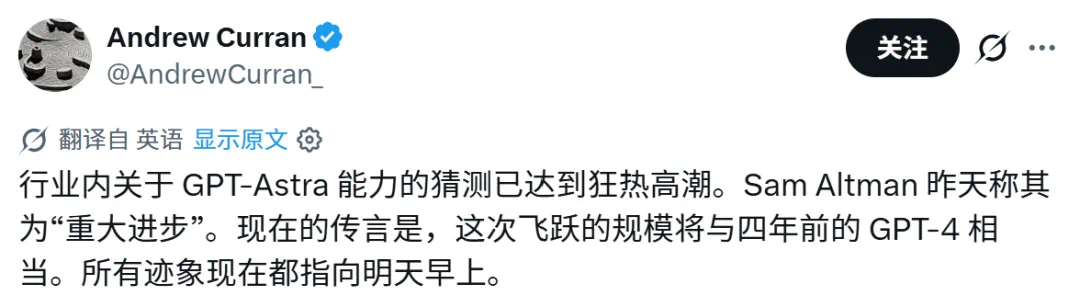
OpenAI's Astra model uses 'recurrent depth', raising safety concerns
OpenAI's upcoming Astra model reportedly uses a technique called 'recurrent depth', allowing it to perform multiple rounds of internal computation before outputting each token, diverging from sequential reasoning typical of most models. The model has achieved a 'critical' cybersecurity capability threshold, with a 100% success rate on a test set of 20 recent V8 high-severity vulnerabilities, and has discovered two zero-day exploits. AI safety experts have expressed alarm over the opacity of the model's internal reasoning, prompting OpenAI's chief scientist to respond.
News updates every hour. Subscribe in your RSS reader to get new stories automatically.
Subscribe