Theory of Agent Survey: How to Split Capabilities Between Model and Harness
Researchers from eight institutions, including Beihang University and the University of Edinburgh, published a survey titled 'Theory of Agent: The Science of Internalization and Externalization for LLM-based Agents'. The survey reviews about 600 recent studies, proposing a unified framework of internalization and externalization to analyze how LLM agents should decide which capabilities to embed in the model versus delegate to external harnesses, covering learning, alignment, evolution, and evaluation.
Coverage timeline
机器之心机器之心
北航、南方科技大学、复旦大学、北京理工大学、爱丁堡大学等 8 家机构的 19 位研究者联合完成 Theory of Agent 综述,讨论模型内部与外部 harness 应如何分配能力,并据此梳理 LLM Agent 的学习、对齐、演化与评测。 一个本可直接推理的问题,Agent 却连续搜索网页、调用多个工具。任务虽然完成了,时间和费用也多花了不少。另一种情况是,问题需要实时信息,Agent 却一直在模型内部推理,最后给出流畅但没有依据的答案。 前一种情况属于过度行动(overacting);后一种往往同时涉及过度思考(overthinking)和行动不足(underacting)。要避免这类决策失误,Agent 需要判断哪些问题可以自行解决,哪些必须向外部世界寻求信息或执行能力。 这篇综述梳理了约 600 项近期研究,用内化(internalization)与外化(externalization)这一统一视角,分析 Agent 从设计到学习、对齐、演化和评测的全过程。 通往认知型智能体(Epistemic Agent)的路径。Agent 根据模型内部知识与外部 harness 的能力,校准思考和工具调用的决策。 论文题目: Theory of Agent: The Science of Internalization and Externalization for LLM-based Agents 作者: Zihao Cheng*, Yixia Li*, Shengbin Yue*, Yuheng Lu*, Yuli Qiu, Yanzhi Tian, Haohuinan Zhang, Cheng Qian, Hongru Wang, Guanhua Chen, Zeming Liu†, Yuhang Guo, Zhongyu Wei, Ke Gu, Liang Li, Jeff Z. Pan, Amos Storkey, Yunhong Wang, Haifeng Wang 作者单位: 北京航空航天大学、南方科技大学、复旦大学、北京理工大学、爱丁堡大学、北京工业大学、中国科学院计算技术研究所、百度 论文链接: https://www.preprints.org/manuscript/202609.0308 GitHub: https://githu

Related stories
AgentForesight: 7B Model Audits Multi-Agent Systems Online to Predict Failures
Researchers from Rutgers, UT Austin, and Purdue propose AgentForesight, a 7B model that audits multi-agent systems during task execution to identify critical errors before they cascade into failures. On the AFTraj-2K benchmark, it achieves an Exact-F1 of 66.44 for key error steps in failed trajectories, outperforming the strongest general model baseline by 19.88 points, with a false positive rate of only 2.37% on successful trajectories.
1 reports · 1 sources

NTU Study: Agent Harness Quality Depends on Model-Task Combination
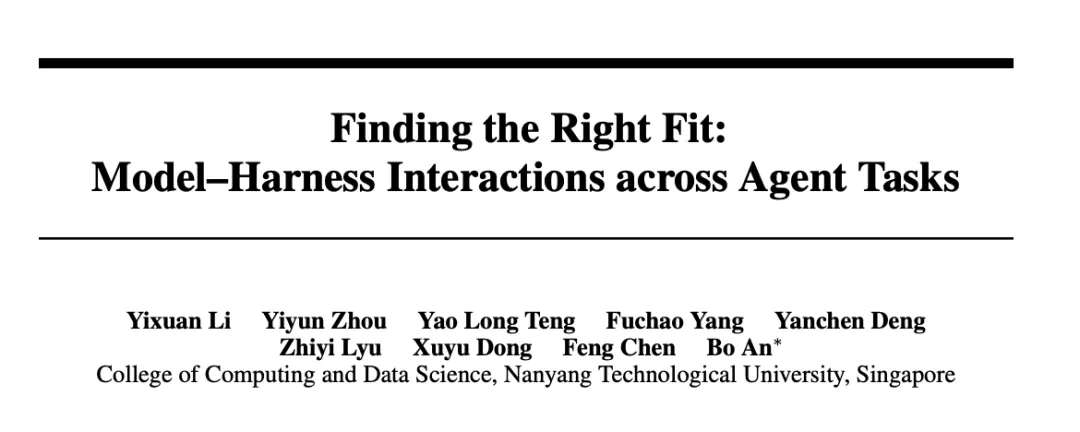
A team led by An Bo at Nanyang Technological University published a report systematically studying model-harness interactions across agent tasks. The study compared four configurable harnesses (OpenHands, DSH, PI, openJiuwen) with five models and two native pairings, concluding that harness quality is not a fixed property but depends on the specific model-task combination, recommending joint evaluation over seeking a universal harness.
NUS Showlab Unveils Show-Harness Interface for VLM Agents to Control Real Robots
Researchers at NUS Showlab introduced Show-Harness, an interface that enables vision-language model (VLM) agents to control real robots directly, moving beyond computer-use to robot-use. The project releases open-source code, models, and data, targeting the gap between frontier models' intelligence and physical robot execution.

Study: Complex Harness Evolution May Not Beat Simple Retrying for Agents
Researchers from AI2 and the University of Washington published a paper rethinking how to evaluate harness evolution for AI agents. Under matched feedback and inference budgets, complex self-modification did not consistently outperform simple test-time scaling (retrying tasks multiple times), and gains largely vanished on new tasks. The findings question the validity of reported improvements from agent self-evolution.

News updates every hour. Subscribe in your RSS reader to get new stories automatically.
Subscribe