Google and Penn State propose Self-Improvement Memory for continual recursive self-improvement
Researchers from Google and Penn State published a preprint introducing continual recursive self-improvement (CRSI) for AI agents, which extends self-improvement across changing models and datasets. They propose a Self-Improvement Memory (SIM) mechanism that transfers optimization experience—including modification rationale, expected and actual outcomes, and evaluation context—alongside the harness, allowing agents to build on prior experience rather than restarting from scratch. The paper is a preprint and has not yet undergone peer review.
Coverage timeline
机器之心机器之心
Agent 的自我改进通常发生在固定模型、固定数据与任务基准下。但实际系统会不断变化:任务模型可能升级,也可能保持模型不变,转向新的数据集或任务基准。此前积累的优化经验,能否帮助系统在这些变化之后继续改进,而不必每次都从头搜索? Google 团队与宾夕法尼亚州立大学合作者近期公开了一项 RSI 新研究,探索 「持续递归自我改进」(CRSI) 。研究同时考察跨数据集与跨模型的持续优化,并提出 Self-Improvement Memory(SIM) :将修改理由、预期结果、实际结果和评估背景与 harness 一起传递,让后续优化能够利用已有经验,并在新设置中继续补充、检验和修订它。论文目前为预印本,尚未经过同行评审。 论文:Self-Improvement Memory Enables Continual Recursive Self-Improvement 作者:Xin Yu、Fei Xia、Jiaqi Pan、Youbao Tang、Chengzhi Liu、Adams Yu、Sicong Jiang、Yanfei Chen、Lingzhou Xue、Ting Yu。 机构:Google Cloud AI、Google DeepMind、Google Cloud AI Research、The Pennsylvania State University。 论文:https://arxiv.org/abs/2611.18856 项目页:https://lucasxinyu.github.io/sim/ 讨论:https://huggingface.co/papers/2611.18856 持续递归自我改进的思路。迁移的不只是优化后的 harness,还包括产生这些修改的经验。图中工作空间示例的分数属于单一实验设置。 从保留代码,到保留修改的依据 Agent 的能力不只取决于模型参数。提示词如何组织、调用哪些工具、怎样处理返回结果、何时停止执行,都由模型外部的程序安排。这套程序通常称为 harness 。 递归自我改进可以发生在这一层:运行当前版本,收集反馈,提出修改,再通过评估选择下一版本。任务模型的权重可以保持冻结,改变的是外部程序。 问题在于,源环境中有效的修改,在新模型或新任务上未必仍然合适。论文中的一个例子是,将 Opus 优化出的 harness 交给

Related stories
DeepSeek open-sources Super-agent architecture for autonomous bug-fixing agents
DeepSeek has publicly released the architectural blueprint for its Super-agent, a research prototype of a personal agent that maintains cross-session context to handle multi-task coordination. Internal tests show the agent can autonomously identify bugs and submit pull requests without being explicitly prompted, with a median task completion time of 12.4 minutes in simulated multi-task environments. DeepSeek positions this as a step toward reducing human attention bottlenecks in multi-task workflows.
3 reports · 3 sources

DeepMind Institute essay explores paths to artificial superintelligence beyond AGI
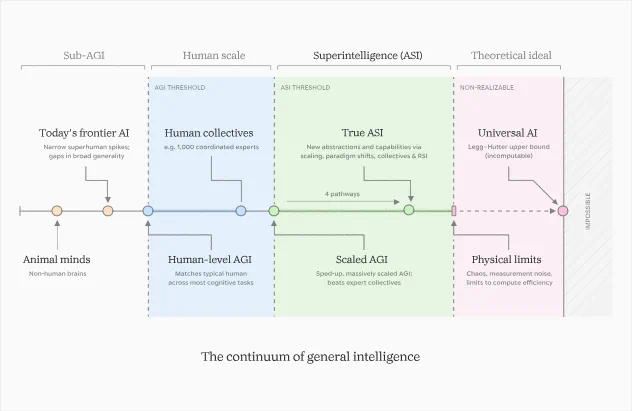
Google DeepMind Institute published an essay titled 'What Comes After AGI?' arguing that AGI is not the endpoint of AI development but a stage on an intelligence continuum, with potential paths toward artificial superintelligence (ASI) that consistently outperforms groups of human experts. The essay outlines four potential technical routes to ASI, including recursive self-improvement, and highlights challenges in measuring, predicting, and governing progress in the superintelligence era.
2 reports · 2 sources
Anthropic: Offline 'dreaming' boosts Claude's memory consolidation over note-taking
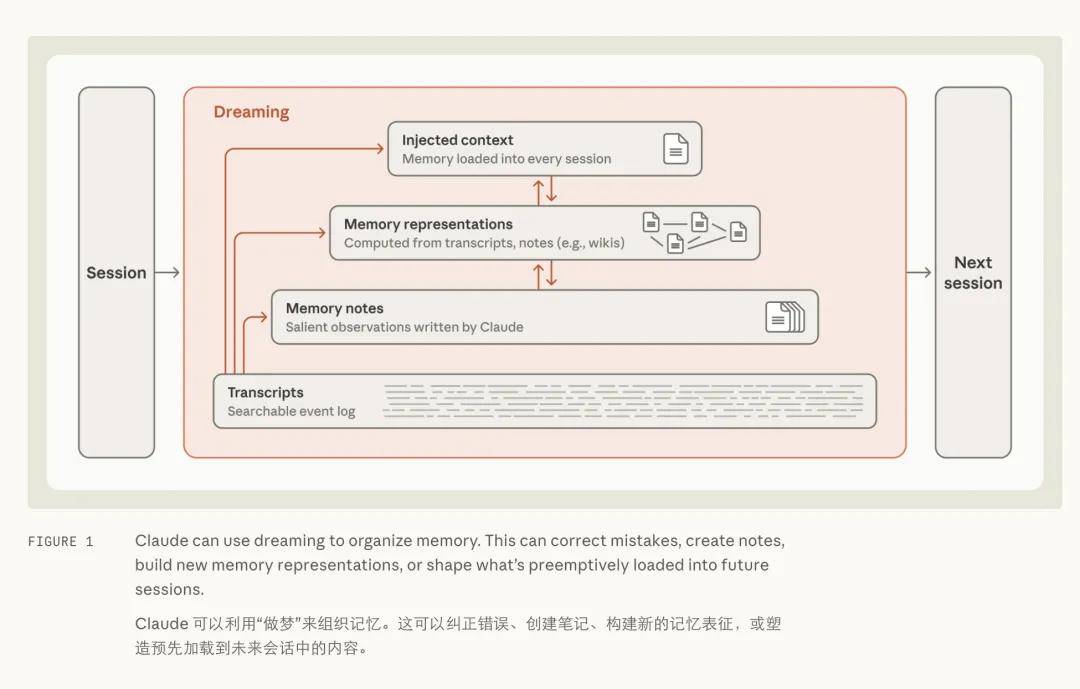
Anthropic published research on the components of agent memory, finding that offline 'dreaming'—reorganizing context during idle time—improves Claude's memory consolidation more effectively than simply writing more notes. The study highlights that agents must decide what to remember before knowing what comes next, and dreaming helps correct mistakes and organize memory.
Tsinghua's SkillMaster Trains LLM Agents to Create and Refine Skills via RL
Researchers from Tsinghua University and collaborators present SkillMaster, a NeurIPS 2026 paper that trains LLM agents to autonomously create, update, and retain skills through reinforcement learning, integrating skill management into the agent's own policy. The method uses two learning signals—making previously failed similar tasks easier and previously successful tasks more efficient—to drive skill editing, enabling skill evolution and task execution to be learned jointly.

News updates every hour. Subscribe in your RSS reader to get new stories automatically.
Subscribe