Strong-to-Weak Scaffolding: Stronger AI Designs Cognitive Exoskeleton for Weaker Model
Salesforce AI and UIUC researchers propose Strong-to-Weak Scaffolding, where a stronger AI automatically designs a 'cognitive exoskeleton'—a harness of rules, tools, and checks—to boost a weaker model's capabilities without retraining. In a main experiment, a GPT-5.4 model with an average accuracy of 0.488 improved significantly using this approach, highlighting a shift from model-centric to system-centric AI capability enhancement.
Coverage timeline
机器之心机器之心
2026 年,AI 领域正在发生一个很容易被普通用户忽略、却可能相当深刻的变化。过去几年,行业讨论 AI 能力时,最常见的问题一直是: 模型有多大?推理有多强?下一代模型又提升了多少? 但到了今年,越来越多注意力开始从 “模型本身” 移向模型周围的整个系统。2 月,OpenAI 就开始以 Harness Engineering 为题讨论如何通过环境、规则、验证机制和工程约束让 Agent 更可靠; 7 月,OpenAI 更是直接披露 Codex 每周用户已经超过 500 万,其中超过 100 万人的使用场景已经走出传统编程。Harness 这个「模型外部运行框架」也越来越频繁地进入企业 AI 的讨论中。 这一变化背后其实藏着一个比 “哪个模型更强” 更本质的问题: 一个 AI 系统的能力,究竟有多少存在于模型的大脑里,又有多少存在于组织这个大脑工作的方式里? 我们可以做一个很简单的类比。如果语言模型是一名员工,那么过去提升 AI 的主流路线,是不断把这名员工送去培训:给它更多数据、更好的反馈、更昂贵的训练,最后真正改变它 “大脑里的参数”。这就是包括知识蒸馏、后训练在内的许多传统能力迁移方法。但另一条路线是: 完全不改变这个员工本身,而是给它设计一套更好的工作制度。 复杂任务先自动分类; 容易算错的部分交给计算器; 需要长期记忆的信息写进表格; 固定规则直接写成程序; 最后再设置检查清单,防止答案格式出错。 在这个过程中,员工的大脑一点没有变,但整个系统却突然变得可靠得多。从这个角度出发,来自 Salesforce AI 和 UIUC 的研究人员在最新的研究中,探索了这个问题的更激的进版本: 能不能让一个更强的 AI,自动为一个更弱的 AI 设计这套 “认知外骨骼”,从而在完全不训练弱模型的情况下,把自己的部分能力迁移过去? 论文把这个问题称为 Strong-to-Weak Scaffolding。这一概念,也正是 「AI4AI」 最本质的样貌和雏形。 论文标题:AI4AI at Test-Time: Strong-to-Weak Capability Transfer via Harnesses 论文链接: https://arxiv.org/pdf/2608.12307 实验给出的答案相当惊人:在主实验中,一个原本平均准确率只有 0.488 的 GPT-5.4-

Related stories
Random KV Cache Eviction Matches Strong Baselines, Boosts Throughput by 43%
Salesforce AI Research and UIUC propose Random Attention, which randomly evicts KV cache entries in reasoning traces instead of using content-based importance scores. It matches strong baselines across four models and six reasoning tasks, and improves inference throughput by 32%–43% over the strongest baseline TriAttention in vLLM serving tests.
1 reports · 1 sources

Recuris: Recursive Memory Self-Improvement Boosts LLM Agents from 3B to Claude Opus 5
Researchers from NUS, Princeton, Stanford, and Oxford introduced Recuris, the first agent architecture applying recursive self-improvement to memory control. It addresses memory retrieval and iteration failures in long-horizon tasks via three core techniques, achieving training-free performance gains across models from 3B to Claude Opus 5. The paper and code are publicly available.

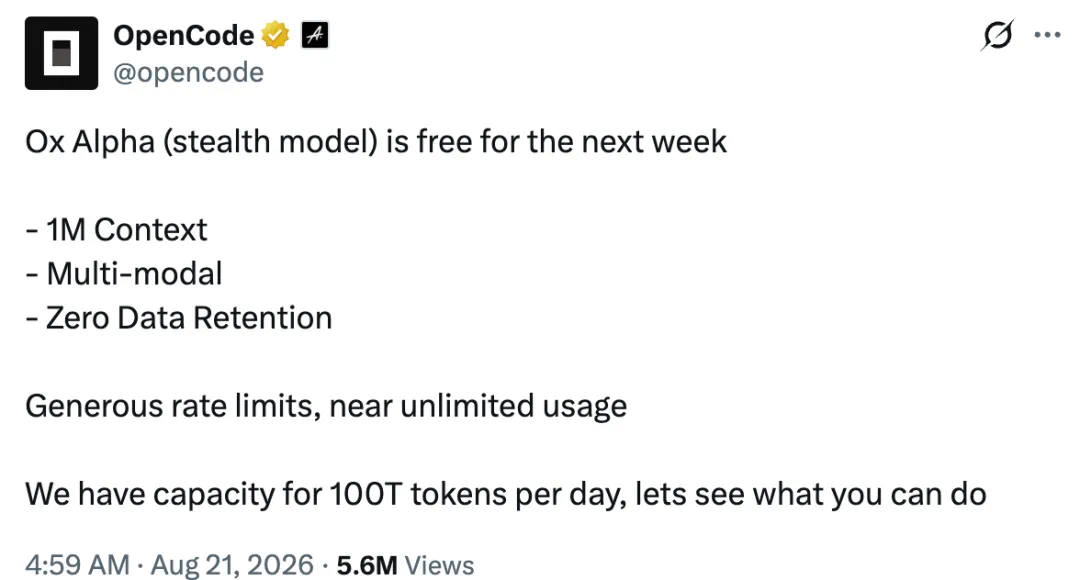
Z.ai confirms Ox Alpha is GLM-5.3 Flash, releases open weights
Z.ai confirmed that the anonymous model 'Ox Alpha', which went viral on OpenRouter, is a new iteration of its GLM series, specifically GLM-5.3 Flash, and released its weights on Hugging Face under a new license. The model, a 320B-parameter natively multimodal model running on domestic chips, topped OpenRouter's leaderboard and ended DeepSeek's 56-day streak on OpenCode. The license requires companies with over $10B in revenue to pass a security review.
9 reports · 4 sources801 points · 281 comments
Former OpenAI and Google AI leads launch Core Automation, target next-gen architecture beyond Transformer
Jerry Tworek, former OpenAI reasoning lead, and Rohan Anil, former Google Gemini pretraining lead, co-founded Core Automation, arguing that large-scale reinforcement learning has not led to AGI and that current models lack the ability to continue learning after deployment. Separately, the Shanghai AI Laboratory's Mobius team proposed a knowledge-reasoning decoupled architecture as a potential path beyond Transformer's scaling limits.

News updates every hour. Subscribe in your RSS reader to get new stories automatically.
Subscribe