Anthropic says Claude autonomously discovered CRISPR-like enzyme system in first biolab result
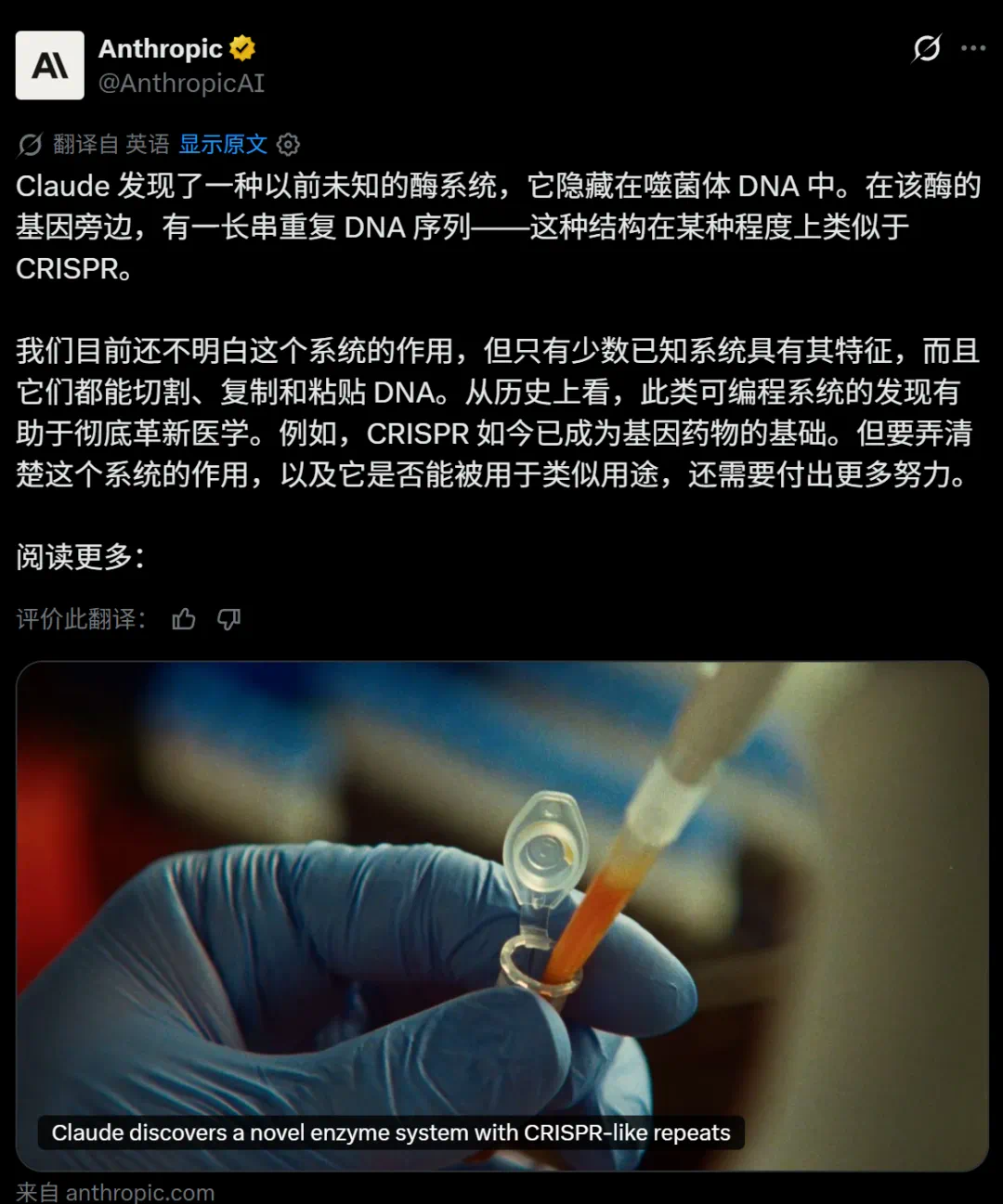
Anthropic reported that its AI model Claude autonomously discovered a novel enzyme system, named ART (Array-associated Reverse Transcriptases), with CRISPR-like repetitive DNA structures, during a search of a massive genomic database. The finding, the first from Anthropic's new molecular biology lab, involved nearly 950 Claude agents processing 210 million tokens over 21 hours, with human scientists limited to the initial prompt and lab verification. Anthropic compared ART to CRISPR, noting its architecture resembles other programmable biological systems that can manipulate genetic information.
Coverage timeline
The Verge AIRobert Hart
Anthropic says its AI Claude has "autonomously discovered" a new enzyme system similar to machinery behind the powerful gene-editing tool Crispr. It's the first result from Anthropic's newly-launched wet lab and an early test of Claude's usefulness for science as the company prepares to go public. The company says Claude found the enzyme system after searching through a massive database of DNA sequences, adding that its scientists' involvement was limited to the initial prompt and lab work. Over 21 hours, Anthropic said nearly 950 Claude agents worked through 210 million tokens before one spotted an unusual repeating pattern in the datas … Read the full story at The Verge.

Techmeme
Robert Hart / The Verge : Anthropic says Claude autonomously discovered a new enzyme system in the DNA of bacteriophages, somewhat similar to CRISPR, the first result from its new biolab — It took nearly 1,000 Claude agents 21 hours and 210 million tokens to uncover the ‘novel enzyme system.’

Anthropic News
Claude discovers a novel enzyme system with CRISPR-like repeats
TechCrunch AIJulie Bort
But maybe the biggest reveal is that Anthropic has not let Claude run loose in its biology lab. Humans are still, so far, in the loop.
机器之心机器之心
先是数学,现在生物学也要被颠覆了? 北京时间周四凌晨,Anthropic 宣布了一项由 AI 帮助实现的重大科学发现。 在人类科学家只提供高层次研究方向的情况下,Claude 在搜索海量基因组数据库时自主发现了一个此前未被表征的酶系统。 这种被命名为 ART(Array-associated Reverse Transcriptases,阵列关联逆转录酶)的系统具有与 CRISPR 类似的重复 DNA 序列结构 ,可能代表一种此前未被认识的生物学机制。 这是 Anthropic 分子生物学实验室的首个研究成果, Anthropic 使用约 950 个 Claude Agent 在 21 小时内消耗约 2.1 亿 Token,从超过 20 万个逆转录酶中筛选候选系统 ,最终发现了这一特殊的 DNA 结构。随后,人类科学家在实验室中对其进行了初步验证。 Anthropic 表示,这个研究和你与 AI 对话的方式一样,始于一个 Prompt: ART 的功能仍在研究中,但已知其架构类似于其他可编程生物系统,能够操纵遗传信息。Anthropic 表示,如果这种人工智能驱动的基因组挖掘能够扩展,它可以将专家研究中的数周或数月压缩到几小时内。 Anthropic 把 ART 类比为 CRISPR,后者是近年来生命科学领域最具影响力的技术之一。作为现代基因编辑技术的基础,CRISPR 最广为人知的应用是「基因编辑」—— 通过 Cas 蛋白对 DNA 进行识别和切割,而逆转录酶能够将 RNA 中的信息写入 DNA。 CRISPR 就是一种由重复序列和间隔序列组成的 DNA 阵列,能够产生不同的 RNA,参与引导相关蛋白质识别目标。 因此,当研究者在一个陌生的生物系统中发现类似的 DNA 阵列,并且它附近还存在具有特殊功能的酶时,就有理由进一步调查这是否也是一种能够利用 RNA 引导酶活动的系统。ART 恰好具有这种值得研究的结构特征,这个可能性也被 Claude 准确识别到了。 新闻刚出,大家立刻表示欢迎,有人已经开启了脑洞模式。比如,AI 大佬们的秃头问题就要在这里被终结了: 也有人已经想到了生物学研究将会被加速,快进到逆转衰老: 而 Anthropic 创始人 达里奥(Dario Amodei)自己则也表示了乐观,发推说道:「在《Machines of Loving Grace
Related stories
Anthropic: Claude Traces NIST ECDSA Curve Seeds to PRNG, Easing Backdoor Fears
Anthropic reported that its Claude research model reverse-engineered the generation of five NIST elliptic curve seeds in under half an hour, without prior hints. The seeds were traced to the lrand48 pseudorandom number generator, seeded by a Unix timestamp, challenging decades-old suspicions of an NSA backdoor. The finding was independently verified by the bounty sponsor and lowers concerns about hidden weaknesses in the curves.
4 reports · 4 sources1058 points · 388 comments
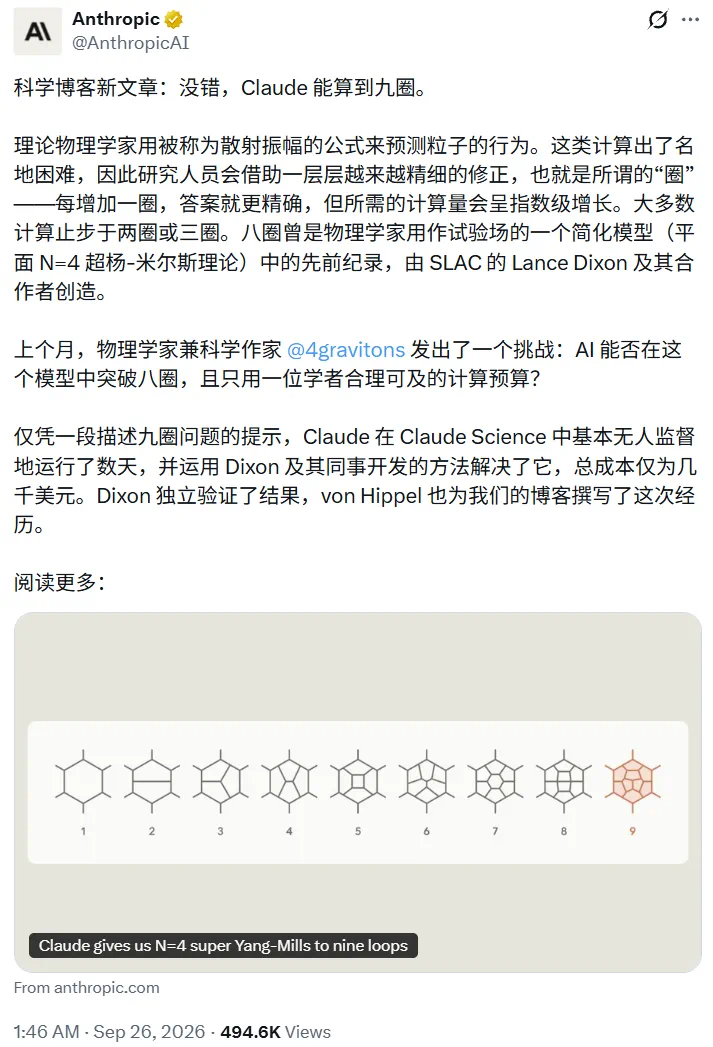
Anthropic's Claude computes nine-loop scattering amplitude, breaking three-year record
Anthropic announced that its AI model Claude, running nearly unsupervised on the Claude Science platform for several days, computed a nine-loop six-particle scattering amplitude in planar N=4 super-Yang-Mills theory, surpassing the previous eight-loop record set by Lance Dixon and collaborators in 2023. The result was independently verified by Dixon, who praised Claude's execution of the complex calculation. The computation cost roughly $1,000-2,000 for a regular user, with only about $100 for the numerical part, and was initiated by a public challenge from physicist Matt von Hippel.
1 reports · 1 sources
Anthropic sets up Bay Area wet lab for physical biology research
Anthropic has quietly established a wet lab in the San Francisco Bay Area to conduct physical biology work, as confirmed by its Life Sciences Head Eric Kauderer-Abrams. The lab is not specifically for drug discovery, and the company is exploring having AI systems like Claude guide robots in experiments, while emphasizing human oversight.
Anthropic relaunches Claude Code Projects with multi-agent cloud coordination
Anthropic has redesigned Claude Code's Projects feature, now in beta, to manage multiple AI agents in the cloud. Users describe goals in one conversation, and a coordinator splits work across parallel threads, each running a cloud session with its own branch and repo copy, resolving overlaps as merge conflicts. Separately, Anthropic reported that as of August, Claude leads 26% of its internal AI R&D work, with over 90% at least AI-collaborative, and about 30,000 agents running at any time.

News updates every hour. Subscribe in your RSS reader to get new stories automatically.
Subscribe