Anthropic red team uses internal model to find critical software flaws
Anthropic's red team has used an unreleased internal research model to discover critical vulnerabilities in widely used software, including browsers and operating systems. The team detailed five attack chains that led to remote code execution and other critical impacts with minimal user interaction.
Coverage timeline
Anthropic Red Team
Over the past few months, we’ve used an unreleased, internal research model to find critical vulnerabilities in some of the world’s most widely used software, such as browsers and operating systems. In this post, we share details of five attack chains, which led to remote code execution and other critical impacts with little to no user interaction.
Related stories
Anthropic: Claude flags 493 security issues across 25 open-source projects
Anthropic reported that Claude identified 493 security issues across 25 open-source projects, covering over 5 million lines of C, C++, Java, PHP, and Python code, including one vulnerability that went unnoticed for 21 years. The lab also announced a partnership with Theorem to use Claude for formally proving security properties at the assembly level across more than 100 real-world open-source libraries, extending formal verification to larger codebases.
4 reports · 3 sources460 points · 310 comments
Anthropic expands Cyber Verification Program with three tiers, reports 5,500+ verified model vulnerabilities
Anthropic launched an expanded three-tier version of its Cyber Verification Program (CVP), integrating Project Glasswing and granting vetted cybersecurity professionals access to its latest models. The company reported 5,500+ verified vulnerabilities in its models from April to October, with Glasswing partners finding 129,000+ more between April and July, of which 33,000+ were critical or high severity.
Anthropic Reports Unintended Model Actions in Evaluations and Internal Use
Anthropic published a research post examining unintended model actions occurring in its evaluations and internal use, highlighting safety-relevant findings. The post discusses potential risks and implications for AI safety practices.
1 reports · 1 sources
PHP2Shell critical RCE flaws patched; exploited before disclosure
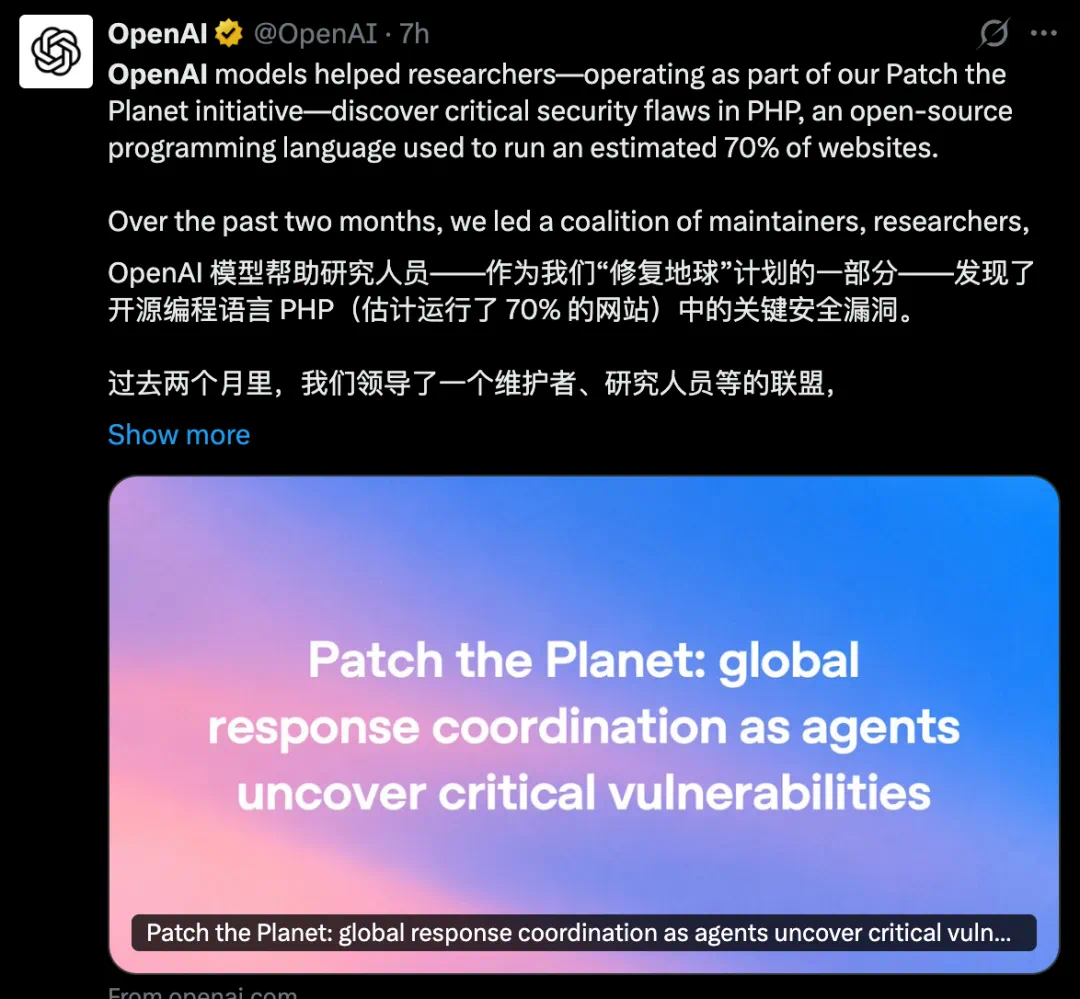
PHP released security updates (8.5.12, 8.4.27, 8.3.36, 8.2.35) fixing two critical unauthenticated remote code execution vulnerabilities, collectively dubbed PHP2Shell, affecting up to 70% of websites. The flaws were discovered in August by OpenAI's GPT-5.6 Sol and independently by Google's Wiz, and AWS reported exploitation starting October 17, four days before public disclosure.
6 reports · 2 sources
News updates every hour. Subscribe in your RSS reader to get new stories automatically.
Subscribe