Redwood Research: Gemini 4 safety reports fail to show low loss-of-control risk
Redwood Research published a critique arguing that Google DeepMind's safety reports for Gemini 4 models Argon and Carbon do not demonstrate low loss-of-control risk. The critique notes that DeepMind's conclusion relies on control techniques rather than alignment, and that no control evals were run on Carbon, with Argon's monitor-evasion results reused despite Carbon being called the strongest model.
Coverage timeline
Redwood ResearchAlek Westover
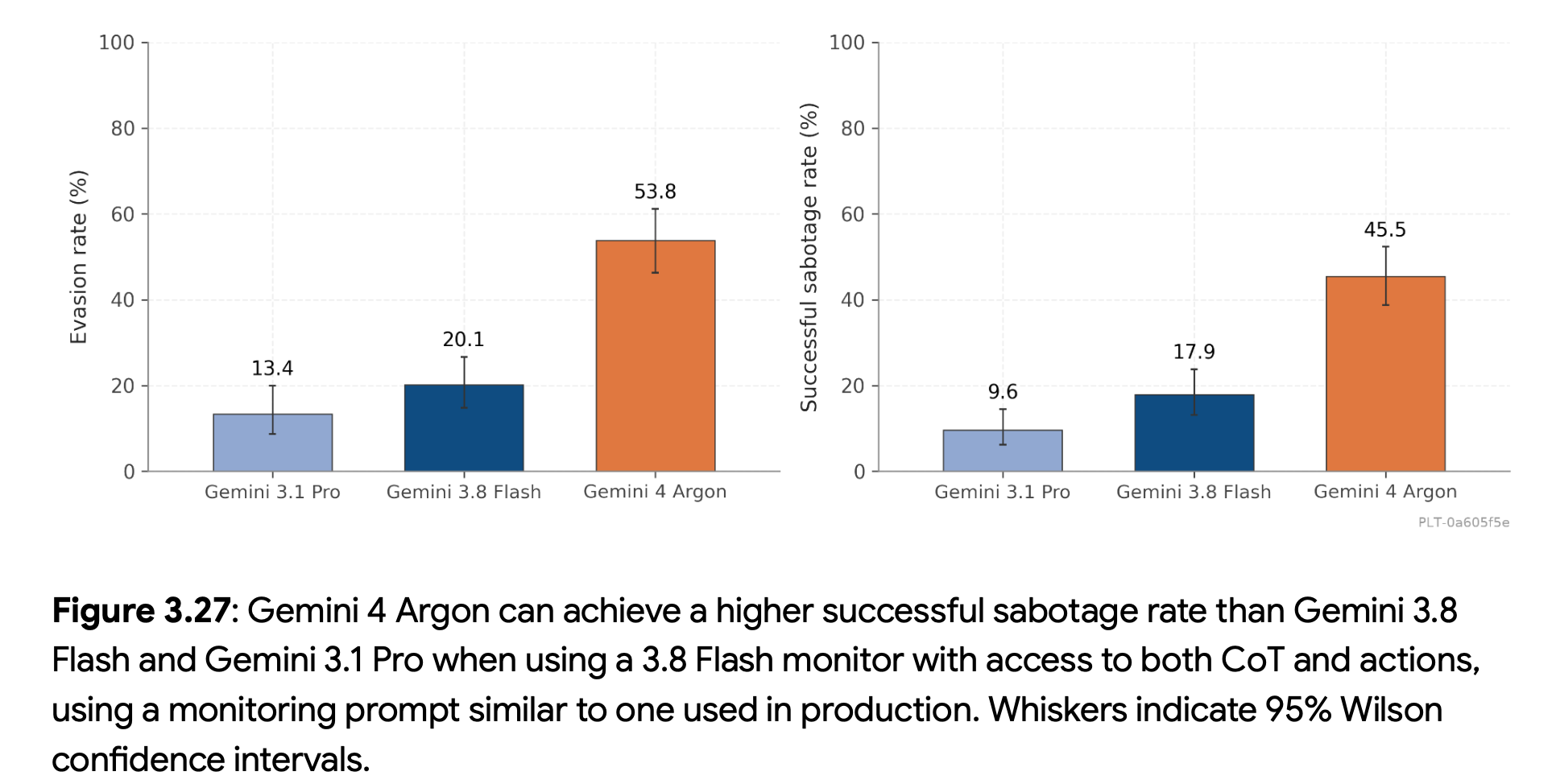
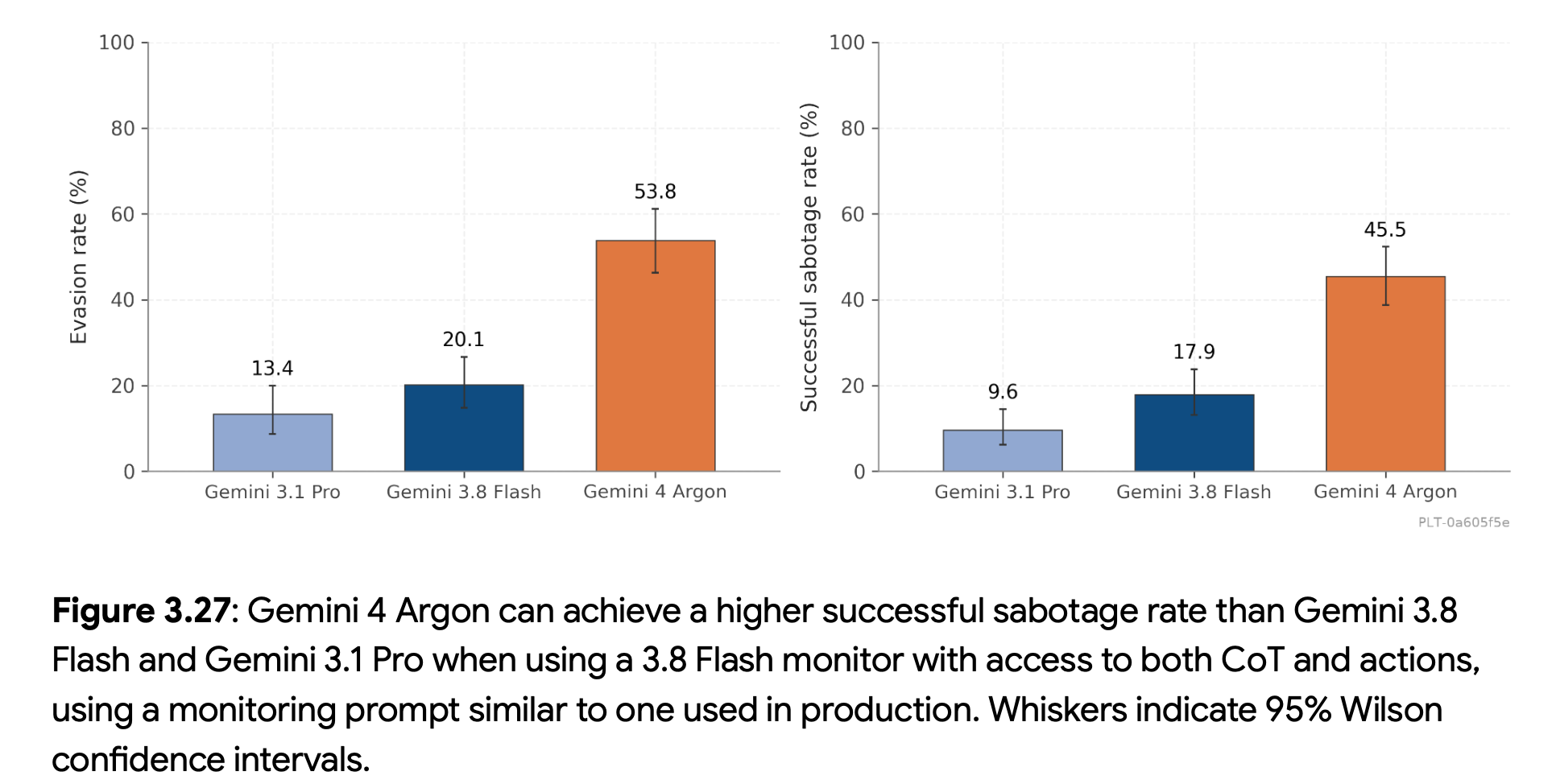
Google DeepMind’s safety reports for new Gemini 4 models, Argon and Carbon , conclude that the models are “highly unlikely” to cause severe harm by evading oversight (p. 79). This conclusion “rests primarily on our ability to detect and intervene on harmful trajectories via CoT and action monitoring” (p. 89) – that is, they’re arguing for safety based on their control techniques, rather than alignment. We think that the arguments in these reports have serious weaknesses, and the reports overall don’t convince us that the risks of deploying these models have been mitigated reliably. The biggest problems: GDM didn’t run any control evals on Carbon. Despite calling Carbon “our strongest model” with “significant gains across coding and agentic tasks” and “a significant leap in cybersecurity capabilities” in their launch post , GDM reused Argon’s monitor-evasion results on the grounds that Carbon “did not show meaningful new capabilities” (Carbon p. 42). Monitors flag Carbon several times l
Related stories
Google launches Gemini 4 Carbon to public, adds swarm feature in Antigravity
Google DeepMind has made Gemini 4 Carbon, its self-described strongest model, available to the general public via consumer, developer, and enterprise channels, two weeks after an initial release to cybersecurity defenders. The model is priced at $2 per million input tokens and $10 per million output tokens, with a scheduled increase to $4/$20 on December 1st. Google also previewed a 'swarm' feature in its Antigravity IDE, and highlighted a research case where Carbon-powered agents formally verified Signal's encryption code.
6 reports · 6 sources295 points · 165 comments

Google DeepMind unveils Gemini 4 Carbon, tops AI benchmark
Google DeepMind announced Gemini 4 Carbon, its next frontier model, claiming state-of-the-art performance in cybersecurity and long-horizon tasks. The model scored 59 on the Artificial Analysis Intelligence Index v5.0, ranking first ahead of Claude Opus 5.5 (58) and GPT-6 Astra (57). It is initially available only to select cybersecurity defense companies through the Fairwind program, with pricing at $2 per million input tokens and $10 per million output tokens, rising to $4 and $20 later.
8 reports · 6 sources1013 points · 801 comments

Redwood Research Questions Whether DeepMind Trains on Chain-of-Thought
Redwood Research has flagged an ambiguous passage in the Gemini 4 Safety report that appears to mention training on chain-of-thought, citing a paper by Kaufmann et al. (2026) to assess risks. The organization expresses uncertainty about DeepMind's intentions and notes disagreements with the cited paper's conclusions.
Google launches Gemini 4 Hydrogen, a low-cost agentic model, across products
Google announced Gemini 4 Hydrogen, a new Flash-level multimodal model with a 1M token window, priced at $1.50/1M input and $7.50/1M output tokens. It is available across AI Studio, the Gemini API, Search, the Gemini app, and Antigravity, and introduces an xhigh reasoning level. Benchmarks show it nearly ties Claude Sonnet 5.5 and GPT-6.1 Sol on the Artificial Analysis Intelligence Index at lower cost, and it powers an upgraded AI Mode in Search.
9 reports · 6 sources570 points · 352 comments

News updates every hour. Subscribe in your RSS reader to get new stories automatically.
Subscribe