Channel Specialization in Hybrid Architectures: Attention Retrieves, Recurrence Shapes Language
Highlights of This Issue
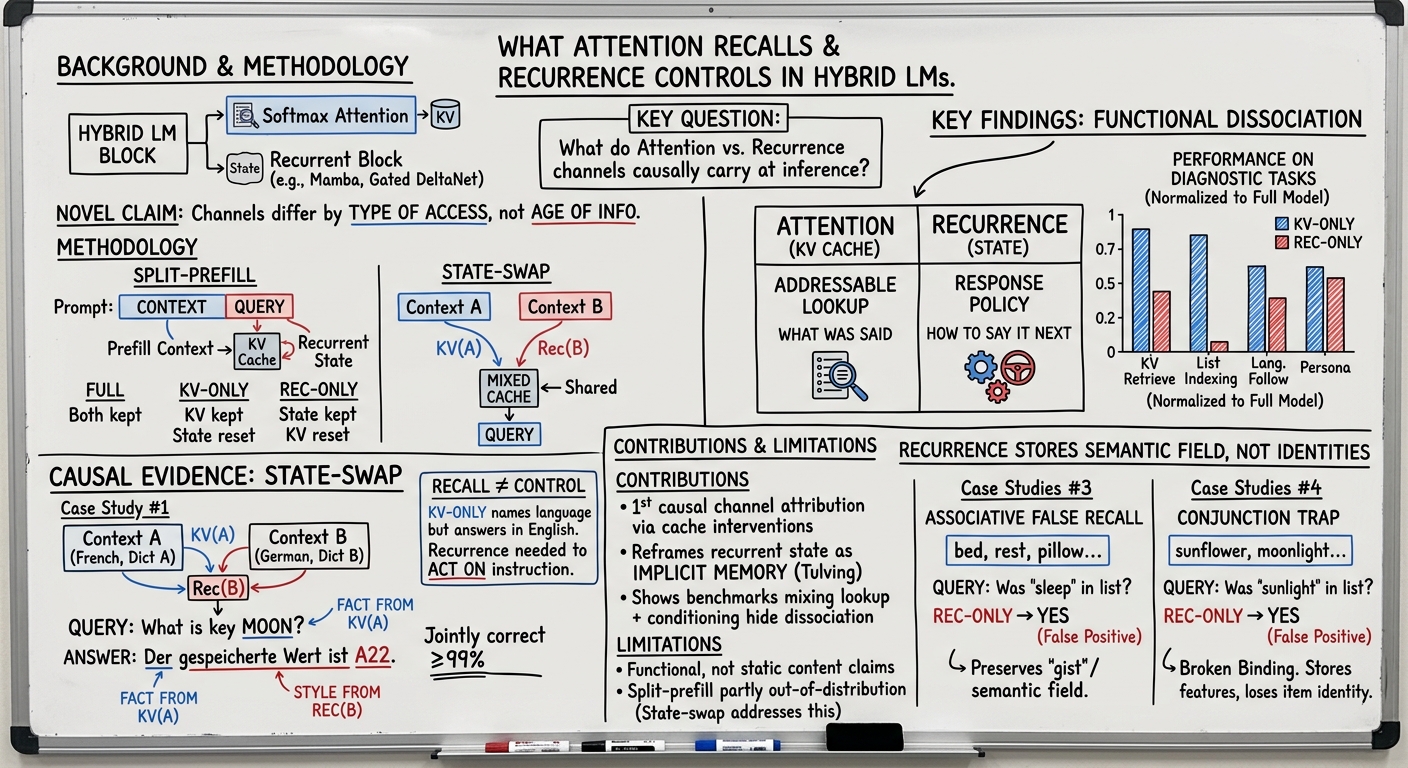
The strongest signal this issue comes from direct causal evidence on channel specialization in hybrid architectures. What Attention Recalls and Recurrence Controls in Hybrid Language Models uses two cache-level interventions, split-prefill and state-swap, on trained Qwen3.5 and Falcon-H1 to fully separate the functions of attention and recurrent channels: precise retrieval survives only through the KV cache (64-98%), while output language and persona survive only through the recurrent state (70-80%). State-swap further demonstrates that answer values come from the KV side, while language comes from the recurrent side. This directly challenges the temporal framework that "recurrent states are short-term buffers"—the functional dichotomy is not about information age but about access type—and advances the frequency-axis intervention from Issue 4's 'Implicit Hybrids' to channel-level causal exchange.
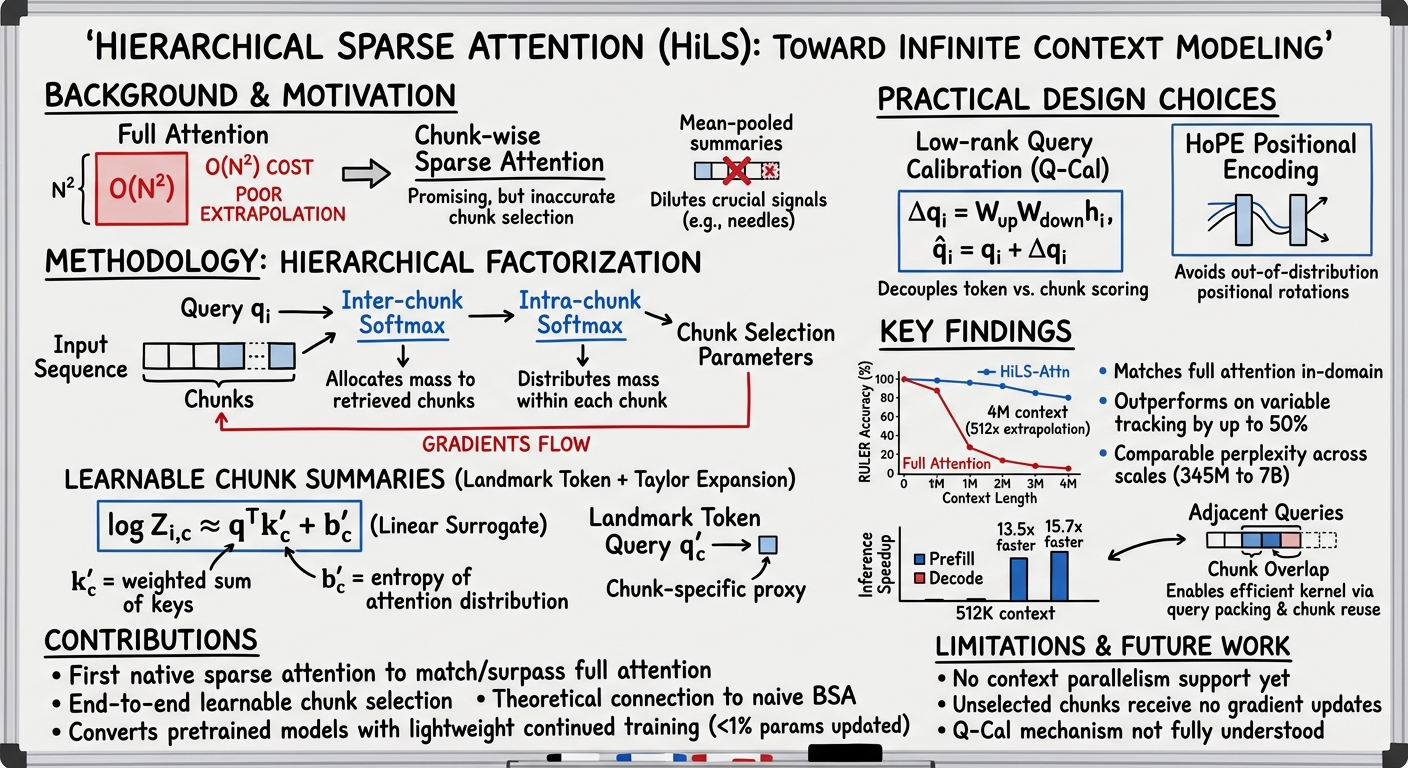
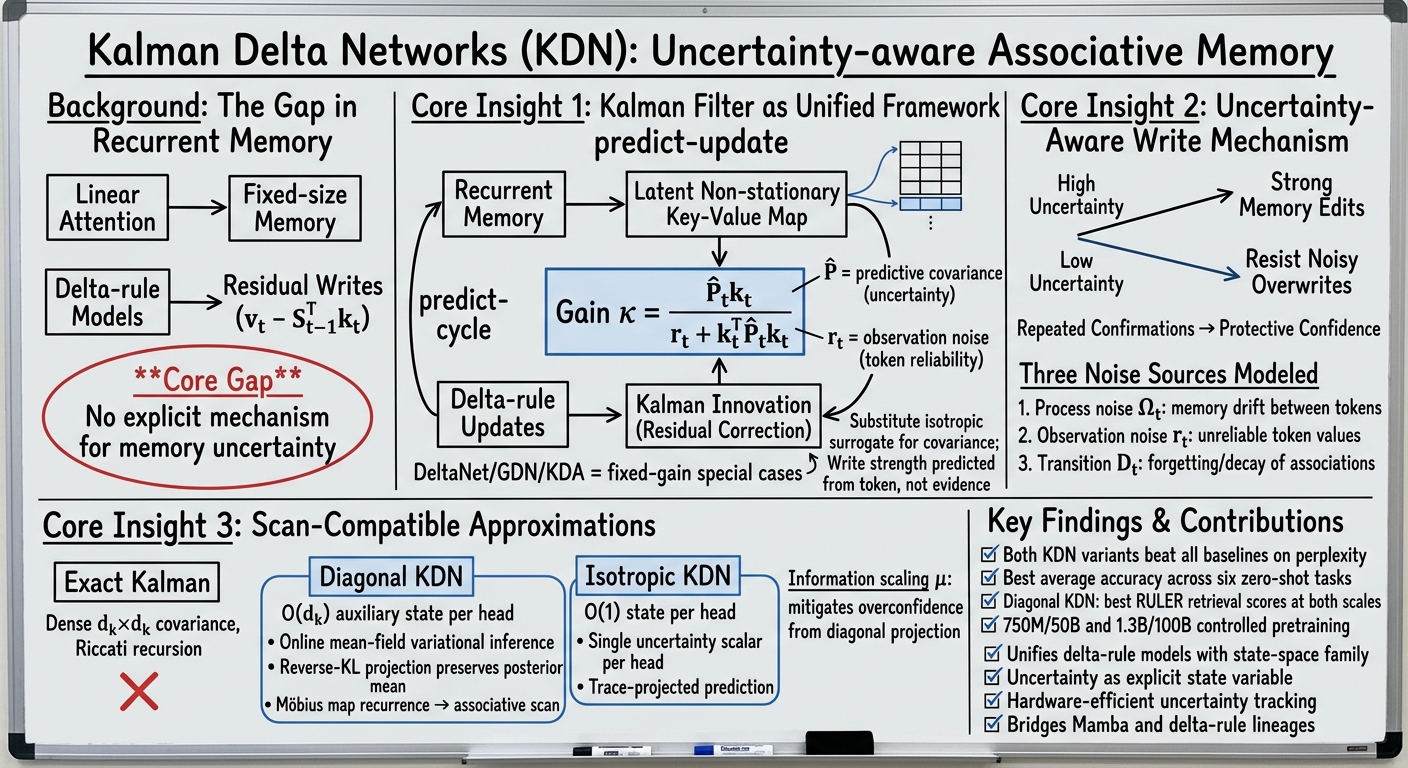
Trainable sparse indexers and hybrid architecture design axes continue to advance. HiLS: Hierarchical Sparse Attention Done Right is the first to advance the chunk summary for block-sparse selection from mean-pooling to a learnable form aligned with the first-order Taylor expansion of LogSumExp chunk mass, and uses hierarchical softmax to make selection scores directly supervised by the LM loss, addressing the insufficient alignment between the indexer and the main attention distribution. Morphing into Hybrid Attention Models advances layer selection for Transformer-to-hybrid conversion from heuristics to budget-constrained joint gating optimization, reducing selection cost to 20M tokens. Kalman Delta Networks reframes delta-rule linear attention as a linear-Gaussian state-space model, using covariance propagation to explicitly track memory uncertainty, so that the gain of each write is determined by cumulative evidence rather than the current token.
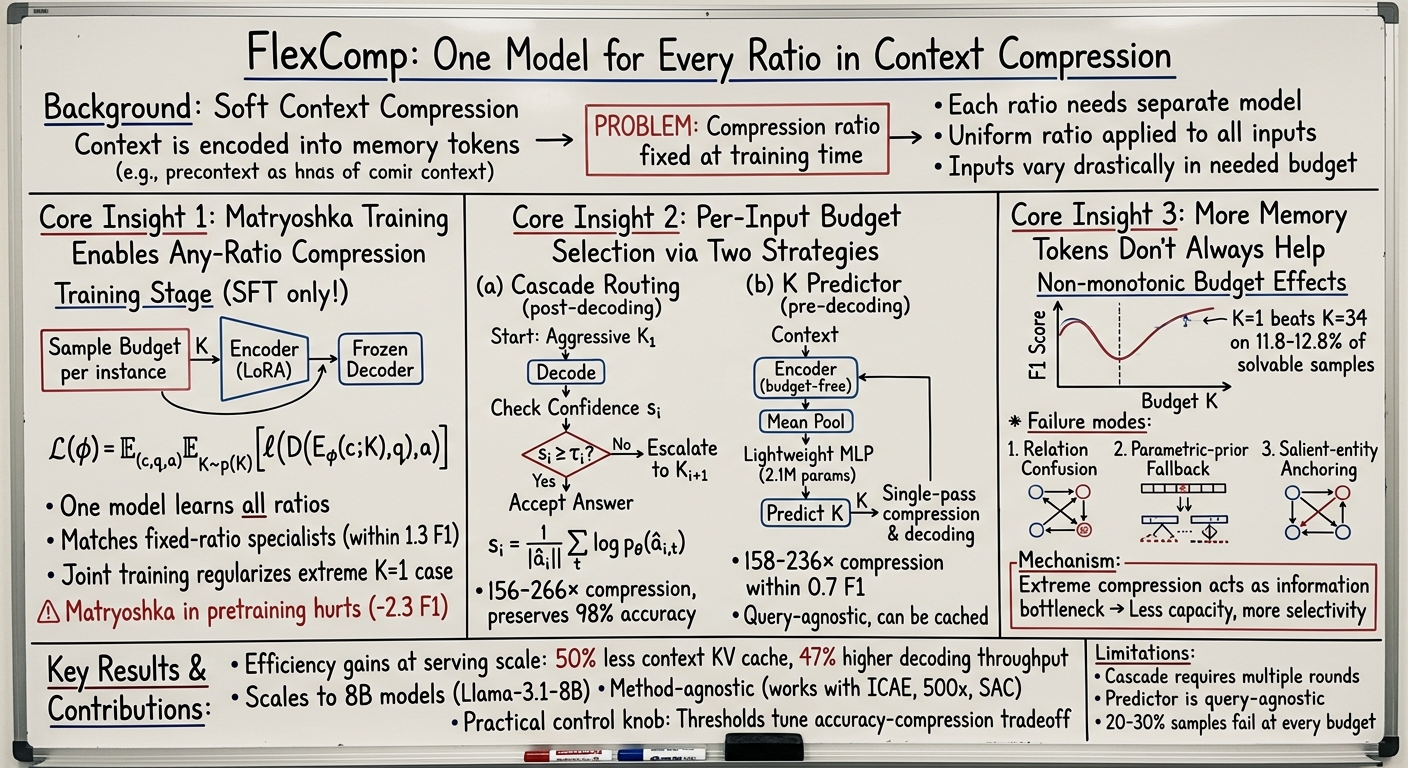
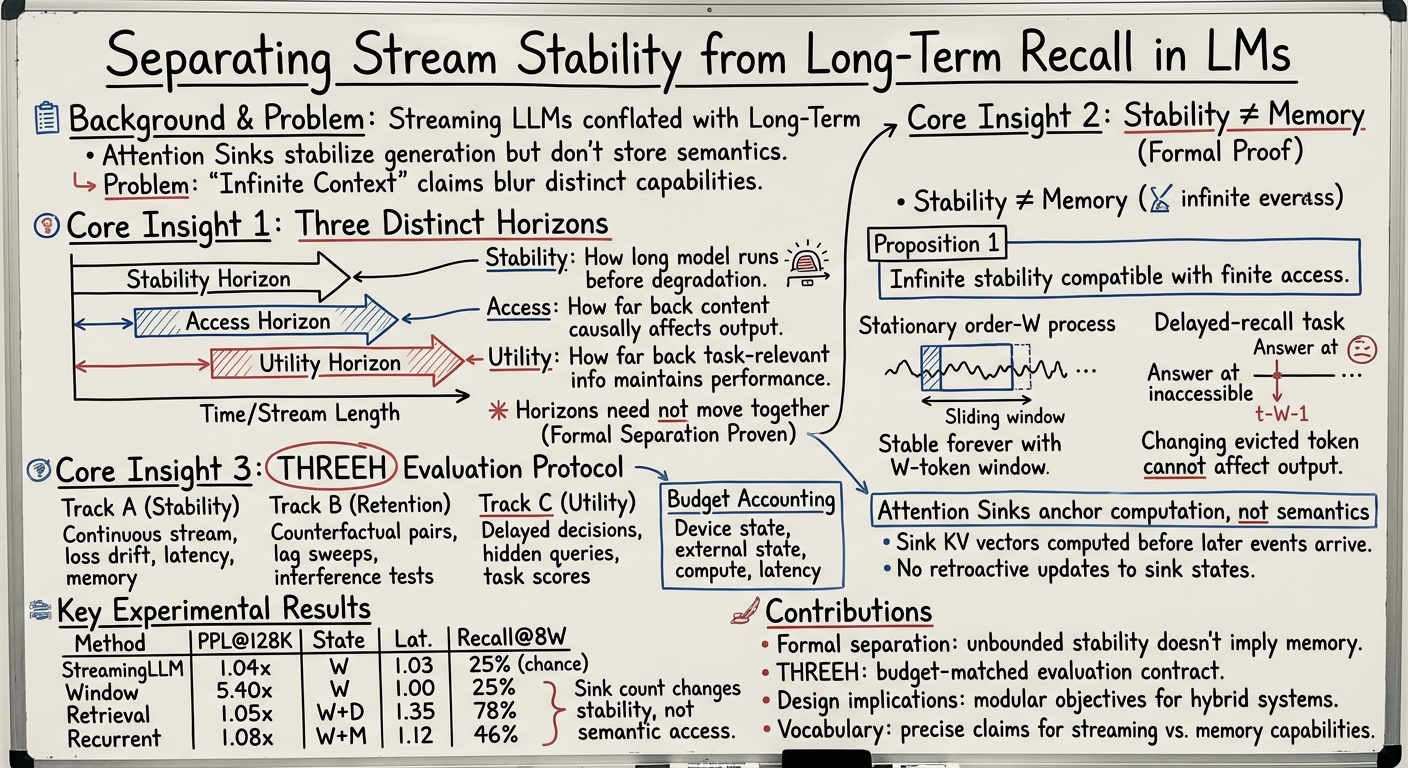
On the compression and evaluation validity side, FlexComp introduces Matryoshka representation learning to soft context compression, transforming a fixed-compression-ratio model into a single arbitrary-compression-ratio model, and systematically demonstrates budget non-monotonicity. Separating Stream Stability from Long-Term Recall provides a constructive proof that attention sinks can make the stability horizon infinite while access and utility horizons remain finite, drawing a boundary of "infinite context ≠ memory" for any sink-based streaming design.
Community and Developments
Open-source frontier models have pushed several design axes in this direction to production scale. Kimi K3 uses a 3:1 interleaved KDA and Gated MLA layer structure with a 1M token window, engineering attention sink/recency handling into a trainable Attention Residuals mechanism—sinks evolve from emergent artifacts into design features. GLM-5.2's IndexShare lets a single sparse indexer serve four layers, reducing per-token FLOPs by 2.9× at 1M context, corroborating the cross-layer index reuse route from Issue 1's 'You Only Index Once', and the official acknowledgment that this is not end-to-end acceleration is an important negative record against misreading FLOPs as throughput.
On the evaluation validity side, The Sparse Frontier is the largest compute-matched study of training-free sparse attention to date (six methods, up to 128K, 0.95 sparsity), showing that longer sequences tolerate higher sparsity and that single-needle/single-QA metrics mask aggregation and multi-hop failures—consistent with this issue's preference for real degradation curves. Retrieval Heads are Dynamic delivers a negative result that directly impacts static retrieval-head-based KV compression schemes: retrieval heads change dynamically across time steps and cannot be replaced by static heads, so static average-importance pruning risks discarding long-tail critical heads.
Open Questions
- The channel-level functional separation (What Attention Recalls) is an inference-time observation on trained models—if interventions are applied to the recurrent state during training, does the "attention retrieves, recurrence shapes language" division still hold? Can this division in turn guide the design of inter-layer ratios?
- The covariance tracking in Kalman Delta Networks changes write gains from current-token prediction to cumulative-evidence derivation—how will this uncertainty mechanism interact with the layer-wise organization of massive activations from Issue 3? Does explicit uncertainty change the spike/plateau morphology under hybrid ratios?
- HiLS makes selection scores differentiably affect attention outputs—compared to serving only as a routing signal, does the gain from end-to-end supervision come from better chunk summary alignment or from training stability? Can it be combined with the second-order cumulant selector from Issue 2's COBS?
- The budget non-monotonicity of FlexComp (larger budgets retaining misleading surface details can be worse) is currently only validated on MRQA—does this information bottleneck effect also appear on RULER/HELMET-style long-context benchmarks, or is it masked by retrieval-type tasks?
Papers in this issue
In hybrid language models, attention's KV cache enables exact item retrieval while the recurrent state controls output language and persona, revealing a functional dissociation.
Editor's noteFirst to use split-prefill and state-swap, two cache-level interventions, to causally separate the functions of attention and recurrent channels in trained hybrid LLMs (Qwen3.5, Falcon-H1): precise retrieval survives only through the KV cache (64-98%), while output language/persona survives only through the recurrent state (70-80%). State-swap proves that answer values come from the KV side, while language comes from the recurrent side. Relative to Issue 4's 'Modern Transformers Are Implicit Hybrids' frequency-axis intervention, it advances the functional dichotomy to channel-level causal exchange and reveals that recurrent states produce associative and conjunctive false memories. Anyone doing prior research on hybrid architecture layer ratios or efficient attention optimization should read it.
HiLS-Attention achieves 512x length extrapolation and 15x speedup via hierarchical softmax and learnable chunk summaries optimized end-to-end.
Editor's noteAdvances the chunk summary for block-sparse selection from mean-pooling to a learnable form aligned with the first-order Taylor expansion of LogSumExp chunk mass, and uses hierarchical softmax to make selection scores directly supervised by the LM loss, addressing the insufficient alignment between the indexer and the main attention distribution. Relative to Issue 1's MiniMax Sparse Attention per-group block-level top-k and Issue 2's COBS second-order cumulant selector, its increment is providing a mathematically aligned form for chunk summaries and making selection differentiably affect outputs. Provides compute-matched comparisons at 345M/1.4B/7B, degradation curves for 8K training with 4M extrapolation, and necessary ablations for HoPE/landmark.
Kalman Delta Networks reformulate delta-rule associative memory as a Kalman filter that tracks uncertainty, outperforming linear-attention baselines in perplexity and retrieval.
Editor's noteReframes delta-rule linear attention as a linear-Gaussian state-space model, using covariance propagation to explicitly track memory uncertainty, so that write gains are derived from cumulative evidence and observation noise rather than current-token prediction. Diagonal/Isotropic scan-compatible approximations reduce the uncertainty recursion to Möbius maps. Relative to DeltaNet/Gated DeltaNet/KDA and Preconditioned DeltaNet, it is the first to add the missing confidence state variable to delta rules. Provides compute-matched comparisons at 750M/1.3B against KDA, Mamba-3, and GDN-2, plus RULER degradation curves—a new principle axis for hybrid linear attention design.
FlashMorph converts Transformers to hybrids via budget-constrained joint optimization of layerwise gates, achieving perfect 256K retrieval with 20M tokens and 2.81x prefill speedup.
Editor's noteAdvances Transformer-to-hybrid layer selection from heuristics (fixed patterns, per-layer scoring) to budget-constrained joint gating optimization: on a morphable model, freeze weights and optimize only per-layer gates, using linearized regularization to capture inter-layer dependencies and redundancy. Relative to Issue 4's 'Modern Transformers Are Implicit Hybrids' head-granularity design principles, its increment is making layer selection itself a differentiable joint optimization problem, reducing selection cost to 20M tokens (11.7× lower than HALO). Provides RULER/NIAH degradation curves and compute-matched comparisons across 0.6B-30B with multiple linear attention variants.
FlexComp enables one model to compress contexts at any ratio via Matryoshka training, with per-input budget selection preserving accuracy at up to 266x compression and 47% higher throughput.
Editor's noteFirst to introduce Matryoshka representation learning to soft context compression: during training, sample memory budget K per instance, transforming a fixed-compression-ratio compressor into a single arbitrary-compression-ratio model, with confidence-cascade routing and a lightweight K predictor as two inference-time budget selection strategies. Relative to Issue 4's 'Still' amortized synthetic compression, its increment is decoupling the compression ratio itself from a training/deployment constant into a learnable free variable, and systematically demonstrating budget non-monotonicity (larger budgets can hurt performance by retaining misleading surface details). Provides compute-matched comparisons across three compressors and 1B/8B scales, but evaluation is limited to MRQA.
Streaming stability and long-term memory are separate capabilities, proven by horizon-separated evaluation where attention sinks stabilize perplexity but fail to extend semantic recall beyond the active window.
Editor's noteSeparates stability horizon, access horizon, and utility horizon into three independent concepts, and constructively proves that the stability horizon can be infinite while access and utility horizons remain finite—attention sinks stabilize the stream without extending semantic access. Relative to Issue 4's 'Benchmarking the Residual' long-range task diagnostics and Issue 3's 'Distractor-Aware Truncation' truncation protocol, it specifically targets sink-based streaming systems, providing counterfactual retention protocols to prevent fluent guessing from masquerading as memory. A key warning of "infinite context ≠ memory" for any researcher doing sink-based streaming, KV compression, or hybrid architectures.
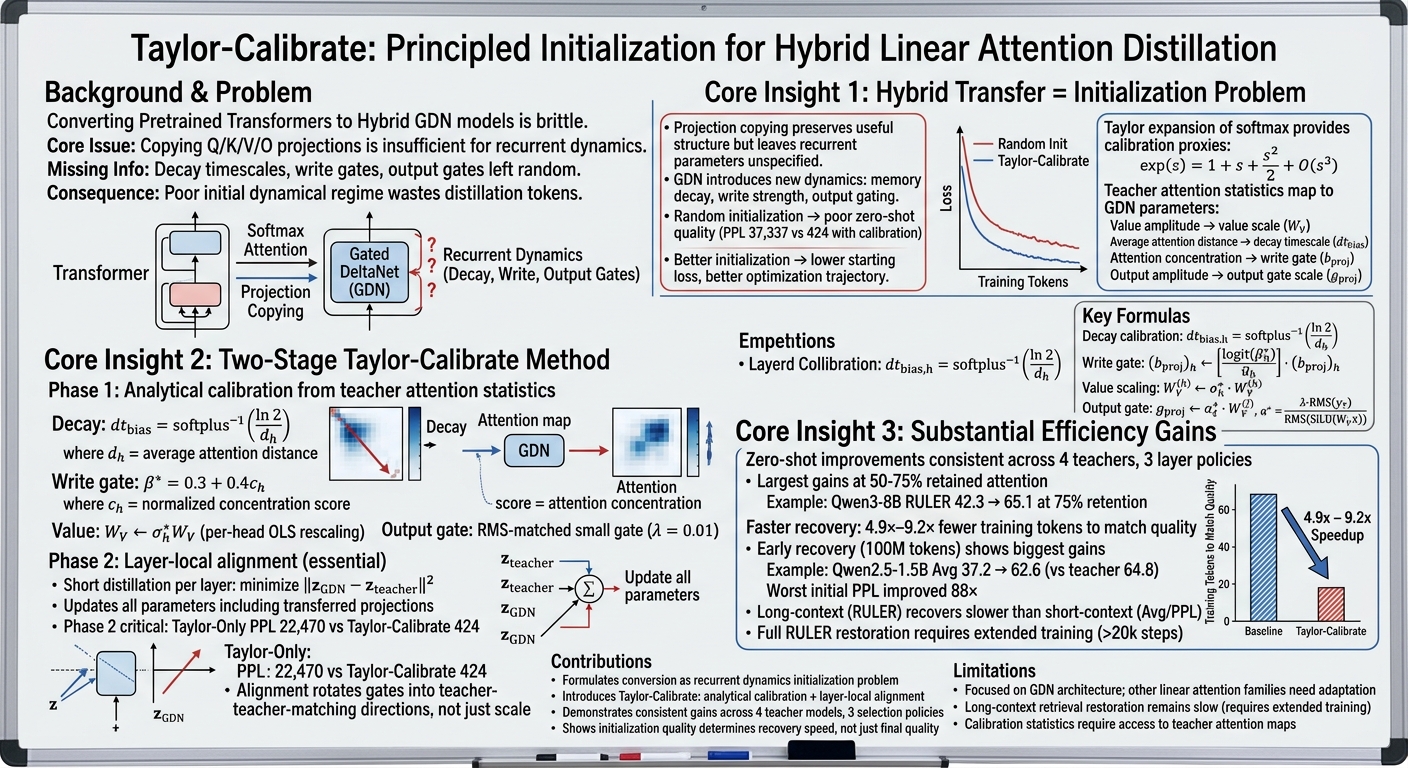
Taylor-Calibrate initializes Gated DeltaNet hybrid layers from teacher attention statistics, cutting distillation tokens 4.9x-9.2x while matching transformer quality.
Editor's noteAdvances the conversion of pretrained Transformers into hybrid Gated DeltaNet students from projection copying to an initialization problem for the new recurrent dynamics (decay, write gate, output gate), using Taylor-expanded teacher attention statistics (average attention distance, entropy, output magnitude) to analytically derive initialization, followed by short layer-local alignment. Relative to Issue 2's 'Priming' layer selection and weight transfer, its increment is first addressing the initialization of the recurrent parameters themselves, a neglected critical factor. Provides compute-matched comparisons and long-context RULER trajectories, directly relevant to those doing hybrid conversion/distillation.