Cross-Layer Reuse and Spectral Reparameterization: Efficient Sequence Modeling Toward Serving
Highlights of This Issue
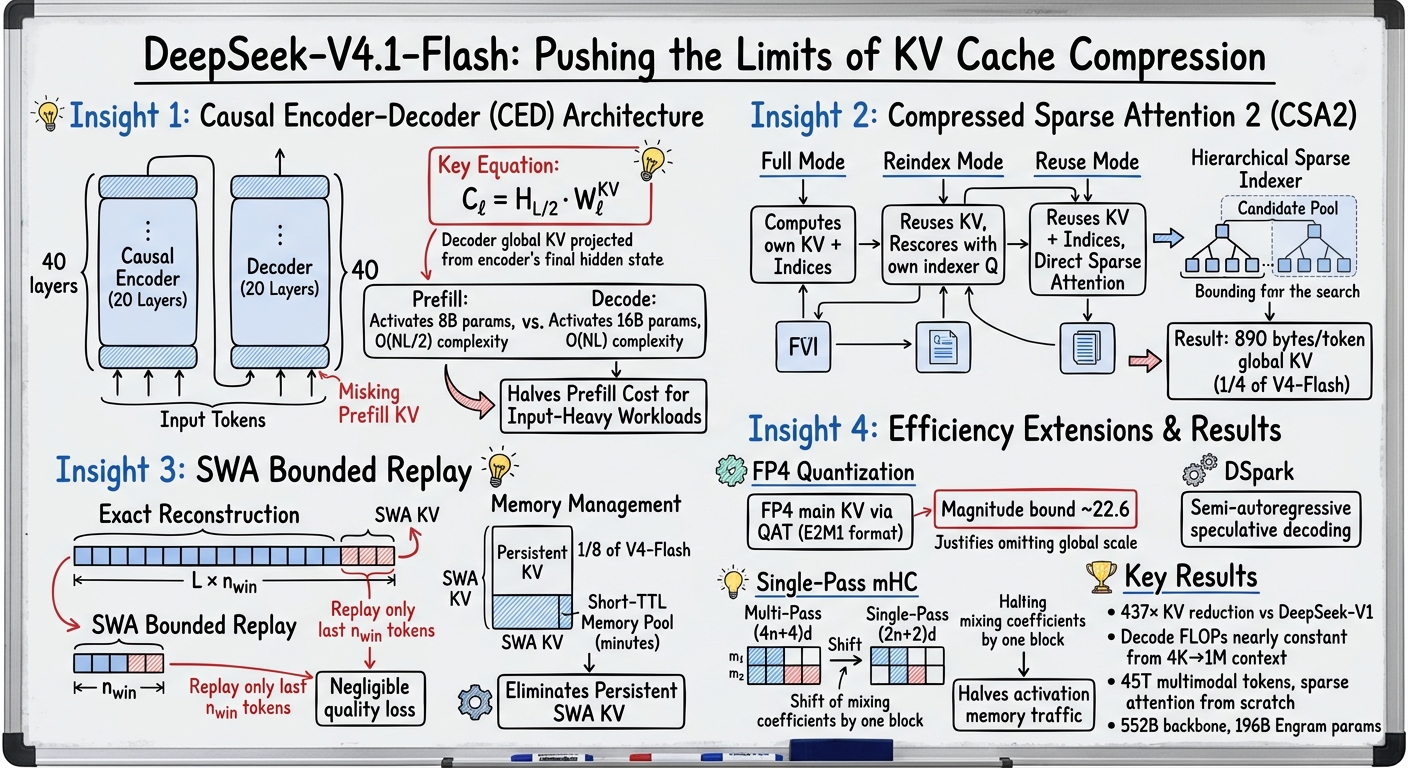
The strongest signal this issue is that cross-layer KV and index reuse has moved from research prototypes to production-grade instantiations. DeepSeek-V4.1-Flash's CSA2 is the first to jointly cover the three multiplicative dimensions of KV compression (entry size, sequence, and layers): through three static modes—Full/Reindex/Reuse—it simultaneously shares the main KV, indexer K, and Top-K indices, paired with a Hierarchical Sparse Indexer that lets the first Full layer construct the candidate pool, decoupling the per-query scoring cost of subsequent Reindex layers from context length. This directly responds to the 'You Only Index Once' cross-layer index reuse route from Issue 1, but advances it into a complete design that decouples cache sharing from index reuse, compressing global KV to 890 bytes per token at 552B parameters and 1M context. Notably, its efficiency claims are mostly system-level rather than compute-matched scientific comparisons, and long-context degradation evidence relies mainly on LongBench-V2—this is the judgment boundary to keep in mind when reading.
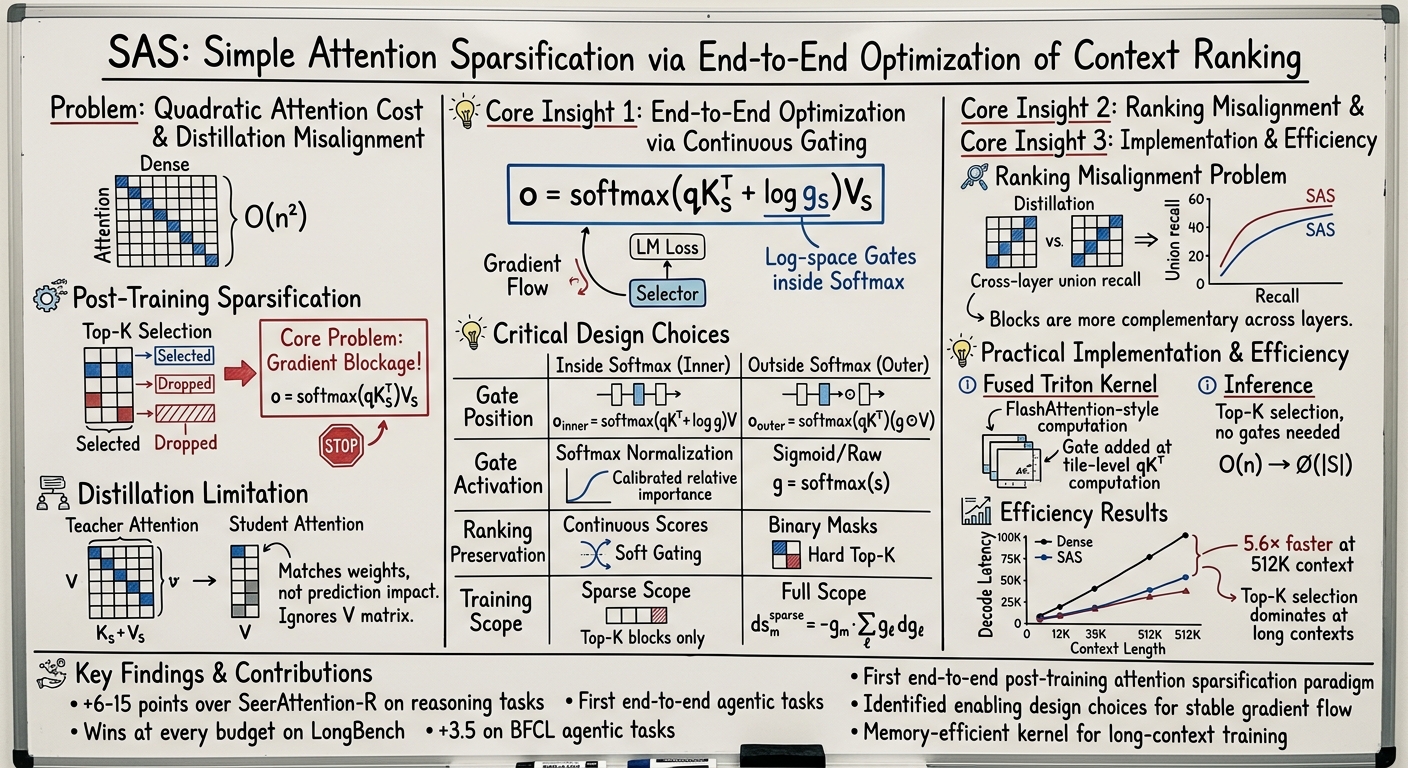
A key turn has emerged in the route of aligning indexers with main attention. SAS abandons layer-wise dense attention distillation, instead injecting the selector's continuous scores into the attention softmax via a log-space gate, allowing the LM loss to backpropagate directly to the selector—and identifies four design choices (gate position, activation normalization, ranking preservation, and training scope) that make this simple relaxation work. It finds that end-to-end training reduces per-layer attention quality coverage but increases overlap with cross-layer and full-attention oracles, contrasting with HiLS from Issue 5's differentiable selection: HiLS uses hierarchical softmax to let selection scores be supervised by the LM loss, while SAS achieves the same end-to-end goal via log-space gate injection, but explicitly compares the ranking misalignment issue of distillation supervision.
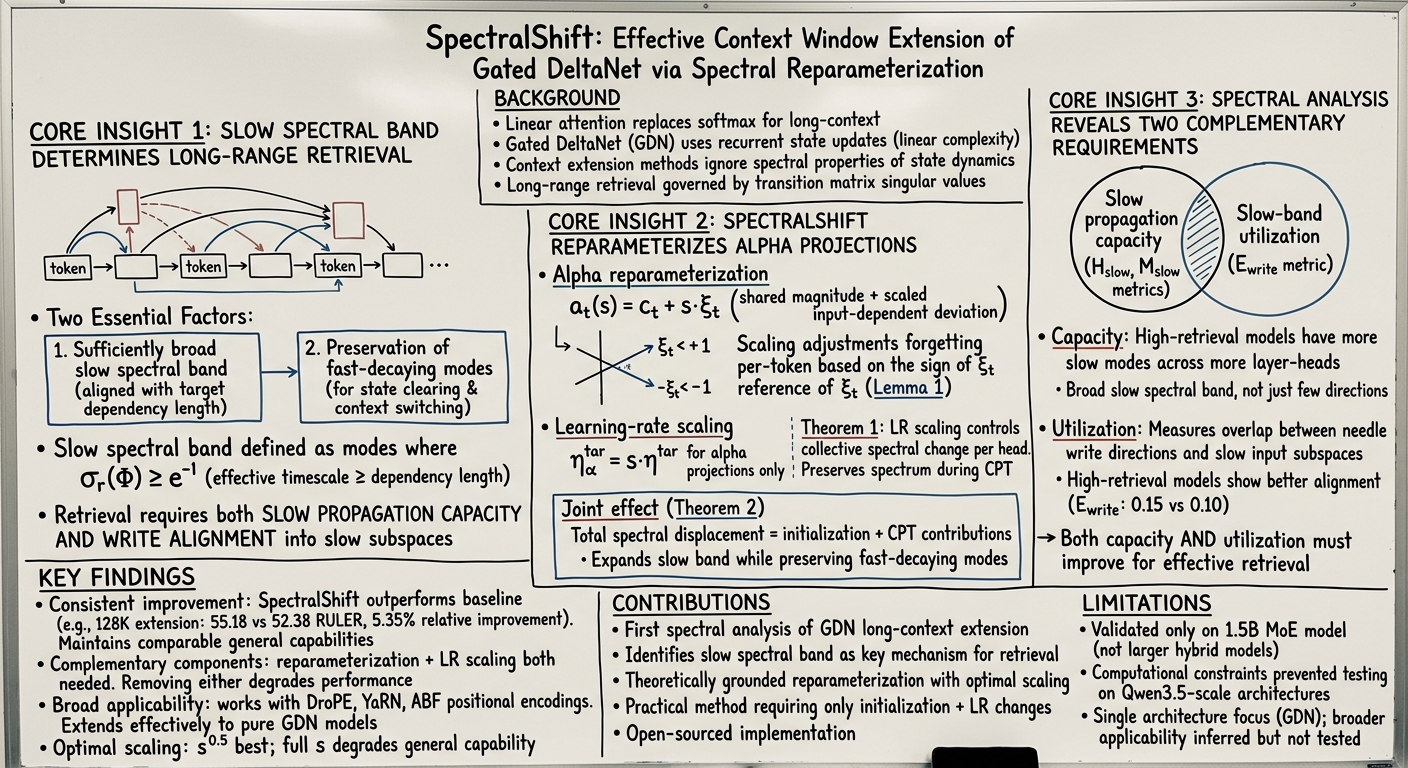
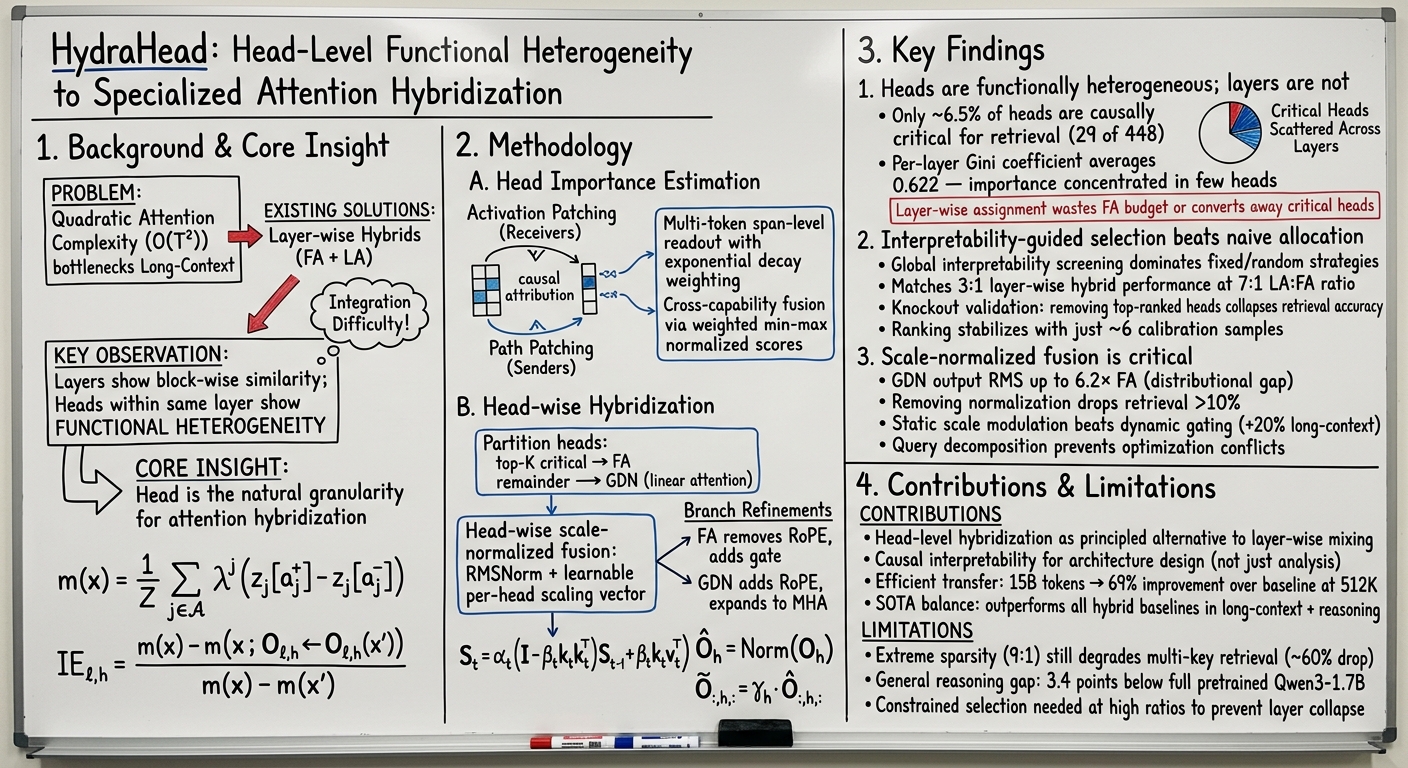
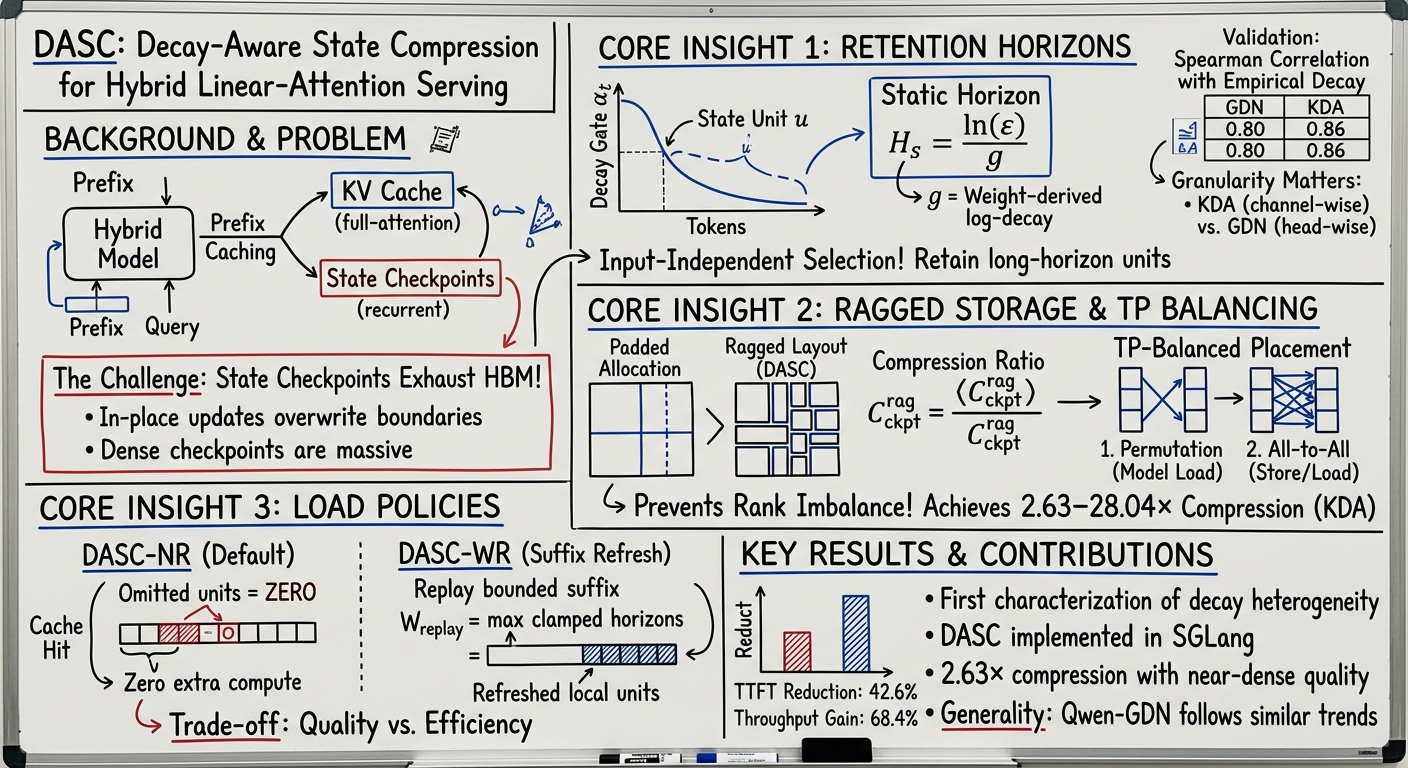
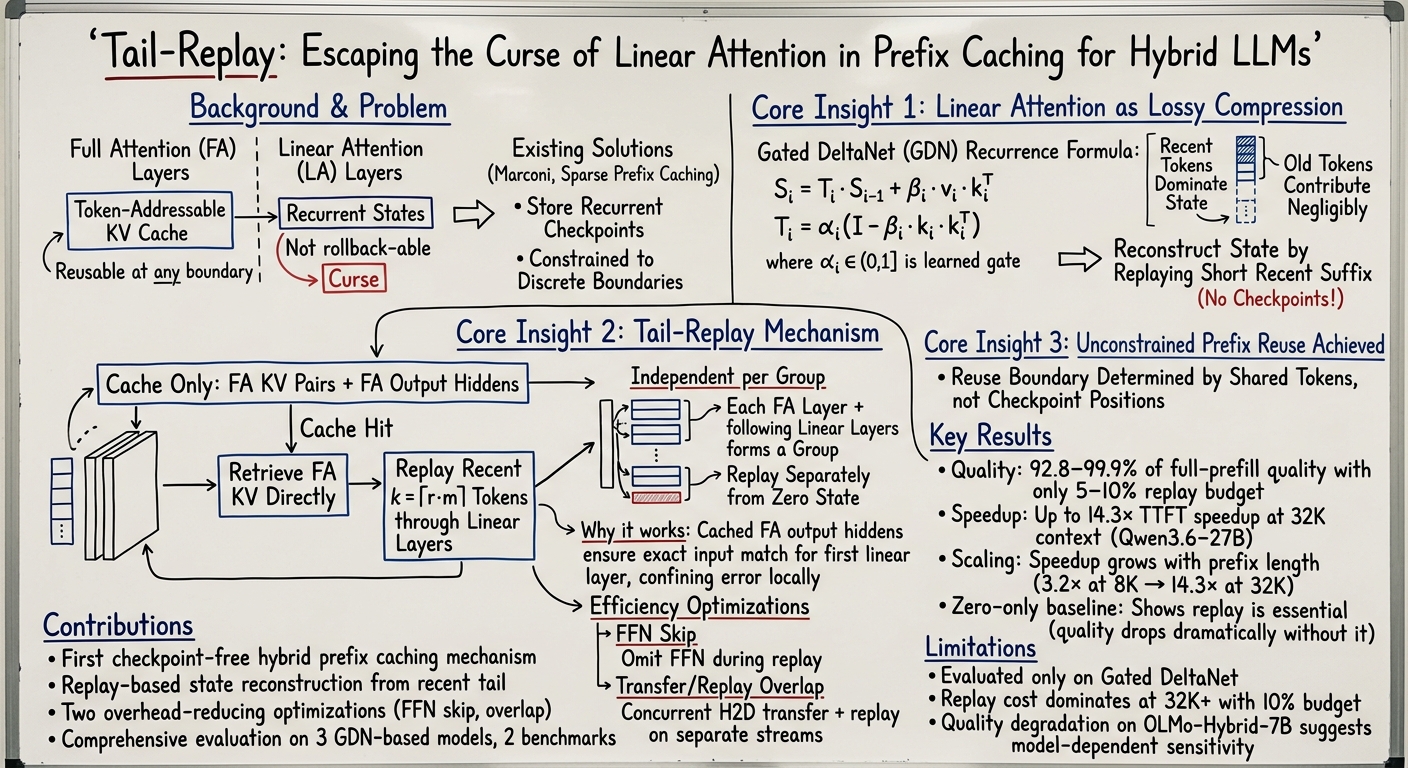
Hybrid architectures and serving-time optimizations each advance a new axis. SpectralShift is the first to formalize Gated DeltaNet's long-context extension as spectral reparameterization of the transition matrix—scaling the deviation of the alpha projection around the global mean to widen the slow spectral band, paired with learning-rate scaling specific to the alpha projection, turning context extension from 'direct CPT + positional encoding scaling' into a spectral initialization plus training-time spectral preservation problem. HydraHead advances FA/LA mixing from layer granularity to head granularity, using interpretability-driven head selection to retain FA only for retrieval-critical heads, matching the long-context performance of 3:1 layer-level mixing at a 7:1 LA:FA ratio. On the serving side, DASC and Tail-Replay address the prefix cache bottleneck of hybrid models from state checkpoint compression and 'replaying a short suffix to reconstruct recurrent state' perspectives, respectively.
Community and Developments
There are noteworthy practical advances in indexer engineering and long-context extension. MiniMax Sparse Attention official source code implements indexer alignment plus warm-up as reproducible PagedTensor prefill and FP8/FP4 decoding kernels, serving as the engineering reference implementation for the Issue 1 MSA paper, facilitating compute-matched comparisons with full attention. From 128K to 4M provides a single-step CPT recipe (YaRN RoPE scaling + special document separators) extending Llama-3.1-8B to 4M context, explicitly reporting short-context preservation on RULER/LV-Eval/InfiniteBench rather than just needle-in-a-haystack scores—but the abstract lacks compute-matched comparisons, so its 'preservation' claims should be treated cautiously.
Two open-source projects on the serving side supplement the evidence base in this direction. xKV proposes grouped-layer joint low-rank decomposition of KV caches with selective reconstruction at decode time, advancing cross-layer subspace sharing to the compression axis; mamba-hybrid-lm performs compute-matched ratio scans of 1:3/1:7/1:15 for Mamba-2/attention hybrids at ~50M scale, reporting perplexity, throughput, and KV cache trade-offs—though limited in scale, it provides a reproducible methodological template for inter-layer ratios. On the evaluation validity side, ctxprobe reports a concrete retrieval degradation curve (near-perfect to about 17k, then dropping to 0.30 at 30k-middle), which is precisely the real degradation data preferred in this direction rather than saturated needle-in-a-haystack scores.
Open Questions
- SAS's end-to-end training reduces per-layer attention quality coverage but increases cross-layer overlap—does this 'coverage vs. complementarity' trade-off imply that Issue 5's HiLS chunk summary alignment and SAS's log-space gate injection can complement each other? Does the gain from end-to-end supervision come from better ranking or from training stability?
- DeepSeek-V4.1-Flash's Hierarchical Sparse Indexer limits the candidate domain of deeper indexers to the first Full layer—how does this candidate pool mechanism compare with Issue 1's 'You Only Index Once' cross-layer index sharing and Issue 5's HiLS hierarchical indexing? Does the construction of the candidate pool introduce new alignment biases?
- SpectralShift's spectral reparameterization causally links slow spectral band width to write alignment (E_write)—can this spectral perspective be unified with Issue 5's Kalman Delta Networks covariance propagation uncertainty mechanism, i.e., restating 'spectral preservation' as 'spectral constraints under uncertainty recursion'?
- Tail-Replay reconstructs recurrent state via short suffix replay, while DASC compresses state checkpoints using weight-derived retention horizons—both rely on Gated DeltaNet's lossy compression properties. Does this 'replay/compression' dichotomy still hold on architectures like KDA with more uneven channel-level decay, or does it require new reconstruction mechanisms?
Papers in this issue
DeepSeek-V4.1-Flash compresses KV cache 437x via causal encoder-decoder and FP4 sparse attention, enabling a 552B model to outperform larger frontier models on agentic benchmarks.
Editor's noteA representative work advancing cross-layer KV and index reuse to production-grade instantiation. CSA2 uses three static modes—Full/Reindex/Reuse—to simultaneously share the main KV, indexer K, and Top-K indices, paired with a Hierarchical Sparse Indexer that decouples the per-query scoring cost of deeper indexers from context length, compressing global KV to 890 bytes per token at 552B parameters and 1M context. Relative to Issue 1's 'You Only Index Once' cross-layer index sharing, its increment is the first joint coverage of the three multiplicative dimensions of KV compression and the decoupling of cache sharing from index reuse. Note that its efficiency claims are mostly system-level rather than compute-matched scientific comparisons, and long-context degradation evidence relies mainly on LongBench-V2.
SAS replaces layer-wise attention distillation with end-to-end selector training via log-space gates inside softmax, improving reasoning accuracy by up to 15.5 points under tight budgets.
Editor's noteAbandons layer-wise dense attention distillation, injecting the selector's continuous scores into the attention softmax via a log-space gate, allowing the LM loss to backpropagate directly to the selector, and identifies four key design choices: gate position, activation normalization, ranking preservation, and training scope. Relative to Issue 5's 'HiLS' differentiable selection, its increment is explicitly comparing the ranking misalignment of distillation supervision and finding that end-to-end training reduces per-layer attention quality coverage but increases overlap with cross-layer and full-attention oracles. Provides compute-matched comparisons across reasoning, long-context, and agentic tasks, with the largest gains under tight budgets.
SpectralShift reparameterizes Gated DeltaNet alpha projections with optimal scaling and learning-rate adjustment, consistently improving long-context retrieval while preserving general capabilities across architectures and positional encodings.
Editor's noteThe first to formalize Gated DeltaNet's long-context extension as spectral reparameterization of the transition matrix: scaling the deviation of the alpha projection around the global mean to widen the slow spectral band, paired with learning-rate scaling specific to the alpha projection, turning context extension from 'direct CPT + positional encoding scaling' into a spectral initialization plus training-time spectral preservation problem. Relative to Issue 5's 'Taylor-Calibrate' recurrent parameter initialization, its increment is providing causal evidence linking slow spectral band width to write alignment (E_write). Provides compute-matched comparisons on 1.5B MoE and RULER degradation curves from 8K to 128K.
HydraHead hybridizes full and linear attention at the head level, guided by causal interpretability, achieving over 69% long-context improvement with minimal training tokens.
Editor's noteAdvances FA/LA mixing from layer granularity to head granularity: uses interpretability-driven head selection to retain FA only for retrieval-critical heads, paired with scale-normalized fusion to bridge the distribution gap between FA and LA outputs. Relative to Issue 4's 'Modern Transformers Are Implicit Hybrids' head-granularity design principles and Issue 5's 'Morphing' layer selection optimization, its increment is providing interpretability evidence of head-level functional heterogeneity (average within-layer Gini coefficient of 0.622), matching the long-context performance of 3:1 layer-level mixing at a 7:1 LA:FA ratio.
DASC compresses recurrent state checkpoints by retaining only units with long retention horizons, achieving 2.63x compression, 42.6% lower TTFT, and 68.4% higher throughput with negligible quality loss.
Editor's noteThe first to formalize recurrent state checkpoint compression in hybrid linear attention prefix caches: derives a static retention horizon directly from model weights as an input-independent selection signal, paired with ragged layout and TP-balanced placement. Relative to Issue 5's 'Kalman Delta Networks' confidence states and Issue 4's 'Why Gated DeltaNet Survives 4-Bit' quantization robustness, its increment is advancing the redundancy of recurrent states to the representation size of serving-time prefix caches, providing complete serving experiments and degradation curves at both KDA channel-level and GDN head-level granularities.
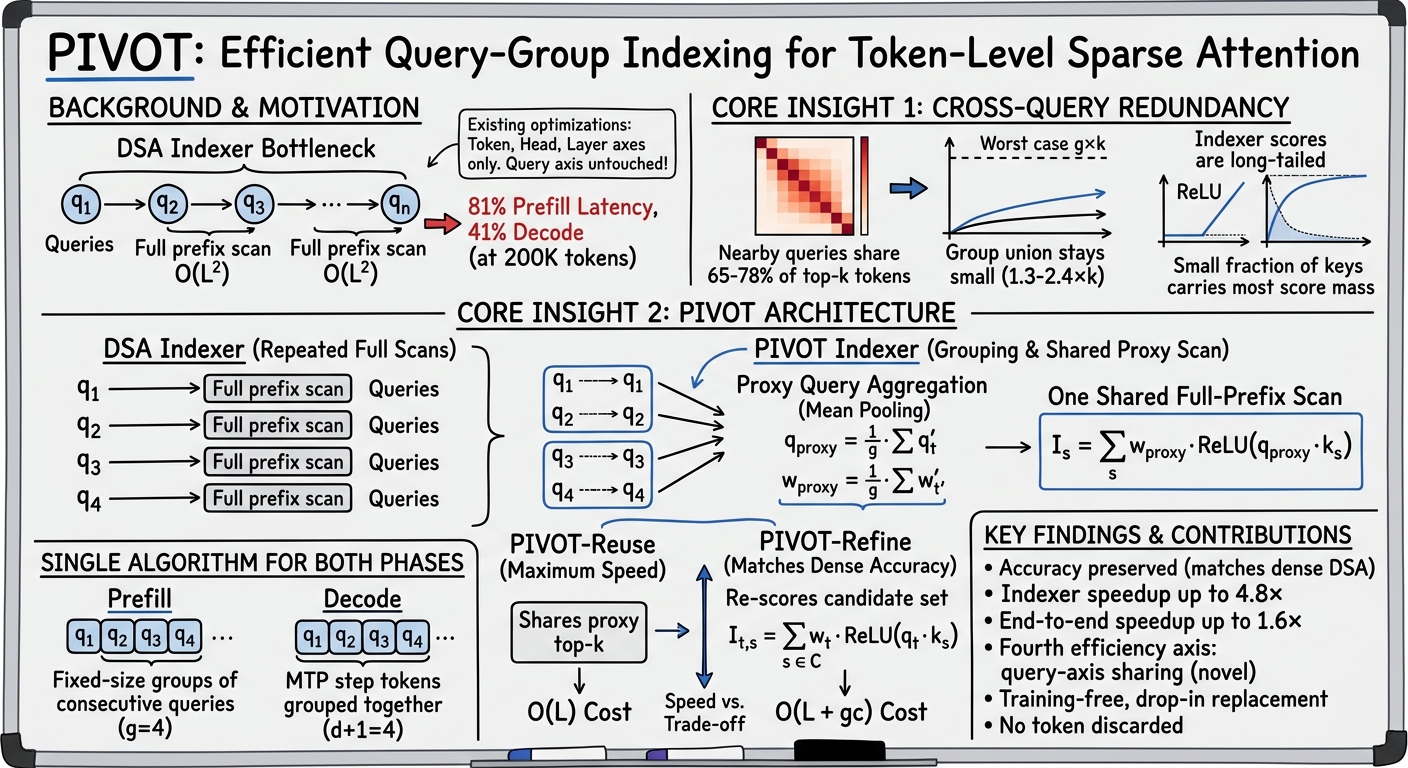
PIVOT groups nearby queries to share one proxy indexer scan, cutting indexing cost from O(gL) to O(L) and speeding up long-context inference up to 4.8x without accuracy loss.
Editor's noteIntroduces a fourth efficiency axis for DSA-style token-level sparse attention: uses mean-pooled proxy queries to share a single full-prefix indexer scan across query groups, paired with Reuse/Refine two speed-fidelity variants. Relative to Issue 1's 'SparDA' decoupled indexer and 'LongCat' cross-layer indexing, its increment is the first use of cross-query redundancy in indexer top-k selection, amortizing per-query scan cost from O(gL) to O(L+gc). Provides RULER degradation curves up to 128K and compute-matched comparisons, serving as a training-free drop-in indexer acceleration.
Tail-Replay enables unconstrained token-level prefix caching in hybrid LLMs by replaying only a 5-10% recent suffix to reconstruct linear-attention states, preserving 92.8-99.9% quality while achieving up to 14.3x TTFT speedup.
Editor's noteAddresses the 'linear attention curse' of hybrid LLM prefix caches: instead of storing recurrent state checkpoints, it caches exact FA KV and reconstructs Gated DeltaNet's recurrent state via short near-suffix replay on cache hits, making the reuse boundary determined by shared tokens rather than checkpoint positions. Relative to Marconi/Sparse Prefix Caching's checkpoint constraints, its increment is leveraging GDN's lossy compression properties to achieve unconstrained token-level prefix reuse, with a 5-10% replay budget preserving 92.8-99.9% quality and achieving 9.1-14.3× TTFT speedup at 32K.