Hybrid Position Extrapolation-Extension Seesaw, Indexer Cost Becomes New Bottleneck
Highlights
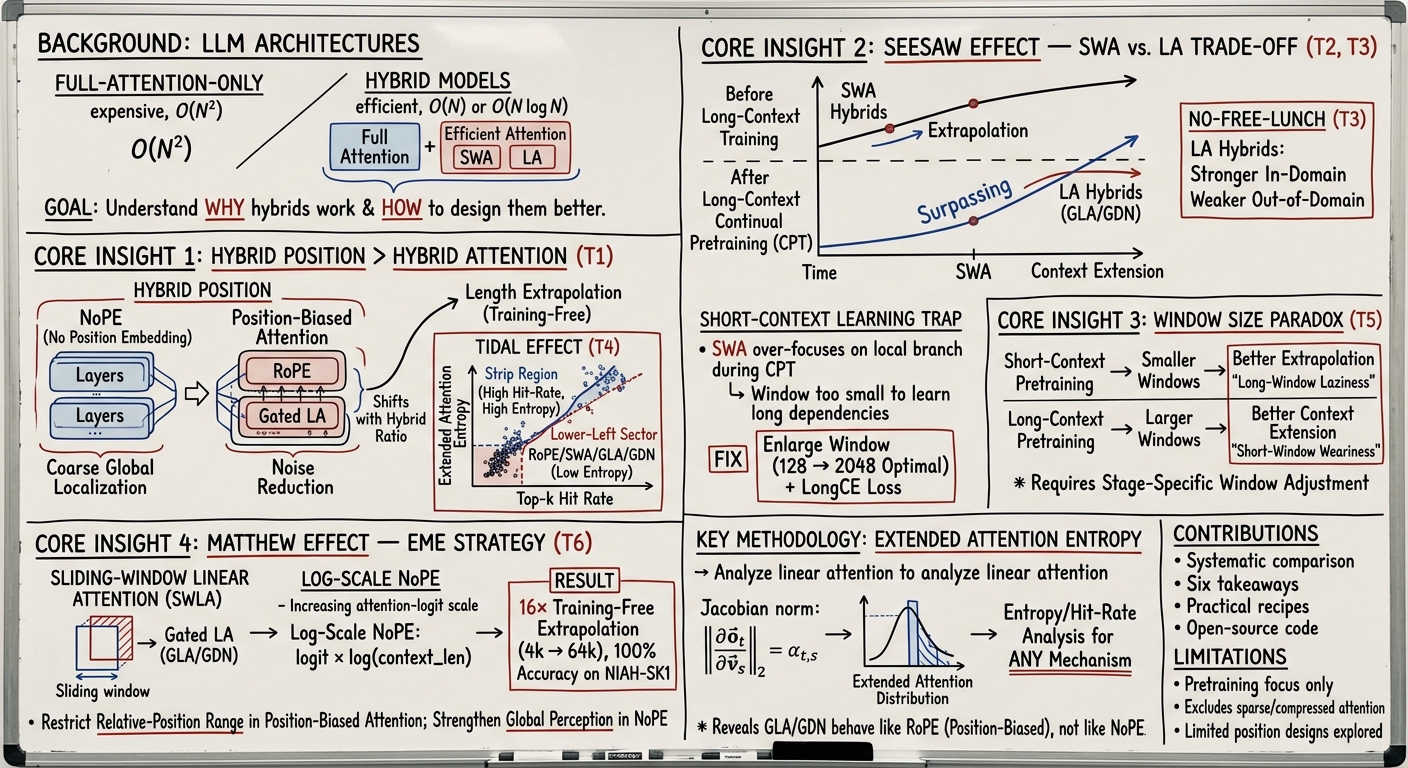
The strongest signal this issue is a systematic hybrid position study. Mechanics of Long-Context Hybrid Models Part 1.1 is the first to conduct compute-matched cross-family comparisons on four hybrid types: SWA/GLA/GDN/RoPE-NoPE, proposing the "Seesaw Effect": SWA hybrids excel in extrapolation but are overtaken by LA hybrids after long-context continual pretraining—because SWA hybrids fall into the "short-context learning trap" (long-context dependencies don't help prediction, short-context loss abnormally decreases), while LA hybrids suffer from the "no free lunch effect" (strong fit within training length, weak generalization beyond). As a fix, it proposes Sliding-Window Linear Attention (SWLA), which confines linear attention's relative position signals within the window, achieving 16× training-free extrapolation from 4K→64K. This directly advances the position mechanism dichotomy from Issue 8 'Shifting Mechanisms' and Issue 4 'Modern Transformers', pushing the "extrapolation vs extension" trade-off from single-point observation to a testable seesaw law.
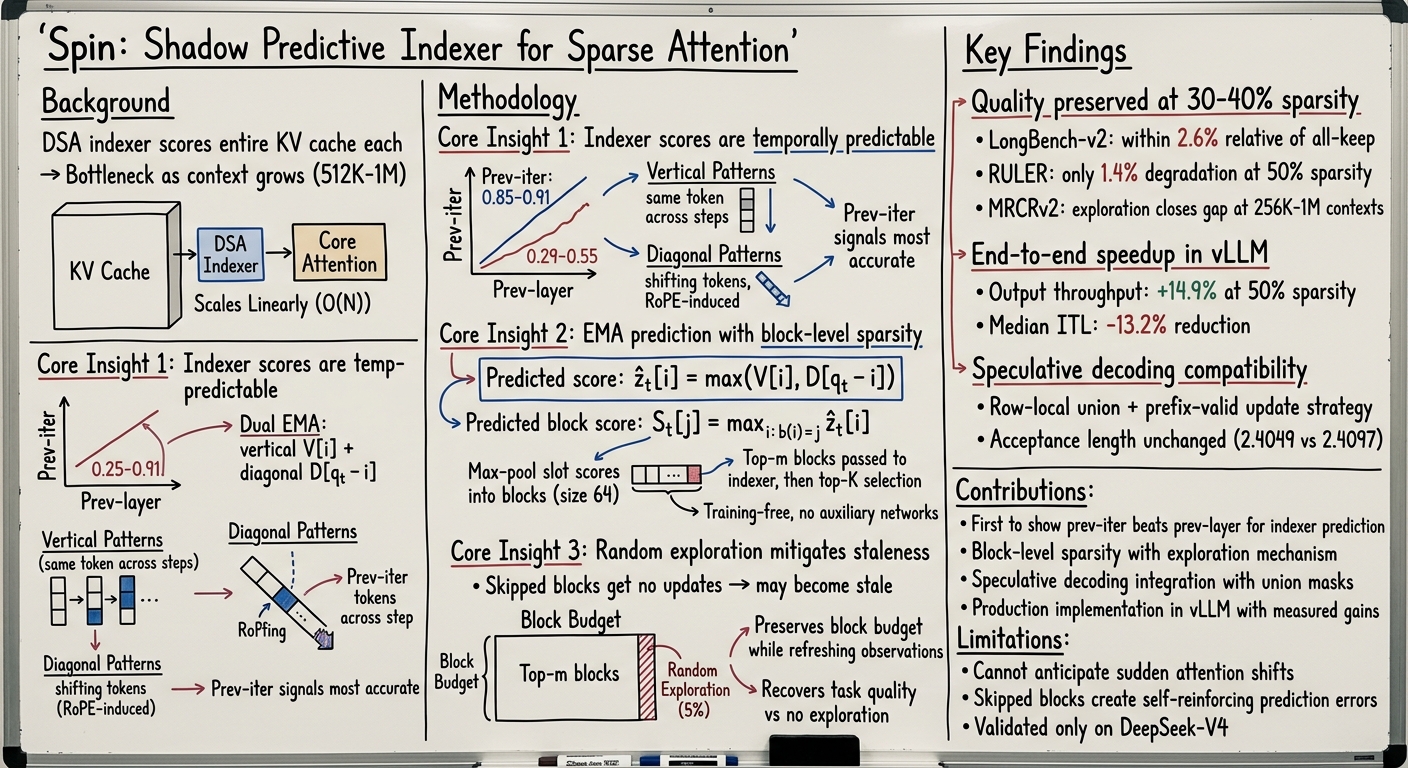
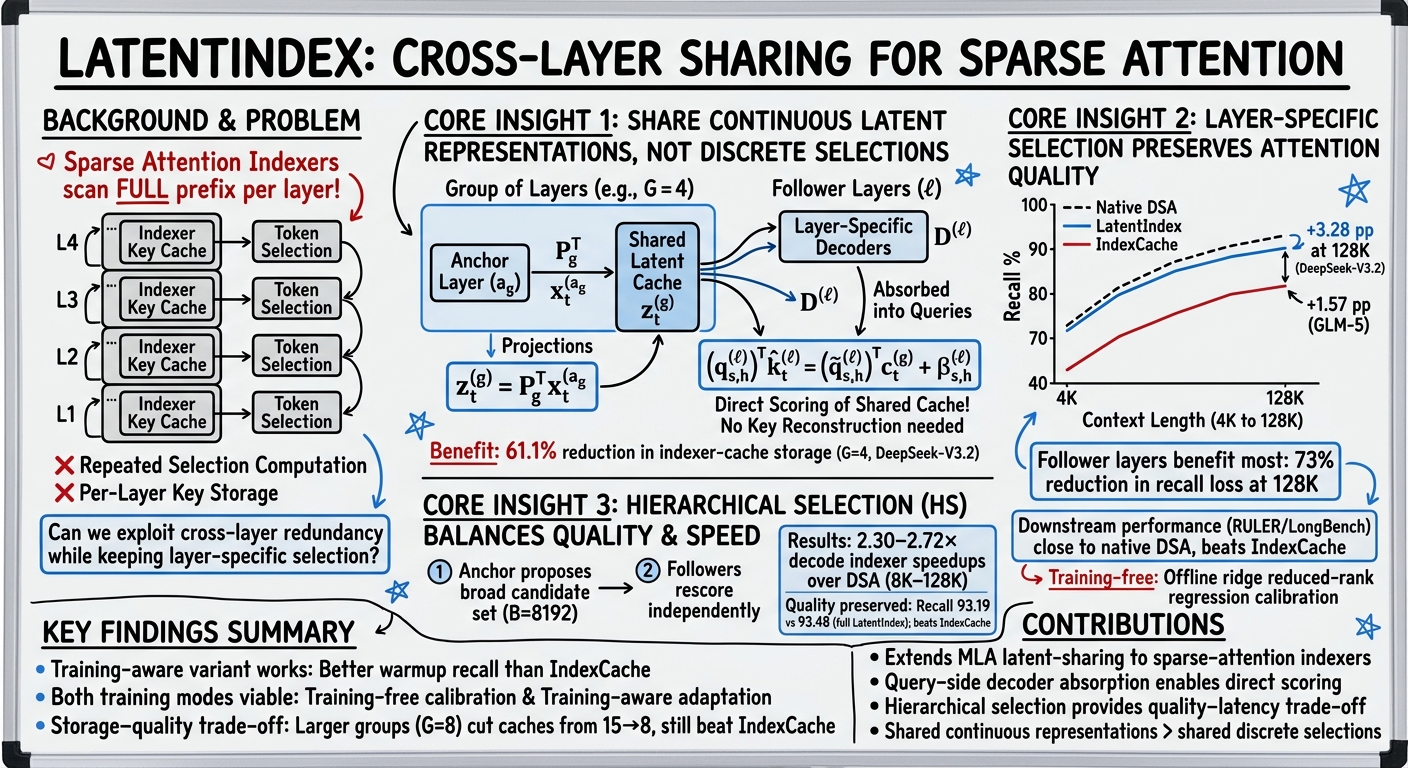
Indexer scoring cost is becoming a new bottleneck for long-context decoding, with three complementary routes this issue. SPIN is the first to optimize the indexer's own scoring overhead: using vertical and diagonal EMA statistics to predict block importance, skipping low-score KV blocks before indexer input, with random exploration to mitigate staleness, achieving 30-40% block sparsity while preserving task quality and end-to-end throughput up to 14.9% on DeepSeek-V4. LatentIndex extends MLA's latent sharing principle to the indexer layer: sharing continuous latent caches instead of discrete top-k selection, allowing follower layers to independently select tokens, reducing indexer cache storage by 61.1% on DeepSeek-V3.2/GLM-5 with better recall than IndexCache. On the engineering side, NVIDIA's Guess-Verify-Refine uses previous step's top-k to warm up the exact indexer, reducing scans from 3-4 to 1-2, mutually reinforcing SPIN's temporal correlation insight; DeepSelect confirms indexer top-k is already a critical path worth kernel-level optimization. On the theory side, Attention via Black-Box Vector Search proves that under a single index, top-k retrieval has an information-theoretic lower bound of Θ(√n/ε), with priority sampling being the correct framework, and provides a SoftmaxLift construction to bypass the lower bound—offering the first complexity theory for the entire indexer route.
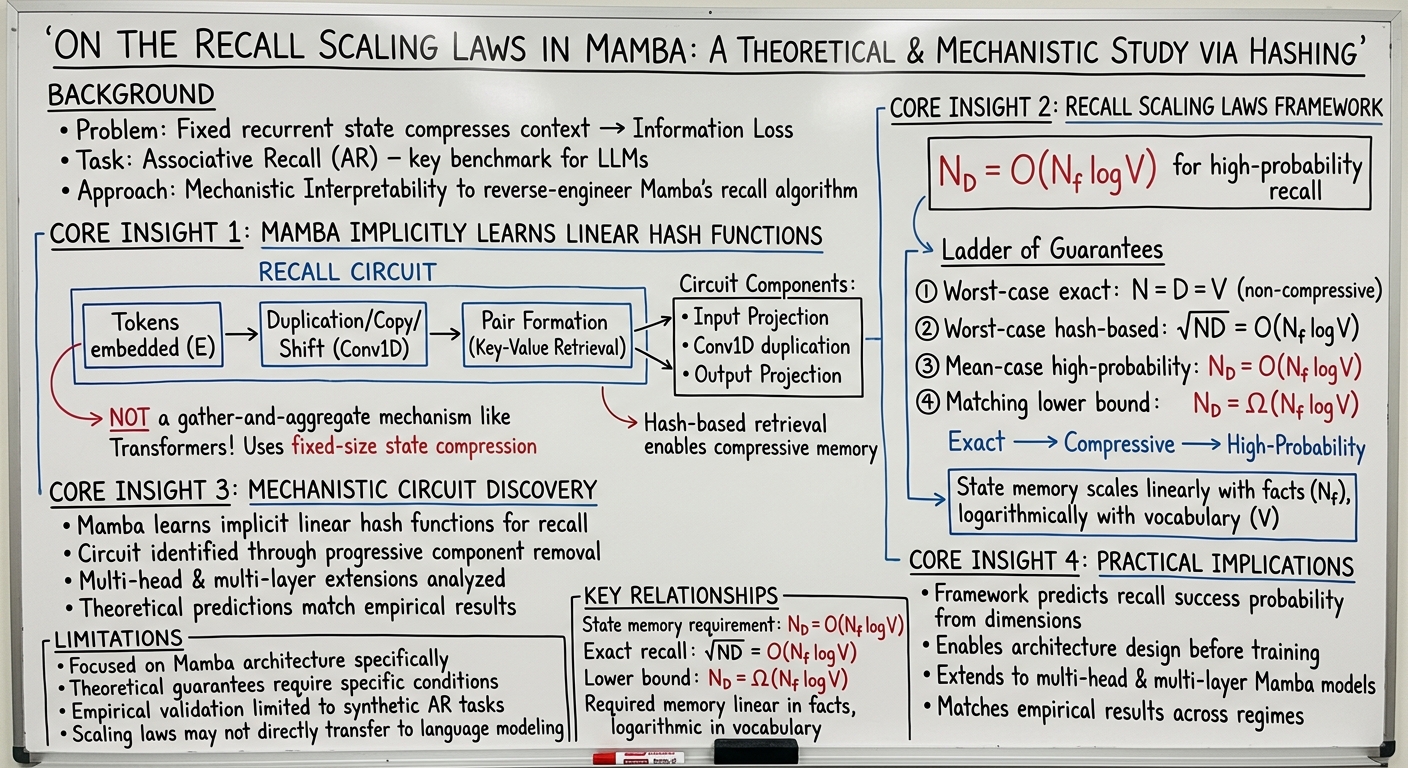
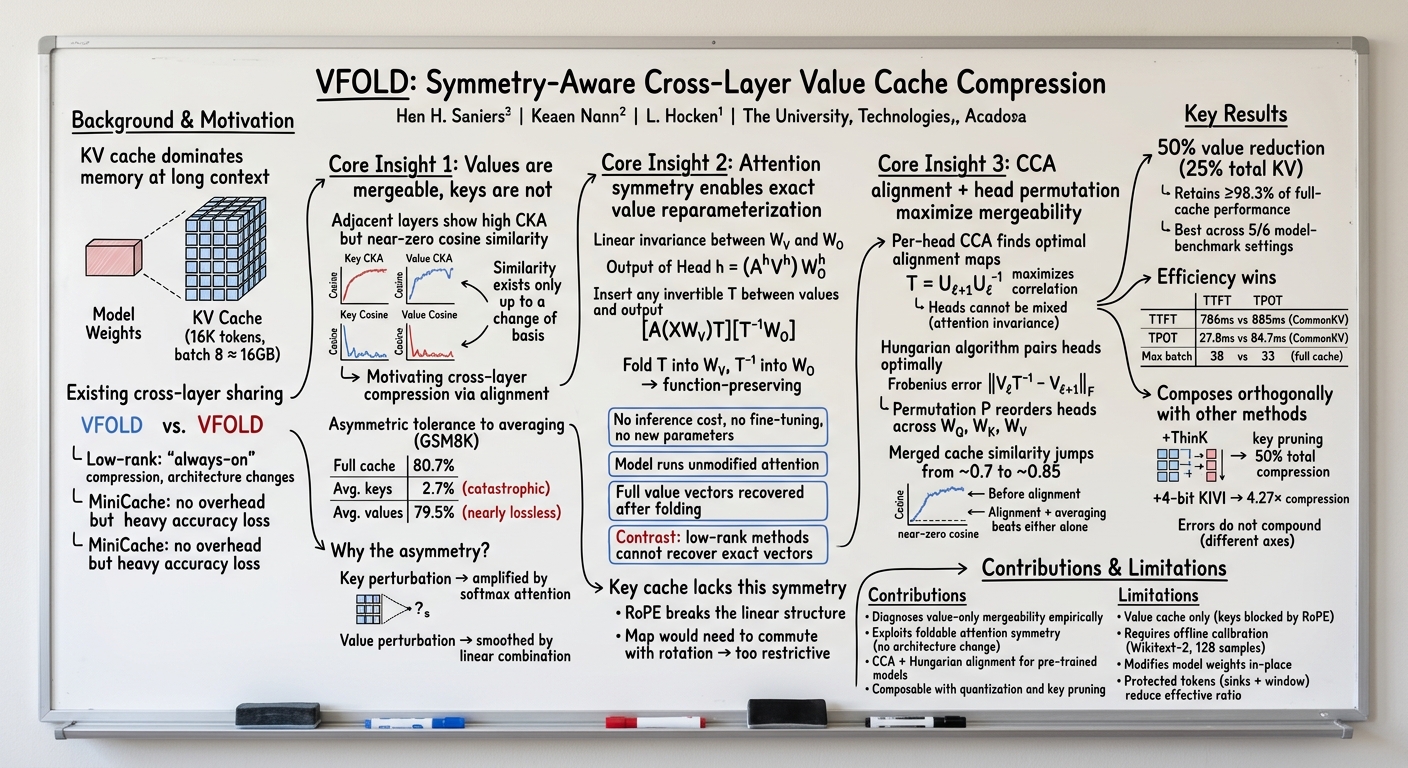
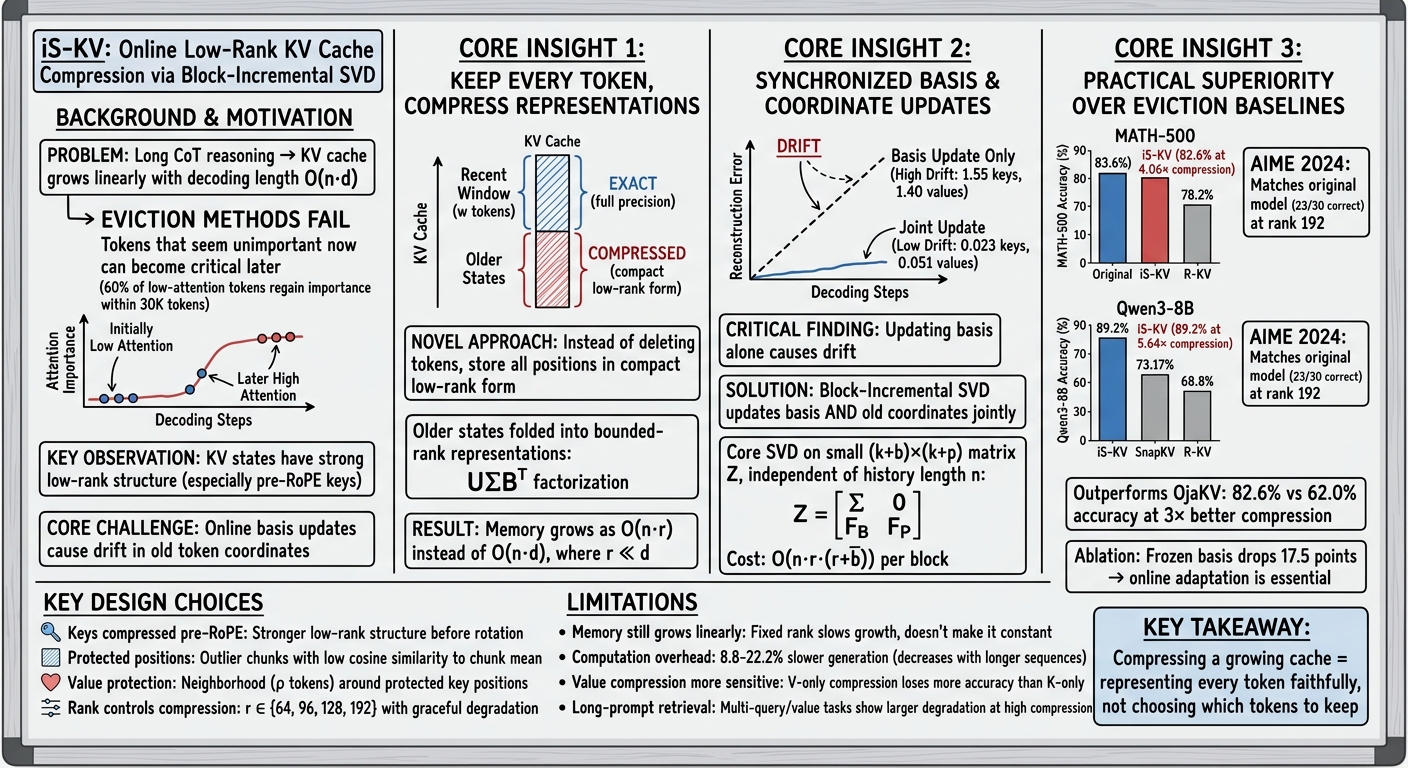
KV compression sees two new axes. VFold is the first to exploit function-preserving symmetry in attention weights (linear invariance between W_V and W_O), using offline CCA alignment and per-head permutation to losslessly fold adjacent-layer value caches into weights, with attention completely unmodified during decoding, orthogonal to quantization and key pruning. iS-KV formalizes the difficulty of online low-rank compression as "base update and old coordinate synchronization": if only the base is updated while old token coordinates remain fixed, stored history drifts (drift 1.55→0.023), and its block-incremental SVD jointly updates base and old coordinates, retaining all token positions rather than evicting, approaching the original model with 4-5.6× compression on long CoT reasoning. Additionally, On the Recall Scaling Laws in Mamba reverse-engineers the underlying algorithm of Mamba's associative recall (implicit JL linear hashing), providing a closed-form capacity law p_recall ≈ Φ(√(ND/(aN_f+N)) − √(2 log V)), and proves MQA/MKA multi-head degenerates while MHA improves—a step from Issue 8's 'Anatomy of Associative Recall' diagnostic decomposition to predictive capacity laws.
Community and Dynamics
The interaction between fixed local windows and learnable sparse selection reveals a cautionary negative result. OCTOPUS finds in gated selective attention: under a fixed budget, increasing the local window from 32 to 64 actually drops accuracy from 76% to 74.1%—a larger forced window squeezes the budget for learnable gating to retain long-range information, and removing the recent window (68.0%) hurts more than removing attention sinks (73.1%). This contrasts with Issue 7's Elastic Threshold Attention's "uniform floor eliminates sinks" claim, suggesting budget competition between fixed local tools and learnable sparse selection.
On long-context evaluation validity, Proof of Tech's NIAH critique provides a concrete failure mode: when distractors and needles are topically similar, frontier models collapse significantly at 128K (e.g., Llama-3.1-70B drops from 67.7 to 25.85), while standard NIAH's uniform filler massive contexts never expose this—consistent with Issue 8's reservations about "lossless" conclusions, and again confirming this issue's SWLA limitation of relying solely on NIAH-SK1 as evidence.
Open Questions
- Mechanics of Long-Context Hybrid Models Part 1.1's SWLA uses NIAH-SK1 100% as evidence, but Issue 8 'Shifting Mechanisms' has shown SWA NoPE's long-context gains degrade on competitive key discrimination—does SWLA's 16× extrapolation still hold on real long contexts with dense distractors and multi-key competition?
- SPIN's prediction feeds back into its own observations: skipped blocks no longer produce scores, potentially forming self-reinforcing prediction errors. Can temporal correlation combine with cross-layer signals or current query signals to eliminate worst-case misses?
- On the Recall Scaling Laws in Mamba's capacity law is derived on a simplified linear model without gating, with full-model fitting being heuristic (a_full ≈ 0.5 a_linear)—do gated GDN/KDA still obey the same closed-form law? Can the conclusion that MHA improves while MQA/MKA degenerates guide Issue 4 'Modern Transformers' head-granularity hybrid design?
- VFold only compresses value caches (about 25% of total KV), while iS-KV retains all positions—can weight symmetry folding combine with online low-rank compression, or do they conflict in representation?
Papers in this issue
Hybrid position combining NoPE with position-biased attention, not hybrid architecture alone, drives long-context performance, with SWLA enabling 16x training-free length extrapolation.
Editor's noteFirst compute-matched cross-family comparison on SWA/GLA/GDN/RoPE-NoPE hybrids, proposing the Seesaw Effect (SWA excels in extrapolation, LA overtakes after long-context CPT) and the short-context learning trap, with SWLA achieving 16× training-free extrapolation from 4K→64K. Relative to Issue 8 'Shifting Mechanisms' and Issue 4 'Modern Transformers' position mechanism dichotomy, its increment is advancing "extrapolation vs extension" into a testable seesaw law with a concrete fix—anyone doing hybrid layer mixing or long-context CPT should read.
Spin exploits temporal patterns in indexer scores to skip up to 40% of KV blocks, boosting throughput by 14.9% without task-quality loss.
Editor's noteFirst to optimize the indexer's own scoring cost: using vertical and diagonal EMA statistics to predict block importance, skipping low-score KV blocks before indexer input, with random exploration to mitigate staleness. Relative to Issue 6 DeepSeek-V4.1-Flash's CSA2 and Issue 7 HySparse2's cross-layer index reuse, its increment is exploiting temporal correlation of indexer scores rather than reusing index results, achieving 30-40% block sparsity while preserving quality and end-to-end throughput up to 14.9% on DeepSeek-V4.
LatentIndex shares continuous key representations across layers in sparse-attention indexers, improving recall by up to 3.28 points over IndexCache while cutting indexer-cache storage by 61.1%.
Editor's noteExtends MLA's latent sharing principle to the indexer layer: sharing continuous latent caches instead of discrete top-k selection, allowing follower layers to independently select tokens, with training-free ridge calibration and hierarchical selection variants. Relative to IndexCache and Issue 6 DeepSeek-V4.1-Flash's Reuse mode, its increment is proving shared continuous representations rather than discrete selection preserve per-layer selection quality, reducing indexer cache storage by 61.1% on DeepSeek-V3.2/GLM-5.
Mamba models learn linear hash functions for associative recall, requiring state memory scaling as ND = Θ(Nf log V) — linear in facts, logarithmic in vocabulary.
Editor's noteReverse-engineers Mamba's associative recall underlying algorithm as implicit JL linear hashing, providing a closed-form capacity law p_recall ≈ Φ(√(ND/(aN_f+N)) − √(2 log V)), extended to multi-layer and multi-head (MQA/MKA degenerate, MHA improves). Relative to Issue 8 'Anatomy of Associative Recall' fixed-state decomposition, its increment is providing a predictive closed-form capacity law rather than diagnostic decomposition, directly guiding state size and embedding dimension choices.
VFOLD compresses LLM value caches by folding cross-layer alignment maps into attention weights, achieving 25% KV reduction with over 98% performance retention.
Editor's noteFirst to exploit function-preserving symmetry in attention weights (linear invariance between W_V and W_O), using offline CCA alignment and per-head permutation to losslessly fold adjacent-layer value caches into weights, with attention completely unmodified during decoding. Relative to Issue 6 DeepSeek-V4.1-Flash's static pattern sharing and Issue 7 HySparse2's two-level sharing, its increment is proving value-cache-specific linear symmetry can be losslessly folded, avoiding low-rank methods' always-on reconstruction overhead, and orthogonal to quantization/key pruning.
iS-KV compresses KV caches via block-incremental SVD, jointly updating basis and coordinates to retain all tokens, achieving near-original accuracy at 4-7x compression, outperforming eviction methods.
Editor's noteFirst to formalize online low-rank KV compression difficulty as "base update and old coordinate synchronization": updating only the base causes stored history drift (drift 1.55→0.023), and its block-incremental SVD jointly updates base and old coordinates, retaining all token positions rather than evicting. Relative to Issue 8 KV-Kaizen's compression axis selection and Issue 7 CompKV's eviction+compensation, its increment is providing a joint update mechanism for online low-rank, approaching the original model with 4-5.6× compression on long CoT reasoning.
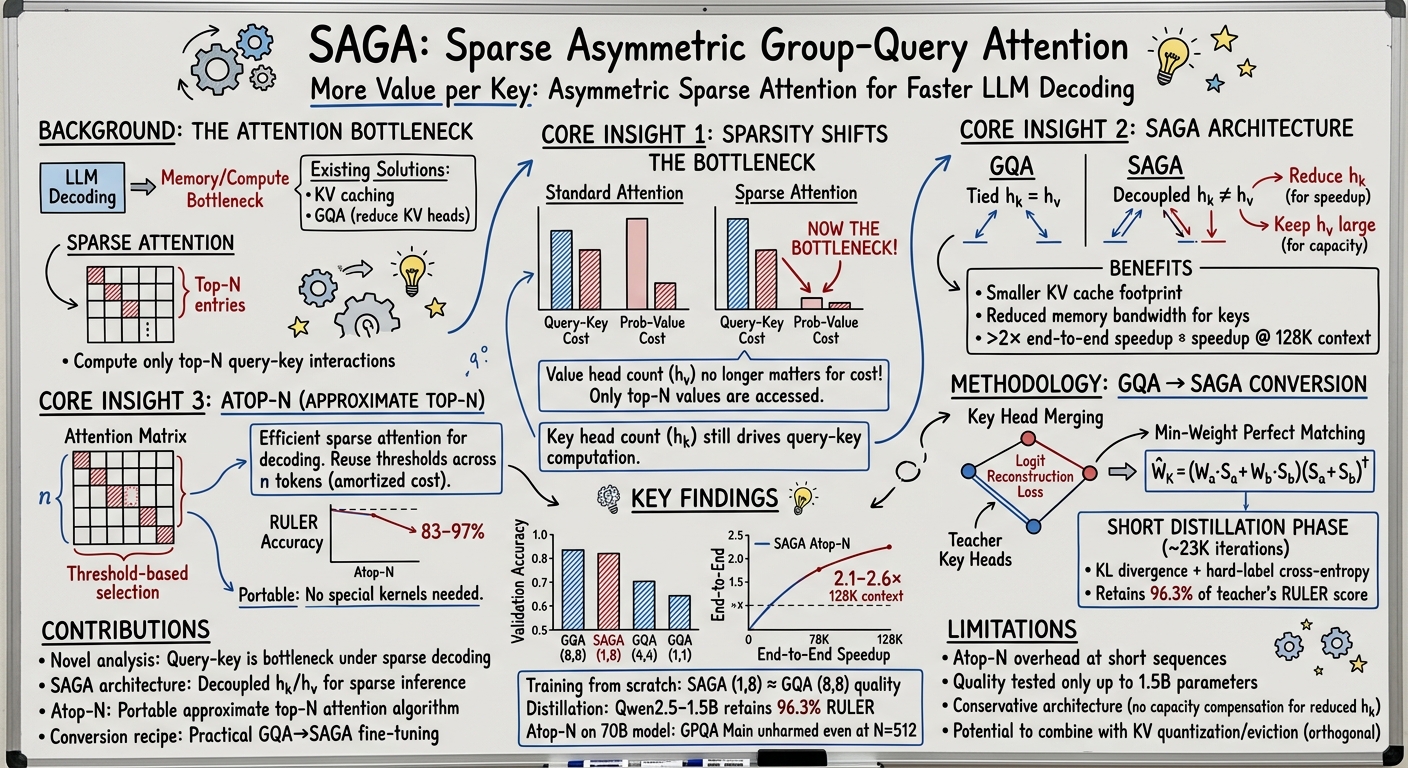
SAGA decouples key and value head counts to exploit sparse attention's shifted bottleneck, achieving over 2x decoding speedup at 128K context with near-baseline quality.
Editor's noteFirst to push decoding bottleneck under sparse attention to the architectural level of key/value head count decoupling: under top-N sparsity, query-key multiplication becomes the dominant bottleneck, so key heads can be independently reduced while retaining value heads (SAGA), with closed-form minimum-weight perfect matching initialization for training-free conversion of GQA models to SAGA. Relative to Issue 7 HySparse2 and Issue 6 DeepSeek-V4.1-Flash's shared axes, its increment is identifying asymmetric value of key/value head counts under sparse decoding, contrasting with Issue 4 'Modern Transformers' head-granularity principles.
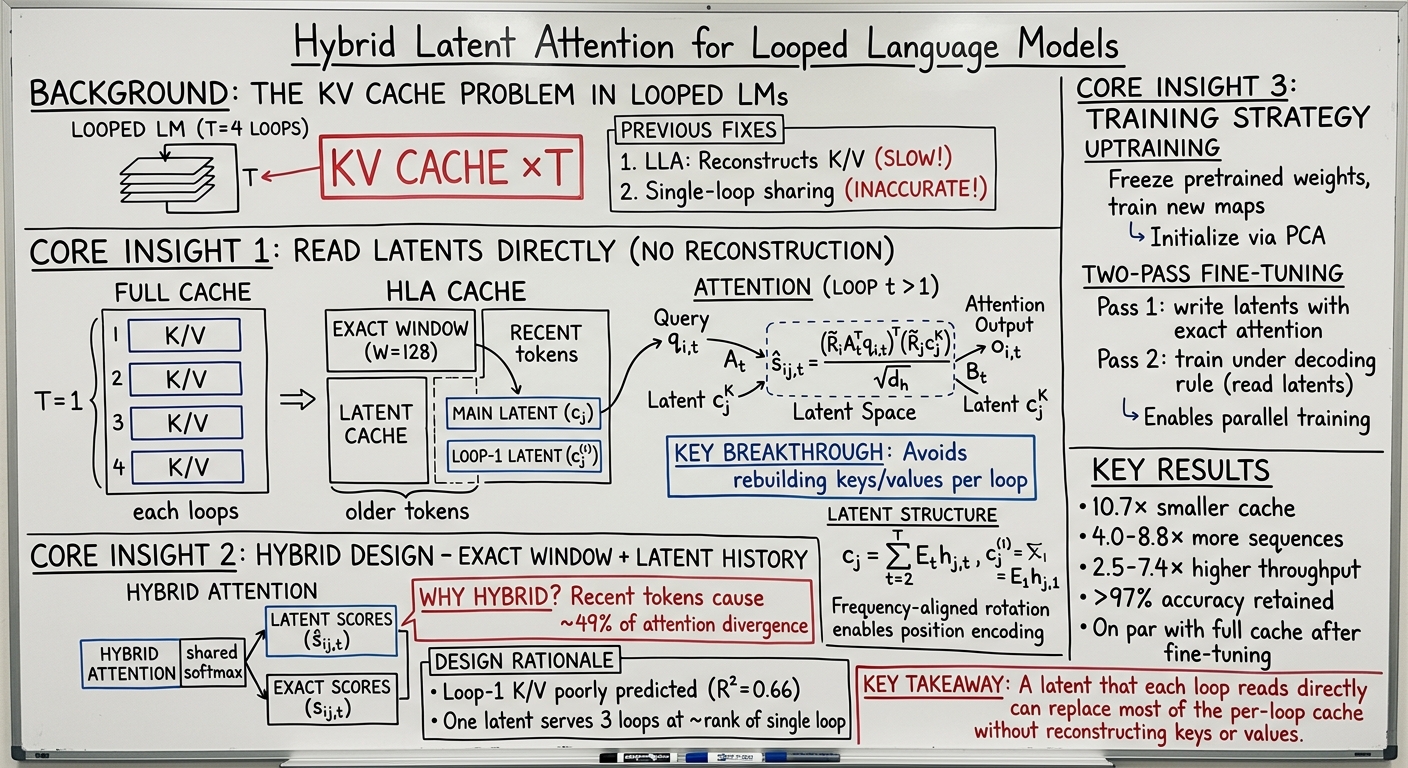
Hybrid Latent Attention compresses looped language model KV caches 10.7x by having attention read compact latents directly, boosting decoding throughput up to 7.4x while retaining over 97% accuracy.
Editor's noteFirst to extend MLA-style latent absorption (query directly reads latent, no KV reconstruction) across loops to looped LM: each old token stores a cross-loop shared main latent plus a loop-1-specific small latent, with exact sliding window. Relative to LLA's per-step KV reconstruction and Ouro's last-loop sharing, its increment is eliminating reconstruction cost, achieving 10.7× cache compression and 2.5-7.4× decoding throughput improvement on Ouro T=4, retaining 96-100% long-context retrieval accuracy.
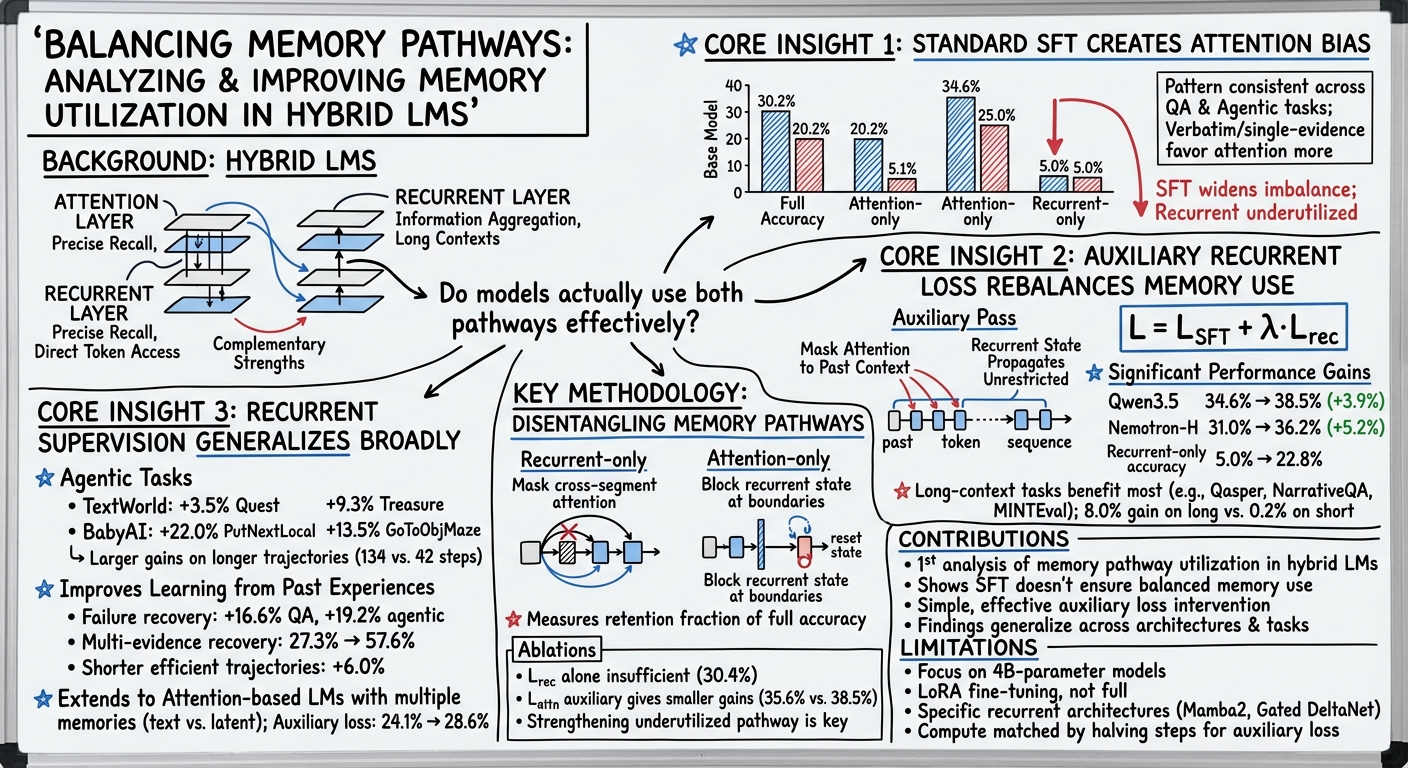
Hybrid language models over-rely on attention and underuse recurrent memory, but an auxiliary loss forcing recurrent routing improves QA accuracy by up to 5.2% and agentic success rates.
Editor's noteIdentifies training-side imbalance in hybrid LMs: standard SFT improves overall performance but doesn't improve coordination of the two memory pathways, with models relying more on attention and recurrent memory left idle; its auxiliary loss masks attention's access to early context in the forward pass, forcing recurrent pathway use, with significant gains on long-context QA and agentic tasks. Relative to Issue 8 'How Linear Attention Remembers' and Issue 5 'What Attention Recalls' analysis-type interventions, its increment is providing a training-side intervention that directly coordinates pathways.