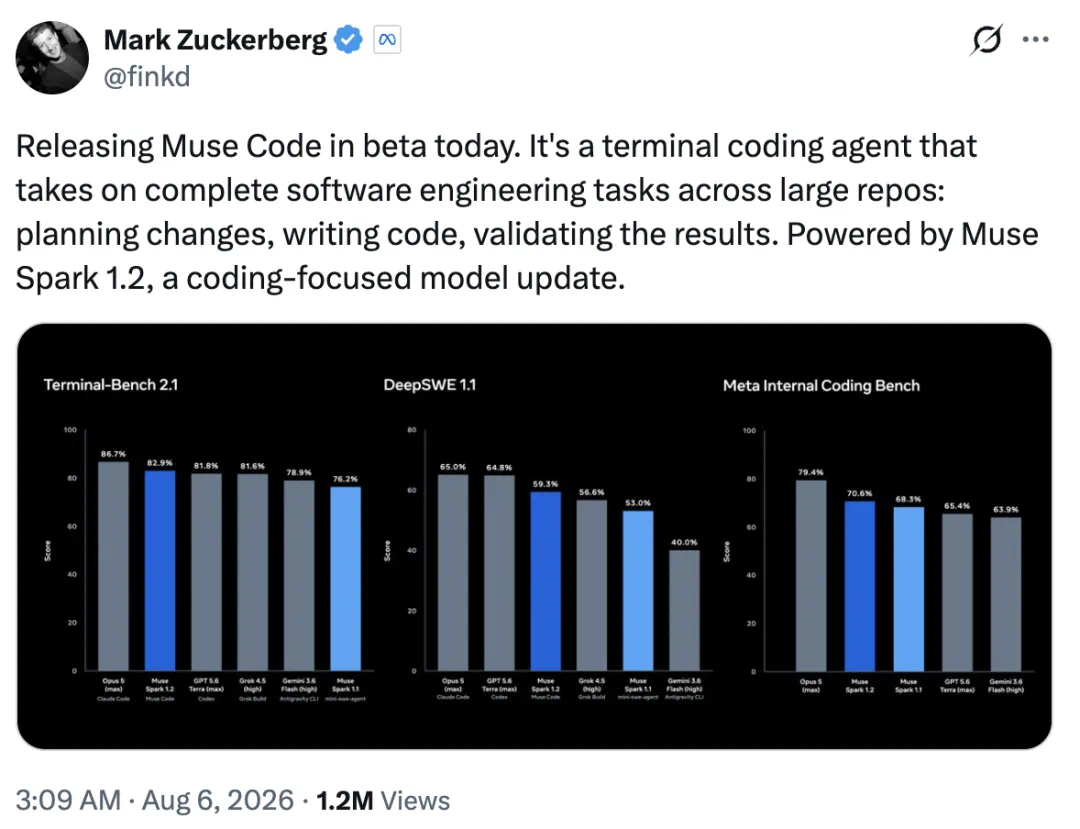
Meta launches Muse Code coding agent and Muse Spark 1.2 model
Meta released Muse Code, a terminal-based AI coding agent for large codebases, powered by the new Muse Spark 1.2 model. The agent uses a persistent loop with asynchronous background agents to handle complex tasks like debugging, feature addition, and refactoring, with features like local event logs for recovery and built-in skills. Muse Spark 1.2 focuses on coding improvements, and Meta co-trained it with Muse Code for optimal performance.
Coverage timeline
TechCrunch AILucas Ropek
Meta expanded its AI coding offerings with a new agent that, it promises, can handle complex tasks with complex software.
Simon Willison
Introducing Muse Code and Muse Spark 1.2 Yet more evidence that the most important characteristic of any model these days is long-sequence agentic tool calling. Meta shipped their own coding agent as part of getting that to work! Muse Spark 1.2 is a coding-focused update to Muse Spark 1.1, with improvements in code generation, complex debugging, codebase understanding, and end-to-end developer workflows. In Muse Spark 1.2, we significantly scaled up training compute on coding tasks while expanding training environment diversity. The model also maintains its strength in other key areas like general agents. [...] We co-trained Muse Spark 1.2 with Muse Code to ensure the model exhibits its best performance and coding usability when paired together. The training included rejection sampled harness trajectories and recipe optimizations for goals, compaction, and subagents, alongside the integration of the Muse Code toolset to maximize harness compatibility. [...] Muse Spark 1.2 was extensive

机器之心机器之心
编辑|杜伟、Youli 终于,Meta 下场做 Coding Agent 了。 今日,Meta 正式发布 Muse Code 测试版。这是一款运行在终端中的 AI 编码 Agent,由最新的 Muse Spark 1.2 模型驱动。扎克伯格发文表示:「它可以在大型代码仓库中完成复杂软件工程任务,包括分析项目、规划修改、编写代码、运行工具以及验证结果。」 这也意味着,Meta 与 OpenAI、Anthropic,终于又在编码 Agent 这一热门赛道「狭路相逢」了。 而产品一经发布,便引起网友热议。一网友直接问起了当下讨论比较多的开源话题,问「Muse Code 是否会采用开源方式」?而扎克伯格也立即回应:「很快将会有更多关于这一话题的内容要分享」。 目前,Muse Code 支持 macOS 和 Linux,通过一条终端命令即可安装。用户可以直接向它提出一个完整需求,例如修复跨越多个模块的 Bug、添加一项新功能,或者对大型项目进行重构。接到任务后,Muse Code 会先理解代码库,再制定计划、修改文件、运行测试,并根据结果继续调整。 下面,我们来详细了解一下。 Muse Code:Meta 首个 AI 编程智能体 Muse Code 采用一个简单的智能体循环,并配合一组异步后台智能体,以增强主智能体的能力。 这些专用后台智能体会在整个会话期间持续运行,不会针对每项任务临时启动,从而减少重复的信息收集。它们可以自主执行后续步骤,并判断何时向主智能体反馈结果。 这种持续运行的机制能够降低延迟,也减少了主智能体在处理复杂、多步骤任务时对人工引导的依赖。 demo 展示 Muse Code 具有两大核心特征: 一是运行时设计。 Muse Code 使用本地事件日志,模型调用、工具运行、审批操作和代码修改都会被依次记录。作为唯一可信的数据源,这套日志机制让运行过程可以被精确重放,并能在重启后安全恢复。即使程序崩溃,智能体也能从中断的位置继续执行。 凭借这一能力,Muse Code 可以处理运行时间较长的任务,不会因中途故障导致整个流程偏离或中断。 二是内置技能。 Muse Code 默认提供多项技能。「/plan 」可以将任务拆解为一份需要审批后才能执行的计划;「/grill 」会对计划进行反复压力测试,直到方案足够可靠;「/goal 」则会围绕指定目标持续推进,直至任