DiffuSpace releases open-source diffusion LLM Clover-35B-A3B-Preview
DiffuSpace, the startup with the largest funding round for diffusion language models, released the open-source diffusion model Clover-35B-A3B-Preview. The company claims it matches or surpasses autoregressive models of similar size on agentic coding and tool-use benchmarks while achieving faster generation, demonstrating that high speed and high performance can coexist.
Coverage timeline
机器之心机器之心
编辑|张倩 2008 年,英伟达曾用一场颇为疯狂的实验,向人们展示并行计算的威力。 在现场,一台绘画机器人按部就班、一个像素接一个像素地绘制出一幅「笑脸」简笔画。 但接下来,画风突变。工作人员启动了一台布满 1100 个彩弹发射管的巨大装置。伴随着一声巨响,上千颗彩弹几乎同时射出,在画布上留下密密麻麻的颜料痕迹。一幅《蒙娜丽莎》就这样瞬间出现,用时 80 毫秒。 两种绘画方式,展示了串行与并行的巨大差异。 18 年后,并行计算早已成为人工智能发展的重要基础,英伟达的 GPU 支撑起了今天的大模型训练和推理。但有意思的是,绝大多数主流大语言模型仍然沿用着一种相当「串行」的文本生成方式。 它们像当年那台绘画机器人一样,从左到右,一个 Token 接着一个 Token 地生成答案。即使拥有再强大的计算硬件,后一个 Token 的生成也通常需要等待前一个 Token 完成。 那么,有没有可能 让语言模型也像那台彩弹装置一样,同时生成多个 Token ? 扩散语言模型(dLLM)正在探索这样的可能性,而且这个方向在近两年变得备受关注,相关模型的表现也是一再刷新大家的认知。 最近,这一方向的实力玩家、创下全球扩散语言模型最大规模融资纪录的公司 —— 扩散智能(DiffuSpace) 公布了一项新进展,发布了 开源扩散语言模型 Clover-35B-A3B-Preview 。官方数据显示,这一新模型 在多项能力评测中达到或超过同规模自回归模型,同时实现了更快的生成速度,而且是在智能体编程和工具使用这类较难的任务上 。 之前,大家总是调侃这类模型「别管对不对,你就说快不快吧」,也就是速度和质量总是顾此失彼。但这次,Clover 35B-A3B 在它的尺度上证明了: 高速生成与高性能,可以共存于同一模型。 看来,扩散语言模型这个赛道的前沿,又被往前推了一步。 这次,dLLM 和自回归模型 站上了同一起跑线 在深入细节之前,我们先感受一下 Clover 35B-A3B 是怎么工作的: 在这个 demo 里,模型被要求用单个 HTML 文件模拟一个桌面环境,支持窗口拖动,并能打开多个小应用。Clover 根据这条需求,生成了包含程序坞、窗口系统以及记事本、计算器、时钟、天气和设置等应用的模拟桌面。过程中,Clover 在多个位置同时、快速生成,不慢放都看不清楚。 实测数据显示,Clove

Related stories
Diffusion Intelligence Unveils 350B-Parameter MoE Diffusion Language Model Clover-35B-A3B-Preview
Diffusion Intelligence released Clover-35B-A3B-Preview, a 350B-parameter MoE diffusion language model with about 3B active parameters per token, supporting thinking mode. In the WindTunnel web agent benchmark across 49 tasks with 3 attempts each, Clover achieved a median execution time of 1.52 seconds and a success rate of 98.6%, compared to 3.21 seconds and 95.9% for the Jev + Mercury 2.5 combination. The model can handle coding, web operations, tool calls, and HTML generation, and is positioned as faster than autoregressive models at similar scale.
1 reports · 1 sources

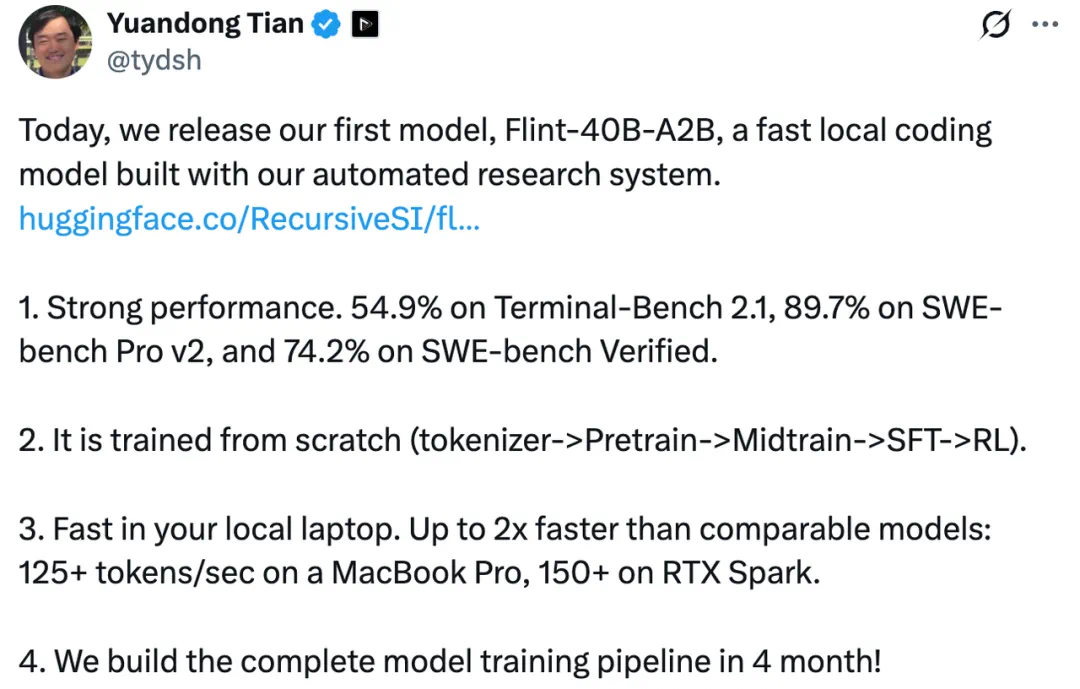
Recursive releases Flint, 40B coding model built largely by its Eureka Machine AI system
Startup Recursive has released Flint, an open-weight, 40B-parameter mixture-of-experts coding model with 2.5B active parameters per token, built in under four months with heavy automation from its Eureka Machine AI research system. The model outperforms sub-50B MoE models on coding benchmarks like SWE-Bench Pro v2 and runs at over 125 tokens per second on a MacBook Pro M4 Pro, with weights available on Hugging Face under Apache 2.0.
3 reports · 3 sources
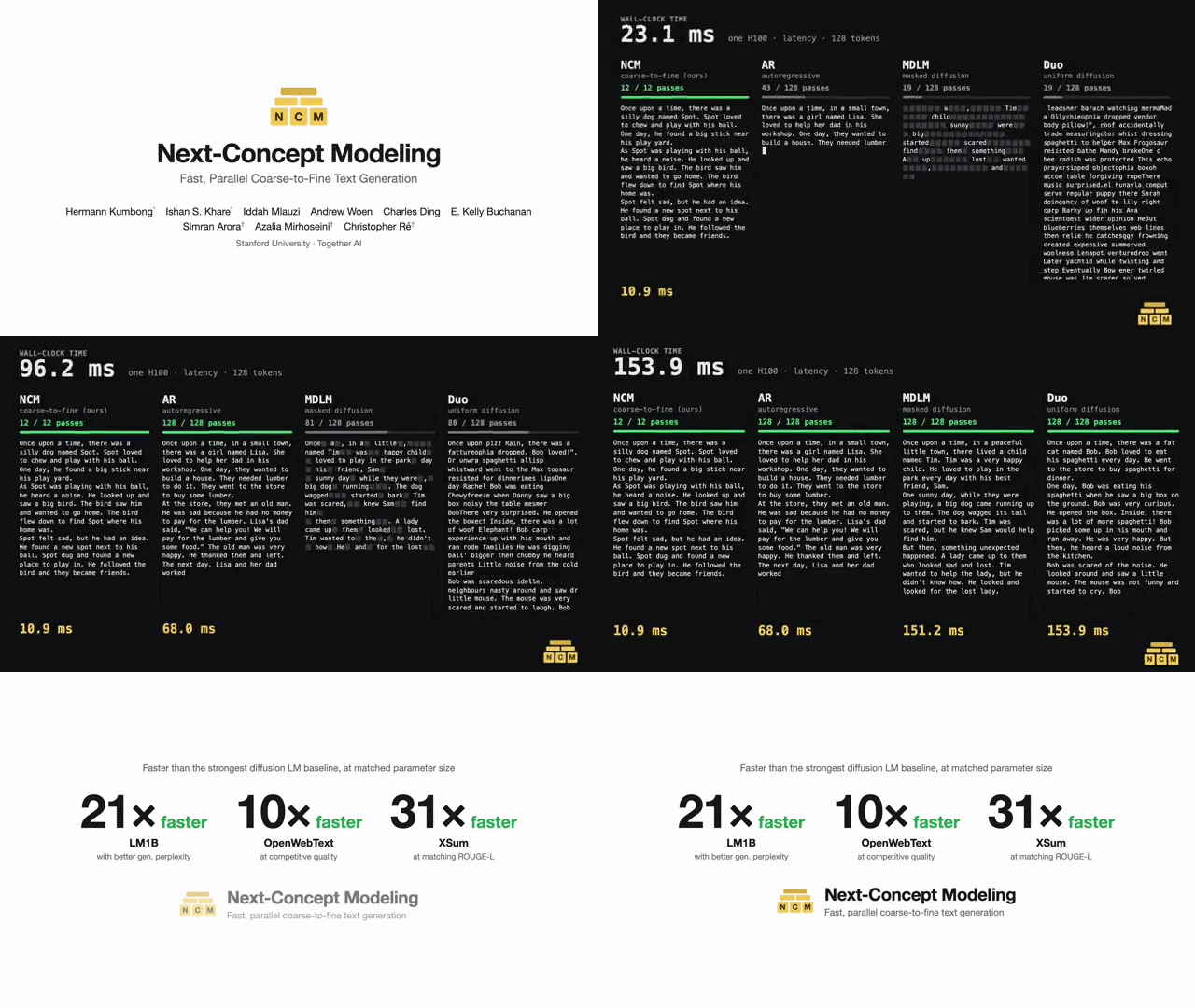
Stanford, Together AI propose Next-Concept Modeling for parallel text generation, 10-31x speedup
Researchers from Stanford University and Together AI introduced Next-Concept Modeling (NCM), a coarse-to-fine parallel text generation paradigm adapted from next-scale prediction used in image generation. In experiments, NCM achieved 10-31x speedup over diffusion language models with comparable or better quality, offering an alternative to both autoregressive and diffusion approaches.
Liquid AI releases LFM2.5-24B-A2B, an open-weight 24B reasoning model with 2B active parameters
Liquid AI announced LFM2.5-24B-A2B, an open-weight 24B reasoning model with 2B active parameters, designed for fast, private on-device agents. The company claims it outperforms Qwen3.6-35B-A3B on the LiveClaw benchmark.
2 reports · 2 sources287 points · 80 comments

News updates every hour. Subscribe in your RSS reader to get new stories automatically.
Subscribe