NariQ claims 3-bit Qwen3.8-27B quant with near-BF16 agentic performance
Nari Labs announced NariQ, a 3-bit-or-lower quantization of Qwen3.8-27B that reportedly retains near-BF16 quality across agentic, math, multilingual reasoning, and image understanding tasks. Benchmarks show 3-bit and 2.5-bit variants matching or exceeding BF16 on DeepSWE, Terminal-Bench 2.1, and AIME, with 2-bit degrading significantly. The quantizations currently require a custom llama.cpp fork, and context-length throughput is reported for 4K, 16K, and 64K.
Coverage timeline
Hacker Newstoebee
We built NariQ: 3-bit-or-lower quantizations of Qwen3.8-27B that retain near-BF16 quality across agentic tasks, math, multilingual reasoning, and image understanding. To our knowledge, this is the first 3-bit-or-lower quantization that retains BF16 lvl performance on long-horizon agentic tasks. Benchmarks (BF16 / 3-bit / 2.5-bit / 2-bit): - DeepSWE: 39.8 / 41.0 / 41.9 / 28.6 - Terminal-Bench 2.1: 62.6 / 63.8 / 60.2 / 52.4 - AIME 25+26: 97.7 / 98.3 / 96.5 / 86.0 - MSGM: 94.0 / 93.1 / 91.8 / 90.6 - RealWorldQA: 82.4 / 82.4 / 81.3 / 80.9 Decode speed is comparable to other quants on an RTX PRO 6000. Context-length results below (3-bit / 2.5-bit / 2-bit / Unsloth UD-IQ3_XXS): - 4K: 88.9 / 99.2 / 111.7 / 94.7 - 16K: 84.5 / 93.8 / 105.1 / 89.8 - 64K: 70.7 / 77.5 / 85.0 / 74.8 Running these currently require our llama.cpp fork: ( https://github.com/nari-labs/nari-llama.cpp ) Feedback and questions welcome. We'd love to hear how these perform on your workloads.
Related stories
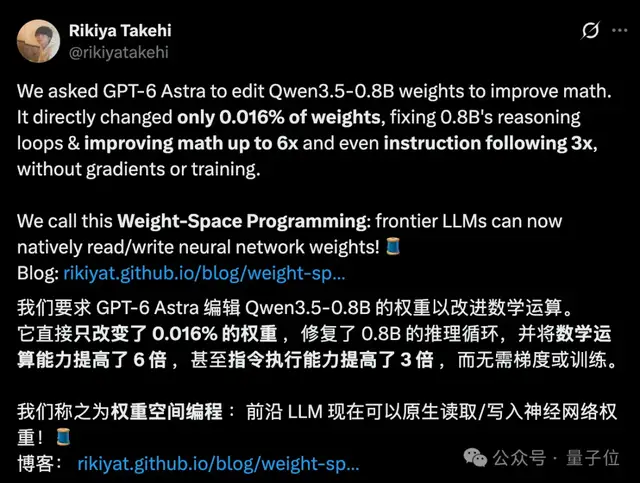
MIT: GPT-6 Astra edits Qwen weights, boosting MATH-500 from 7.9% to 48.1%
MIT CSAIL researchers demonstrated that GPT-6 Astra can directly read and modify the weights of Qwen3.5-0.8B, improving its MATH-500 score from 7.9% to 48.1% by altering only 0.016% of parameters, without training or gradient descent. The team named this capability Weight-Space Programming. However, spaCy author Matthew Honnibal publicly challenged the paper, arguing that the experimental conditions across the three claimed abilities differ significantly and that the presentation is misleading.
6 reports · 5 sources2949 points · 892 comments
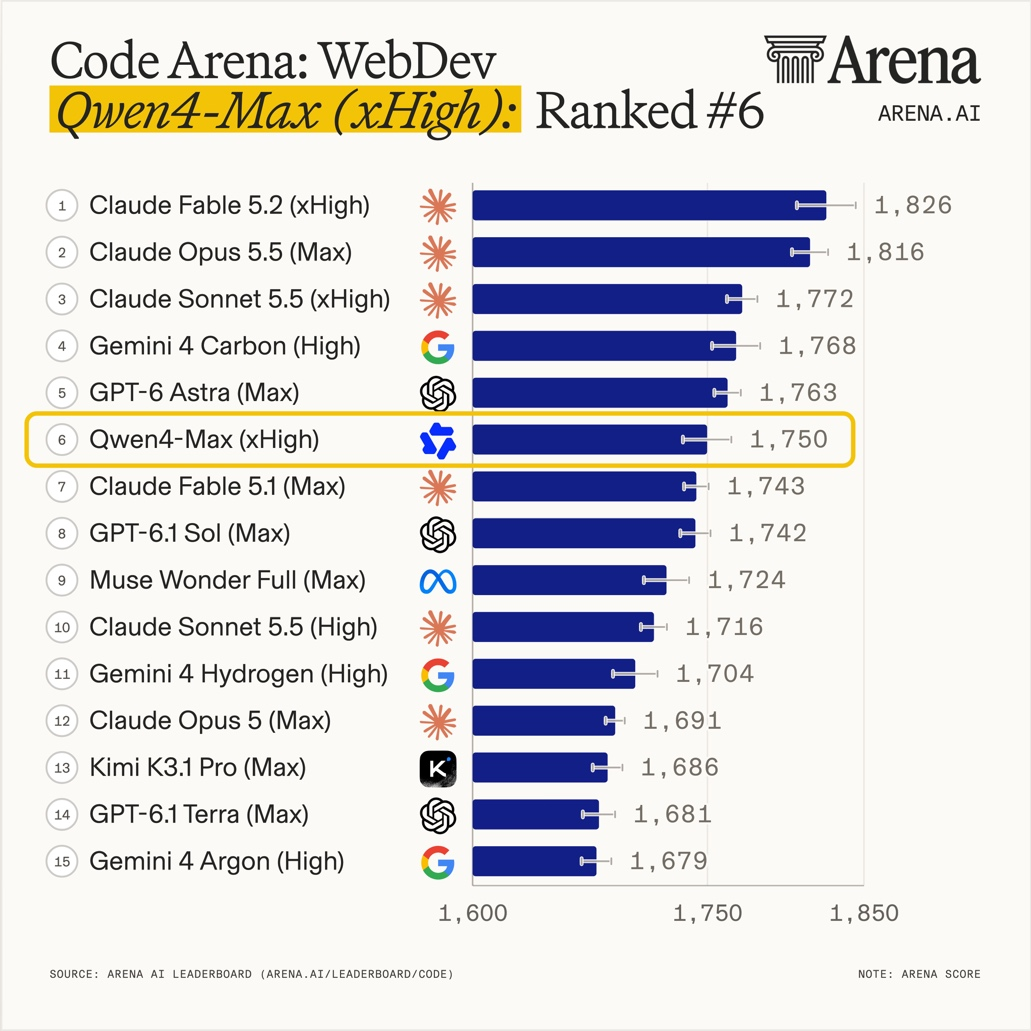
Alibaba launches Qwen4-Max, a 2.4T-parameter MoE model with 1M context
Alibaba released Qwen4-Max, a new flagship 2.4T-parameter mixture-of-experts model with native vision and a 1M-token context window, available via API on the Qwen AI platform. The company claims it outperforms Qwen3.8-Max with up to ~50% fewer tokens per task and lower costs, while smaller open-weight versions are planned. Independent benchmarks show it scores 43 on the Artificial Analysis Intelligence Index, trailing Kimi K3.1 Pro but at lower cost per task.
7 reports · 4 sources879 points · 485 comments
Thinking Machines releases open-weights Inkling 2 Mini, a 26.4B looped transformer
Thinking Machines Lab released Inkling 2 Mini, an open-weights 26.4B-parameter multimodal transformer that loops its middle layers three times per token, with 5.4B active parameters and a 1M-token context window. vLLM announced day-0 support, and Artificial Analysis reports it matches Qwen3.8 27B on its Intelligence Index with about 5x fewer active parameters.
4 reports · 3 sources

NES 6502 CPU Emulator Runs Inside Qwen3.5-4B Model Weights
Drew Breunig built a working NES 6502 CPU emulator inside the weights of Qwen3.5-4B, inspired by qwenputer by Divyansh Agrawal. The emulator can run NES ROMs such as Super Mario Bros, albeit very slowly. Breunig shared the Opus 5.5 prompts used to create the system, which involved exploring chip and RAM emulation techniques and using NES CPU conformance tests.
News updates every hour. Subscribe in your RSS reader to get new stories automatically.
Subscribe