BAAI AREX-2: 27B model beats larger rivals on ML, algorithm benchmarks
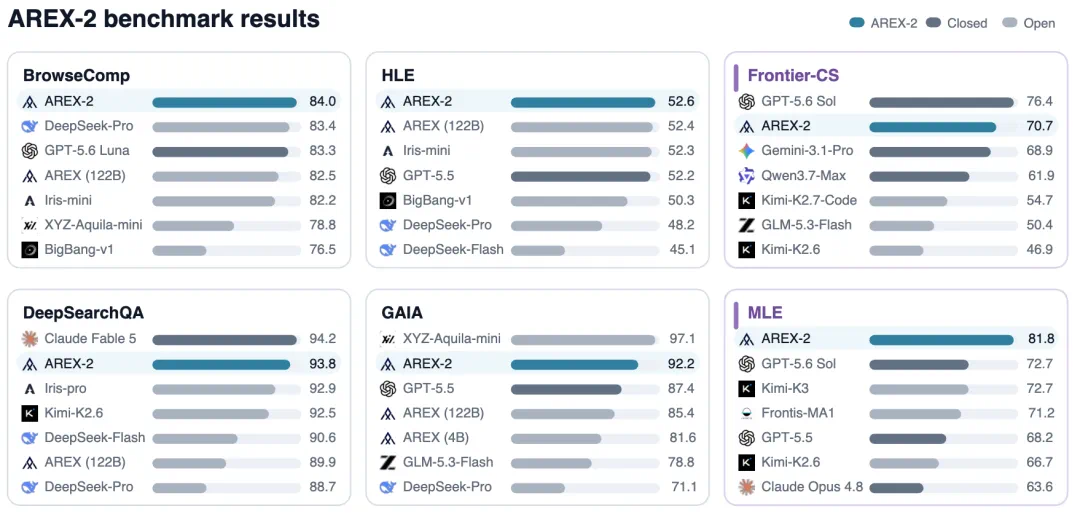
The AREX research group, involving BAAI, USTC, and Renmin University, released AREX-2, a 27B-parameter model built on Qwen3.8-27B and trained on long-horizon reflection data for machine learning and algorithm programming. It outperforms larger models on MLE-bench Lite and Frontier-CS, and sets open-weight records on BrowseComp and HLE, suggesting that long-horizon reflection training can foster cross-domain self-improvement capabilities.
Coverage timeline
机器之心机器之心
当模型学会持续迭代改进算法,便推开了通往智能自主进化的大门。 近日,由来自智源研究院、中国科技大学、中国人民大学等多个机构的研究人员组成的 AREX 研究小组发布 AREX-2 模型。该模型以轻量级的 Qwen3.8-27B 为基座,基于围绕机器学习与算法编程场景构建的长程反思数据训练而成,不仅在 MLE-bench Lite、Frontier-CS 上展现出领先的机器学习与算法编程能力,更将这种能力迁移至深度研究与科学问题求解,在 BrowseComp、HLE 等重要基准上刷新了开源轻量模型的最佳表现。这些结果表明,长程反思训练有望帮助模型习得跨领域的自我改进能力,让更多测试时投入持续转化为更好的结果,为 RSI 提供一条可训练、可验证的实现路径。 九月的前三周,GPT-6 Astra、Fable 5.1 等旗舰模型接连登场。当人们还在惊叹于 Claude 用 11 天、1300 万行代码完成费马大定理的首个形式化证明时,仅仅四天后,OpenAI 就宣布,其模型可能解决了另一道数学难题 —— 千禧年大奖难题之一的 Navier–Stokes 方程问题。新模型不断涌现,一次次刷新人们对智能边界的想象,也让一个问题愈发引人关注:模型能否持续改进自身,从而走得更远? 递归自我改进(Recursive Self-Improvement,简称 RSI)由此成为研究者、创业者和投资人共同关注的方向。但热议之下,一个基本问题仍有待回答:究竟什么是 RSI,又该如何培养和衡量这种能力? AREX 团队给出了一个具体的切入点:在单次任务中,让智能体在测试时通过持续反思与迭代,不断改进自身的解题方案。从这一视角看,RSI 并不神秘,而是一种新的测试时扩展(test-time scaling)范式 —— 让更多轮次的投入,持续转化为更好的结果。 这一能力的核心,在于 反思与长程 。前者决定每一轮改进的质量,后者决定改进能够持续多久。二者如同复利中的收益率与时间,共同影响最终的回报。而培养这种能力的关键,是让模型从训练数据中学会 “如何持续改进”。 AREX 团队进一步提出:长程反思是一种可以跨领域迁移的元能力。如果能找到合适的训练场,模型便有望将在一个领域习得的改进方法,运用到其他领域。为此,团队选择了机器学习与算法编程两个场景:它们既有丰富的任务素材,也能提供清晰、可验证的环境反馈,
Related stories
Reflection AI unveils open-weight model Beam, claims lower compute and near-Qwen3.8-Max performance
Reflection AI, backed by Nvidia, has unveiled its first open-weight model, Beam, claiming it excels at coding and agentic tasks while using 3x-4x less compute than comparable models. The company says Beam's reasoning performance nears Qwen3.8-Max and rivals GLM-5.2 at lower inference compute, with weights expected to be released this month.
2 reports · 2 sources
Meta releases Muse Spark Open, an 816B-parameter open-weight model optimized for Apple silicon
Meta released Muse Spark Open, an open-weight multimodal mixture-of-experts model with 816B total and 42B active parameters and a 1M-token context window, claiming it is the most capable US open-weight model. Optimized for Apple silicon via MLX, it can run locally on two M5 Ultra Mac Studios, with day-0 support from vLLM and other inference engines.
6 reports · 6 sources

Microsoft unveils MAI-Base-2 MoE model with 2.8T total parameters
Microsoft AI announced MAI-Base-2, a mixture-of-experts model with 2.8 trillion total parameters and 80 billion active parameters. The company claims it achieves 4x-12x greater pretraining FLOPs-efficiency compared to DeepSeek-V4-Pro-Base. This follows the June announcement of MAI-Thinking-1, a reasoning model post-trained on MAI-Base-1.
1 reports · 1 sources
Liquid AI releases LFM2.5-24B-A2B, an open-weight 24B reasoning model with 2B active parameters
Liquid AI announced LFM2.5-24B-A2B, an open-weight 24B reasoning model with 2B active parameters, designed for fast, private on-device agents. The company claims it outperforms Qwen3.6-35B-A3B on the LiveClaw benchmark.
2 reports · 2 sources287 points · 80 comments
News updates every hour. Subscribe in your RSS reader to get new stories automatically.
Subscribe