OpenAI launches BioBasicsBench, 100-task benchmark for AI wet-lab agents
OpenAI has introduced BioBasicsBench, a benchmark comprising 100 tasks that evaluate how well AI agents interpret raw experimental data and perform everyday wet-lab science. The benchmark is designed to measure agent capabilities in handling real-world laboratory workflows.
Coverage timeline
OpenAI Blog
OpenAI introduces BioBasicsBench, a 100-task benchmark measuring how well AI agents interpret raw experimental data and handle everyday wet-lab science.
Related stories
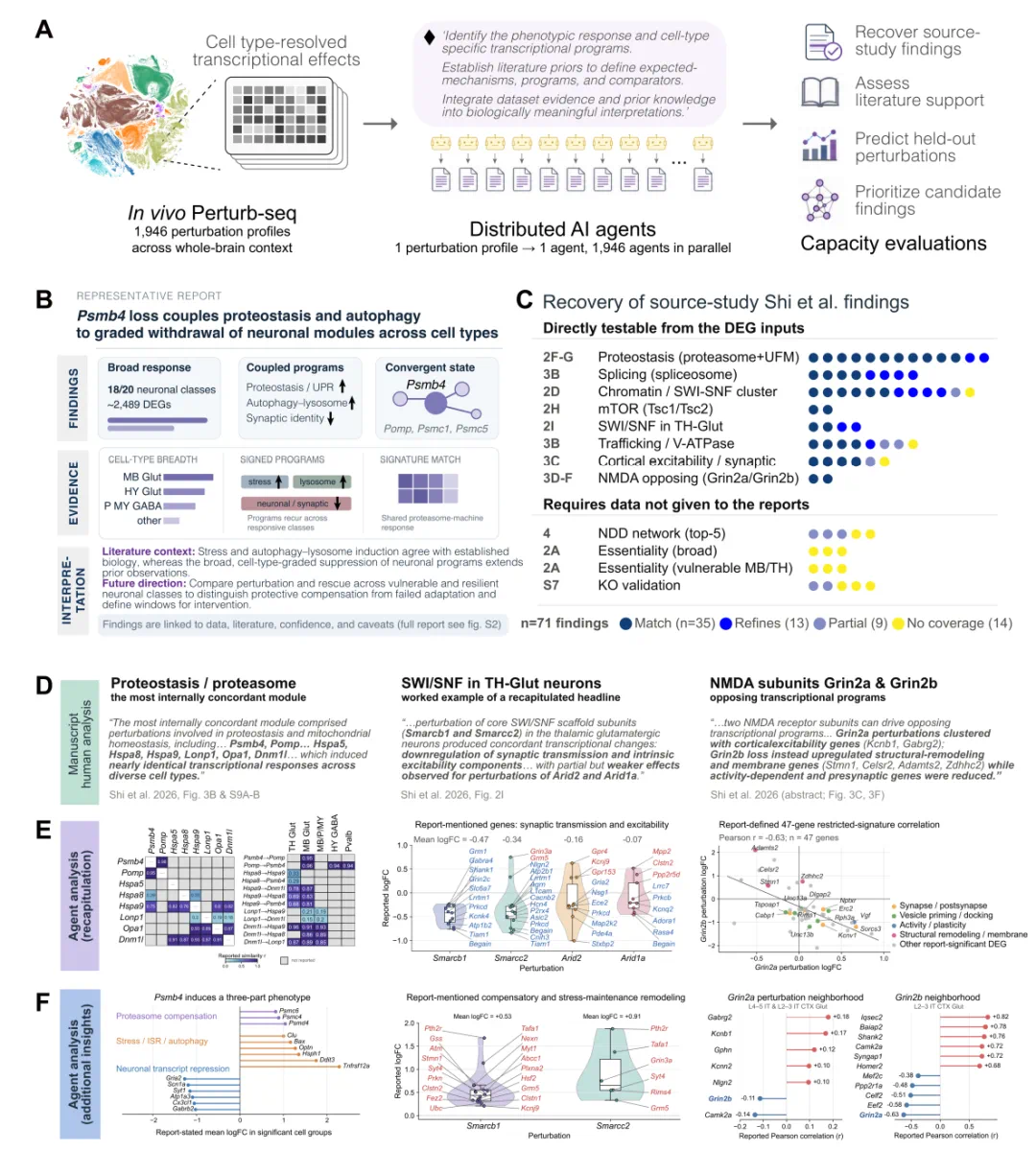
OpenAI, PerturbAI, Scripps deploy thousands of AI agents to analyze brain-cell CRISPR atlas in 32 minutes
On October 21, 2026, OpenAI, PerturbAI, and Scripps Research announced a study using thousands of AI agents powered by the GPT-Rosalind architecture to analyze a whole-mouse-brain CRISPR perturbation atlas. The distributed workflow completed in 32 minutes, a task estimated to take human researchers months to a year, and aggregated results into a structured reasoning atlas linking gene perturbations to cellular responses and literature.
2 reports · 2 sources159 points · 105 comments
DeepSeek open-sources Super-agent architecture for autonomous bug-fixing agents
DeepSeek has publicly released the architectural blueprint for its Super-agent, a research prototype of a personal agent that maintains cross-session context to handle multi-task coordination. Internal tests show the agent can autonomously identify bugs and submit pull requests without being explicitly prompted, with a median task completion time of 12.4 minutes in simulated multi-task environments. DeepSeek positions this as a step toward reducing human attention bottlenecks in multi-task workflows.
3 reports · 3 sources

Realtime-Bench: Frontier LLMs achieve only 44% success on real-time interactive tasks
Researchers from NVIDIA, UT-Austin, and other institutions released Realtime-Bench, a benchmark of 50 interactive game and web tasks that require real-time decision-making. Testing 12 frontier models, the best performer (GPT-6-Astra) achieved only 44% success, highlighting LLMs' weakness in low-latency tasks.

Fudan, Tencent Hunyuan, Tsinghua Release ExplorationBench to Test AI Rule Discovery
Fudan University, Tencent Hunyuan, and Tsinghua University released ExplorationBench, a benchmark measuring how AI systems discover rules in unfamiliar environments. It includes two altered 'alien worlds'—the programming language AlienCode and the logic proof system AlienLogic—where models must learn rules through trial and error. Results showed that without environment feedback, scores remained low (max 11.0%), while autonomous exploration led to high scores (up to 89.0%).

News updates every hour. Subscribe in your RSS reader to get new stories automatically.
Subscribe