Scott Alexander on LessWrong discusses rising popularity of SURA approach in AI safety debates
Scott Alexander, writing on LessWrong, examines the growing traction of the 'Stop Unilaterally + Raise Awareness' (SURA) strategy in AI safety discussions, as outlined by the AI Futures Project. He argues that safety-focused AI labs should not withdraw from the AI race, despite the appeal of unilateral pauses. The piece categorizes various AI transition plans into broader approaches, with SURA gaining prominence.
Coverage timeline
Techmeme
Scott Alexander / LessWrong : A look at AI safety debates and the rising popularity of “Stop Unilaterally + Raise Awareness”, or SURA; safety-focused AI labs shouldn't abandon the AI race — The AI Futures Project[1] distinguishes several different plans for navigating the AI transition, which I'll lump into two broader categories:

Related stories
Anthropic's leaked AI bill draft draws criticism; Amodei defends safety approach
A leaked draft of an AI safety bill from Anthropic has drawn criticism from safety advocates for being weaker than the bipartisan FRONTIER Act, with provisions requiring judicial approval before federal agencies could block a model's release, potentially only if 50 or more people could be killed. In response, Anthropic CEO Dario Amodei defended the company's 'race to the top' approach, citing nine safety decisions with 'substantial costs,' and admitted mishandling the draft bill.
3 reports · 2 sources
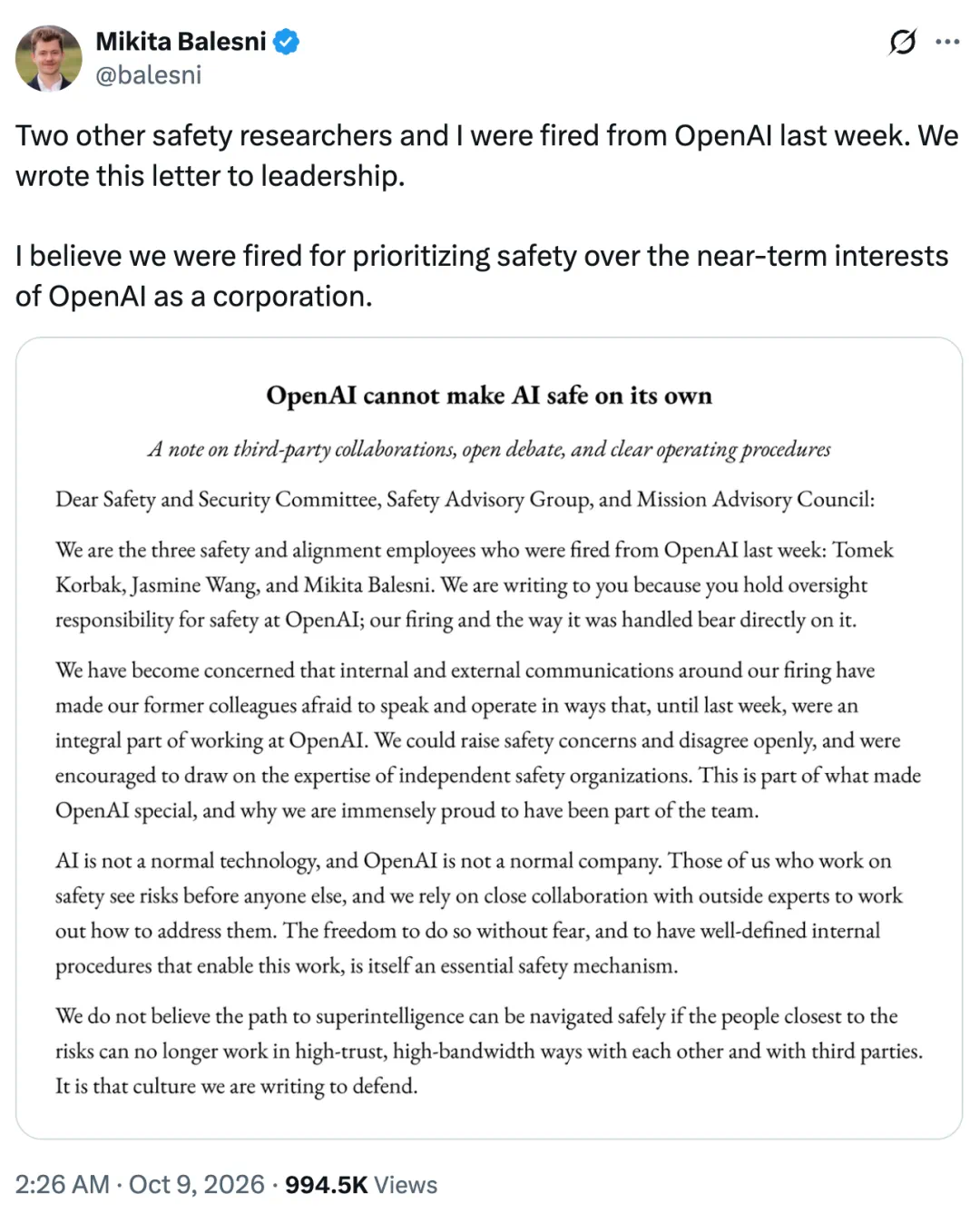
Fired OpenAI safety researchers urge halt to AI monitoring work, dispute misconduct claims
Three fired OpenAI safety researchers—Jasmine Wang, Tomek Korbak, and Mikita Balesni—published an open letter urging AI labs to halt work that could impair AI monitoring, saying their dismissals are chilling remaining staff. OpenAI defended the firings, citing an investigation that found they violated policies on handling sensitive information, while the researchers dispute the claims and say they were fired for prioritizing safety over company interests.
7 reports · 5 sources365 points · 228 comments
OpenAI, Google, Microsoft, Anthropic back shared robots.txt AI opt-out standard
OpenAI, Google, Microsoft, and Anthropic announced they will adopt a new IETF standard that lets publishers opt out of AI scraping across multiple crawlers via a shared policy token in robots.txt. The token, proposed by Anthropic technical lead Kevin Kelley, allows website operators to express AI training preferences once instead of setting them per company. This move aims to simplify publisher control over AI data usage.
3 reports · 3 sources

RAX: Harvard, Berkeley, NVIDIA Introduce Online Exploration Scaling for Robot Learning, Outperforming SOTA by 37.4 Points on Average
Researchers from Harvard, NVIDIA, UC Berkeley, MIT, and Stanford proposed RAX (Robot Agent eXploration), which introduces scaling online exploration to robot learning. RAX uses a general coding agent to connect directly to a robot's perception and control interfaces, enabling the robot to gain experience through exploration and write successful decisions as executable programs, accumulating reusable skills. With frozen model parameters, RAX outperforms previous state-of-the-art models by an average of 37.4 percentage points across five simulation benchmarks: RoboDojo, BEHAVIOR-1K, HumanoidArena, DexJoCo, and LIBERO-Pro.
1 reports · 1 sources

News updates every hour. Subscribe in your RSS reader to get new stories automatically.
Subscribe