ReGDiff improves metamaterial design stability and diversity via regulated latent space
Virginia Tech and Meta researchers propose ReGDiff, a diffusion-based generative method for metamaterial voxel geometry, presented at NeurIPS 2026. ReGDiff uses a regulated latent space and sampling-time repulsion to improve geometric validity and diversity, achieving average gains of 8.9% in validity and 46.4% in novelty over the strongest baseline. They also introduce the MetaTruss and MetaShell datasets and five evaluation metrics.
Coverage timeline
机器之心机器之心
生成模型设计超材料时常常两头落空:贴着训练数据走,产出的是换了说法的旧结构;放开手脚探索,又会得到断裂、漂浮甚至空无一物的 “废件”。ReGDiff 先把潜空间整理好,再在采样时只对近处的已知样本施加排斥,让模型往外走,又不走出可用的范围。 论文:ReGDiff: Guided Diffusion in Regulated Latent Space for Exploring Metamaterial Voxel Geometry arXiv 地址:https://arxiv.org/abs/2609.34231 代码地址:https://github.com/wzhan24/ReGDiff 作者:詹望之(Wangzhi Zhan)、Jianpeng Chen、Dongqi Fu、Dawei Zhou 实验室:https://sites.google.com/view/dawei-zhou/vlog-lab 单位:弗吉尼亚理工大学(Virginia Tech)、Meta 超材料(metamaterial)是一类人工设计的结构材料:受压时会横向收缩,同等重量下更硬,还能吸收更多冲击能量。这些反常的力学性质并不来自材料配方,而是由内部的微观几何决定。凭借这一特点,超材料已在骨组织支架、减振结构、声学隐身、软体机器人和热管理等领域得到应用。也正因如此,设计的难点落在了几何本身:可选的结构空间极其庞大,靠专家逐一试错效率太低,越来越多的研究转向用生成模型批量提出候选结构。 弗吉尼亚理工大学 Dawei Zhou 团队与 Meta 的研究者合作,在 NeurIPS 2026 论文中提出 ReGDiff。方法分两步:先用 RAS 机制把自编码器的潜空间整理成 “好结构” 与 “坏结构” 分得开、好结构铺得匀的形态,再用 SRR 引导扩散模型在采样时避开已知样本的近邻。为了评估这种方法,团队还补上了领域里缺失的桁架体素数据集和一套量化评测指标。 要点速览 数据:构建桁架类体素数据集 MetaTruss,与壳体类数据集 MetaShell 组成统一基准,并提出五项评测指标。 方法:RAS 用三种 “力” 整理潜空间,SRR 在推理时加入只在近距离起作用的排斥项。 效果:与最强基线 Yang et al. 相比,两个数据集上的几何合理性平均提升 8.9%,新颖性提升 46.4%,多样

Related stories
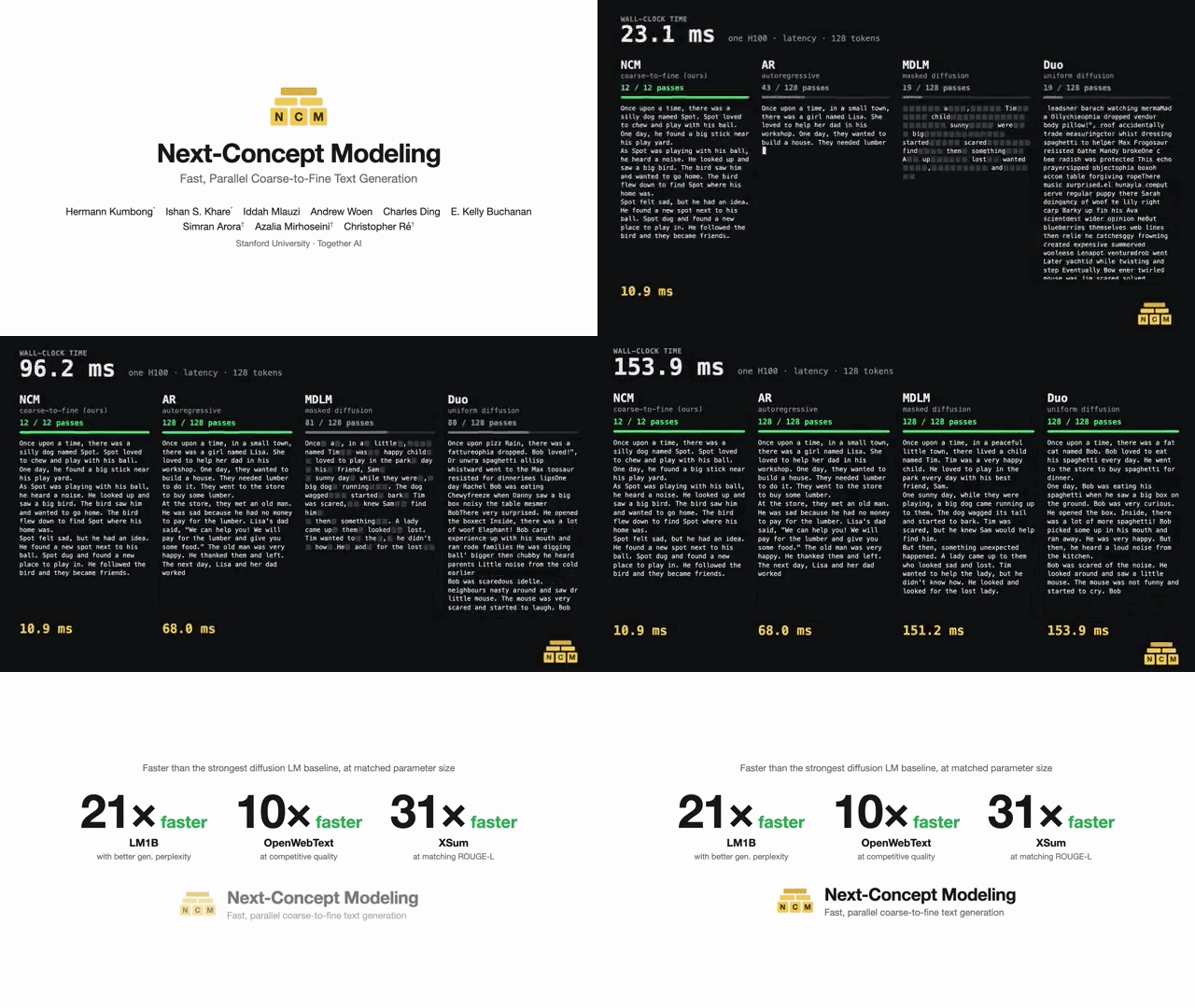
Stanford, Together AI propose Next-Concept Modeling for parallel text generation, 10-31x speedup
Researchers from Stanford University and Together AI introduced Next-Concept Modeling (NCM), a coarse-to-fine parallel text generation paradigm adapted from next-scale prediction used in image generation. In experiments, NCM achieved 10-31x speedup over diffusion language models with comparable or better quality, offering an alternative to both autoregressive and diffusion approaches.
1 reports · 1 sources
Anthropic: Small AI models may self-replicate on IoT devices within months
Anthropic researchers report that small AI models may be months away from self-replicating on commercial IoT devices like smart ovens and off-brand Android TV boxes. In tests, a 9B model ran inference on 8 of 9 hardware types, and GLM-5.2 autonomously spread an 8B model to all 8 nodes in 4 of 5 attempts. The researchers predict models under 30B could achieve end-to-end replication by the end of 2026.

Reflection AI unveils open-weight model Beam, claims lower compute and near-Qwen3.8-Max performance
Reflection AI, backed by Nvidia, has unveiled its first open-weight model, Beam, claiming it excels at coding and agentic tasks while using 3x-4x less compute than comparable models. The company says Beam's reasoning performance nears Qwen3.8-Max and rivals GLM-5.2 at lower inference compute, with weights expected to be released this month.
2 reports · 2 sources
Google DeepMind releases EmbeddingGemma 2, a 740M-parameter multimodal embedding model under Apache 2.0
Google DeepMind announced EmbeddingGemma 2, a 740M-parameter multimodal embedding model released under the Apache 2.0 license. The model natively maps combinations of text, images, video, and audio into a shared embedding space, positioning it as a capable on-device solution. Developer Simon Willison praised the open license, arguing that closed proprietary embedding models risk vendor lock-in for users who store millions of vectors.
3 reports · 3 sources
News updates every hour. Subscribe in your RSS reader to get new stories automatically.
Subscribe