MoRI UMBP Runs Agentic KV Cache on NVMe, Within 1% of DRAM on AMD MI355X
A vLLM blog reports that MoRI UMBP, an agentic KV cache pool, runs on NVMe and matches DRAM performance within 1% on AMD Instinct MI355X GPUs for Kimi-K3. The blog also notes that NVMe drives holding a day of agent KV cost less than DRAM holding 31 minutes.
Coverage timeline
vLLM BlogAMD and Embedded LLM
On AMD Instinct™ MI355X GPUs, a MoRI UMBP KV pool on NVMe matched a DRAM pool of the same size within 1% for Kimi-K3 on vLLM, and drives that hold a day of agent KV cost less than DRAM that holds 31 minutes.
Related stories
vLLM Adds Day-0 Support for Kimi K3.1 Pro with Sparse Attention and Packed KV Cache
vLLM announced day-0 support for Kimi K3.1 Pro, enabling sparse attention on a KDA hybrid, a packed KV cache with FP8 or NVFP4 latents and MXFP4 index keys, token-sharded prefill, decode context parallelism, and fused low-latency decode. This integration allows users to run the model immediately upon release with optimized performance.
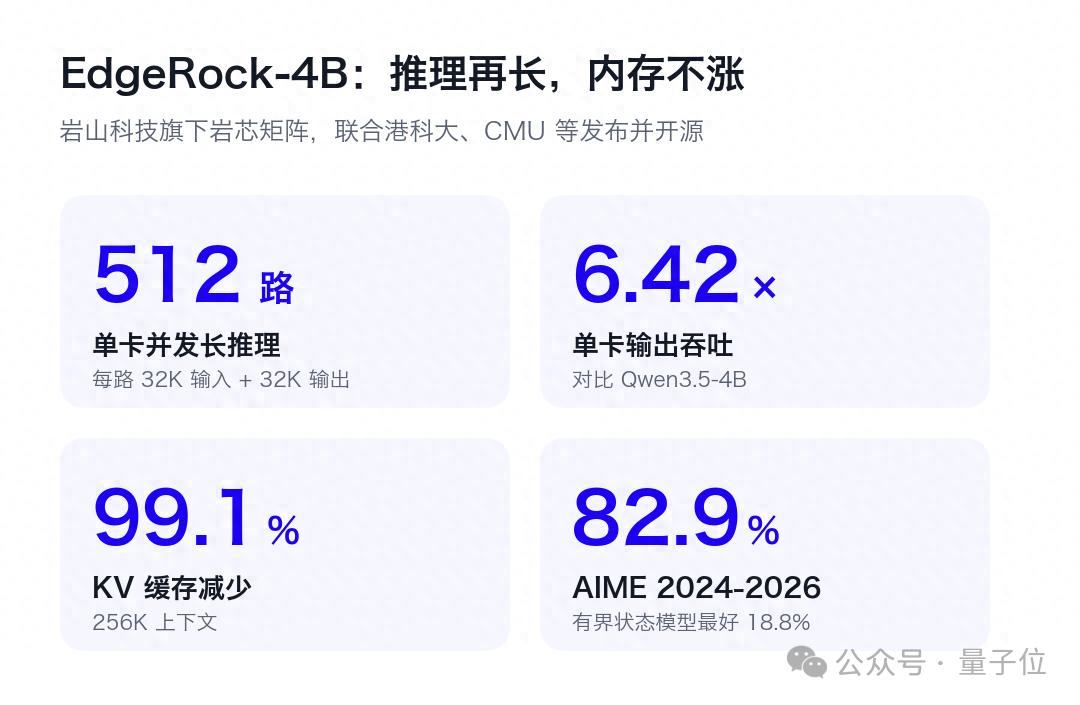
EdgeRock-4B open-weight model cuts KV cache 99.1%, boosts throughput 6.42x
Rock Matrix (a unit of Yandex? no, 岩山科技) together with HKUST and CMU released and open-sourced EdgeRock-4B, an open-weight model that keeps KV cache fixed at 72MiB from 4K to 256K context, a 99.1% reduction versus the source model. On a single 80GB GPU it runs 512 concurrent long-context inferences at 12,124 tokens/s output throughput, 6.42x the source model, while retaining an 82.9% average pass rate on AIME 2024-2026, far above the best bounded-state model at 18.8%. The model supports text and image inference, with weights and code open-sourced.
1 reports · 1 sources
vLLM Introduces REINFORCE Zero for Bit-Aligned Async RL on DeepSeek-V4.1-Flash and Kimi K3.1
The vLLM blog announced REINFORCE Zero, an asynchronous reinforcement learning method that aligns rollout and training kernels bit-for-bit to eliminate mismatch, using unclipped importance sampling to correct stale-weight lag. The approach is applied to DeepSeek-V4.1-Flash, Kimi K3.1, and AMD MI355X.
Tsinghua and CUHK propose Cache Engineering, open-source AKV to cut inference costs
Researchers from Tsinghua University and the Chinese University of Hong Kong proposed Cache Engineering, an approach that lets agents directly manage KV cache instead of compressing context, and open-sourced the inference system AKV. In evaluations across three models and four agent tasks, Cache Engineering reduced average inference costs by 27.7% and improved average task success by 1.7% compared to Context Engineering.
1 reports · 1 sources
News updates every hour. Subscribe in your RSS reader to get new stories automatically.
Subscribe