Stanford's OpenWAM framework isolates design choices in world-action models
Stanford researchers led by Li Fei-Fei, Jiajun Wu, and Ehsan Adeli released OpenWAM, an open framework for composable world-action models, aiming to systematically isolate which design choices drive performance gains. The release follows Black Forest Labs' open-source FLUX 3 Action, a 7B world-action model that surpassed Cosmos 3 Nano on Nvidia's RoboLab-120 leaderboard with less than half the parameters.
Coverage timeline
机器之心机器之心
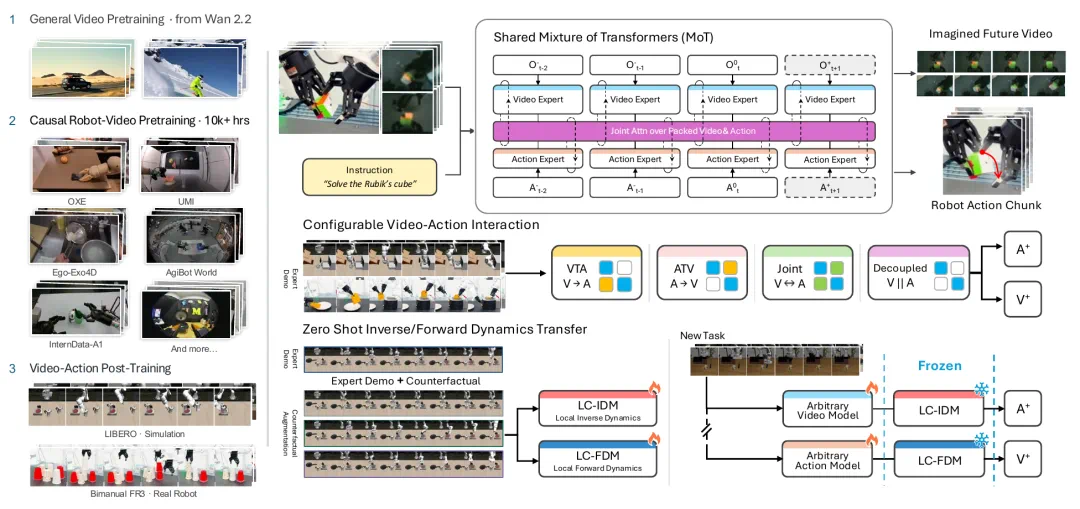
编辑|Panda 9 月 22 日,以 FLUX 图像模型闻名的 Black Forest Labs 跨界发布了开源 7B 世界动作模型 FLUX 3 Action。据其官方博客,该模型在英伟达 RoboLab-120 榜单上超过了此前最强的开源模型 Cosmos 3 Nano,参数量却不到后者一半。一家做图像生成的公司跑来卷机器人控制,说明 视频模型里积累的「物理直觉」正被越来越多的团队当作机器人大脑的底座 。 这条路线即所谓 世界动作模型(World-Action Model,WAM) 。自今年 2 月英伟达在 DreamZero 论文中明确提出这一术语以来,相关论文快速涌现。但热闹背后有个尴尬的问题:这些系统几乎都同时换了视频骨干、训练数据、视频与动作的交互方式和推理流程,谁也说不清究竟是哪个设计带来了提升。 本周,斯坦福大学李飞飞、吴佳俊、Ehsan Adeli 等人的团队发布论文,提出开放的世界动作建模框架 OpenWAM ,试图给这个问题一个系统性的回答。 OpenWAM 框架总览:三阶段训练、共享 MoT 架构、四种可配置交互方式,以及可冻结复用的局部动力学模型。 论文标题:OpenWAM: An Open Framework for Composable World-Action Models 论文地址:https://arxiv.org/abs/2610.07922 项目主页:https://openwam.stanford.edu 代码仓库:https://github.com/OpenWAM/OpenWAM 为什么需要一张「统一考卷」 传统的视觉-语言-动作模型(VLA)像一个凭条件反射开车的司机,看到画面、听到指令就直接给出动作。 WAM 则多了一步「脑内预演」: 同时预测接下来几秒画面会怎样,以及为此该怎么动 。视频天然记录了物体如何下落、碰撞和被推动,用海量视频预训练过的模型因此自带物理先验。 问题在于,「预测画面」和「生成动作」可以有很多种耦合方式:先想象再动作,先动作再想象后果,两者同时生成,或者各算各的。各家选择不同、底座和数据也不同,放在一起比较,就像几位厨师同时换了食材、灶具和下锅顺序,很难判断菜好吃究竟归功于哪一步。 第二个问题更隐蔽。机器人训练数据大多是成功示范,只告诉模型「正确的路怎么走」,几乎不包含「手多伸出去两厘米会怎
Related stories
FAME: Flow-Driven Multi-Anchor Exploration for Active 3D Mapping Accepted as NeurIPS 2026 Spotlight
Researchers from Tianjin University and Hefei University of Technology proposed FAME, a flow-driven multi-anchor exploration method for open-environment active 3D mapping. Unlike traditional methods that predict a single exploration goal, FAME uses Conditional Flow Matching to generate multiple possible goals, combined with path planning, exploration mode clustering, and hierarchical selection. The paper was accepted as a Spotlight at NeurIPS 2026, with 292 out of 7,900 accepted papers selected for this distinction.
1 reports · 1 sources

RAX: Harvard, Berkeley, NVIDIA Introduce Online Exploration Scaling for Robot Learning, Outperforming SOTA by 37.4 Points on Average
Researchers from Harvard, NVIDIA, UC Berkeley, MIT, and Stanford proposed RAX (Robot Agent eXploration), which introduces scaling online exploration to robot learning. RAX uses a general coding agent to connect directly to a robot's perception and control interfaces, enabling the robot to gain experience through exploration and write successful decisions as executable programs, accumulating reusable skills. With frozen model parameters, RAX outperforms previous state-of-the-art models by an average of 37.4 percentage points across five simulation benchmarks: RoboDojo, BEHAVIOR-1K, HumanoidArena, DexJoCo, and LIBERO-Pro.

Oxford, Monash, Bristol Researchers Propose Oneira Interactive Video World Model
Researchers from Oxford, Monash, and Bristol universities propose Oneira, an interactive video world model that separates world state from visual rendering. A Coding Agent maintains a World State Table to record object positions and states, enabling precise, persistent object changes even when the camera moves away and back. The model addresses limitations of existing video world models that lack explicit state tracking, leading to wrong interactions or lost modifications.

Tsinghua, Infinigence-AI, SJTU Open-Source On-Device Inference Engine APXInf for Embodied Models
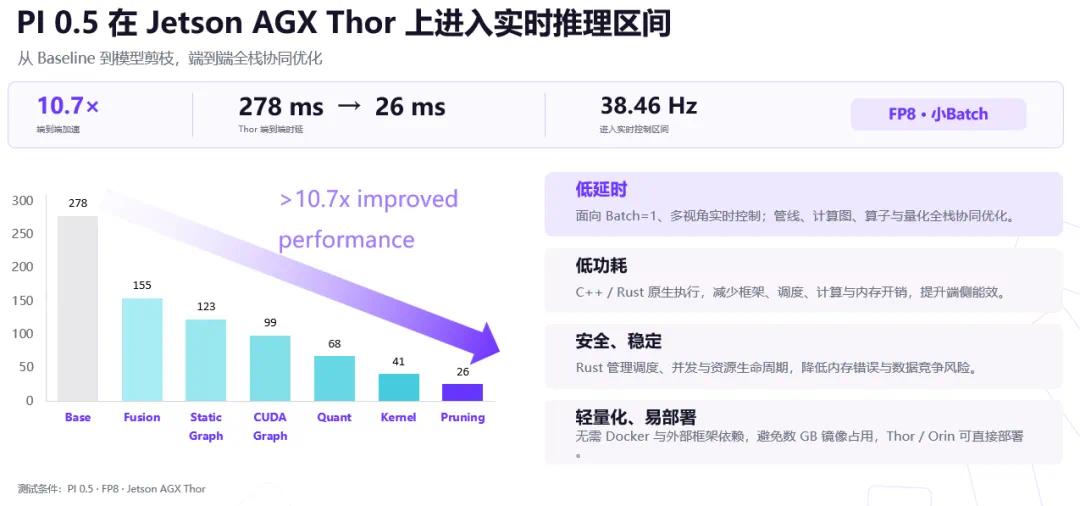
On September 15, Tsinghua University, Infinigence-AI, and Shanghai Jiao Tong University open-sourced APXInf, an on-device inference engine for embodied models. The engine reportedly achieves a 10.7x end-to-end speedup on robot hardware, reducing inference latency from 278ms to 26ms on Thor chips with FP8 configuration, enabling real-time control at 38.46Hz.
News updates every hour. Subscribe in your RSS reader to get new stories automatically.
Subscribe