Rumor: Anthropic AI Solved Navier-Stokes? Tao Denies
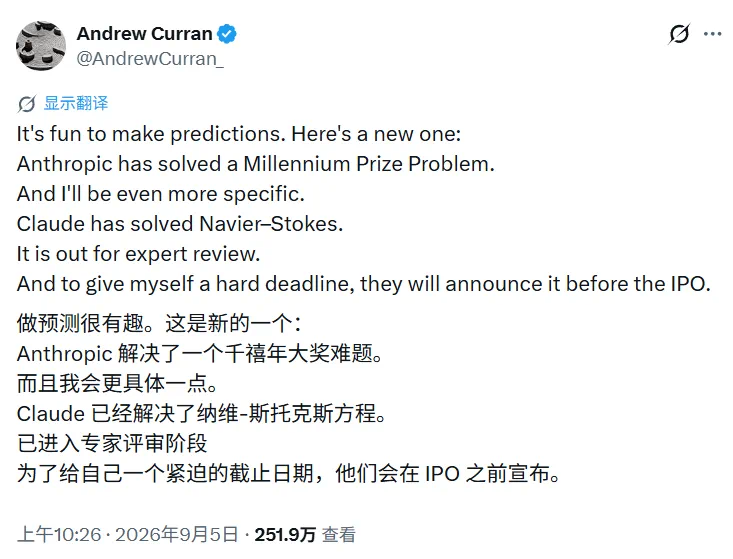
A viral rumor claims Anthropic's AI solved the Navier-Stokes existence and smoothness problem, one of the Millennium Prize Problems. The rumor originated from a speculative post by blogger Andrew Curran, following mathematician Terence Tao's thought experiment about AI solving open math problems. Tao has denied having insider information, and no paper or proof has been publicly released.
Coverage timeline
机器之心机器之心
过去一天,一条关于 Claude 的数学传闻在社交媒体上迅速扩散。 昨天,博主 Andrew Curran 发帖「预测」,Anthropic 已经解决了一个千禧年大奖难题,即纳维-斯托克斯方程相关的存在性与光滑性问题,目前成果正在接受专家评审,并可能在 Anthropic IPO 前对外公布。 这条帖子很快获得超过 250 万次浏览,也被越来越多账号转发。 截至目前,公开渠道中还看不到对应论文、证明文本或专家评审材料,Clay 数学研究所仍将纳维-斯托克斯存在性与光滑性问题列在未解决的千禧年大奖难题中。 不过,这条传闻并非空穴来风。它的一个重要背景,来自数学家陶哲轩两天前发布的一组帖子。 一篇关于 AI 的假想 9 月 3 日,陶哲轩以纳维-斯托克斯方程为例,讨论 AI 解决重大开放数学问题之后,可能给数学研究带来的影响。 https://mathstodon.xyz/@tao 纳维-斯托克斯方程描述水、空气等流体如何运动。数学家真正悬而未决的问题,是三维不可压缩情况下,从光滑初始状态出发,解能否始终保持光滑,还是会在有限时间内形成奇点。这个问题已经被 Clay 数学研究所列为千禧年大奖难题,奖金为 100 万美元。 陶哲轩在帖子里设想了一种未来可能出现的研究流程:自主 AI 系统拥有大量计算资源,可以持续尝试不同的数学构造,分析失败原因、调整方案、验证结果,最终形成一个极其复杂的候选证明,并用 Lean 等形式化证明系统完成机器验证。 他的重点是这个过程中产生的数学知识如何保存下来。 在传统数学研究中,一个困难问题往往会在多年探索中产生大量副产品:新的引理、新的工具、新的研究方向,以及之后值得继续研究的问题。陶哲轩担心,如果 AI 在封闭环境中完成整套探索,人类最终拿到一份已经验证完成的结果,很多有价值的中间路径可能很难进入数学共同体。 帖子中的场景写得相当具体:AI 搜索候选结构、进行数值检验、形成庞大的 Lean 证明文件,最后解决纳维-斯托克斯正则性问题。 于是,互联网熟悉的剧情出现了。 一些人开始猜测,陶哲轩是否掌握了尚未公开的信息。社交平台上很快出现「陶哲轩是不是在暗示 Claude 已经解决了纳维-斯托克斯」的讨论,随后 Curran 又给出了更加明确的预测:「Claude 已经解决了纳维-斯托克斯。」这一说法由此迅速传播。 随着猜测扩大,陶哲轩随后专
Techmeme
Joseph Howlett / Scientific American : Mathematician Tristan Buckmaster alleges OpenAI learned of his work with Anthropic's Levent Alpöge on Navier-Stokes and used an internal model to solve it — A mathematician compared the feat to the history-making chess competition in which IBM's Deep Blue computer beat Garry Kasparov in 1997

Related stories
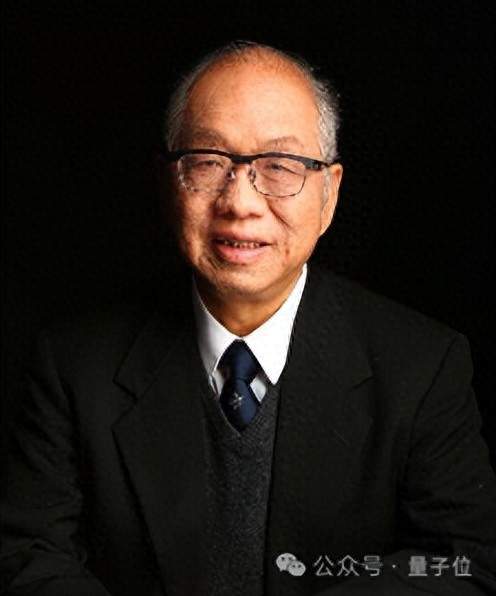
Yau Shing-Tung's paper on exotic spheres acknowledges GPT 6 Astra and Claude Pro
Mathematician Yau Shing-Tung, who once said AI could not affect top mathematicians, has co-authored a paper that thanks GPT 6 Astra and Claude Pro for helping explore proof ideas and calculations. The paper addresses a conjecture about seven-dimensional exotic spheres, listed by Yau in 1982, and provides an answer to whether these spheres can have positive sectional curvature everywhere.
1 reports · 1 sources
OpenAI forms independent math advisory group for AI results
OpenAI announced it is working with an independent Advisory Group on Mathematics and Artificial Intelligence (AGMAI) to guide the review and communication of emerging AI mathematical results. The group will advise on the evaluation and publication of internal models' results, including over 100 claimed solved open problems, though the group won't have authority to slow or redirect research. The move follows a reputational crisis over OpenAI's mathematical results and caught many mathematicians by surprise.
4 reports · 4 sources77 points · 67 comments

Nature explores 'Einstein test': AI confined to 1900 knowledge hints at light quanta
Nature reports on the 'Einstein test', proposed by Google DeepMind co-founder Demis Hassabis, which challenges AI to rediscover physics theories using only historical knowledge. Independent researcher Michael Hla trained GPT-1900 on 22 billion tokens with a knowledge cutoff of 1900, and the model produced a passage highly similar to Einstein's 1905 light quantum paper, though it failed most physics tasks.
OpenAI's Noam Brown Discusses Multi-Agent Systems and Navier-Stokes in Podcast
In a Dwarkesh Podcast episode, OpenAI researcher Noam Brown discussed multi-agent systems, AI solving the Navier-Stokes problem, and the gap between internal and external models. Brown emphasized the importance of not underestimating AI capabilities.
1 reports · 1 sources
News updates every hour. Subscribe in your RSS reader to get new stories automatically.
Subscribe