Google DeepMind unveils SynthID Bio to watermark AI-designed proteins
Google DeepMind introduced SynthID Bio, a proof-of-concept family of watermarking methods for AI-generated proteins, aimed at supporting biosecurity and scientific integrity. The methods are designed to mark AI-designed proteins while preserving their biological function.
Coverage timeline
Google DeepMind Blog
Proof of concept for watermarking AI-generated proteins while preserving biological function.
Techmeme
John Timmer / Ars Technica : Google DeepMind introduces SynthID Bio, a family of watermarking methods for AI-designed proteins to help with biosecurity and scientific integrity — AI-based tools seem to be causing security threats on a nearly daily basis, in part because we've been slow to recognize potential threats.

Related stories
ByteDance Seed's Recycler recycles hidden states to boost reasoning efficiency
ByteDance Seed introduces Recycler, a model architecture that recycles hidden states across decoding steps to improve reasoning efficiency with negligible overhead. The design, motivated by the observation that a multitoken prediction head with only ~2% of backbone parameters achieves loss comparable to a standalone model ~25% its size, feeds both token embeddings and previous hidden states through a lightweight adapter into the next step. Experiments show strong parameter efficiency, particularly in reasoning and mathematics.
1 reports · 1 sources
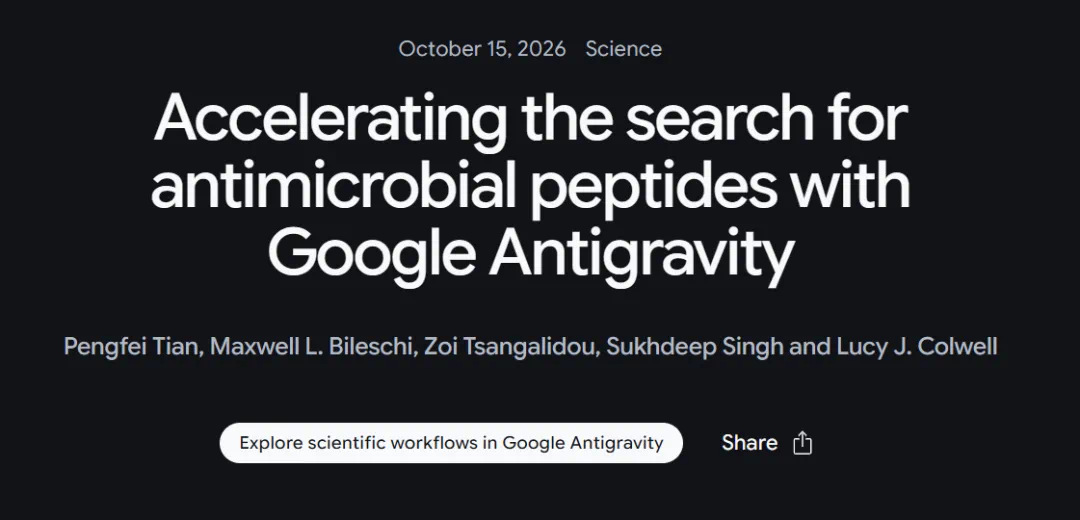
Google DeepMind Uses AI Agent Antigravity and ProtNLM to Discover Novel Antimicrobial Peptides
On October 15, Google DeepMind published a technical demo showing how its AI agent platform Antigravity and ProtNLM model can discover novel antimicrobial peptides (AMPs) from protein databases. The workflow narrowed millions of UniProt records to a candidate bacteriocin from Streptococcus pseudopneumoniae, which has entered wet-lab validation.
1 reports · 1 sources
Google launches SynthID Detector website for AI media detection
Google launched SynthID Detector, a website that allows users to verify whether images, videos, or audio clips are AI-generated, supporting dozens of common file formats. The tool aims to help people identify AI-generated media across multiple content types.
1 reports · 1 sources
Import AI 475: Swarm scaling, Google DeepMind biology watermarking, AI science economy
Import AI 475 discusses swarm scaling, noting that swarms are useful for speed due to parallelization, though they require more total tokens than single agents. The issue also covers Google DeepMind's watermarking of biology and the emerging AI science economy.
1 reports · 1 sources

News updates every hour. Subscribe in your RSS reader to get new stories automatically.
Subscribe