ByteDance Seed's Recycler recycles hidden states to boost reasoning efficiency
ByteDance Seed introduces Recycler, a model architecture that recycles hidden states across decoding steps to improve reasoning efficiency with negligible overhead. The design, motivated by the observation that a multitoken prediction head with only ~2% of backbone parameters achieves loss comparable to a standalone model ~25% its size, feeds both token embeddings and previous hidden states through a lightweight adapter into the next step. Experiments show strong parameter efficiency, particularly in reasoning and mathematics.
Coverage timeline
ByteDance Seed PapersByteDance Seed
Standard autoregressive decoding links successive steps only through sampled discrete tokens, discarding the continuous semantics encoded in previous hidden states. In contrast, recurrent multitoken prediction (MTP) heads propagate both token embeddings and hidden states across steps. Remarkably, an MTP head with only ∼ 2% of the backbone parameters achieves a loss comparable to that of a standalone model ∼ 25% its size, underscoring the value of continuous hidden state feedback. Motivated by this observation, we introduce Recycler, a simple and effective architecture that feeds both embedding and the previous token’s hidden state through a lightweight adapter into the next step, preserving richer cross-step semantics with negligible decoding overhead. We develop a complete training and inference pipeline covering pretraining, SFT, continued pretraining and RL. Experiments demonstrate strong parameter efficiency, particularly in reasoning and mathematics. Although earlier integration y
Related stories
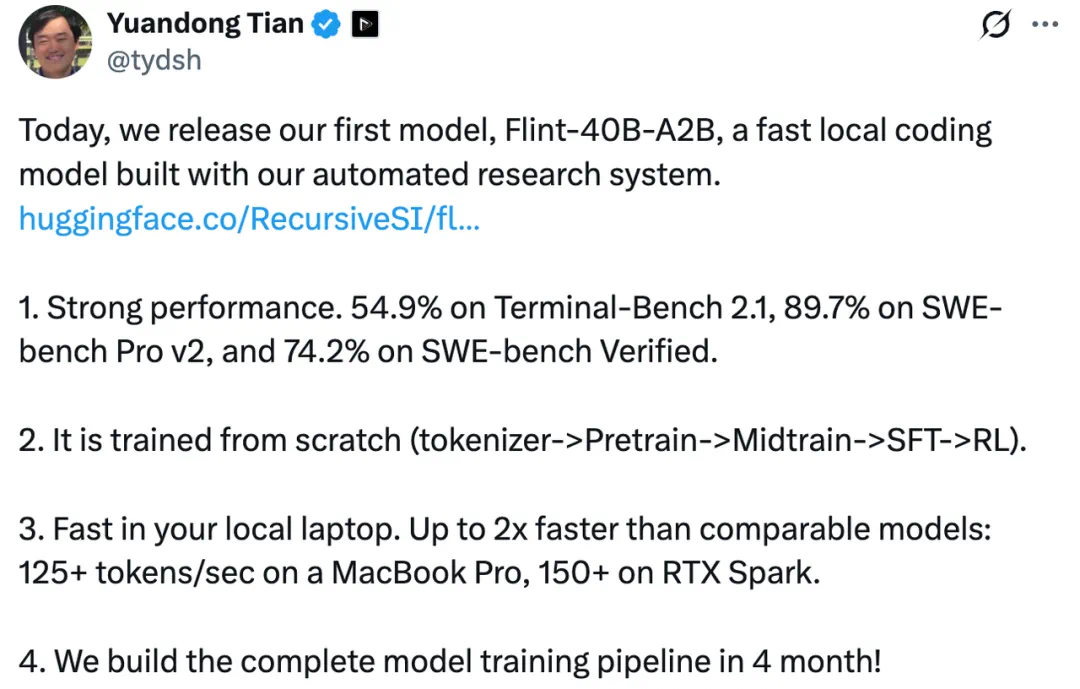
Recursive releases Flint, 40B coding model built largely by its Eureka Machine AI system
Startup Recursive has released Flint, an open-weight, 40B-parameter mixture-of-experts coding model with 2.5B active parameters per token, built in under four months with heavy automation from its Eureka Machine AI research system. The model outperforms sub-50B MoE models on coding benchmarks like SWE-Bench Pro v2 and runs at over 125 tokens per second on a MacBook Pro M4 Pro, with weights available on Hugging Face under Apache 2.0.
3 reports · 3 sources
Together AI releases HybridAgent, an LLM agent that reasons in latent space and acts through text
Together AI has released HybridAgent, an LLM agent that combines latent-space reasoning with text-based actions, along with evaluations and open-source code. The agent is designed to improve reasoning efficiency by thinking in a compressed latent space while still communicating through natural language. The release includes code on GitHub, model collections on Hugging Face, and an arXiv paper with evaluation results.
1 reports · 1 sources517 points · 238 comments
Google DeepMind unveils SynthID Bio to watermark AI-designed proteins
Google DeepMind introduced SynthID Bio, a proof-of-concept family of watermarking methods for AI-generated proteins, aimed at supporting biosecurity and scientific integrity. The methods are designed to mark AI-designed proteins while preserving their biological function.
2 reports · 2 sources
Reflection AI unveils open-weight model Beam, claims lower compute and near-Qwen3.8-Max performance
Reflection AI, backed by Nvidia, has unveiled its first open-weight model, Beam, claiming it excels at coding and agentic tasks while using 3x-4x less compute than comparable models. The company says Beam's reasoning performance nears Qwen3.8-Max and rivals GLM-5.2 at lower inference compute, with weights expected to be released this month.
2 reports · 2 sources
News updates every hour. Subscribe in your RSS reader to get new stories automatically.
Subscribe