Apple and Duke propose LensVLM, compressing long context into images with on-demand zoom
Apple's foundation model team and Duke University introduced LensVLM, a method that compresses long context into images and lets the model zoom into relevant pages on demand. In seven text QA benchmarks, it achieved 68.9% average accuracy with 4.3x effective compression, close to the 72.4% of full-text reference. The work was accepted at NeurIPS 2026, and a public 9B demo is available.
Coverage timeline
机器之心机器之心
Agent 执行长程任务时,代码、工具输出和交互记录不断累积,上下文也跟着变长。 生成摘要、压缩上下文,可以减少输入,却也可能删掉后续任务需要的细节。一段当时看起来无关紧要的记录,到了下一步,或许就是关键线索。如果模型只能看到压缩结果,就很难再把它找回来。 DeepSeek-OCR 展示了另一条路线: 让图像承载文字,用较少的视觉 token 表示文本信息 。压缩页面能够覆盖全文,但清晰度成了新的瓶颈。字符越小,模型越难辨认;压得太狠,答案就在页面上,模型却已经看不清了。 许多压缩方案对模型而言是一条单行道:压缩之后,它就无法按需回头查阅原文。那 如果给模型一个 “放大镜” 呢 ? 苹果基础大模型团队与杜克大学提出 LensVLM ,让模型先浏览覆盖全文的压缩页面,再展开与问题有关的页面。在七项文本问答评测中,它以 4.3 倍有效压缩达到 68.9% 的平均准确率 ,接近完整文本参照的 72.4%。 这项工作近期被 NeurIPS 2026 接收,在 X 上也获得了较高关注,并引发了不少关于 “将文本转化为图像进行长上下文理解” 的讨论。Hugging Face 产品负责人 Victor Mustar 在 X 上介绍了该研究,相关帖文获得约 28 万次浏览。公开的 LensVLM 9B Demo 也已上线,读者可以体验模型选页、展开与作答的过程。 论文:https://arxiv.org/abs/2605.07019 模型:https://huggingface.co/apple/LensVLM-9B 代码:https://github.com/apple-aiml-research/ml-lensvlm Demo:https://huggingface.co/spaces/hugging-apps/lensvlm-9b-demo 文字变成图,省下了什么? 语言模型通常将文字拆成文本 token;视觉语言模型则通过视觉编码器,将图像转换为视觉 token。一页图像如果容纳了足够多的文字,表示它所需的视觉 token 就可能少于直接输入原文所需的文本 token。 字号、页面尺寸和文字密度,因此都可以用来调节压缩率,无需重新设计文本词表。与先检索少量片段再阅读相比,压缩图片能够覆盖全文,让分散在不同位置的证据仍有机会被模型找到。 代价也很直接:字符越压越小,可能超出视

Related stories
Sleep framework proposed to help LLMs retain knowledge in continual learning
A research paper introduces the Sleep framework, a new method designed to help large language models retain knowledge during continual learning. The framework aims to address the challenge of catastrophic forgetting, where models lose previously learned information when trained on new tasks.
1 reports · 1 sources233 points · 33 comments
NV-CoT: Multimodal LLMs Predict Continuous Coordinates for Visual Chain-of-Thought, NeurIPS 2026 Oral
Researchers from NTU, USTC, NUS, and Microsoft propose NV-CoT (Numerical Visual Chain-of-Thought), a method that lets multimodal LLMs directly predict continuous numerical coordinates for region selection instead of generating bounding boxes as text tokens. The work, accepted as a NeurIPS 2026 Oral (top 0.4%), supports supervised fine-tuning and reinforcement learning, addressing mismatches between token-level training and spatial error.
1 reports · 1 sources

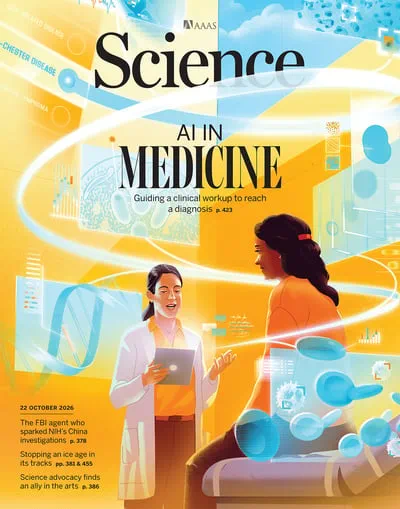
Microsoft Research's Sequential Diagnosis with Language Models Featured on Science Cover
On October 22, 2026, Microsoft Research's paper 'Sequential diagnosis with language models' was featured on the cover of Science, introducing the Sequential Diagnosis Benchmark (SDBench) and the Diagnostic Orchestrator (DxO) system. SDBench reframes diagnosis as a staged information-gathering process, recording both final diagnosis and examination costs, addressing limitations of traditional static medical AI benchmarks. The study uses 304 complex cases from NEJM and 325 cases from MIMIC-IV-ED, with a Gatekeeper model controlling information release to prevent premature access to full records.
Pitt Researchers Uncover 3D Scene Topology in VLM Latent Spaces
University of Pittsburgh researchers analyzed the latent representations of vision-language models (VLMs) and found that intermediate layers encode spatial structures such as rings, grids, and random layouts, corresponding to 3D scene topology. Their paper, accepted as a NeurIPS 2026 spotlight, introduces methods to separate spatial signals from appearance attributes in high-dimensional activations.

News updates every hour. Subscribe in your RSS reader to get new stories automatically.
Subscribe