Microsoft Research's Sequential Diagnosis with Language Models Featured on Science Cover
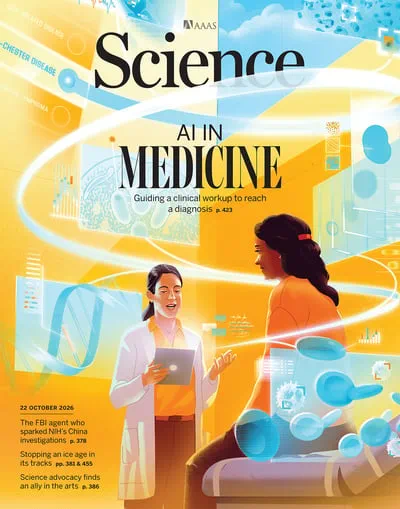
On October 22, 2026, Microsoft Research's paper 'Sequential diagnosis with language models' was featured on the cover of Science, introducing the Sequential Diagnosis Benchmark (SDBench) and the Diagnostic Orchestrator (DxO) system. SDBench reframes diagnosis as a staged information-gathering process, recording both final diagnosis and examination costs, addressing limitations of traditional static medical AI benchmarks. The study uses 304 complex cases from NEJM and 325 cases from MIMIC-IV-ED, with a Gatekeeper model controlling information release to prevent premature access to full records.
Coverage timeline
机器之心机器之心
编辑丨& 临床诊断并不是一道信息完整的选择题。医生通常只能从患者最初的主诉和有限的体征出发,先形成几种可能的诊断,再决定追问哪些病史、安排什么检查,并根据结果不断修正判断。每一次检查都需要考虑诊断价值、经济成本和患者负担;什么时候继续收集证据或是下达结论,也同样重要。 2026 年 10 月 22 日,微软研究团队论文「 Sequential diagnosis with language models 」登上《 Science 》封面,介绍了一个用于评估分步诊断能力的基准 Sequential Diagnosis Benchmark(SDBench),以及名为 Diagnostic Orchestrator(DxO) 的诊断协调系统。 这项研究针对传统医学 AI 评测的一个局限:许多基准会直接提供完整病历、检查结果甚至关键线索,模型只需输出诊断。但这样的测试很难评估系统是否主动问对问题、避免不必要的检查,或能否在证据不足时继续调查。SDBench 把诊断重新设计成一场分阶段的信息收集过程,并同时记录最终诊断与检查开销。 论文链接: https://www.science.org/doi/10.1126/science.aeh7930 SDBench 为克服传统静态病历评测的局限,SDBench 将诊断重新设计成了一场分阶段的信息收集与决策过程。 研究团队引入了两大高质量病例来源: 第一组(304例): 来自《新英格兰医学杂志》(NEJM)临床病理病例讨论的复杂疑难病例,侧重极高的诊断难度与教学价值。 第二组(325例): 来自 MIMIC-IV-ED 数据库、由急诊就诊后收治入院的患者记录整理而成的病例,更贴近常规急诊的真实场景。 图 1:SDBench 中的编排。 每个病例都会先转换成一段不包含最终诊断的简短描述。随后,诊断者可以选择追问病史或体格检查信息、申请实验室和影像等检查,或直接给出诊断。 一个称为 Gatekeeper(信息把关智能体)的模型负责根据请求释放对应的病例信息,避免诊断者提前看到完整病历和答案。对于原始病例中没有记载的检查,系统也可以生成与病例背景一致的合理模拟结果,减少因某项信息缺失而泄露线索的风险。 DxO DxO 是一种模型无关的编排器,通过模拟一群互补角色的临床专家,在每个步骤中融入成本意识的测试管理,并在独立运行中汇总诊断,实现顺
Related stories
Fudan, Tencent Hunyuan, Tsinghua Release ExplorationBench to Test AI Rule Discovery
Fudan University, Tencent Hunyuan, and Tsinghua University released ExplorationBench, a benchmark measuring how AI systems discover rules in unfamiliar environments. It includes two altered 'alien worlds'—the programming language AlienCode and the logic proof system AlienLogic—where models must learn rules through trial and error. Results showed that without environment feedback, scores remained low (max 11.0%), while autonomous exploration led to high scores (up to 89.0%).
2 reports · 1 sources

Tsinghua introduces SRHarness and MechBench for agentic symbolic regression and mechanism discovery
Tsinghua University researchers introduced SRHarness, a runtime framework for agentic symbolic regression, and MechBench, a benchmark for mechanism discovery, aiming to improve AI's ability to derive formulas from data and understand underlying physical mechanisms. Experiments show SRHarness achieves 72.97% symbol recovery with DeepSeek-v4-flash-0731, far exceeding Codex's 20.72%, while MechBench reveals that even GPT-5.6-sol-powered Codex recovers mechanisms at only 13.75% on the core set, highlighting a significant gap between pattern discovery and mechanism understanding.

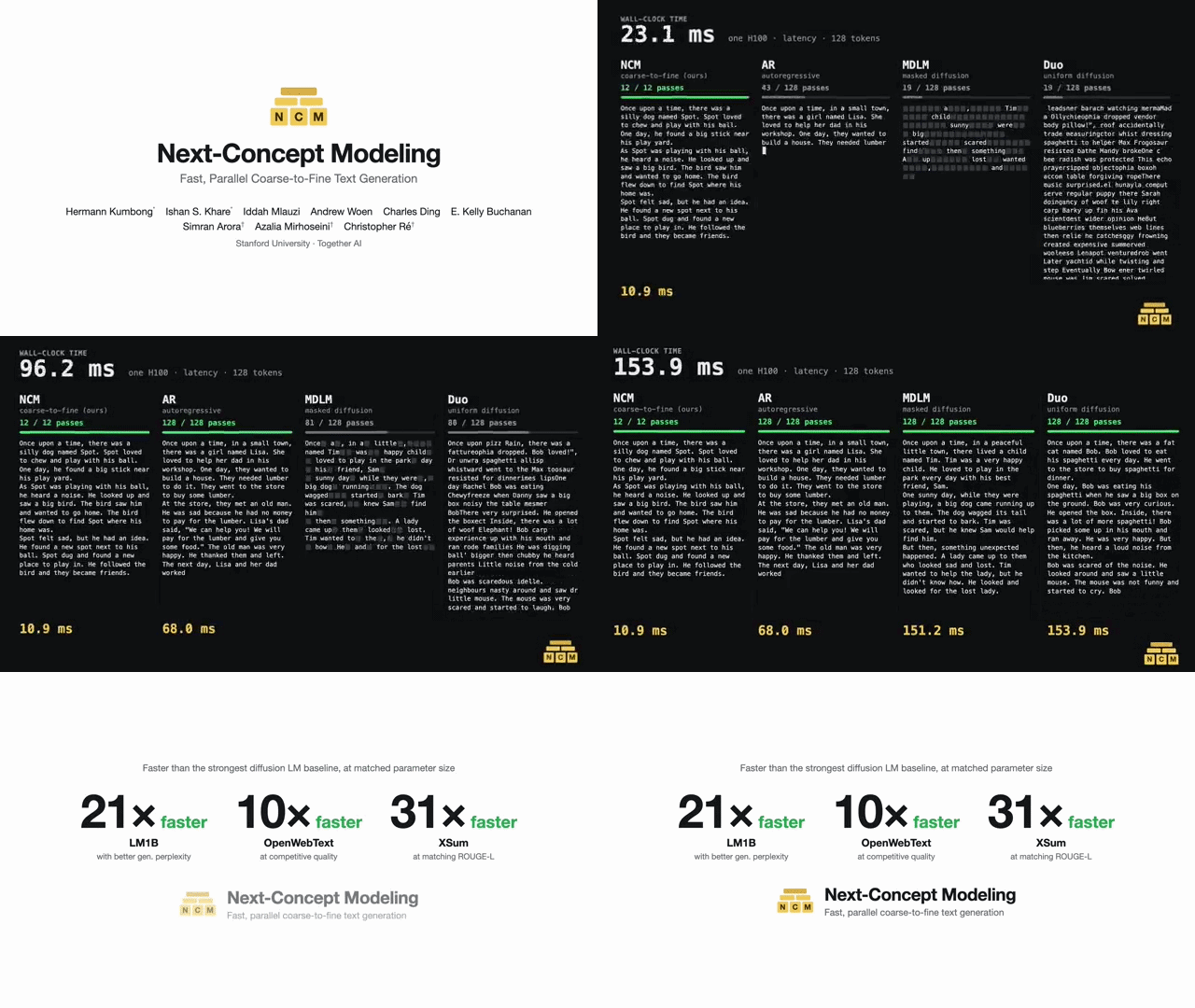
Stanford, Together AI propose Next-Concept Modeling for parallel text generation, 10-31x speedup
Researchers from Stanford University and Together AI introduced Next-Concept Modeling (NCM), a coarse-to-fine parallel text generation paradigm adapted from next-scale prediction used in image generation. In experiments, NCM achieved 10-31x speedup over diffusion language models with comparable or better quality, offering an alternative to both autoregressive and diffusion approaches.
Apple and Duke propose LensVLM, compressing long context into images with on-demand zoom
Apple's foundation model team and Duke University introduced LensVLM, a method that compresses long context into images and lets the model zoom into relevant pages on demand. In seven text QA benchmarks, it achieved 68.9% average accuracy with 4.3x effective compression, close to the 72.4% of full-text reference. The work was accepted at NeurIPS 2026, and a public 9B demo is available.

News updates every hour. Subscribe in your RSS reader to get new stories automatically.
Subscribe